
Ressources
Explorez une large gamme de ressources sur le GCED afin d’approfondir votre compréhension et de renforcer vos activités de recherche, de plaidoyer, d’enseignement et d’apprentissage.
169 résultats trouvés
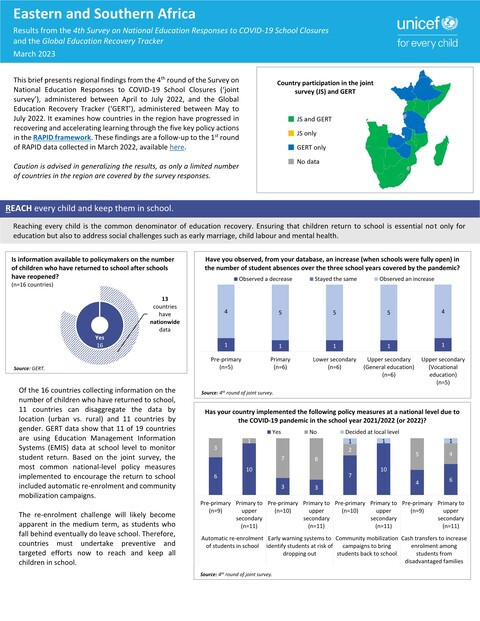 Education in a Post-COVID World: Towards a Rapid Transformation; Eastern and Southern Africa Regional Brief Année de publication: 2023 Auteur institutionnel: United Nations Children's Fund (UNICEF) On March 11, 2020, the World Health Organization declared COVID-19 a global pandemic, resulting in disruptions to education at an unprecedented scale. In response to the urgent need to recover learning losses, countries worldwide have taken RAPID actions to: Reach every child and keep them in school; Assess learning levels regularly; Prioritize teaching the fundamentals; Increase the efficiency of instruction; and Develop psychosocial health and wellbeing. This brief presents regional findings from the 4th round of the Survey on National Education Responses to COVID-19 School Closures (‘joint survey’), administered between April to July 2022, and the Global Education Recovery Tracker (‘GERT’), administered between May to July 2022. It examines how countries in the region have progressed in recovering and accelerating learning through the five key policy actions in the RAPID framework. These findings are a follow-up to the 1st roundof RAPID data collected in March 2022.
 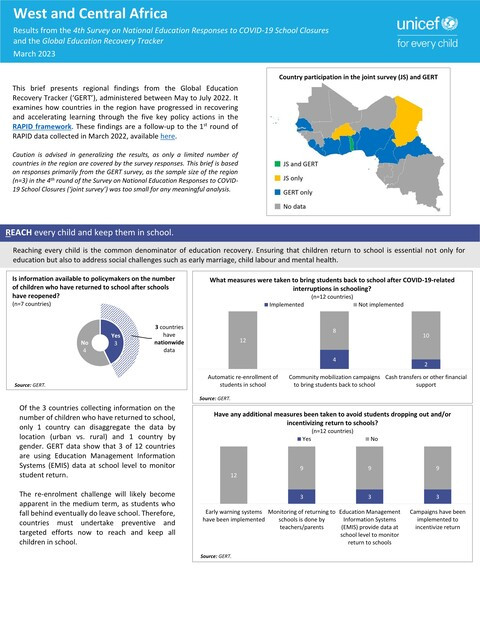 Education in a Post-COVID World: Towards a Rapid Transformation West and Central Africa Regional Brief Année de publication: 2023 Auteur institutionnel: United Nations Children's Fund (UNICEF) On March 11, 2020, the World Health Organization declared COVID-19 a global pandemic, resulting in disruptions to education at an unprecedented scale. In response to the urgent need to recover learning losses, countries worldwide have taken RAPID actions to: Reach every child and keep them in school; Assess learning levels regularly; Prioritize teaching the fundamentals; Increase the efficiency of instruction; and Develop psychosocial health and wellbeing. This brief presents regional findings from the Global Education Recovery Tracker (‘GERT’), administered between May to July 2022. It examines how countries in the region have progressed in recovering and accelerating learning through the five key policy actions in the RAPID framework. These findings are a follow-up to the 1st round of RAPID data collected in March 2022.
 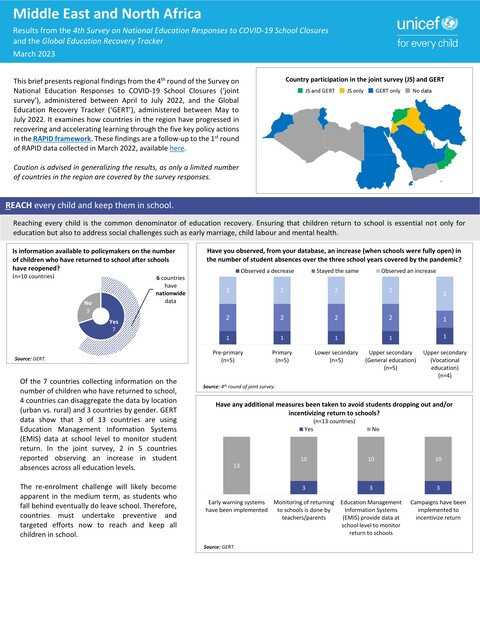 Education in a Post-COVID World: Towards a Rapid Transformation; Middle East and North Africa; Regional Brief Année de publication: 2023 Auteur institutionnel: United Nations Children's Fund (UNICEF) On March 11, 2020, the World Health Organization declared COVID-19 a global pandemic, resulting in disruptions to education at an unprecedented scale. In response to the urgent need to recover learning losses, countries worldwide have taken RAPID actions to: Reach every child and keep them in school; Assess learning levels regularly; Prioritize teaching the fundamentals; Increase the efficiency of instruction; and Develop psychosocial health and wellbeing. This brief presents regional findings from the 4th round of the Survey on National Education Responses to COVID-19 School Closures (‘joint survey’), administered between April to July 2022, and the Global Education Recovery Tracker (‘GERT’), administered between May to July 2022. It examines how countries in the region have progressed in recovering and accelerating learning through the five key policy actions in the RAPID framework. These findings are a follow-up to the 1st round of RAPID data collected in March 2022.
 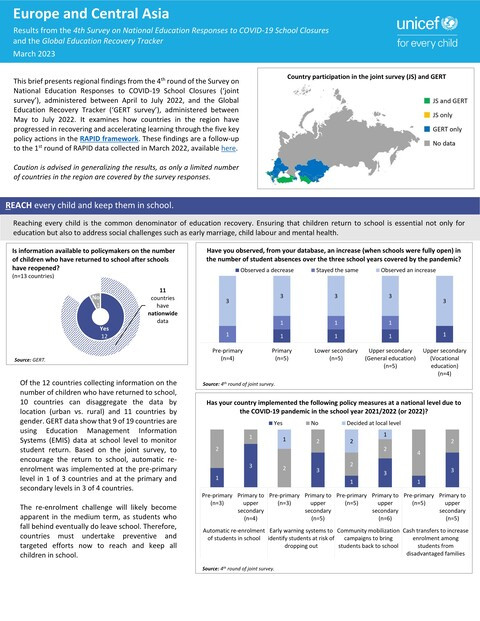 Education in a Post-COVID World: Towards a Rapid Transformation; Europe and Central Asia Regional Brief Année de publication: 2023 Auteur institutionnel: United Nations Children's Fund (UNICEF) On March 11, 2020, the World Health Organization declared COVID-19 a global pandemic, resulting in disruptions to education at an unprecedented scale. In response to the urgent need to recover learning losses, countries worldwide have taken RAPID actions to: Reach every child and keep them in school; Assess learning levels regularly; Prioritize teaching the fundamentals; Increase the efficiency of instruction; and Develop psychosocial health and wellbeing. This brief presents regional findings from the 4th round of the Survey on National Education Responses to COVID-19 School Closures (‘joint survey’), administered between April to July 2022, and the Global Education Recovery Tracker (‘GERT survey’), administered between May to July 2022. It examines how countries in the region have progressed in recovering and accelerating learning through the five key policy actions in the RAPID framework. These findings are a follow-up to the 1st round of RAPID data collected in March 2022.
  Challenges and Perspectives of Inclusive Education: A Regional Perspective Année de publication: 2024 Auteur institutionnel: National Commission for the Continuous Improvement of Education (Mejoredu) | Organization of Ibero-American States for Education, Science and Culture (OEI) This work compiles the four analysis tables Challenges and perspectives of inclusive education, which, to contribute to this purpose, were constituted as spaces for reflection and plural and democratic dialogue. During the analysis tables held in June 2023, the prominent speakers gave life to a space for reflection and plural and democratic dialogue, seeking to contribute through conversations to a topic of debate that cannot be postponed in the life of schools, speaking about the current situation of populations historically violated in their fundamental rights, the challenges of inclusive education in the region, experiences in educational care for historically disadvantaged populations and proposals for actions that contribute to educational systems moving towards inclusive education. Retos y perspectivas de la educación inclusiva: Una mirada regional Année de publication: 2024 Auteur institutionnel: National Commission for the Continuous Improvement of Education (Mejoredu) | Organización de Estados Iberoamericanos para la Educación, la Ciencia y la Cultura (OEI) Esta obra compila las cuatro mesas de análisis Retos y perspectivas de la educación inclusiva, las cuales, para contribuir a este propósito, se constituyeron en espacios de reflexión y diálogo plural y democrático. Durante las mesas de análisis realizadas en junio de 2023, los destacados ponentes dieron vida a un espacio de reflexión y diálogo plural y democrático, buscando aportar mediante conversatorios a un tema de debate inaplazable en la vida de las escuelas, hablando sobre la situación actual de las poblaciones históricamente vulneradas en sus derechos fundamentales, los desafíos de la educación inclusiva en la región, experiencias en atención educativa de poblaciones históricamente desfavorecidas y propuestas de acciones que contribuyan a que los sistemas educativos avancen hacia una educación inclusiva.
 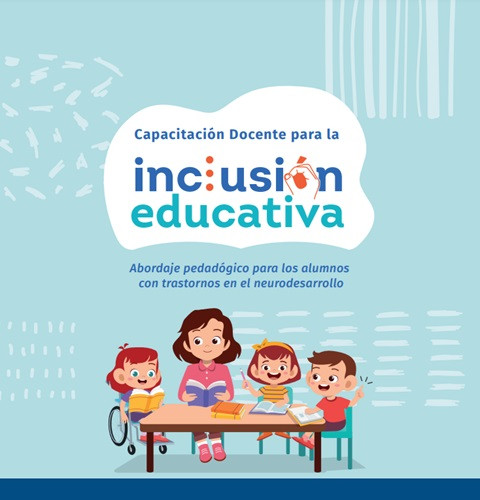 Teacher Training for Educational Inclusion: Pedagogical Approach for Students With Neurodevelopmental Disorders Année de publication: 2024 Auteur institutionnel: Paraguay. Ministry of Education and Science | Organization of Ibero-American States for Education, Science and Culture (OEI) The course aims to design teacher training for educational inclusion with a specific pedagogical approach for students with neurodevelopmental disorders. This course is divided into ten modules, addressing fundamental topics such as: basic notions and concepts of inclusive education, the main paradigms and approaches, the types of accessibility necessary to eliminate barriers to learning and student participation. It also deals with the application of the dimensions of inclusive education (policy, practice and culture) and the exploration of the principles of reasonable adjustments and Universal Design for Learning (UDL). Capacitación docente para la inclusión educativa: Abordaje pedadógico para los alumnos con trastornos en el neurodesarrollo Année de publication: 2024 Auteur institutionnel: Paraguay. Ministry of Education and Science | Organización de Estados Iberoamericanos para la Educación, la Ciencia y la Cultura (OEI) Con el objetivo de diseñar una capacitación docente para la inclusión educativa con un enfoque pedagógico específico para alumnos con trastornos en el neurodesarrollo. Este curso se divide en diez módulos, abordando temas fundamentales como: nociones y conceptos elementales de la educación inclusiva, los principales paradigmas y enfoques, los tipos de accesibilidad necesarios para eliminar barreras en el aprendizaje y la participación de los alumnos. Asimismo, trata de la aplicación de las dimensiones de la educación inclusiva (política, práctica y cultural) y de la exploración de los principios de los ajustes razonables y el Diseño Universal para el Aprendizaje (DUA).
  Tools for a More Inclusive Education Année de publication: 2020 Auteur institutionnel: Chile. Ministry of Education This document presents a conceptual framework to help the different educational teams deployed at the national level to devise and implement inclusive practices in their daily management, in their ways of living together and in their teaching-learning processes. This, within the framework of the promulgation of Law 20,845, modifies the General Education Law (N°20,370/2009) in its article 4, adding that “It is the duty of the State to strive to ensure quality inclusive education for all people. Herramientas para una educación más inclusiva Année de publication: 2020 Auteur institutionnel: Chile. Ministry of Education En este documento se presenta un marco técnico conceptual para contribuir a que los distintos equipos educativos desplegados a nivel nacional puedan idear e implementar prácticas inclusivas en su gestión cotidiana, en sus modos de convivir y en sus procesos de enseñanza – aprendizaje. Esto, en el marco de la promulgación de la Ley 20.845 modifica la Ley General de Educación (N°20.370/2009) en su artículo 4° agregando que “Es deber del Estado propender a asegurar a todas las personas una educación inclusiva de calidad.”