
Ressources
Explorez une large gamme de ressources sur le GCED afin d’approfondir votre compréhension et de renforcer vos activités de recherche, de plaidoyer, d’enseignement et d’apprentissage.
16 résultats trouvés
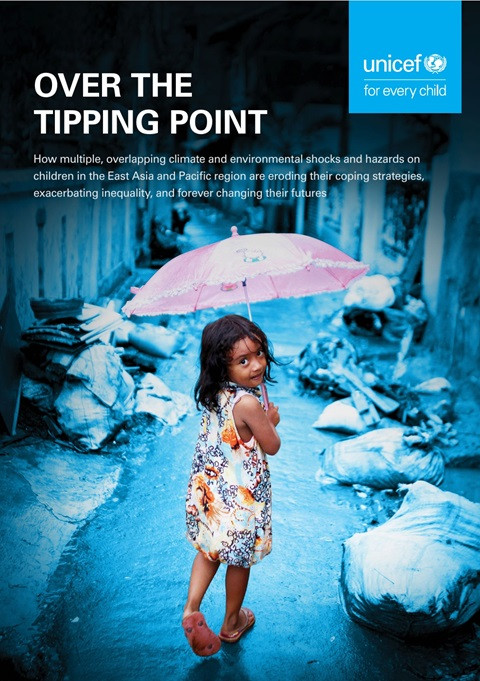 Over the Tipping Point: How Multiple, Overlapping Climate and Environmental Shocks and Hazards on Children in the East Asia and Pacific Region are Eroding their Coping Strategies, Exacerbating Inequality, and Forever Changing Their Futures Année de publication: 2023 Auteur institutionnel: United Nations Children's Fund (UNICEF) This report unveils the intensifying frequency and compounding effects of climate-related hazards intertwined with non-climate shocks like the COVID-19 pandemic and socio-economic challenges. Given that children are already facing the impacts of climate change, adaptation and resilience measures are needed now to reduce the full force of impacts. This report recommends three areas to do so: Children have continued access to the key services they need: This requires investing in climate-smart and disaster-resilient education, health, and water, sanitation and hygiene (WASH) services for children, so that children can access these services despite the shocks they face; Child protection and social protection systems are in place and are climate-responsive; and There is understanding of what to expect and how to adjust as necessary, establishing and utilizing strong early warning, risk management and disaster preparedness systems. In all of this, children and young people must be at the forefront of our actions. Urgency demands that they take action themselves, leading the way with innovative solutions for both mitigation and adaptation. We must support their efforts, providing them with the necessary skills and resources to amplify their work. Above all, we owe them every opportunity for success as we work together to secure a better world for generations to come.
  Inequalities and Gender Violence in Latin America and the Caribbean Année de publication: 2023 Auteur: Karina Batthyány Auteur institutionnel: Consejo Latinoamericano de Ciencias Sociales (CLACSO) The chapters of this book are the result of the powerful research work carried out within the framework of the call “Inequalities and gender violence in Latin America and the Caribbean", promoted by CLACSO. They seek, as a whole, to outline answers to these questions, through innovative methodologies that redefine conventional tools and give the texts great singularity. The point of view is, in all cases, novel and localized: territorially, but also in terms of theory and epistemology. The reading of This book manages to immerse the reader's gaze in a truly critical approach to the reality of the continent. Desigualdades y violencias de género en América Latina y el Caribe Année de publication: 2023 Auteur: Karina Batthyány Auteur institutionnel: Consejo Latinoamericano de Ciencias Sociales (CLACSO) Los capítulos del presente libro son fruto de los potentes trabajos de investigación realizados en el marco de la convocatoria “Desigualdades y violencias de género en América Latina y el Caribe", promovida por CLACSO. Buscan, en su conjunto, esbozar respuestas a dichos interrogantes, mediante metodologías innovadoras que resignifican herramientas convencionales y dotan a los textos de gran singularidad. El punto de vista es, en todos los casos, novedoso y localizado: territorialmente, pero también en lo que a la teoría y a la epistemología se refiere. La lectura de este libro logra sumergir la mirada de la lectora o el lector a un acercamiento verdaderamente crítico a la realidad del continente.
  Weaving Education and Equity in Ibero-America Année de publication: 2024 Auteur: Ricardo Cuenca Auteur institutionnel: Organization of Ibero-American States for Education, Science and Culture (OEI) Addressing the complex relationship between education and inequality in Latin America is a challenge. Economic and social disparities create a complex network in the region. Despite progress, access remains an obstacle for many. During its 75-year history, the OEI has been working to break down the barriers that hinder equitable education for all. Ricardo Cuenca, member of the OEI Advisory Board, explains to what extent educational policies can contribute to mitigating these inequalities in Latin America. Tejiendo educación y equidad en Iberoamérica Année de publication: 2024 Auteur: Ricardo Cuenca Auteur institutionnel: Organización de Estados Iberoamericanos para la Educación, la Ciencia y la Cultura (OEI) Abordar la compleja relación entre educación y desigualdad en Iberoamérica es todo un desafío. Las disparidades económicas y sociales tejen un entramado complejo en la región. A pesar de los avances, el acceso sigue siendo un obstáculo para muchos. En esta travesía, la OEI ha venido trabajando durante sus 75 años de historia para derribar las barreras que obstaculizan una formación equitativa para todos. Ricardo Cuenca, miembro del Consejo Asesor de la OEI, nos explica hasta qué punto las políticas educativas pueden contribuir a mitigar esas desigualdades en Iberoamérica.
 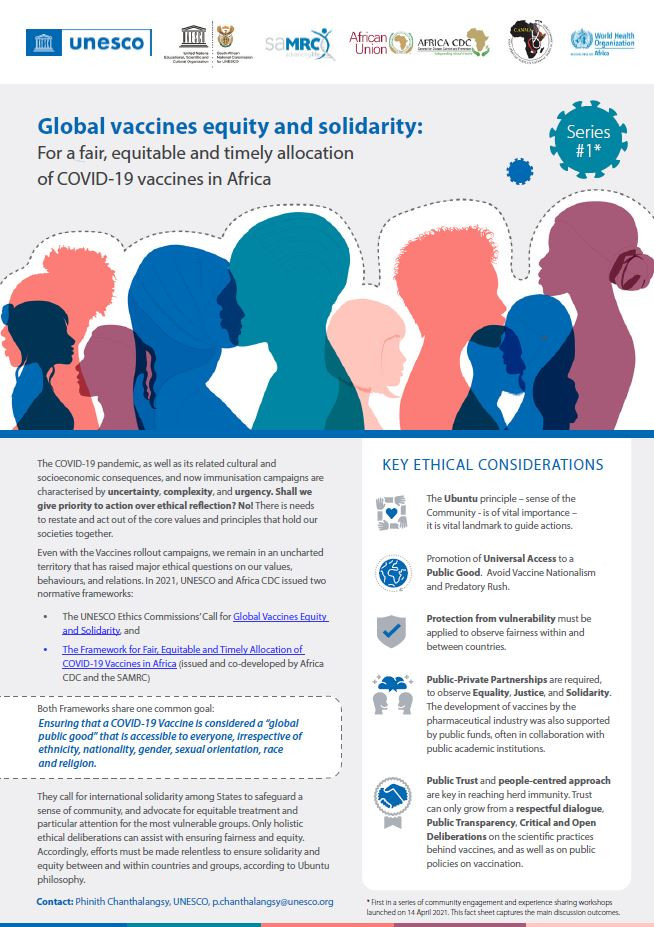 Global Vaccines Equity and Solidarity: For a Fair, Equitable and Timely Allocation of COVID-19 Vaccines in Africa; Series #1 Année de publication: 2021 Auteur institutionnel: UNESCO Harare African populations have been side-lined through the COVID-19 Vaccination roll-out process. A vaccination timeline taking Africa into 2023 would be unethical. African countries need to invest in their own structures and stop relying on colonial structures. There is a moral obligation to safeguard the population through equal distribution. This not only makes moral and ethical sense but also scientific and economic sense as a slow roll out in Africa will impact the rest of the world. First in a series of community engagement and experience sharing workshops launched on 14 April 2021. This fact sheet captures the main discussion outcomes.
  The Role of Education in Addressing Future Challenges Année de publication: 2020 Auteur institutionnel: Bridge 47 In response to UNESCO’s Futures of Education consultation, Bridge 47 has released the following report on the power that transformative education has to address future challenges, including those linked to inequalities, climate change and health.Through the consultation process UNESCO raises questions about the importance and purpose of education by 2050. In a fast-evolving world, Bridge 47 supports the idea that education should foster the kind of education that helps learners of all ages to become active global citizens and thus contribute to building a more just and sustainable report world for all.The report, ‘The Role of Education in Addressing Future Challenges’, further emphasises the importance of measuring and monitoring the progress towards achieving the transformative vision of education as outlined in Sustainable Development Goal Target 4.7. It is hoped that the overall Future of Education report will encourage a measuring framework for SDG 4.7 that acknowledges the connection between non-formal and formal education as well as supporting dialogue between key actors that the reflect any conceptual shifts within the fields of Education for Sustainable Development and Global Citizenship Education.
  Guide to Significant Learning Situations in the Classroom for Global Citizenship and Sustainable Development in Secondary School Année de publication: 2024 Auteur: Helena Rodriguez de Guzmán Auteur institutionnel: Entreculturas | Spanish Agency for International Development Cooperation (AECID) This didactic proposal aims to promote new models of education so that they are more attractive, more conscious and with a profound and greater influence on the exercise of citizenship. Designed from the foundations of Transformative Education, it is committed to giving all students the opportunity to acquire the necessary skills for global and critical citizenship by supporting their vital growth in a comprehensive manner, as proposed by UNESCO (UNESCO, 2022). In turn, this teaching resource provides tools that support the educational strategies promoted by the LOMLOE whose main objective is to guarantee the comprehensive training of students, contributing to the development of their personality, the full exercise of human rights and active and democratic citizenship in the actual society. Guía de situaciones de aprendizaje significativas en el aula para la ciudadanía global y el desarrollo sostenible en secundaria Année de publication: 2024 Auteur: Helena Rodriguez de Guzmán Auteur institutionnel: Entreculturas | Spanish Agency for International Development Cooperation (AECID) Esta propuesta didáctica pretende impulsar nuevos modelos de educación para que éstos sean más atractivos, más conscientes y con una profunda y mayor influencia en el ejercicio de la ciudadanía. Diseñada desde los fundamentos de la Educación Transformadora, apuesta por dar la oportunidad a todo el alumnado a adquirir las competencias necesarias para una ciudadanía global y crítica desde el acompañamiento a su crecimiento vital de forma integral, tal y como propone la UNESCO (UNESCO, 2022). A su vez, este recurso didáctico aporta herramientas que apoyan las estrategias educativas que promueve la LOMLOE cuyo objetivo principal es garantizar la formación integral del alumnado contribuyendo al desarrollo de su personalidad, el ejercicio pleno de los derechos humanos y a una ciudadanía activa y democrática en la sociedad actual.
  A New Era of Social Justice: International Labour Conference, 100th Session, 2011 Année de publication: 2011 Auteur institutionnel: International Labour Organization (ILO) This report specifically presents to the conference what the Director believes are the fundamental problems the ILO faces as it oversees a century of its inception in 2019. These problems are the remnants of an ineffective growth pattern that has increased inequality around the world over the past 30 years. The mission of the organization is to continue to work together to develop effective responses to these challenges - within the ILO itself, with national bodies such as governments, employers and workers, and through ILO cooperation with others.