
Ressources
Explorez une large gamme de ressources sur le GCED afin d’approfondir votre compréhension et de renforcer vos activités de recherche, de plaidoyer, d’enseignement et d’apprentissage.
51 résultats trouvés
 Overview of Information Literacy Resources Worldwide Année de publication: 2013 Auteur: Forest Woody Horton Auteur institutionnel: UNESCO This publication aims to bring together Information Literacy contributions in forty-two languages from all of the different geographic regions around the world in order to provide inclusive and multilingual Information Literacy resources for Library and Information Science professionals, teachers, researchers, and students.
  Seoul Declaration on Media and Information Literacy for Everyone and by Everyone: A Defence Against Disinfodemics Année de publication: 2020 Auteur institutionnel: UNESCO On the 10th anniversary of Global Media and Information Literacy Week, stakeholders from all over the world gave a resounding affirmation as to the urgency to strengthen people’s media and information literacy competencies. The number of celebratory events increased from one hundred events in 2019 to over three hundred events in 2020.The outcomes of the deliberations in the Feature Conference and Youth Agenda Forum have been immortalized in the Seoul Declaration on Media and Information Literacy for Everyone and by Everyone: A Defence against Disinfodemics. This Seoul Declaration benefited from a consultation with close to one thousand registered participants.Through the Seoul Declaration, partners and participants called for media and information literacy for all. They:Emphasized that “media and information literacy (MIL) is a core competency for addressing the disinfodemic, and that MIL also contributes to access to information, freedom of expression, protection of privacy, prevention of violent extremism, promotion of digital security and combating hate speech and inequality”.Recognized “UNESCO’s effort to promote a Global MIL Cities Framework to stimulate creative learning about MIL in city spaces and the involvement of non-traditional actors in promoting MIL”.Called on duty bearers at the national to city levels to “commit to advancing ‘Media and Information Literacy for Everyone and by Everyone’ through policy and resource allocation across all relevant areas, including education, health, elections, child protection, climate, gender equality, governance and regulation, to mention some examples”.Urged technological intermediaries to “play an accountable role, through institutionalized multi-stakeholder systems, as part of the social endeavor to tackle disinformation and to build communities that are media and information literate”.Requested UNESCO, in cooperation with other UN Agencies, to “maintain a focus on inclusion of disadvantaged groups in MIL engagements, and to continue to foster gender equality in relation to MIL.”
  Journalism, Fake News & Disinformation: Handbook for Journalism Education and Training Année de publication: 2018 Auteur: Julie Posetti | Cherilyn Ireton | Claire Wardle | Hossein Derakhshan | Alice Matthews | Magda Abu-Fadil | Tom Trewinnard | Fergus Bell | Alexios Mantzarlis Auteur institutionnel: UNESCO This handbook seeks to provide an internationally-relevant model curriculum, open to adoption or adaptation, which responds to the emerging global problem of disinformation that confronts societies in general, and journalism in particular. Serving as a model curriculum, the publication is designed to give journalism educators and trainers a framework and lessons to help students and practitioners of journalism to navigate the issues associated with ‘fake news’.The contents draw together the input of leading international journalism educators, researchers and thinkers who are helping to update journalism method and practice to deal with the challenges of misinformation and disinformation. The lessons are contextual, theoretical and in the case of online verification, extremely practical. Used together as a course, or independently, they can help refresh existing teaching modules or create new offerings.It is part of the “Global Initiative for Excellence in Journalism Education”, which is a focus of UNESCO’s International Programme for the Development of Communication (IPDC). The Initiative seeks to engage with teaching, practising and researching of journalism from a global perspective, including sharing international good practices.
 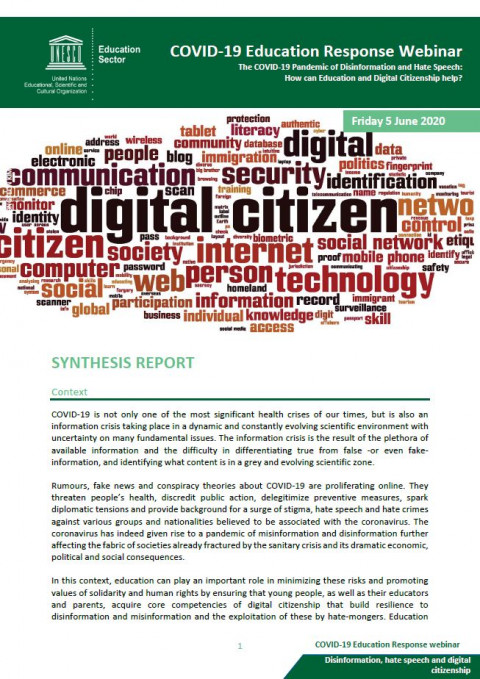 The COVID-19 Pandemic of Disinformation and Hate Speech: How can Education and Digital Citizenship Help? ; Synthesis Report Année de publication: 2020 Auteur institutionnel: UNESCO COVID-19 is not only one of the most significant health crises of our times, but is also an information crisis taking place in a dynamic and constantly evolving scientific environment with uncertainty on many fundamental issues. The information crisis is the result of the plethora of available information and the difficulty in differentiating true from false -or even fake- information, and identifying what content is in a grey and evolving scientific zone.In this context, education can play an important role in minimizing these risks and promoting values of solidarity and human rights by ensuring that young people, as well as their educators and parents, acquire core competencies of digital citizenship that build resilience to disinformation and misinformation and the exploitation of these by hate-mongers. Education can also help young people engage in the online environment in a safe, sensitive, critical, ethical and accountable way as well as encourage them to play a role in pioneering educational initiatives that contribute to promoting digital citizenship.
 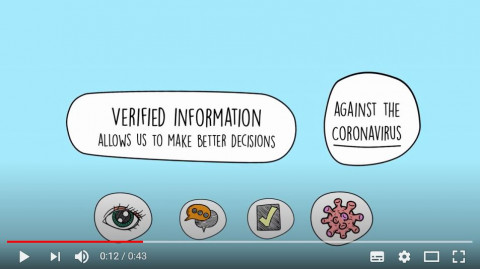 How to Stop Misinformation in Times of Coronavirus? Année de publication: 2020 Auteur institutionnel: United Nations Development Programme (UNDP) | UNESCO Learn how to identify unverified content you receive on your cell phone and avoid spreading information on social media that has not been checked by credible sources. Caring for reliable information is everyone's responsibility, and helps us make better decisions.Learn more about this campaign by UNESCO and UNDP at:https://en.unesco.org/news/disinformation-silent-weapon-times-pandemic
  Media and Information Literate Citizens: Think Critically, Click Wisely! Année de publication: 2021 Auteur: Alton Grizzle | Carolyn Wilson | Ramon Tuazon | C.K. Cheung | Jesus Lau | Rachel Fischer | Dorothy Gordon | Kwame Akyempong | Jagtar Singh | Paul R. Carr | Kristine Stewart | Samy Tayie | Olunifesi Suraj | Maarit Jaakkola | Gina Thésée | Curmira Gulston Auteur institutionnel: UNESCO Content providers such as libraries, archives, museums, media and digital communications companies can enable inclusive and sustainable development. However, they do not always live up to these ideals, which creates challenges for the users of these services. Content providers of all types open up new opportunities for lifelong learning. But at the same time, they open up challenges such as misinformation and disinformation, hate speech, and infringement of online privacy, among others.Media and information literacy is a set of competencies that help people to maximize advantages and minimize harms. Media and information literacy covers competencies that enable people to critically and use of digital technologies. Capacities in these areas are indispensable for all citizens regardless of their ages or backgrounds.This pioneering curriculum presents a comprehensive competency framework of media and information pedagogical suggestions. It features various detailed modules covering the range of competencies needed to navigate today’s communications ecosystem. This resource links media and education, education for sustainable development, cultural literacy and the exponential information literacy curriculum, everyone can become media and information literate as well as peer-educators of media and information literacy.
  Citoyens éduqués aux médias et à l’information : penser de manière critique, cliquer à bon escient ! Année de publication: 2023 Auteur: Alton Grizzle | Carolyn Wilson | Ramon Tuazon | C.K. Cheung | Jesus Lau | Rachel Fischer | Dorothy Gordon | Kwame Akyempong | Jagtar Singh | Paul R. Carr | Kristine Stewart | Samy Tayie | Olunifesi Suraj | Maarit Jaakkola | Gina Thésée | Curmira Gulston Auteur institutionnel: UNESCO Pouvons-nous améliorer nos sociétés en cliquant à bon escient ?Les fournisseurs de contenus que sont les bibliothèques, les archives, les musées, les médias et les entreprises de communication numérique, entre autres, peuvent favoriser un développement inclusif et durable. Cependant, ils ne sont pas toujours à la hauteur de cet idéal, ce qui pose des difficultés aux utilisateurs de ces services.Les fournisseurs de contenus de tous types ouvrent de nouvelles opportunités d’apprentissage tout au long de la vie. Mais dans le même temps, ils ouvrent aussi la porte aux problèmes que sont la mésinformation, la désinformation, les discours de haine et la violation de la confidentialité en ligne, entre autres.L’éducation aux médias et à l’information est un ensemble de compétences qui permet d’optimiser les avantages et de minimiser les préjudices. L’éducation aux médias et à l’information couvre les compétences qui permettent à chacun d’interagir de façon critique et efficace avec le contenu des communications, les institutions qui fournissent ce contenu et les technologies numériques. Les capacités dans ces domaines sont indispensables pour tout citoyen, quel que soit son âge ou son origine.Ce programme novateur présente un cadre de compétences complet en matière d’éducation aux médias et à l’information, ainsi que des suggestions pédagogiques structurées pour les éducateurs et les apprenants. Il se compose de plusieurs modules détaillés couvrant l’éventail des compétences nécessaires pour évoluer dans l’écosystème des communications d’aujourd’hui. Cette ressource relie l’éducation aux médias et à l’information à des questions émergentes telles que l’intelligence artificielle, l’éducation à la citoyenneté numérique, l’éducation en vue du développement durable, l’éducation culturelle et l’augmentation exponentielle de la mésinformation et de la désinformation. En utilisant ce programme d’éducation aux médias et à l’information de façon efficace, chacun peut s’éduquer aux médias et à l’information, voire devenir pair éducateur dans ce domaine.
  Ciudadanía alfabetizada en medios e información: pensar críticamente, hacer clic sabiamente Année de publication: 2023 Auteur: Alton Grizzle | Carolyn Wilson | Ramon Tuazon | C.K. Cheung | Jesus Lau | Rachel Fischer | Dorothy Gordon | Kwame Akyempong | Jagtar Singh | Paul R. Carr | Kristine Stewart | Samy Tayie | Olunifesi Suraj | Maarit Jaakkola | Gina Thésée | Curmira Gulston Auteur institutionnel: UNESCO ¿Podemos mejorar nuestras sociedades haciendo clic sabiamente?Los proveedores de contenidos como bibliotecas, archivos, museos, medios y empresas de comunicación digital pueden permitir un desarrollo inclusivo y sostenible. Sin embargo, no siempre están a la altura de estos ideales, lo que crea desafíos para los usuarios de estos servicios. Los proveedores de contenidos de todo tipo abren nuevas oportunidades para el aprendizaje permanente. Pero al mismo tiempo, plantean desafíos como la información falsa y la desinformación, el discurso de odio y la violación de la privacidad en línea, entre otros.La Alfabetización Mediática e Informacional es un conjunto de competencias que ayudan a las personas a maximizar las ventajas y minimizar los daños. La Alfabetización Mediática e Informacional abarca las competencias que permiten a las personas interactuar de manera crítica y efectiva con el contenido de las comunicaciones; las instituciones que facilitan este contenido y el uso de tecnologías digitales. Las capacidades en estos ámbitos son indispensables para la ciudadanía, independientemente de su edad o procedencia. Este Currículum pionero presenta un marco integral de competencias de Alfabetización Mediática e Informacional y ofrece a educadores y estudiantes sugerencias pedagógicas estructuradas. Cuenta con varios módulos detallados que cubren la gama de competencias necesarias para navegar por el ecosistema de comunicaciones de hoy.Este recurso vincula la Alfabetización Mediática e Informacional con cuestiones emergentes como la Inteligencia Artificial, la educación para la ciudadanía digital, la educación para el desarrollo sostenible, la alfabetización cultural y el aumento exponencial de la información falsa y la desinformación. Con el uso efectivo de este Currículum de Alfabetización Mediática e Informacional, todos pueden volverse alfabetizados mediáticos e informacionales, así como educadores pares de la Alfabetización Mediática e Informacional.
  Медийно и информационно грамотные граждане: мыслите критически, кликайте с умом! Année de publication: 2021 Auteur: Alton Grizzle | Carolyn Wilson | Ramon Tuazon | C.K. Cheung | Jesus Lau | Rachel Fischer | Dorothy Gordon | Kwame Akyempong | Jagtar Singh | Paul R. Carr | Kristine Stewart | Samy Tayie | Olunifesi Suraj | Maarit Jaakkola | Gina Thésée | Curmira Gulston Auteur institutionnel: UNESCO Можем ли мы улучшить общество, в котором живем, кликая с умом?Поставщики информации, такие как библиотеки, архивы, музеи, медиа и компании, занимающиеся цифровой коммуникацией, могут содействовать инклюзивному и устойчивому развитию. Однако они не всегда соответствуют этому идеалу, что создает определенные трудности для их пользователей. Поставщики информации всех типов располагают широким спектром возможностей для реализации непрерывного обучения, но, в то же время, оказываются связаны с такими проблемными явлениями, как распространение дезинформации и некорректной информации, пропаганда ненависти, нарушение неприкосновенности частной жизни и др.Медийная и информационная грамотность представляет собой набор компетенций, которые помогают людям максимально использовать указанные преимущества и минимизировать возможный вред. Компетенции, составляющие МИГ, позволяют критически и эффективно взаимодействовать с разнообразным контентом, теми акторами и структурами, которые этот контент создают и распространяют, с цифровыми технологиями. Такие возможности необходимы всем людям, вне зависимости от их возраста или рода занятий.Данная Учебная программа содержит структурированную модель компетенций в области медийной и информационной грамотности и учебные модули для преподавателей и учащихся, охватывающие широкий диапазон компетенций, которые необходимы для того, чтобы ориентироваться в современной коммуникационной экосистеме. В программе также показано, как медийная и информационная грамотность связана с рядом актуальных вопросов и проблем, таких как искусственный интеллект, образование в области цифрового гражданства, образование в интересах устойчивого развития, формирование культурной грамотности, экспоненциальный рост дезинформации и некорректной информации. Эффективное использование Программы может помочь каждому значительно повысить свой уровень медийной и информационной грамотности, а также стать преподавателем этого вида грамотности.
  الدراية الإعلامية والمعلوماتية للمواطنين Année de publication: 2023 Auteur: Alton Grizzle | Carolyn Wilson | Ramon Tuazon | C.K. Cheung | Jesus Lau | Rachel Fischer | Dorothy Gordon | Kwame Akyempong | Jagtar Singh | Paul R. Carr | Kristine Stewart | Samy Tayie | Olunifesi Suraj | Maarit Jaakkola | Gina Thésée | Curmira Gulston Auteur institutionnel: UNESCO ملخص قصيرهل يمكننا تحسين مجتمعاتنا من خلال النقر بحكمة؟يمكن لمزودي المحتوى مثل المكتبات، ودور المحفوظات، والمتاحف، ووسائل الإعلام وشركات الاتصالات الرقمية تمكين التنمية الشاملة والمستدامة. ومع ذلك، فإنها لا ترقى دائمًا إلى مستوى هذه المثاليات، مما يخلق تحديات لمستخدمي هذه الخدمات. يفتح موفرو المحتوى من جميع الأنواع فرصًا جديدة للتعلم مدى الحياة، ولكن في الوقت نفسه، فإنها تؤدي إلى تحديات مثل المعلومات الخاطئة والمضللة، وخطاب الكراهية، وانتهاك الخصوصية على الإنترنت، من بين أمور أخرى.الدراية الإعلامية والمعلوماتية هي مجموعة من الكفاءات التي تساعد الناس على تعظيم المزايا وتقليل الأضرار. تغطي الدراية الإعلامية والمعلوماتية الكفاءات التي تمكن الناس من المشاركة بشكل نقدي وفعال مع محتوى الاتصالات، والمؤسسات التي تسهل هذا المحتوى، واستخدام التقنيات الرقمية. القدرات في هذه المجالات لا غنى عنها لجميع المواطنين بغض النظر عن أعمارهم أو خلفياتهم.يقدم هذا المنهاج الرائد إطار كفاءات شامل لوسائل الإعلام والدراية المعلوماتية ويقدم للمعلمين والمتعلمين اقتراحات تربوية منظمة. ويضم مكونات مفصلة مختلفة تغطي مجموعة من الكفاءات المطلوبة للتمكن من النظام البيئي للاتصالات اليوم. يربط هذا المورد الدراية الإعلامية والمعلوماتية بالقضايا الناشئة مثل الذكاء الاصطناعي، وتعليم المواطنة الرقمية، والتعليم من أجل التنمية المستدامة، والدراية الثقافية، والارتفاع الهائل في المعلومات الخاطئة والمضللة. من خلال الاستخدام الفعال لهذا المنهاج، يمكن للجميع أن يصبحوا متعلمين ومثقفين إعلاميًا ومعلوماتيًا، وكذلك معلمي أقران في هذا المجال.