
Ressources
Explorez une large gamme de ressources sur le GCED afin d’approfondir votre compréhension et de renforcer vos activités de recherche, de plaidoyer, d’enseignement et d’apprentissage.
25 résultats trouvés
 글로벌시민교육: 새로운 교육의제 Année de publication: 2014 Auteur institutionnel: 유네스코 본 문서는 2013년 9월 9-10일 서울에서 개최된, 우리 정부(외교부, 교육부)와 유네스코가 공동 주최하고 유네스코 아시아태평양 국제이해교육원이 실행 기관으로 참여한 ‘글로벌 시민교육 전문가회의(Technical Consultation on Global Citizenship Education)에 기초하여 작성되었다. 본 문서에는 a) 사전 설문지에 대한 전문가들의 응답, b) 전문가들의 회의 발표(프레젠테이션) 내용, 3) 회의에서의 토론 내용 및 d) 참고 자료 및 레퍼런스가 수록되어 있다. 본 문서의 최종본은 파리 유네스코 본부의 ‘평화와 지속 가능 발전을 위한 교육(Education for Peace and Sustainable Development)’ 부서가 작성하였다. Global Citizenship Education: An Emerging Perspective Année de publication: 2014 Auteur institutionnel: UNESCO This document draws on inputs to, and common perspectives emerging from, a Technical Consultation on Global Citizenship Education organized by UNESCO and the Republic of Korea (i.e., the Ministries of Foreign Affairs and of Education, and the Asia-Pacific Centre of Education for International Understanding) in Seoul on 9-10 September 2013 . Informing this draft document are: a) responses from the expert participants to a questionnaire circulated by UNESCO in advance of the consultation; b) presentations from experts during the consultation; c) discussions during the consultation; and d) reference material contributing to, and prepared for, the consultation. The final draft of this document was prepared by UNESCO’s Division of Education for Peace and Sustainable Development at Headquarters in Paris, with the assistance of a drafting team. Éducation à la Citoyenneté Mondiale:Nouveaux sujets de discussions éducatifs Année de publication: 2014 Auteur institutionnel: UNESCO Ce document se fonde sur les entrées et les perspectives communes qui sortent d'une Consultation Technique sur l'Éducation à la Citoyenneté Mondiale organisée par l'UNESCO et la République de Corée (ie, les Ministères des Affaires Étrangères et de l'Éducation, et le Centre Asie-Pacifique de l'Éducation pour la Comprendre) à Séoul les 9-10 Septembre 2013. Informer ce projet de document sont: a) les réponses des participants d'experts à un questionnaire diffusé par l'UNESCO à l'avance de la consultation; b) des présentations d'experts lors de la consultation; c) des discussions au cours de la consultation; et matériel d) de référence contribuant à, et préparé pour la consultation. La version finale de ce document a été préparé par la Division de l'Éducation pour la Paix et le Développement Durable au Siège de l'UNESCO à Paris, avec l'aide d'une équipe de rédaction.
  Shaping the future we want: UN decade of education for sustainable development; final report Année de publication: 2014 Auteur: Carolee Buckler | Heather Creech Auteur institutionnel: UNESCO The United Nations Decade of Education for Sustainable Development (2005 –2014) (DESD) aimed at integrating the principles and practices of sustainable development into all aspects of education and learning, to encourage changes in knowledge, values and attitudes with the vision of enabling a more sustainable and just society for all. The mandate of the DESD has energized a vast number of stakeholders – across Member States, UN agencies, the education sector, the private sector and civil society – to work in partnership to reorient education systems towards sustainable development. This final DESD Global Monitoring and Evaluation Report (GME) provides an assessment of progress towards embedding Education for Sustainable Development (ESD) into education systems and into sustainable development efforts. Building on the findings of the past two DESD GME reports, and based upon Member States’ and other stakeholders’ assessments of the current state of ESD, this report maps the achievements and challenges of a decade of progress and action on ESD at the global, regional, national and local levels – and within all areas and levels of education. Shaping the future we want: UN decade of education for sustainable development; final report Année de publication: 2014 Auteur: Carolee Buckler | Heather Creech Auteur institutionnel: Organisation des Nations Unies pour l'éducation, la science et la culture (UNESCO) La Décennie de l’ONU pour l'Éducation pour le Développement Durable (2005 -2014) (DEDD) visant à intégrer les principes et pratiques du développement durable dans tous les aspects de l'éducation et de l'apprentissage, afin d'encourager les changements dans les connaissances, les valeurs et les attitudes avec la vision de permettre à un plus durable et plus juste pour tous. Le mandat de la DEDD a stimulé un grand nombre de parties prenantes - dans tous les États Membres, les organismes de l’ONU, le secteur de l'éducation, le secteur privé et la société civile – pour travailler en partenariat afin de réorienter les systèmes d'éducation vers un développement durable. Cette dernière DEDD Suivi Mondiale et le Rapport d'Évaluation (SME) fournit une évaluation des progrès accomplis vers l'intégration Éducation pour le Développement Durable (EDD) dans les systèmes d'éducation et dans les efforts de développement durable. Se fondant sur les conclusions des deux dernières DEDD SME rapports, et basées sur des États membres et d'autres parties prenantes et les évaluations de l'état actuel de l'EDD, ce rapport maps les réalisations et les défis d'une décennie de progrès et d'action sur l'EDD à l'échelle mondiale, niveaux régional, national et local - et dans tous les domaines et niveaux d'éducation. Façonner l'avenir que nous voulons: décennie des Nations Unies pour l'éducation au service du développement durable (2005-2014), rapport final, résumé Année de publication: 2014 Auteur: Carolee Buckler | Heather Creech Auteur institutionnel: Organisation des Nations Unies pour l'éducation, la science et la culture (UNESCO) This summary for policy- and decision-makers provides a brief overview of the key findings and trends, a synopsis of highlights, challenges and actions across all levels and areas of education, and steps for scaling up actions presented in the UNESCO 2014 Global Monitoring and Evaluation Final Report, Shaping the Future We Want – UN Decade of Education for Sustainable Development (2005-2014). The Final Report provides an assessment of progress towards embedding education for sustainable development (ESD) into education systems and into sustainable development efforts. Building on the findings of the past two DESD Global Monitoring and Evaluation reports, and based upon Member States’ and other stakeholders’ assessments of the current state of ESD, the Final Report maps the achievements and challenges of a decade of progress and action on ESD at the global, national, regional and local levels, and within all areas and levels of education. The Final Report concludes that a solid foundation has been laid for ESD at the end of the DESD, achieved by raising awareness, influencing policies and generating significant numbers of good practice projects in all areas of education and learning. At the end of 10 years of work, 10 key findings and trends have emerged that will guide ESD into the future. The report also shows that despite the successes, a full integration of ESD into education systems has yet to take place in most countries. Recorridos nacionales rumbo a la educación para el desarrollo sostenible, 2011: análisis de las experiencias de los países Chile, Indonesia, Kenya, Omán, Países Bajos Année de publication: 2011 Auteur: I. Mulà | Daniella Tilbury Auteur institutionnel: UNESCO This publication has sourced information from a series of national reviews commissioned by UNESCO in 2010 and written by authoritative stakeholders in Chile, Indonesia, Kenya, the Netherlands and Oman. The selection of countries was based on: i) work showcased at the 2009 World Conference on Education for Sustainable Development held in Bonn, Germany; ii) submissions to the monitoring and evaluation process for the Decade of Education for Sustainable Development (DESD); as well as iii) through evaluation material submitted by UNESCO staff in regional bureaux of education. The countries showcased in this report are not necessarily the ‘best’ examples of the region, as many other countries are also progressing effectively towards implementing ESD. Rather, the countries selected illustrate the wide diversity of ESD approaches and initiatives taking place in different parts of the learnt world. The national studies were then edited and harmonized before common themes and lessons learned were identified to support other national efforts in moving towards the second half of the UN Decade of Education for Sustainable Development. Des pays en marche vers l'éducation pour le développement durable, 2011: examen des expériences nationales; Chili, Indonésie, Kenya, Oman, Pays-Bas Année de publication: 2011 Auteur: I. Mulà | Daniella Tilbury Auteur institutionnel: UNESCO This publication has sourced information from a series of national reviews commissioned by UNESCO in 2010 and written by authoritative stakeholders in Chile, Indonesia, Kenya, the Netherlands and Oman. The selection of countries was based on: i) work showcased at the 2009 World Conference on Education for Sustainable Development held in Bonn, Germany; ii) submissions to the monitoring and evaluation process for the Decade of Education for Sustainable Development (DESD); as well as iii) through evaluation material submitted by UNESCO staff in regional bureaux of education. The countries showcased in this report are not necessarily the ‘best’ examples of the region, as many other countries are also progressing effectively towards implementing ESD. Rather, the countries selected illustrate the wide diversity of ESD approaches and initiatives taking place in different parts of the learnt world. The national studies were then edited and harmonized before common themes and lessons learned were identified to support other national efforts in moving towards the second half of the UN Decade of Education for Sustainable Development. 우리가 원하는 미래를 조성하자: 유엔 지속가능 발전교육 10년 최종 보고서 Année de publication: 2014 Auteur: Carolee Buckler | Heather Creech Auteur institutionnel: 유네스코 유엔 지속가능 발전교육10년은(2005-2014, 이하DESD) 교육과 학습의 모든 측면에서 지속가능한 발전의 원칙과 관행의 통합, 모두를 위한 정의로운 사회, 보다 지속가능한 비전을 가지고 지식과 가치와 태도의 변화를 독려하는 것을 그 목적으로 한다. 지속가능 발전교육의 권한은 지속가능한 교육 시스템에 새로운 방향을 제시함으로 파트너십을 발휘하는 다수의 이해 당사자당들- UN 회원국, UN 기관, 교육분과, 민간 부문 및 시민 사회-에 동력을 공급한다. 이 최종 지속가능 발전교육 글로벌 모니터링 및 평가 보고서(이하GME)는 지속가능한 발전 노력과 교육 시스템으로 지속가능 발전교육(이하 ESD)을 포함한 진행 평가를 제공한다.지난 DESD, GME, 이 두 개의 보고서는 회원국과 ESD현상황에 대한 평가를 하는 이해 당사자들에 의존하여 세계, 국가 및 모든 지역과 교육 수준에서의 ESD 성과와 10년의 진행 경과에 대해서 그 지도를 그리고 있다.
 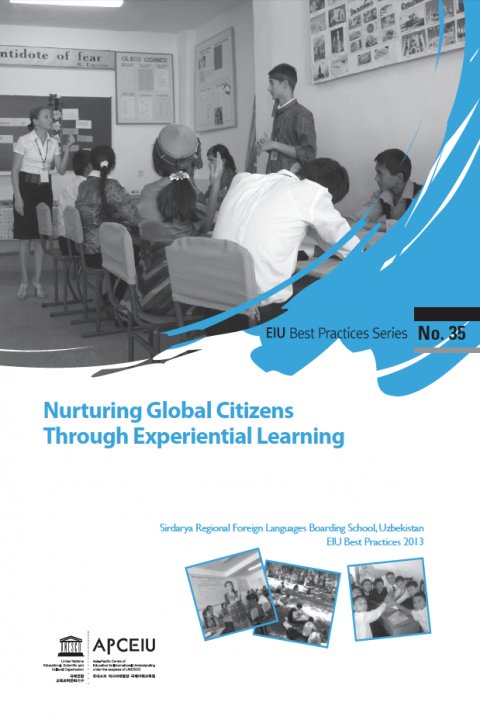 EIU Best Practice Series No. 35: Nurturing global citizens through experiential learning Année de publication: 2013 Auteur: Ildar Yusupov | Feruza Ahmedova Auteur institutionnel: APCEIU The following case is set in Uzbekistan where evidently diverse social groups live in harmony despite their differences. Among the schools in the country, the Sirdarya Regional Foreign Languages Boarding School in Gulistan City is arguably an exceptionally unique school due to the close engagement of parents with the boarding school’s EIU-themed activities. Activities range from extra-curricular activities including artwork and sports, to classroom-based activities such as role plays and international awareness events. Each activity is carefully designed to arouse the interest of the students in EIU-related themes such as tolerance, understanding and sustainable development. In the process, the students become highly motivated to take leading roles as responsible global citizens in creating a more peaceful world.