
Ressources
Explorez une large gamme de ressources sur le GCED afin d’approfondir votre compréhension et de renforcer vos activités de recherche, de plaidoyer, d’enseignement et d’apprentissage.
371 résultats trouvés
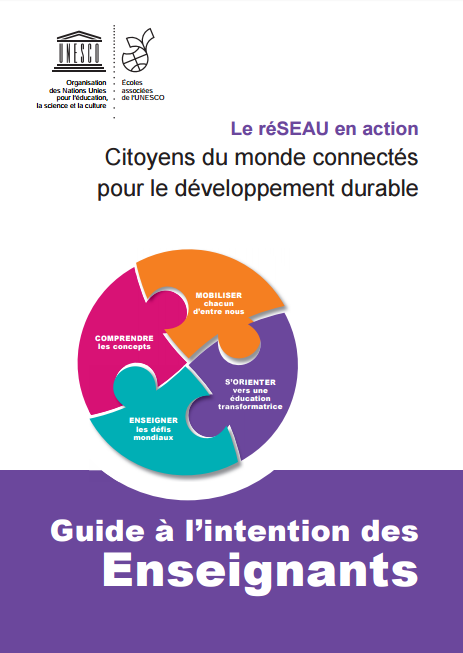 Le réSEAU en action: Citoyens du monde connectés pour le développement durable: guide à l'intention des enseignants Année de publication: 2017 Auteur institutionnel: UNESCO Le guide à l’intention des enseignants : donne aux élèves une idée de ce que signifie pour eux « devenir des citoyens du monde » ainsi que des suggestions pour contribuer au développement durable ; propose des idées d’activités en classe pour aider les élèves du secondaire à développer des connaissances, des compétences, des valeurs, des attitudes et des comportements en faveur de l’ECM et de l’EDD ; présente une sélection d’activités sur l’ECM et l’EDD mises en œuvre par les écoles du réSEAU du monde entier.
  لاجتماع العاشر للفريق الرفيع المستوى المعني بالتعليم للجميع Année de publication: 2011 Auteur institutionnel: UNESCO This statement is the outcome of 10th meeting of the High-level Group on Education for All. The meeting was held from 22 to 24 March 2011 in Jomtien, Thailand to urge to progress towards the EFA goals.
  Values Education thorugh Sports (infographics) Année de publication: 2016 Auteur institutionnel: UNESCO Education aux valeurs par le sport (infographie) Année de publication: 2016 Auteur institutionnel: Organisation des Nations Unies pour l'éducation, la science et la culture (UNESCO)
  Rethinking Education: Towards a Global Common Good? Année de publication: 2015 Auteur institutionnel: UNESCO The changes in the world today are characterized by new levels of complexity and contradiction. These changes generate tensions for which education is expected to prepare individuals and communities by giving them the capability to adapt and to respond. This publication contributes to rethinking education and learning in this context. It builds on one of UNESCO’s main tasks as a global observatory of social transformation with the objective of stimulating public policy debate.It is a call for dialogue among all stakeholders. It is inspired by a humanistic vision of education and development, based on respect for life and human dignity, equal rights, social justice, cultural diversity, international solidarity, and shared responsibility for a sustainable future. These are the fundamentals of our common humanity. This book enhances the vision provided by the two landmark UNESCO publications: Learning to Be: The world of education today and tomorrow (1972), the ‘Faure Report’, and Learning: The treasure within (1996), the ‘Delors Report’.
 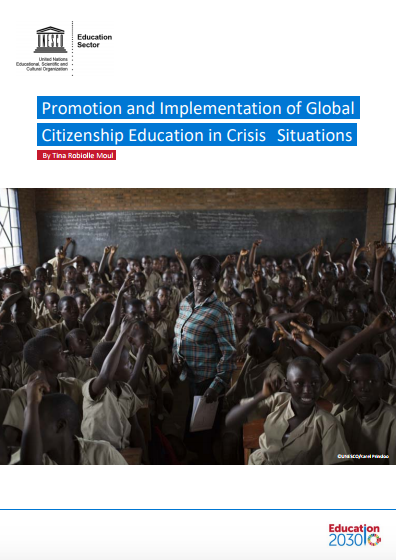 Promotion and implementation of global citizenship education in crisis situations Année de publication: 2017 Auteur: Robiolle Moul, Tina Auteur institutionnel: 유네스코 Crisis situations affect the realization of human rights of many people and communities across all regions of the world. Within UNESCO’s relevant areas of work, GCED is a powerful approach to education that can empower people to recover from crises and transform their communities into peaceful and sustainable societies. UNESCO commissioned a desk study that aimed at reviewing existing research on the promotion and implementation of GCED and related programs in countries affected by crisis situations, with particular attention to initiatives benefiting the refugee population. This study unveils the key challenges these programs encounter in such contexts, as well as promising practices that can guide the design and implementation of future GCED in crisis situations. This report is a synthesis of this desk study and supports the evidence that, after analyzing the context and the available means, GCED and related programs can and should be systematically adapted and implemented in crisis situations, including in response to refugee crises. Fostering peaceful co-existence through analysis and revision of history curricula and textbooks in Southeast Europe: preliminary stocktaking report Année de publication: 2006 Auteur: Jean Damascène Gasanabo | Jade Maître Auteur institutionnel: UNESCO To accomplish this aim, the study reviews policies and processes for developing history curricula and producing history textbooks in ten participating countries: Albania, Bosnia and Herzegovina, Bulgaria, Croatia, Greece, Romania, Montenegro, Serbia, Slovenia and The Former Yugoslav Republic of Macedonia (FYROM). The resulting report has been compiled for the dual purpose of (1) presenting a composite picture of the educational policies and practices in these countries with regard to history teaching and textbook production, distribution and use; (2) laying the groundwork for the development of national and/or sub-regional initiatives aimed at improving the processes currently in place. Favoriser la coexistence pacifique par l'analyse et la révision des programmes et manuels d'histoire en Europe du Sud-Est: rapport préliminaire d'inventaire Année de publication: 2006 Auteur: Jean Damascène Gasanabo | Jade Maître Auteur institutionnel: UNESCO Pour atteindre cet objectif, l'étude examine les politiques et les processus d'élaboration des programmes d'histoire et de la production de manuels d'histoire dans dix pays participants: Albanie, Bosnie-Herzégovine, Bulgarie, Croatie, Grèce, Roumanie, Monténégro, Serbie, Slovénie et l'ancienne République yougoslave de Macédoine (ARYM). Le rapport qui en résulte a été compilé dans le double but de (1) présentant une image composite des politiques et pratiques éducatives dans ces pays en ce qui concerne l'enseignement de l'histoire et de la production de manuels scolaires, la distribution et l'utilisation; (2) jeter les bases pour le développement d'initiatives nationales et / ou sous-régionaux visant à améliorer les processus actuellement en place.
  Teaching respect for all: implementation guide Année de publication: 2014 Auteur institutionnel: UNESCO Teaching Respect for All is a joint UNESCO-United States of America-Brazil project launched in January 2012 to counteract discrimination both in and through education. Acknowledging that discrimination is on the rise worldwide, Teaching Respect for All promotes an educational response to counter discrimination and violence through strengthening the foundations of mutual tolerance and cultivating respect for all people, regardless of colour, gender, class, sexual orientation, national, ethnic, or religious orientation/identity. Teaching Respect for All has chosen to focus efforts on the formal and informal classroom, targeting learners of 8-16 years old, and aims to build curiosity, openness, critical thinking and understanding among youth learners, thus equipping them with the awareness, knowledge, and skills to cultivate respect and stop discrimination on all levels. The project is founded on the universal values and core principles of human rights, while acknowledging each country has its own history and mechanism for addressing the issue of discrimination in education. Enseigner le respect pour tous: guide de mise en oeuvre Année de publication: 2014 Auteur institutionnel: Organisation des Nations Unies pour l'éducation, la science et la culture (UNESCO) Respect Pédagogique pour Tous est un UNESCO-États-Unis conjointe de projet Amérique-Brésil a lancé en Janvier 2012 pour lutter contre la discrimination à la fois dans et par l'éducation. Reconnaissant que la discrimination est à la hausse dans le monde entier, Respect Pédagogique pour Tous favorise une réponse éducative pour lutter contre la discrimination et la violence en renforçant les fondements de la tolérance mutuelle et de cultiver le respect pour toutes les personnes, indépendamment de la couleur, le sexe, la classe, l'orientation sexuelle, nationale, ethnique ou religieuse orientation / identité. Respect Pédagogique pour Tous a choisi de concentrer les efforts sur la salle de classe formelle et informelle, en ciblant les apprenants de 8-16 ans, et vise à développer la curiosité, l'ouverture, la pensée critique et la compréhension entre les apprenants de la jeunesse, en les dotant ainsi avec la prise de conscience, la connaissance, et les compétences nécessaires pour cultiver le respect et arrêter la discrimination à tous les niveaux. Le projet est fondé sur les valeurs universelles et les principes fondamentaux des droits de l'homme, tout en reconnaissant que chaque pays a sa propre histoire et un mécanisme pour régler le problème de la discrimination dans l'éducation.