
Ressources
Explorez une large gamme de ressources sur le GCED afin d’approfondir votre compréhension et de renforcer vos activités de recherche, de plaidoyer, d’enseignement et d’apprentissage.
10 résultats trouvés
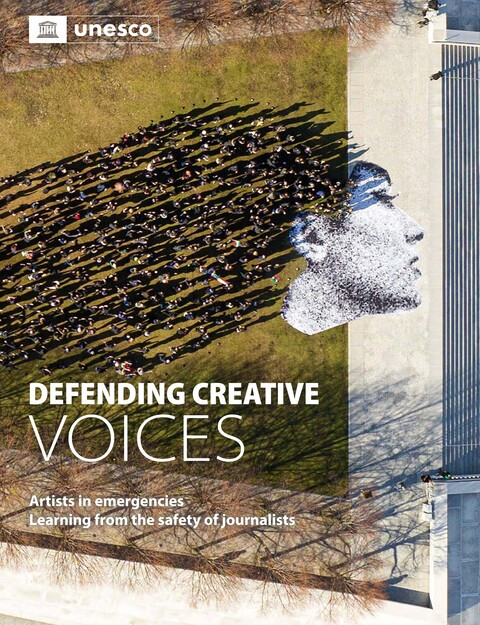 Defending Creative Voices: Artists in Emergencies, Learning from the Safety of Journalists Année de publication: 2023 Auteur: Rosario Soraide Auteur institutionnel: UNESCO Artists and cultural professionals often come across significant challenges to their freedom of expression, including violence and harassment – online and offline – legal persecution, detention, imprisonment and, in the worst of cases, murder. Emergency situations can result in additional risks for them, as many become increasingly targeted in connection to the visibility of their work and see their livelihoods impacted upon by income loss and unemployment in the cultural sector. While the attacks and threats that artists and cultural professionals face during emergencies are similar to those affecting journalists, they do not receive the same level of attention nor access to protection mechanisms and opportunities for assistance. Over the past decades, a strong framework has emerged to advance journalists’ safety at international, regional and national levels, including through legal and regulatory instruments, protection mechanisms, support networks and consistent collective mobilization for their rights. Despite growing awareness of the vulnerability of artists and cultural professionals in emergency contexts and increased efforts to safeguard their rights and ensure their safety, progress in this regard remains comparatively much more incipient. With the support of UNESCO’s Culture and Communication and Information Sector, and based on a comparative analysis, this study therefore aims to strengthen the protection of artists and cultural professionals during emergencies by drawing lessons from the experience, challenges, and achievements in the field of journalists’ safety. It presents actionable recommendations and identifies areas in which synergies between key stakeholders promoting, respectively, artistic and media freedom could serve to reinforce the protection of both at-risk artists and journalists. Défendre les voix créatives: artistes en situation d'urgence, apprendre de la sécurité des journalistes Année de publication: 2023 Auteur: Rosario Soraide Auteur institutionnel: UNESCO Les artistes et les professionnels de la culture se heurtent souvent à des obstacles importants à leur liberté d'expression, comme la violence et le harcèlement, en ligne et hors ligne, la persécution juridique, la détention, l'emprisonnement et, dans le pire des cas, l'assassinat. Les situations d'urgence peuvent engendrer des risques supplémentaires pour ces groupes, car nombre d'entre eux sont de plus en plus ciblés en raison de la visibilité de leur travail et voient leurs moyens de subsistance affectés par la perte de revenus et la hausse du chômage dans le secteur culturel. Alors que les attaques et les menaces auxquelles sont confrontés les artistes et les professionnels de la culture dans les situations d'urgence sont similaires à celles qui touchent les journalistes, ils ne bénéficient pas du même niveau d'attention ni du même accès aux mécanismes de protection et aux aides disponibles. Au cours des dernières décennies, un cadre solide a été mis en place pour promouvoir la sécurité des journalistes aux niveaux international, régional et national, notamment via des instruments juridiques et réglementaires, des mécanismes de protection, des réseaux de soutien et une mobilisation collective constante en faveur de leurs droits. Malgré une prise de conscience croissante de la vulnérabilité des artistes et des professionnels de la culture dans les situations d'urgence et un développement des initiatives visant à sauvegarder leurs droits et garantir leur sécurité, les progrès à cet égard restent comparativement beaucoup plus embryonnaires. Avec le soutien des Secteurs de la Culture, et de la Communication et de l’Information de l'UNESCO, et sur la base d'une analyse comparative, cette étude vise à renforcer la protection des artistes et des professionnels de la culture dans les situations d'urgence en tirant les leçons de l'expérience, des défis et des résultats obtenus dans le domaine de la sécurité des journalistes. Elle élabore des recommandations réalisables et définit les domaines dans lesquels la collaboration entre les principaux acteurs promouvant, respectivement, la liberté artistique et la liberté des médias pourrait servir à renforcer la protection des artistes et des journalistes en danger.
  Draft Text of the Revised 1974 Recommendation Concerning Education for International Understanding, Co-Operation and Peace and Education Relating to Human Rights and Fundamental Freedoms Année de publication: 2023 Auteur institutionnel: UNESCO In accordance with the UNESCO Constitution and the Rules of Procedure concerning Recommendations to Member States and international conventions covered by the terms of Article IV, paragraph 4, of the Constitution, the draft text of the revised Recommendation concerning education for international understanding, co-operation and peace and education relating to human rights and fundamental freedoms, and the related preliminary report, were sent to UNESCO Member States through the circular letter CL/4401 (September 2022) for their written commentsand observations. On the basis of their comments, a second draft of the text was prepared. In circular letter CL/4433 (April 2023), the second draft together with the Definitive Report were submitted to Member States. The Special Committee meeting of experts designated by Member States took place from 30 May to 2 June 2023, as per the circular letter CL/4417 (November 2022), and from 10 to 12 July 2023, as per circular letter CL/4442 (June 2023).
  Recommendation on Education for Peace, Human Rights and Sustainable Development: An Implementation Guide Année de publication: 2025 Auteur institutionnel: UNESCO There is no peace without education. With conflicts rising on so many fronts, there has never been a more urgent need for a transformed education geared towards building and sustaining peace.The Recommendation on Education for Peace and Human Rights, International Understanding, Cooperation, Fundamental Freedoms, Global Citizenship and Sustainable Development, adopted by all 194 Member States of UNESCO in 2023, articulates a humanistic and transformative vision of education that can help address contemporary and future affronts to peace. These challenges range from the resurgence of conflicts driven by systemic inequalities and injustices, the rise and spread of hate speech, racism and discrimination particularly online, to the adverse effects of digital technologies and the existential threat of climate change.UNESCO has developed this Guide as the first of several tools to assist Member States in unpacking and fully implementing the 2023 Recommendation. The Guide elaborates its contents, integrating the 2023 Recommendation’s transdisciplinary lens to connect key concepts and issues. It also provides concrete ideas and curated resources for action at different levels and types of education, while calling for a multi-stakeholder and whole-of-society approach that includes everyone and builds on existing positive efforts.The Guide is a timely addition to the pool of available collective resources to fully implement the 2023 Recommendation and foster an education that is transformative for a just and peaceful world.
  مدى فعالية دور مجلس الأمم المتحدة لحقوق الإنسان في حماية وتعزيز حقوق الانسان (دراسات وأبحاث; Vol.13, No.5) Année de publication: 2021 Auteur: Saffo Nardjesse Auteur institutionnel: University of Djelfa ظلت قضية حقوق الإنسان الأولى في قائمة هواجس وآمال الإنسانية وأحد الأولويات التي ترتبت على عاتق الأمم المتحدة ضمن برامجها وأهدافها المسطرة والصعبة المنال. فما من ريب من كون أهم أسباب نشأتها إنما تعزى لتلك الانتهاكات الصارخة لحقوق الإنسان لاسيما ما ارتبط منها بارتكاب جرائم حرب وأخرى ضد الإنسانية، وهو ما دفع الدول الكبرى على وجه التحديد إلى التفكير في إنشاء هيئة تُعنى ابتداءً بالمحافظة على السلم والأمن الدوليين وحماية وتعزيز حقوق الإنسان، عبر لجنة حقوق الإنسان بوصفها إحدى اللجان الفرعية التي أنشأها المجلس الاقتصادي والاجتماعي والتي أُوكلت لها مهمة الحفاظ على قدسية هذه الحقوق. غير أنه ما لبث أن ثبت عدم فعاليتها بسبب سيطرة الدول المنتهكة لحقوق الإنسان من جهة وتسييس دورها من جهة أخرى. إذ عالجت اللجنة –خلال سنوات- قضايا حقوق الإنسان بطرق وصفها بعض المعلقين بغير المرضية والأكثر عقما، على إثر ذلك تم إنشاء الهيئة الجديدة باسم "مجلس حقوق الإنسان" بقرار الجمعية العامة رقم 251/60 ، وأعتبر أكبر هيئة دولية أنيط لها مسؤولية تعزيز الاحترام العالمي لحقوق الإنسان والحريات الأساسية للجميع ودون تمييز من أي نوع وبطريقة عادلة ومنصفة. فهل عالجت الآلية الجديدة بتشكيلها المستحدث على نحو كافي نقاط ضعف لجنة حقوق الإنسان؟ وبعبارة أخرى، هل أضاف مجلس حقوق الإنسان منذ إنشائه إلى اليوم قيمة ومساهمة أكبر لحماية وتعزيز حقوق الإنسان ؟ How Effective Is the Role of the United Nations Human Rights Council in Protecting and Promoting Human Rights (The Arabic Journal of Human and Social Science; Vol.13, No.5) Année de publication: 2021 Auteur: Saffo Nardjesse Auteur institutionnel: University of Djelfa The issue of human rights remained the first in the list of human concerns and hopes, and one of the priorities that emerged on the shoulders of the United Nations within its established and difficult-to-reach programs and goals. There is no doubt that the most important causes of its emergence are attributable to those flagrant violations of human rights, especially those linked to war crimes and others against humanity, which prompted the major countries specifically to consider establishing a body concerned with the first of all the maintenance of international peace and security and the protection and promotion of human rights. , Through the Commission on Human Rights as one of the sub-committees established by the Economic and Social Council, which is tasked with preserving the sanctity of these rights. However, it soon proved ineffective due to the control of states violating human rights on the one hand and the politicization of their role on the other hand. Over the years, the committee dealt with human rights issues in ways that some commentators described as unsatisfactory and more sterile. As a result, the new body was established under the name of the "Human Rights Council" by General Assembly Resolution 60/251, and was considered the largest international body entrusted with the responsibility of promoting global respect. Human rights and fundamental freedoms for all without discrimination of any kind and in a just and equitable manner. Did the new mechanism, with its newly created composition, adequately address the weaknesses of the Commission on Human Rights? In other words, has the Human Rights Council added from its inception to today a greater value and contribution to the ؟protection and promotion of human rights?
  Urban heritage for resilience: consolidated results of the implementation of the 2011 Recommendation on the Historic Urban Landscape; 3rd Member States Consultation Année de publication: 2023 Auteur institutionnel: UNESCO <Short summary>Integrating heritage conservation with urban development plans: fosters inclusive and sustainable local development Urban heritage, including its tangible and intangible attributes, constitutes a key resource in enhancing the liveability of urban areas and fosters economic development and social cohesion in a changing global environment. The UNESCO 2011 Recommendation on the Historic Urban Landscape has contributed towards promoting a holistic approach to managing historic urban areas. The third Member States consultation on the implementation of the 2011 Recommendation conducted between June to November 2022 emphasizes both the importance and the urgency of integrating heritage conservation with urban development plans, disaster risk reduction and climate action at the local level.The report covered six thematic areas of implementation that captured the key principles of the 2011 Recommendation in the framework of the 2030 Agenda for Sustainable Development, including the mapping and inventorying of heritage values and attributes, governance mechanisms, laws, regulations, and planning tools to protect these different attributes, inclusive and participatory decision-making, equitable economic development, the impacts of climate change, and the use of digital technologies for managing urban heritage including capacity building.The publication includes key recommendations emerging from consultations with international experts, exchanging innovative practices, developing guidance, tools, and initiatives, notably on planning, civic engagement, regulatory frameworks and financial mechanisms and management to support the implementation of the 2011 Recommendation.
  Re|shaping cultural policies: a decade promoting the diversity of cultural expressions for development Année de publication: 2015 Auteur institutionnel: UNESCO This Report presents the work of fourteen independent experts, as well as the Secretary of the Convention and the Principal Editor, who have analysed the implementation of the Convention on the Protection and Promotion of the Diversity of Cultural Expressions. Its purpose is to move forward the process of monitoring the Convention’s implementation that was put in place by a mechanism of Quadrennial Periodic Reports (QPRs) approved by the Convention’s Conference of Parties in 2011. The contributors have consulted the 71 reports submitted by Parties, but have also used data derived from other, non-official sources and have drawn upon their own expert experience. Re|pensar las politicas culturales: 10 anos de promocion de la diversidad de las expresiones culturales para el desarrollo Année de publication: 2015 Auteur institutionnel: UNESCO This Report presents the work of fourteen independent experts, as well as the Secretary of the Convention and the Principal Editor, who have analysed the implementation of the Convention on the Protection and Promotion of the Diversity of Cultural Expressions. Its purpose is to move forward the process of monitoring the Convention’s implementation that was put in place by a mechanism of Quadrennial Periodic Reports (QPRs) approved by the Convention’s Conference of Parties in 2011. The contributors have consulted the 71 reports submitted by Parties, but have also used data derived from other, non-official sources and have drawn upon their own expert experience. Re|penser les politiques culturelles: 10 ans de promotion de la diversité des expressions culturelles pour le développement Année de publication: 2015 Auteur institutionnel: UNESCO This Report presents the work of fourteen independent experts, as well as the Secretary of the Convention and the Principal Editor, who have analysed the implementation of the Convention on the Protection and Promotion of the Diversity of Cultural Expressions. Its purpose is to move forward the process of monitoring the Convention’s implementation that was put in place by a mechanism of Quadrennial Periodic Reports (QPRs) approved by the Convention’s Conference of Parties in 2011. The contributors have consulted the 71 reports submitted by Parties, but have also used data derived from other, non-official sources and have drawn upon their own expert experience.