
Ressources
Explorez une large gamme de ressources sur le GCED afin d’approfondir votre compréhension et de renforcer vos activités de recherche, de plaidoyer, d’enseignement et d’apprentissage.
121 résultats trouvés
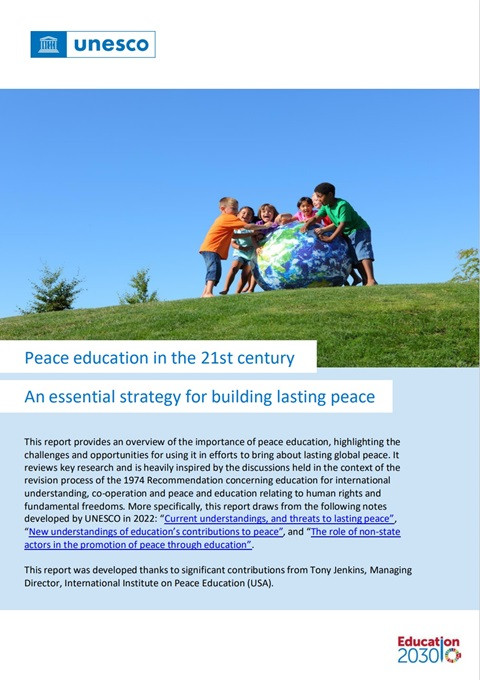 Peace Education in the 21st Century: An Essential Strategy for Building Lasting Peace Année de publication: 2024 Auteur institutionnel: UNESCO This report provides an overview of the importance of peace education, highlighting the challenges and opportunities for using it in efforts to bring about lasting global peace. It reviews key research and is heavily inspired by the discussions held in the context of the revision process of the 1974 Recommendation concerning education for international understanding, co-operation and peace and education relating to human rights and fundamental freedoms. More specifically, this report draws from the following notes developed by UNESCO in 2022: “Current understandings, and threats to lasting peace”, “New understandings of education’s contributions to peace”, and “The role of non-state actors in the promotion of peace through education”.
  Revision Process of the 1974 Recommendation concerning Education for International Understanding, Co-operation and Peace and Education relating to Human Rights and Fundamental Freedoms: Comments from Observers to the Plenary Meetings of the International Expert Group (IEG) Année de publication: 2023 Auteur institutionnel: UNESCO Adopted in 1974, the Recommendation concerning education for international understanding, co-operation and peace and education relating to human rights and fundamental freedoms is considered a landmark legal instrument that brings together for the first time peace, international understanding, human rights, fundamental freedoms and education. In line with the Resolution adopted at UNESCO’s General Conference at its 41st Session in November 2021 (41C/Resolution 17), UNESCO launched the revision of the Recommendation and convened an International Expert Group (IEG) to advise the Organization on the changes. The work of the IEG took place between May and June 2022. Though the meetings of the IEG were technical in nature (category VI), in order to ensure an open and transparent process, the Permanent Delegations were invited to listen-in to the deliberations of the IEG online, as observers, along with a select number of non-governmental organizations, intergovernmental organizations, and United Nations entities. At the end of each plenary meeting, observers to the IEG plenary meetings could submit written comments. This document compiles the comments received from observers during this process and submitted to the IEG members for their consideration.
  Reconciliation through Global Citizenship Education Année de publication: 2023 Auteur institutionnel: UNESCO This document zeroes in on how concepts of GCED and reconciliation are addressed in current research and practice and aims to provide existing grounds and future considerations for policy-makers concerned with reconciliation through education.
 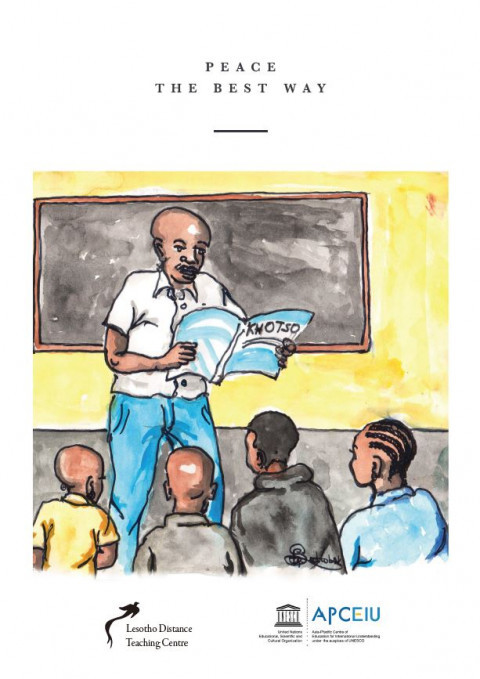 Peace the Best Way Année de publication: 2017 Auteur institutionnel: Lesotho Distance Teaching Centre (LDTC) The storybook titled “Peace, the Best Way (Ngoan’a Khotso Ha a Lebale Tsa Khotso)” is an end-product of Workshop in Lesotho on GCED: Teacher Training on Peace Education & GCED Learning Material Development held between 12 and 14 of July 2017. During the workshop, participants created learning materials on peace and conflict transformation based on what they have learned throughout the sessions.The authors share their stories of conflicts that they encounter in their everyday lives and further identify ways of managing and resolving the conflicts in a peaceful manner to let everyone live in harmony. They hope to instill the importance of peace not only to the adults reading the book, but also to the younger generation who learn from their parents and adults of the community.The book published in English as well as Sesotho, will be used as teaching and learning resources for learners and also be disseminated to public locations including schools, community centers and libraries.For more information on the Workshop, Please click here.
 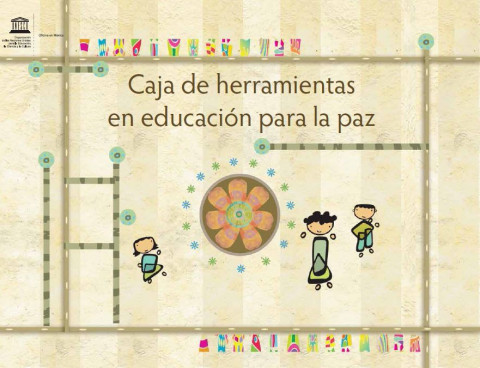 Toolbox in Education for Peace Année de publication: 2013 Auteur: Luz Marfa Chapela Auteur institutionnel: UNESCO Mexico The components of this box form a system in which each element has its own ends and all the elements, gathered and linked, seek the same shared goal: offer recreational materials that encourage introspective reflection, the best knowledge of the other and the environment, the collaborative study, the participation of different agents of the community in support of teachers, the use of mother tongues and the identification of resources, knowledge, talents and skills in local communities. This box is addressed in a special way to teachers and students of basic education, as well as to different agents of the civil society that support them. Its purpose is to favor the development of school communities that make the school a center of study, play, advice and work for all. Because the materials of the Toolbox can also be interesting to young people and adults of all ages. In this sense, the box invites the different agents of the communities to think and produce new playful-educational materials that collect and put into action some priority local contents, which, surely, will enrich the life and educational possibilities of school communities. Caja de Herramientas en Educación para la Paz Année de publication: 2013 Auteur: Luz Marfa Chapela Auteur institutionnel: UNESCO Mexico Los componentes de esta caja forman un sistema en el que cada elemento tiene sus propios fines y todos los elementos, reunidos y vinculados, buscan un mismo fin compartido: ofrecer materiales lúdicoeducativos que propicien la reflexión introspectiva, el mejor conocimiento del otro y del entorno, el estudio colaborativo, la participación de distintos agentes de la comunidad en apoyo a los maestros, el uso de las lenguas maternas y la identificación de recursos, saberes, talentos y habilidades en las comunidades locales. Esta caja se dirige de manera especial a maestros y estudiantes de educación básica, así como a distintos agentes de la sociedad civil que los apoyan. Tiene entre sus propósitos favorecer el desarrollo de comunidades escolares que hagan de la escuela un centro de estudio, juego, asesoría y trabajo para todos. Porque los materiales de la Caja de Herramientas también pueden resultar interesantes a jóvenes y adultos de todas las edades. En este sentido, la caja invita a los distintos agentes de las comunidades a pensar y producir nuevos materiales lúdico-educativos que recojan y pongan en acción algunos contenidos locales prioritarios, mismos que, seguramente, enriquecerán la vida y las posibilidades educativas de las comunidades escolares.
 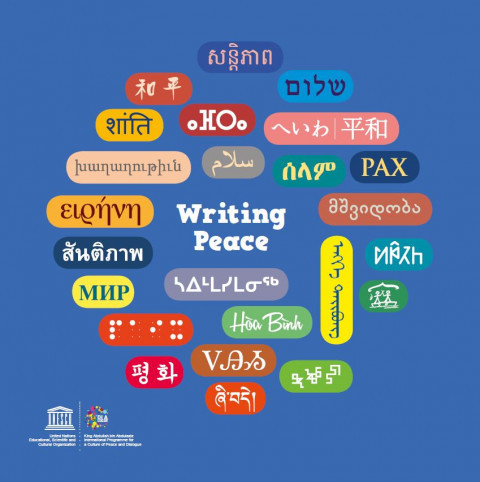 Writing Peace Année de publication: 2017 Auteur: Eric Cattelain Auteur institutionnel: UNESCO “Writing Peace” is a manual that invites young audiences to discover contemporary writings through the introduction of various languages. Its goal is to make the world appear a little closer and a little more familiar. "Writing Peace" encourages children (ages8 to 14) to become aware of the interdependence of cultures through familiarization with contemporary writing systems, their history, and their borrowings.The manual contains 24 activity sheets. Each section presents the characters of a writing system, an introductory text and historical background, the word “peace” and the word “hello,” the language(s) attached to the system(s), and an activity whose answers appear at the end of manual.Six thousand years after the advent of writing, what do we know about others, their systems of thought, and the transcriptions of their writing systems? How can different writing systems contribute to a better understanding of the world and our place within it? By beginning to learn about these writings and their fascinating beauty, the manual connects children to diversity, thus opening their eyes to the concept of peace and our awareness of it. Escribir la Paz Année de publication: 2017 Auteur: Eric Cattelain Auteur institutionnel: UNESCO Escribir la Paz es un manual que invita a un público infantil y juvenil a descubrir las escrituras contemporáneas a través de una muestra de ellas. Tiene por objeto explorar el mundo, volviéndolo más cercano y más familiar. Escribir la Paz ayuda a niños y jóvenes de 8 a 18 años a tomar conciencia de la interdependencia de las culturas, familiarizándose con los sistemas de escritura contemporáneos, su historia y sus aportes mutuos. El manual incluye 24 fichas de actividades. Cada sección presenta los caracteres de un sistema de escritura, un texto introductorio y un contexto histórico, las palabras “Paz” y “Hola”, los idiomas asociados a las distintas escrituras, y una actividad cuyas respuestas se presentan al final del manual. Seis mil años después de la aparición de la escritura, ¿qué sabemos de los demás, de sus sistemas de pensamiento y la transcripción de sus escrituras? ¿De qué manera pueden los distintos sistemas de escritura contribuir a un mejor conocimiento del mundo y del lugar que ocupamos en él? Empezando por el descubrimiento de estas escrituras y su fascinante belleza, el manual conecta a los jóvenes con la diversidad y les sensibiliza al concepto de paz y a la conciencia que de él tenemos. J'écris la paix Année de publication: 2017 Auteur: Eric Cattelain Auteur institutionnel: UNESCO J’écris la Paix est un manuel qui invite le jeune public à découvrir les écritures contemporaines à travers un échantillon d’entre elles. Son but est de partir à la découverte du monde et de le rendre un peu plus proche, un peu plus familier. J’écris la Paix encourage les enfants (de 8 à 18 ans) à prendre conscience de l'interdépendance des cultures en se familiarisant avec les systèmes d'écriture contemporains, leur histoire et leurs emprunts mutuels.Le manuel contient 24 fiches d'activités. Chaque section présente les caractères d'un système d'écriture, un texte d'introduction et un contexte historique, le mot "paix" et le mot "bonjour", les langues associées au(x) système(s), et une activité dont les réponses apparaissent en fin de manuel.Six mille ans après l'avènement de l'écriture, que savons-nous des autres, de leurs systèmes de pensée et des transcriptions de leurs écritures? Comment les différents systèmes d'écriture peuvent-ils contribuer à une meilleure compréhension du monde et de la place que nous y occupons? En commençant par la découverte de ces scripts et de leur beauté fascinante, le manuel relie les enfants à la diversité, leur ouvrant ainsi les yeux sur le concept de paix et sur la conscience que nous en avons.
  Living in a new world starts with education (SangSaeng no. 37 summer autumn 2013) Année de publication: 2013 Auteur: Hans van Ginkel Auteur institutionnel: APCEIU SangSaeng No. 37- How to Foster Global Citizenship? has been published. In order to help our readers better grasp the concept of global citizenship and provide useful information and new ideas, this issue deals with various aspects of global citizenship education.3 Director’s Message4 Special ColumnBuilding True Citizens for a Single Humanity8 Focus: How to Foster Global Citizenship?8 Eliminating World Challenges through Global Citizenship Education 13 Developing Global Citizens with a Global Perspective18 Living in a New World Starts with Education23 GCE in Every Corners of the World28 Best Practices28 Hands-on Hand Print for Environmental Sustainability32 Bhutan Teachers Learn New Models of Education35 Comic Relief: Song of the City36 Special ReportPaving the Way Together for Global Citizenship Education40 InterviewBuilding a Global Community out of the Ashes of Poverty42 LetterCapturing Moments of Living in Harmony44 Peace in My MemoryHow Golf Speaks about Peace47 Understanding the Asia-Pacific RegionDiscovering Locks beyond the Function of Opening and Closing50 APCEIU in Action