
Ressources
Explorez une large gamme de ressources sur le GCED afin d’approfondir votre compréhension et de renforcer vos activités de recherche, de plaidoyer, d’enseignement et d’apprentissage.
232 résultats trouvés
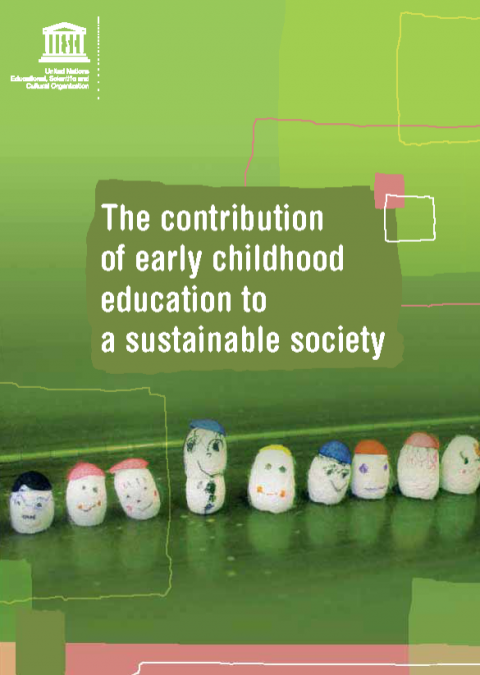 La contribution de l'éducation de la petite enfance à une société durable Année de publication: 2008 Auteur institutionnel: UNESCO Ce rapport provient de l'atelier international, «Le rôle de l'éducation de la petite enfance pour une société durable», organisé conjointement à Göteborg, en Suède, par l'Université de Göteborg, Chalmers University of Technology et la ville de Göteborg, du 2 au 4 mai 2007. Il a réuni trente-cinq participants de seize pays différents (voir «Liste des participants»). L'atelier a été suivi à l'éducation de internationalconférenceon pour le développement durable, «Apprendre à changer notre monde», tenue en mai 2004, à Göteborg. Il était l'un des quatre ateliers préparatoires menant à une autre éducation internationalconférenceon pour le développement durable, qui sera organisée en 2008 ou 2009, dans la même ville. L'objectif des quatre ateliers est de discuter des promoteurs et des obstacles liés à l'apprentissage de la durabilité, et de proposer des recommandations pour la prochaine conférence internationale. Le présent atelier a été conçu pour les raisons suivantes. Tout d'abord, nos sociétés ont un besoin urgent de nouveaux types d'éducation qui peuvent aider à prévenir une nouvelle dégradation de notre planète, et qui favorisent les soins et les citoyens responsables véritablement concernés par et capables de contribuer à un monde juste et pacifique. Deuxièmement, ces nouvelles formes d'éducation doivent être aCECssibles à tous - non seulement une poignée de gens - et se déroulent dans divers milieux, y compris les familles et les communautés. Troisièmement, ils doivent commencer au début de l'enfance, comme les valeurs, les attitudes, les comportements et les compétences acquises dans cette période peuvent avoir un impact durable dans la vie plus tard. Ainsi, l'éducation de la petite enfance a clairement une place importante dans les efforts pour parvenir à un développement durable.
  Education Reform in Pakistan Année de publication: 2014 Auteur institutionnel: International Crisis Group In April 2010, the eighteenth constitutional amendment committed Pakistan to free and compulsory education for all children between the ages of five and sixteen. Yet millions are still out of school, and the education system remains alarmingly impoverished. The madrasa (religious school) sector flourishes, with no meaningful efforts made to regulate the seminaries, many of which propagate religious and sectarian hatred. Militant violence and natural disasters have exacerbated the dismal state of education. The public education system needs to foster a tolerant citizenry, capable of competing in the labour market and supportive of democratic norms within the country and peace with the outside world. Education Reform in Pakistan Année de publication: 2014 Auteur institutionnel: International Crisis Group En Avril 2010, le Pakistan s’est engagé, l'amendement constitutionnel XVIII, à mettre en place une éducation gratuite et obligatoire pour tous les enfants âgés de cinq à seize ans. Pourtant, des millions d’enfants ne sont encore à l'école et le système éducatif s’appauvrit d’une façon alarmante. Le secteur de la madrasa (école religieuse) fleurit, sans que des efforts significatifs soient déployés pour réglementer les séminaires, qui propagent souvent la haine religieuse et le sectarisme. La violence militante et les catastrophes naturelles ont aggravé l'état lamentable de l'éducation. Le système public de l'éducation doit favoriser une citoyenneté tolérante, compétitive sur le marché du travail et apportant son soutien aux normes démocratiques dans le pays et à la paix avec le monde extérieur.
  The Influence of education on conflict and peace building Année de publication: 2010 Auteur: Alan Smith Auteur institutionnel: UNESCO The purpose of this paper is to identify aspects of education that may have a positive influence on the dynamics of conflict or make a contribution to peacebuilding. The UN Secretary-General’s (2009) report on peacebuilding identifies a number of recurring priorities in conflict-affected situations, ‘establishing security, building confidence in a political process, delivering initial peace dividends and expanding core national capacity’. These priorities include ‘the provision of basic services, such as water and sanitation, health and primary education’. However, in conflict-affected situations education is also about more than service delivery because it is a means of socialization and identity development through the transmission of knowledge, skills, values and attitudes across generations. Education may therefore be a driver of conflict (fuelling grievances, stereotypes, xenophobia and other antagonisms), but can also be a way of contributing to ‘conflict transformation’ and ‘peacebuilding’.
  Address by Mr Koïchiro Matsuura, Director-General of UNESCO, on the occasion of the Award Ceremony for the UNESCO Prize for Peace Education 2008; UNESCO, 18 September 2008 Année de publication: 2008 Auteur institutionnel: UNESCO. Director-General, 1999-2009 (Matsuura, K.) This is an address by Address by Mr Koïchiro Matsuura, Director-General of UNESCO, on the occasion of the Award Ceremony for the UNESCO Prize for Peace Education 2008. Discours de M. Koïchiro Matsuura, Directeur Général de l'UNESCO, à l'occasion de la Cérémonie de remise du Prix UNESCO de l'éducation pour la paix 2008; UNESCO, 18 Septembre 2008 Année de publication: 2008 Auteur institutionnel: UNESCO. Director-General, 1999-2009 (Matsuura, K.) Ceci est une adresse par adresse de M. Koïchiro Matsuura, Directeur général de l'UNESCO, à l'occasion de la Cérémonie de remise du Prix UNESCO de l'Éducation pour la Paix 2008.
  Prix UNESCO de l'éducation pour la paix, 2008 Année de publication: 2009 Auteur institutionnel: UNESCO The UNESCO Prize for Peace Education 2008 was awarded to the Institute for Justice and Reconciliation (South Africa) by Mr Koïchiro Matsuura, Director-General of UNESCO, on the recommendation of the International Jury of the Prize. The prize-giving ceremony, organized as part of the celebrations of the International Day of Peace (21 September), the International Decade for a Culture of Peace and Non-Violence for the Children of the World (2001- 2010) and the 60th anniversary of the Universal Declaration of Human Rights, was held at UNESCO Headquarters on 18 September 2008 in the presence of Mr Mohammed Arkoun, President of the International Jury, and H.E. Mr Javier Pérez de Cuéllar, member of the International Jury, former Prize laureates, Permanent Delegates of Member States and representatives of governmental and non-governmental organizations. The award ceremony was preceded by the screening of an excerpt from the documentary Truth, Justice, Memory: South Africa’s Truth and Reconciliation Process and by a video message from Archbishop Emeritus Desmond Tutu, winner of the 1984 Nobel Peace Prize for his role as a unifying leader in the campaign to resolve the problem of apartheid in South Africa, and former Chairperson of South Africa’s Truth and Reconciliation Commission
  UNESCO prize for peace education, 2008 Année de publication: 2009 Auteur institutionnel: UNESCO The UNESCO Prize for Peace Education 2008 was awarded to the Institute for Justice and Reconciliation (South Africa) by Mr Koïchiro Matsuura, Director-General of UNESCO, on the recommendation of the International Jury of the Prize. The prize-giving ceremony, organized as part of the celebrations of the International Day of Peace (21 September), the International Decade for a Culture of Peace and Non-Violence for the Children of the World (2001- 2010) and the 60th anniversary of the Universal Declaration of Human Rights, was held at UNESCO Headquarters on 18 September 2008 in the presence of Mr Mohammed Arkoun, President of the International Jury, and H.E. Mr Javier Pérez de Cuéllar, member of the International Jury, former Prize laureates, Permanent Delegates of Member States and representatives of governmental and non-governmental organizations. The award ceremony was preceded by the screening of an excerpt from the documentary Truth, Justice, Memory: South Africa’s Truth and Reconciliation Process and by a video message from Archbishop Emeritus Desmond Tutu, winner of the 1984 Nobel Peace Prize for his role as a unifying leader in the campaign to resolve the problem of apartheid in South Africa, and former Chairperson of South Africa’s Truth and Reconciliation Commission Discours de M. Koïchiro Matsuura, Directeur général de l'UNESCO, à l'occasion de la Cérémonie de Remise du Prix UNESCO de l'Éducation pour la Paix 2008, UNESCO, 18 Septembre 2008 Année de publication: 2008 Auteur institutionnel: UNESCO. Director-General, 1999-2009 (Matsuura, K.) This is an address by Address by Mr Koïchiro Matsuura, Director-General of UNESCO, on the occasion of the Award Ceremony for the UNESCO Prize for Peace Education 2008. Does vicarious experience of suffering affect empathy for an adversary? The effects of Israelis’ visits to Auschwitz on their empathy for Palestinians Empathy for the adversary is part of peace education. Does the vicarious experience of suffering affect empathy towards the suffering of an adversary? Specifically, does the visit of Israeli youth to Auschwitz affect their empathy toward the Palestinians? Three hundred and nine high school students participated in the study: One half went on the journey, while the other, comparable half, served as a control group. Findings tended to support the hypotheses. The journey increased empathy among participants with initially more positive attitudes toward the Palestinians but it also decreased empathy among those with initially more negative ones. The choice of nationalistic lessons about the holocaust affected feelings of pride and identification with the victims but not empathy. The choice of universalistic lessons affected feelings of fear and helplessness and contributed to increased empathy. Conclusions are drawn pertaining to peace education programs aiming at increasing empathy toward an adversary. (By the author)