
Ressources
Explorez une large gamme de ressources sur le GCED afin d’approfondir votre compréhension et de renforcer vos activités de recherche, de plaidoyer, d’enseignement et d’apprentissage.
232 résultats trouvés
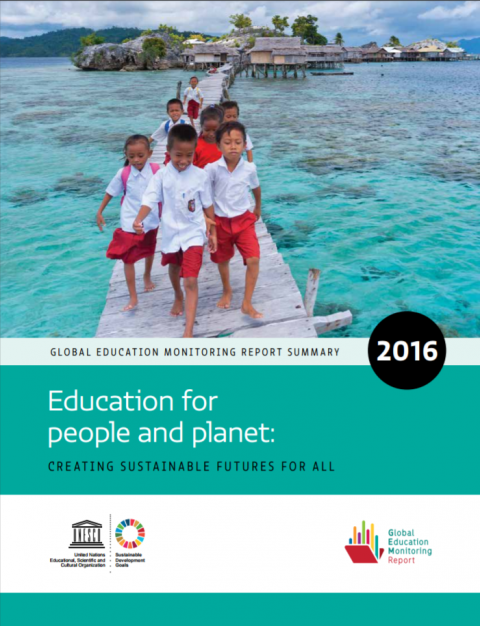 La Educación al servicio de los pueblos y el planeta: creación de futuros sostenibles para todos, resumen del informe de seguimiento de la educación en el mundo 2016; Année de publication: 2016 Auteur institutionnel: UNESCO The GEM Report provides an authoritative account of how education is the most vital input for every dimension of sustainable development. Better education leads to greater prosperity, improved agriculture, better health outcomes, less violence, more gender equality, higher social capital and an improved natural environment. Education is key to helping people around the world understand why sustainable development is such a vital concept for our common future. Education gives us the key tools – economic, social, technological, even ethical – to take on the SDGs and to achieve them. These facts are spelled out in exquisite and unusual detail throughout the report. Yet the report also emphasizes the remarkable gaps between where the world stands today on education and where it has promised to arrive as of 2030.
  Peace education in formal schools of West Africa: an implementation guide Année de publication: 2012 Auteur institutionnel: West Africa Network for Peacebuilding (WANEP) This guide, first and foremost, seeks to bring hope and provide opportunity for practitioners to use tried and tested techniques to develop capacities of young people to build requisite knowledge and skills to become credible and responsible leaders. It provides both a conceptual and practical framework of peace education and confirms the potential benefits of Peace Education, particularly in the formal sector. It has been developed based on the extensive experience of WANEP’s Peace Education programme across West Africa and this experience has been outlined in great detail throughout the manual. The guide lays emphasis on entry points for developing and initiating Peace Education programmes in schools and provides practical tools for engaging various stakeholders and the wide range of potential roles they can play. In terms of the content of a peace education programme, guidelines are provided on developing a comprehensive programme that integrates effectively key concepts such as Gender and Human Rights. Critical issues of sustainability, resource mobilisation and monitoring and evaluation are covered using practical case studies based on the WANEP experience. The concluding chapter is devoted to addressing some Frequently Asked Questions. This laudable initiative and recommend this guide for adoption by West African states and institutions especially the educational sector as a tool for inculcating a culture of peace and nonviolence amongst children.The guide is divided into six chapters.Chapter 1 consists of introduction and the conceptual definition of basic philosophy that influenced the peace education program of WANEP. It also examines the role of peace education on the psycho social behaviour of youths in West Africa.Chapter 2 highlights WANEP’s guiding principles to the development of its peace education in the sub region and also the basic steps it took to implement its program in the seven (7) pilot states.Chapter 3 looks at how to mobilise resources to sustain the peace education program especially within the context of West Africa.Chapter 4 highlights the challenges that WANEP encountered in implementing the program.Chapter 5 emphasises the importance of monitoring and evaluation for impact and success of a peace education program.Chapter 6 deals with frequently asked questions by interested stakeholders. L’éducation à la paix dans les écoles formelles de l'Afrique de l'Ouest: un guide de mise en œuvre Année de publication: 2012 Auteur institutionnel: West Africa Network for Peacebuilding (WANEP) Ce guide, d'abord et avant tout, cherche à apporter l'espoir et offrir la possibilité pour les praticiens à utiliser essayé et testé des techniques pour développer les capacités des jeunes à acquérir des connaissances et des compétences nécessaires pour devenir des leaders crédibles et responsables. Il fournit à la fois un cadre conceptuel et pratique de l'éducation de la paix et confirme les avantages potentiels de l'éducation pour la paix, en particulier dans le secteur formel. Il a été développé sur la base de la longue expérience du programme Education à la Paix de WANEP à travers l'Afrique de l'Ouest et cette expérience a été décrite en détail dans le manuel. Le guide met l'aCECnt sur les points d'entrée pour le développement et le lancement de programmes d'éducation de la paix dans les écoles et fournit des outils pratiques pour engager divers intervenants et le large éventail de rôles potentiels qu'ils peuvent jouer. En termes de contenu d'un programme d'éducation à la paix, les lignes directrices sont prévues sur l'élaboration d'un programme complet qui intègre les concepts efficacement clés tels que le genre et droits de l'homme. Les questions critiques de la durabilité, la mobilisation des ressources et de Suivi et de l'évaluation sont couverts au moyen d'études de cas pratiques fondées sur l'expérience WANEP. Le chapitre final est consacré à aborder quelques questions fréquemment posées. Cette initiative louable et recommande ce guide pour adoption par les Etats et les institutions ouest-africaines en particulier le secteur de l'éducation comme un outil pour inculquer une culture de la paix et de la non-violence chez les enfants. Le guide est divisé en six chapitres. Chapitre 1 est constitué d'introduction et la définition conceptuelle de la philosophie de base qui a influencé le programme d'éducation à la paix de WANEP. Il examine également le rôle de l'éducation de la paix sur le comportement social psycho des jeunes en Afrique de l'Ouest. Le chapitre 2 met en évidence les principes directeurs de WANEP au développement de son éducation à la paix dans la sous-région et aussi les étapes de base qu'il a fallu pour mettre en œuvre son programme dans les sept (7) Etats pilotes. Le chapitre 3 examine comment mobiliser des ressources pour soutenir le programme d'éducation à la paix en particulier dans le contexte de l'Afrique de l'Ouest. Le chapitre 4 met en évidence les défis que WANEP rencontrés dans la mise en œuvre du programme. Le chapitre 5 met l'aCECnt sur l'importance de Suivi et de l'évaluation de l'impact et le succès d'un programme d'éducation à la paix. Chapitre 6 traite des questions fréquemment posées par les parties intéressées.
  Textbooks pave the way to sustainable development (Policy paper 28) Année de publication: 2016 Auteur institutionnel: UNESCO This paper’s focus on textbooks is directly related to the global indicator established for Target 4.7, which seeks to measure the extent to which global citizenship education and education for sustainable development, including gender equality and human rights, are mainstreamed in national education policies, curricula, teacher education and student assessments. Textbooks are related mostly to policy implementation and curricular intentions but also to teacher preparation and student assessment. Informe de seguimiento de la educatión en el mundo: documento de política Année de publication: 2016 Auteur institutionnel: UNESCO This paper’s focus on textbooks is directly related to the global indicator established for Target 4.7, which seeks to measure the extent to which global citizenship education and education for sustainable development, including gender equality and human rights, are mainstreamed in national education policies, curricula, teacher education and student assessments. Textbooks are related mostly to policy implementation and curricular intentions but also to teacher preparation and student assessment. Rapport mondial de suivi sur l'éducation: document d'orientation Année de publication: 2016 Auteur institutionnel: UNESCO This paper’s focus on textbooks is directly related to the global indicator established for Target 4.7, which seeks to measure the extent to which global citizenship education and education for sustainable development, including gender equality and human rights, are mainstreamed in national education policies, curricula, teacher education and student assessments. Textbooks are related mostly to policy implementation and curricular intentions but also to teacher preparation and student assessment.
 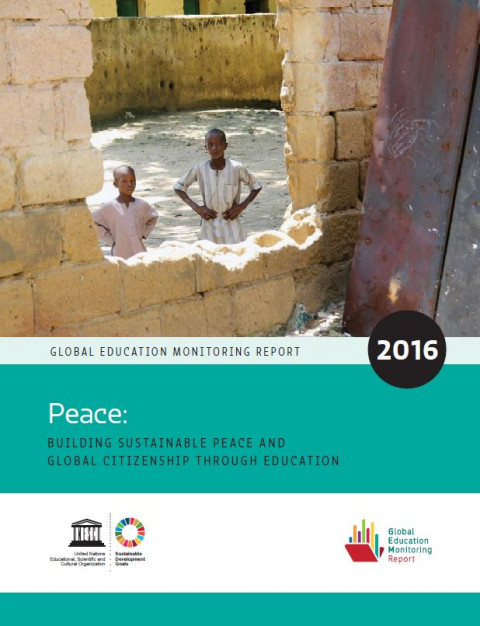 Peace: building sustainable peace and global citizenship through education;Global education monitoring report summary 2016 Année de publication: 2017 Auteur institutionnel: UNESCO The 2016 GEM Report, the first of a new 15-year series, shows that education will not deliver its full potential to catapult the world forward unless rates of improvement dramatically shift, and education systems consider sustainable development in the way services are delivered. This Peace: Building sustainable peace and global citizenship through education publication is a select extract from the full 2016 Global Education Monitoring (GEM) Report: Education for people and planet: Creating sustainable futures for all. It contains two chapters from that full Report – one on peace, political participation and access to justice and the other on education for global citizenship and sustainable development — , along with the associated policy recommendations and a short section of a recent GEM Report Policy Paper Textbooks pave the way to sustainable development.
  UNESCO's Contribution to the Prevention of Violant Extremism Année de publication: 2016 Auteur institutionnel: UNESCO This document provides a summary of recent efforts by UNESCO to step up its action to prevent violent extremism, in the context of the United Nations Secretary-General’s Plan of Action on Violent Extremism, launched in January 2016. Building on its mandate and existing activities, UNESCO has adopted an intersectoral approach, paying particular attention to the needs of young people particularly at risk of radicalization.
 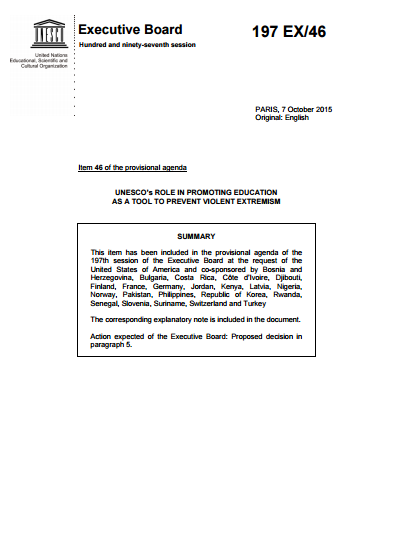 دور اليونسكو في تعزيز التعليم بوصفه أداة لدرء التطرف العنيف Année de publication: 2015 Auteur institutionnel: UNESCO This item has been included in the provisional agenda of the 197th session of the Executive Board at the request of the United States of America and co-sponsored by Bosnia and Herzegovina, Bulgaria, Costa Rica, Côte d’Ivoire, Djibouti, Finland, France, Germany, Jordan, Kenya, Latvia, Nigeria, Norway, Pakistan, Philippines, Republic of Korea, Rwanda, Senegal, Slovenia, Suriname, Switzerland and Turkey UNESCO's role in promoting education as a tool to prevent violent extremism Année de publication: 2015 Auteur institutionnel: UNESCO This item has been included in the provisional agenda of the 197th session of the Executive Board at the request of the United States of America and co-sponsored by Bosnia and Herzegovina, Bulgaria, Costa Rica, Côte d’Ivoire, Djibouti, Finland, France, Germany, Jordan, Kenya, Latvia, Nigeria, Norway, Pakistan, Philippines, Republic of Korea, Rwanda, Senegal, Slovenia, Suriname, Switzerland and Turkey