
Ressources
Explorez une large gamme de ressources sur le GCED afin d’approfondir votre compréhension et de renforcer vos activités de recherche, de plaidoyer, d’enseignement et d’apprentissage.
232 résultats trouvés
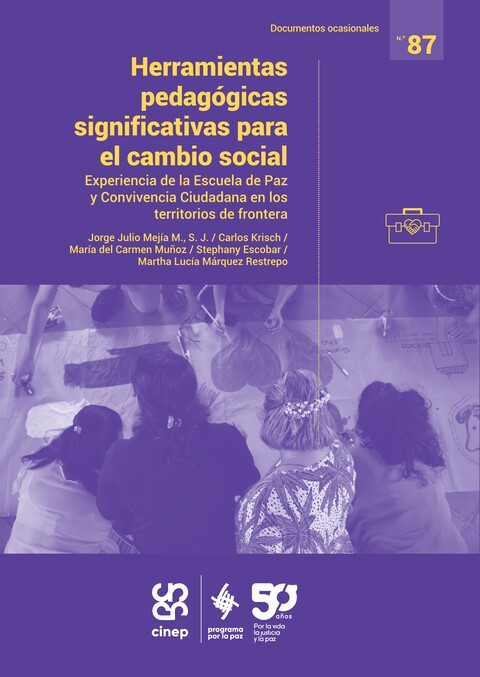 Herramientas pedagógicas significativas para el cambio social Année de publication: 2023 Auteur: Jorge Julio Mejía | Carlos Krisch | Sthepany Escobar | Martha Lucía | Márquez Restrepo | María Del Carmen Muñoz Auteur institutionnel: Center for Research and Popular Education / Program for Peace (CINEP/PPP) En este documento se recogen las herramientas pedagógicas significativas para promover procesos de cambio social a través de experiencias formativas durante doce años en territorios de la frontera colombo-venezolana. Mediante talleres y actividades, los participantes han experimentado transformaciones en actitudes y prácticas que les han resultado útiles para comprender la frontera como un espacio compartido.
  Citizenship Education: Human Rights, History and Memory 50 Years After the 1973 Coup Année de publication: 2023 Auteur institutionnel: Chile. Ministry of Education Educational material that proposes a series of activities regarding the commemoration of the 50 years of the coup d'état, a topic that brings together the country through various channels and constitutes a great opportunity to contextualize the learning objectives linked to memory, democracy and human rights. Educación en ciudadanía derechos humanos historia y memoria: A 50 años del golpe de estado de 1973 Année de publication: 2023 Auteur institutionnel: Chile. Ministry of Education Material educativo que propone una serie de actividades a propósito de la conmemoración de los 50 años del golpe de Estado, tema que convoca al país a través de diversos canales y se constituye como una gran oportunidad para contextualizar los objetivos de aprendizaje vinculados a memoria, democracia y derechos humanos.
  Trust me Année de publication: 2016 Auteur institutionnel: Childnet International The main aim of this resource is to educate young people about inaccurate and pervasive information that they might come across online. This resource is intended to stimulate and facilitate discussions around online risk.Developed in partnership with the London Grid for Learning (LGfL) Safeguarding Board, the resource contains lesson plans for both primary and secondary level that aim to empower educators to discuss how to think critically around the areas of content, contact, and propaganda material that may seek to persuade or change their views. Trust me Année de publication: 2016 Auteur institutionnel: Childnet International L'objectif principal de cette ressource est de mettre en garde les enfants contre les informations fausses et largement répandues qu'ils peuvent trouver en ligne. Elle a pour fonction de stimuler et de faciliter les discussions autour des risques liés à internet.Elaborée en partenariat avec le Conseil de sécurité du London Grid for Learning (LGfL), elle contient des plans de cours destinés aussi bien aux classes primaires que secondaires, afin de donner aux enseignants les outils nécessaires pour apprendre à leurs élèves comment exercer leur esprit critique, interroger les contenus et les objets de propagande pouvant chercher à les influencer.
  Recommendation on Education for Peace, Human Rights and Sustainable Development: An Implementation Guide Année de publication: 2025 Auteur institutionnel: UNESCO There is no peace without education. With conflicts rising on so many fronts, there has never been a more urgent need for a transformed education geared towards building and sustaining peace.The Recommendation on Education for Peace and Human Rights, International Understanding, Cooperation, Fundamental Freedoms, Global Citizenship and Sustainable Development, adopted by all 194 Member States of UNESCO in 2023, articulates a humanistic and transformative vision of education that can help address contemporary and future affronts to peace. These challenges range from the resurgence of conflicts driven by systemic inequalities and injustices, the rise and spread of hate speech, racism and discrimination particularly online, to the adverse effects of digital technologies and the existential threat of climate change.UNESCO has developed this Guide as the first of several tools to assist Member States in unpacking and fully implementing the 2023 Recommendation. The Guide elaborates its contents, integrating the 2023 Recommendation’s transdisciplinary lens to connect key concepts and issues. It also provides concrete ideas and curated resources for action at different levels and types of education, while calling for a multi-stakeholder and whole-of-society approach that includes everyone and builds on existing positive efforts.The Guide is a timely addition to the pool of available collective resources to fully implement the 2023 Recommendation and foster an education that is transformative for a just and peaceful world.
  School Convivencia : Reviewing the Concept (Psicoperspectivas; No. 18, Vol. 1) Année de publication: 2019 Auteur: Cecilia Fierro-Evans | Patricia Carbajal-Padilla Auteur institutionnel: Catholic University of Valparaíso. School of Psychology This article reports an effort to review the concept of school convivencia (peaceful coexistence, living together) in the Spanish context with the purpose of advancing into its clarification, and thus contributing to developing a common language in the Latin American region. The authors conduct a basic literature review oriented to identify the main theoretical approaches in the convivencia field. Subsequently, they analyze four studies focused in systematizing the prevailing approaches in the study of school convivencia. As a result, they propose a concept of convivencia from a social justice perspective adapted to education, and they operationalize it in three areas of school life: pedagogical-curricular, organizationaladministrative, and the socio-communitarian. This comprehensive notion of school convivencia may guide future research, educational initiatives, and school assessments in the convivencia field that may respond to the violence and pervasive social exclusion that exist in the Latin American region. Convivencia escolar: Una revisión del concepto (Psicoperspectivas; No. 18, Vol. 1) Année de publication: 2019 Auteur: Cecilia Fierro-Evans | Patricia Carbajal-Padilla Auteur institutionnel: Catholic University of Valparaíso. School of Psychology El presente trabajo reporta un ejercicio de revisión del concepto de convivencia escolar con vistas a apoyar su clarificación y, por tanto, contribuir al desarrollo de un lenguaje común en la región latinoamericana. Para ello las autoras conducen un trabajo documental orientado a identificar los principales enfoques teóricos en la literatura de convivencia. Posteriormente analizan cuatro estudios enfocados a sistematizar los enfoques prevalecientes en el estudio de la convivencia escolar. Como resultado, proponen un concepto de convivencia desde la perspectiva de la justicia social adaptada a la educación y lo operacionalizan en tres ámbitos de la vida escolar: pedagógico-curricular, organizativo-administrativo y socio-comunitario. Esta noción comprehensiva de la convivencia escolar podría apoyar la realización de investigaciones futuras, propuestas educativas y evaluaciones de convivencia escolar que ofrezcan una respuesta a la violencia y a la persistente exclusión social que existe en la región latinoamericana.
 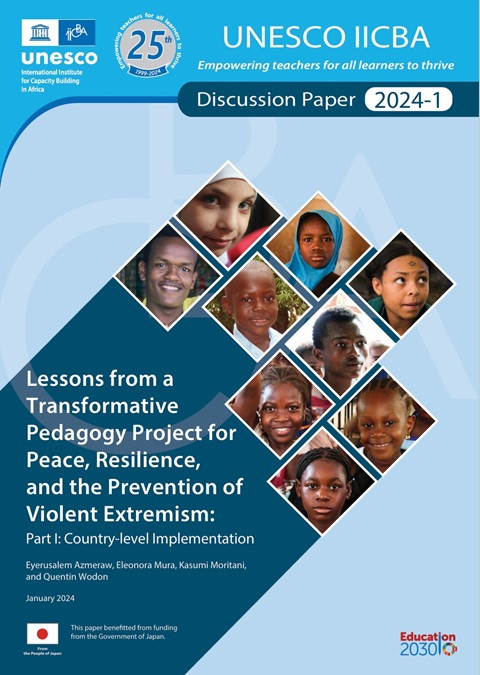 Lessons from a Transformative Pedagogy Project for Peace, Resilience, and the Prevention of Violent Extremism: Part I; Country-Level Implementation Année de publication: 2024 Auteur: Eyerusalem Azmeraw | Quentin Wodon | Eleonora Mura | Kasumi Moritani Auteur institutionnel: UNESCO International Institute for Capacity-Building in Africa (IICBA) From 2017 to 2022, UNESCO’s International Institute for Capacity Building in Africa (IICBA) led a series of projects for peacebuilding and the prevention of violent extremism through education with support from the Government of Japan. This two-part paper draws lessons from the projects. The first part of the paper briefly explains the transformative pedagogy approach that guided project implementation and provides examples of changes that were implemented at the country level under the projects. The analysis is qualitative, with the aim being to outline, through country examples, what can be achieved through such projects. Lessons on factors contributing to impact are also outlined.
 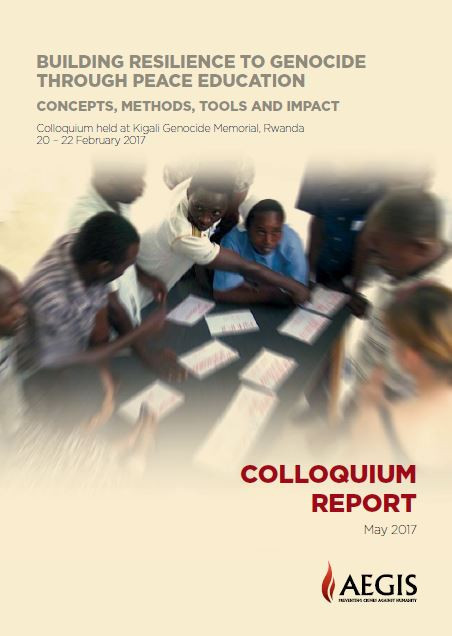 Colloquium Report: Building Resilience to Genocide through Peace Education: Concepts, Methods, Tools and Impact Année de publication: 2017 Auteur: Jonathan Bower, Mariana Goetz Auteur institutionnel: Aegis Trust A three-day Colloquium in Kigali in February brought together academics and practitioners in and around the field of peace education to share concepts, methods and means of measuring impact, contributing to a stronger evidence base for the effectiveness of peace education. Three interesting takeaways from the Colloquium: 1. Building resilience against genocide requires critical thinking about the process of identity-based violence and its reversal.2. The content of peace education programmes matters: interactive role-play type activities have been shown to have a longer lasting impact.3. Unhealed wounds need to be addressed to prevent a repeat of violence; psychosocial support must accompany peace education to reduce anxiety, which can be an obstacle when accessing empathy. A major achievement resulting from the consortium’s advocacy has been that the Government of Rwanda through the Ministry of Education has integrated Peace and Values education into the school curriculum. In a new phase of work Aegis is now supporting the implementation of the revised national curriculum that has integrated peace and values education (2016-19).