
Ressources
Explorez une large gamme de ressources sur le GCED afin d’approfondir votre compréhension et de renforcer vos activités de recherche, de plaidoyer, d’enseignement et d’apprentissage.
8 résultats trouvés
 Discussing Terrorism: a pupil-inspired guide to UK counter-terrorism policy implementation in religious education classroom in England Année de publication: 2016 Auteur: Angela Quartermaine Auteur institutionnel: Christian Education | Taylor & Francis Religious education (RE) in England is affected by the challenging of terrorist ideologies and improving community cohesion, but many RE teachers feel ill-equipped in dealing with the issues that might arise from terrorism discussions. Therefore, I suggest that clarification could help alleviate some of the teacher’s concerns and help provide routes by which critical RE teaching and learning can take place. Discussing Terrorism: a pupil-inspired guide to UK counter-terrorism policy implementation in religious education classroom in England Année de publication: 2016 Auteur: Angela Quartermaine Auteur institutionnel: Christian Education | Taylor & Francis L’éducation religieuse en Angleterre est affectée par les idéologies terroristes et le renforcement des liens communautaires. Dans ce contexte, de nombreux professeurs d’éducation religieuse se sentent insuffisamment équipés pour traiter des sujets qui peuvent découler de discussions relatives au terrorisme. Ainsi, une clarification permettrait de soulager leurs inquiétudes et d’offrir des pistes pour mettre en place une pédagogie adaptée.
  Case Study - Pakistan: Education, Religion and Conflict Année de publication: 2015 Auteur: Raza Rumi Auteur institutionnel: Tony Blair Faith Foundation | McGill University Pakistan is in the midst of crisis. It is threatened by virulent extremist groups and is suffering from a failing education system that is poorly funded and politically manipulated. It promulgates an undefined Islamo-nationalist ideology that lays the foundations for widespread acceptance of ideologically motivated violence. Reforms to the curriculum have been legislated but are badly implemented by the country's politicians; the international community has largely turned a blind eye to these shortcomings. Unless aid and advocacy are specifically focused on far-reaching educational reform that directly tackles extremism, the long-term consequences will be extremely severe. Case Study - Pakistan: Education, Religion and Conflict Année de publication: 2015 Auteur: Raza Rumi Auteur institutionnel: Tony Blair Faith Foundation | McGill University Le Pakistan traverse une crise. Il est menacé par des groupes extrémistes virulents et souffre d'un système éducatif défaillant, mal financé et manipulé politiquement. Il promulgue une idéologie islamo-nationaliste vague qui jette les bases d'une large acceptation de la violence idéologique. Il y a une législation sur les réformes du programme mais celles-ci sont mal appliquées par les politiciens du pays ; la communauté internationale dans son ensemble a fermé les yeux sur ces lacunes. Si l'assistance et le plaidoyer ne sont pas spécifiquement axés sur une vaste réforme de l'éducation abordant directement l'extrémisme, les conséquences à long terme seront extrêmement graves. Impact of Radical Islamisation of Education on Pakistani Society Année de publication: 2012 Auteur: Muhammad Safeer Awan This article traces the history, rather briefly, of how the national educational policies and curricula in social sciences and humanities have been changed to serve the jihadist ideology in Pakistani society. The crumbling social order in Pakistan is not only an indication of the bad governance but also the systemic inculcation of ideologies of hatred and extremism among a whole generation of schoolchildren and college graduates. It is a society where extremism, not only of the radical Islamists but also of the average person, is on the rise. Impact of Radical Islamisation of Educaion on Pakistani Society Année de publication: 2012 Auteur: Muhammad Safeer Awan Cet article revient brièvement sur la façon dont les politiques éducatives nationales et les programmes scolaires en sciences sociales et en sciences humaines ont été modifiés au profit de l'idéologie djihadiste présente au sein de la société pakistanaise. Au Pakistan, le délitement de l'ordre social n'est pas seulement révélateur de la mauvaise gouvernance, il dénonce également de l’enseignement systématique d'idéologies haineuses et extrémistes auprès d'une génération entière d'élèves et d'étudiants. C'est une société où l'extrémisme, pas seulement celui porté par les islamistes radicaux mais aussi celui provenant de n'importe quel individu moyen, ne cesse de croître.
  Confronting the Holocaust in Religious Education Studies of Holocaust education in secondary schools have tended to focus on how the subject is taught as part of the history curriculum. Comparatively little work of either a theoretical or an empirical nature has looked at how the subject is handled in other curricular areas. Religious education is a case in point, for the field is marked both by a dearth of literature on appropriate content and by a virtual absence of research on teachers' practices. The need to address these lacunae provides the rationale for the article. In relation to content, two concerns dominate the discussion. The first is that the Holocaust may be portrayed as an act of religious intolerance; the second is that students may be offered a diluted or distorted account of the part played by Christianity. The empirical core of the article surveys the practices of 28 teachers of religious education in connection with both concerns. It also contains a content analysis of how textbooks used by the teachers treat the attempted annihilation of European Jewry. The article concludes with a discussion of the policy implications of the findings. (By the author)
 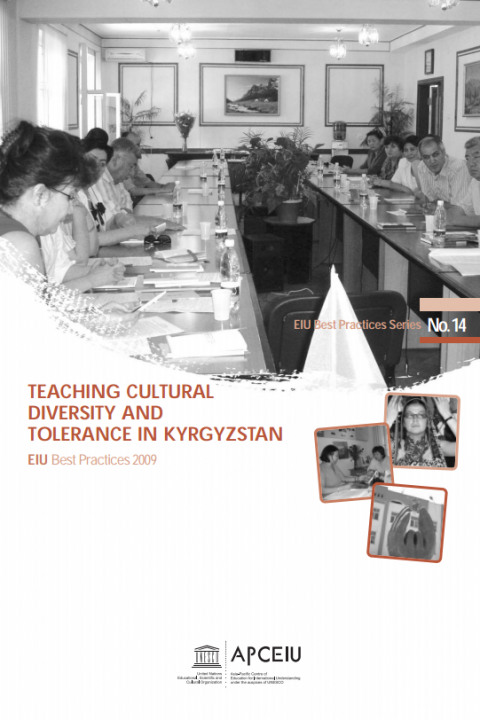 EIU Best Practices Series No. 14: Teaching Cultural Diversity and Tolerance in Kyrgyzstan Année de publication: 2009 Auteur: Erkeayim Jorobekavo | Almakan Naizabekova Auteur institutionnel: APCEIU This report is one of APCEIU's EIU Best Practices Series, which aims to encourage educators, scholars, and activists to implement and share local initiatives on EIU. The Series No.14 introduces ‘Culturology,’ a mandatory course instituted in Kyrgyz-Uzbek University, designed and implemented to teach cultural diversity and tolerance to students. Given the nation’s recent history of independence and racial and religious diversity, the University chose to develop the course program and methodology guidebook to foster understanding of international education and multiculturalism.