
Ressources
Explorez une large gamme de ressources sur le GCED afin d’approfondir votre compréhension et de renforcer vos activités de recherche, de plaidoyer, d’enseignement et d’apprentissage.
56 résultats trouvés
 The “Hate Speech” Policies of Major Platforms during the COVID-19 Pandemic Année de publication: 2021 Auteur institutionnel: UNESCO Montevideo This document reports an increase in so-called “hate speech” posts on Facebook, Twitter, and YouTube after the onset of the COVID-19 pandemic. Although dissimilar, such an increase can be observed in the transparency reports of the different platforms and the surge in content moderation since March 2020.During the same period—as a result of the lockdown measures adopted in most countries around the world—platforms increased the use of AI tools for content moderation. Therefore, we can’t fully say whether the interannual growth is linked to increased posts or changes in monitoring systems. Las políticas de las grandes plataformas sobre discurso de odio durante el Covid-19 Année de publication: 2021 Auteur institutionnel: UNESCO Montevideo Este documento da cuenta de un aumento de posteos considerados discurso de odio a partir de la llegada de la pandemia COVID-19 en Facebook, Twitter y YouTube. Aunque dispar, ese aumento puede establecerse a partir de los informes de transparencia de las distintas plataformas y los crecimientos registrados en la moderación de esos contenidos a partir de marzo de 2020.Dado que en ese mismo período, y como consecuencia de las medidas de aislamiento tomadas ven la mayoría de los países del mundo, las plataformas tomaron la decisión de aumentar el uso de herramientas de inteligencia artificial en sus procesos de moderación no es posible asegurar a ciencia cierta que ese crecimiento se haya registrado por un aumento en la creación y publicación de mensajes o a partir de un cambio en los sistemas de detección que afectó los resultados entre un año y otro.
  Spot and Fight Disinformation Année de publication: 2021 Auteur institutionnel: European Commission The pandemic demonstrated just how fast misleading or false information can spread online. With this toolkit, secondary school teachers can help their students separate what is real from what is fake when they are browsing online. The toolkit is comprised of an editable presentation (which includes real life examples and group exercises) and an instruction booklet for teachers. Detectar y combatir desinformación Année de publication: 2021 Auteur institutionnel: European Commission La pandemia ha puesto de manifiesto la rapidez con que informaciones falsas se propagan en línea. Con este kit de herramientas, los profesores de enseñanza secundaria pueden ayudar a sus alumnos a distinguir lo verdadero de lo falso cuando navegan por internet. El kit de herramientas se compone de una presentación editable y de un folleto de instrucciones. Repérer et combattre la désinformation Année de publication: 2021 Auteur institutionnel: European Commission La pandémie a montré à quel point les fausses informations se diffusent rapidement en ligne. Grâce à cette boîte à outils, les enseignants du secondaire peuvent aider leurs élèves à démêler le vrai du faux lorsqu’ils naviguent en ligne. Elle se compose d’une présentation éditable et d’une brochure contenant des instructions.
  Monde numérique: quels droits ? Année de publication: 2021 Auteur institutionnel: La défenseur des droits Cette fiche a pour objectif de faire comprendre de façon pédagogique les droits et les devoirs de chacun·e, adultes, parents, enseignant·e·s, éducateur·rice·s, animateur·rice·s, enfants et adolescent·e·s, dans un monde numérique, en particulier en matière de traitement des données personnelles et de diffusion de contenus. Elle donne également des clés pour mieux appréhender le phénomène du cyber-harcèlement, des signes annonciateurs jusqu’aux sanctions, en passant par les réflexes à adopter quand on y est confronté. The aim of this fact sheet is to provide an educational understanding of the rights and duties of everyone, adults, parents, teachers, educators, youth workers, children and teenagers - in a digital world, particularly as regards world, particularly as regards the handling of personal data and the distribution of content. It also provides the keys to a better understanding of the phenomenon of cyber bullying, from the warning signs to the sanctions, and how to deal with it. from the warning signs to the penalties, including the reflexes to adopt when confronted with it.
 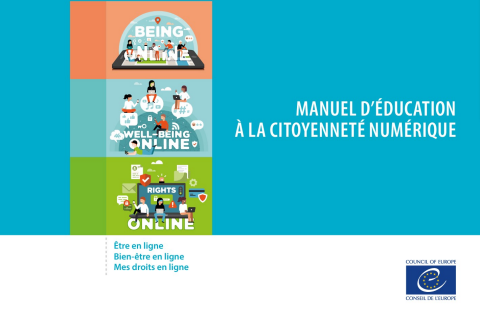 Manuel d'éducation à la citoyenneté Numérique Année de publication: 2020 Auteur: Janice Richardson | Elizabeth Milovidov Auteur institutionnel: Conseil de l'Europe Le manuel se divise en trois chapitres:Chapitre 1: Être en ligne – Quels sont nos modes d’action et d’existence en ligne? Ce chapitre propose une réponse en trois thèmes: accès et inclusion, apprentissage et créativité, éducation aux médias et à l’information.Chapitre 2: Bien-être en ligne – Comment nous sentons-nous en ligne? La réponse se décline là encore en trois thèmes: éthique et empathie, santé et bien-être, présence et communications en ligne.Chapitre 3: Mes droits en ligne – Qui rend compte de quoi sur internet ?Ce chapitre aborde quatre derniers thèmes: participation active, droits etresponsabilités, vie privée et sécurité, sensibilisation des consommateurs. The manual is divided into three chapters: Chapter 1: Being online - How do we act and exist online? This chapter proposes a response in three themes: access and inclusion, learning and creativity, media and information literacy. Chapter 2: Online well-being - How do we feel online? Again, the answer is divided into three themes: ethics and empathy, health and well-being, online presence and communications. Chapter 3: My rights online - Who is accountable for what online? This chapter covers four final themes: active participation, rights and responsibilities, privacy and security, and awareness.
  être citoyen numérique, ça te dit ? Année de publication: 2022 Auteur institutionnel: TRALALERE Vinz est très excité, il a été sélectionné pour participer au concours du meilleur citoyen numérique ! En effet, dans les vidéos qu’il a déjà réalisées, il respecte, sans le savoir, la Charte pour l’éducation à la culture et à la citoyenneté numériques. Une belle occasion pour Vinz de nous expliquer les notions de charte et de citoyenneté numérique. Vinz is very excited - he's been selected to take part in the best digital citizen competition! In fact, in the videos he's already made, he unknowingly respects the Charter for Education in Digital Culture and Citizenship. This is a great opportunity for Vinz to explain the concepts of the Charter and of digital citizenship.
  L'éducation aux médias, à l'information et à la citoyenneté numérique - rapport sur l'exercice 2022-2023 Année de publication: 2023 Auteur institutionnel: Autorité de Régulation de la Communication audiovisuelle et numérique Pour la troisième année consécutive, l'Arcom présente un bilan rendant compte des actions entreprises par les médias audiovisuels en matière d'éducation aux médias, à l'information et à la citoyenneté numérique, et mettant en lumière des initiatives innovantes à l’échelle nationale ou européenne.For the third year in a row, Arcom is presenting a review reporting on actions undertaken by audivisual media, in the field of media education, information literacy, and digital citizenship, and highligthing innovative initiative on nationale and european scale.
  Disinformation and Peacebuilding in Sub-Saharan Africa : Security Implications of AI-Altered Information Environments : Research Report Année de publication: 2024 Auteur: Eduardo Albrecht | Eleonore Fournier-Tombs | Rebecca Brubake Auteur institutionnel: United Nations University This report aims to further explore the way in which AI technologies as they currently stand impact peace and conflict, and what methods might be used to mitigate their adverse effects - through the development of better tools and the inclusion of peace and conflict considerations in AI governance frameworks. The report proposes the following recommendations: 1. More funding and support should be provided to civil society organization efforts to expand media literacy and fact-checking initiatives using AI tools to enhance capabilities. 2. Governments need to work with civil society to develop and implement comprehensive, transparent legal frameworks combating disinformation. These legislative measures need to support digital and media literacy campaigns and fact-checking organizations. 3. Social media companies need to expand investment and research into understanding local information environments, so they can better identify and respond to instances of disinformation in all contexts in which they operate and enhance transparency. 4. Peacebuilding organizations need to carefully consider local media ecosystems and information environments when conducting conflict analyses, and factor these dynamics into their projects' frameworks.