
Ressources
Explorez une large gamme de ressources sur le GCED afin d’approfondir votre compréhension et de renforcer vos activités de recherche, de plaidoyer, d’enseignement et d’apprentissage.
195 résultats trouvés
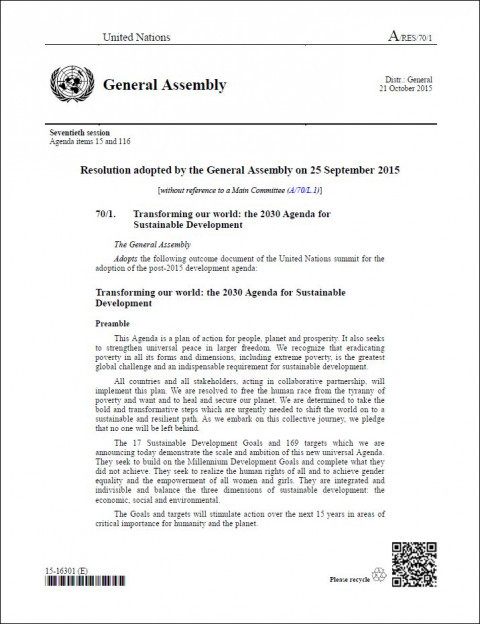 Transforming our world: the 2030 Agenda for Sustainable Development Année de publication: 2015 Auteur institutionnel: United Nations (UN) This Agenda is a plan of action for people, planet and prosperity. It also seeks to strengthen universal peace in larger freedom. We recognize that eradicating poverty in all its forms and dimensions, including extreme poverty, is the greatest global challenge and an indispensable requirement for sustainable development. All countries and all stakeholders, acting in collaborative partnership, will implement this plan. We are resolved to free the human race from the tyranny of poverty and want and to heal and secure our planet. We are determined to take the bold and transformative steps which are urgently needed to shift the world on to a sustainable and resilient path. As we embark on this collective journey, we pledge that no one will be left behind.The 17 Sustainable Development Goals and 169 targets which we are announcing today demonstrate the scale and ambition of this new universal Agenda. They seek to build on the Millennium Development Goals and complete what they did not achieve. They seek to realize the human rights of all and to achieve gender equality and the empowerment of all women and girls. They are integrated and indivisible and balance the three dimensions of sustainable development: the economic, social and environmental. The Goals and targets will stimulate action over the next 15 years in areas of critical importance for humanity and the planet.
 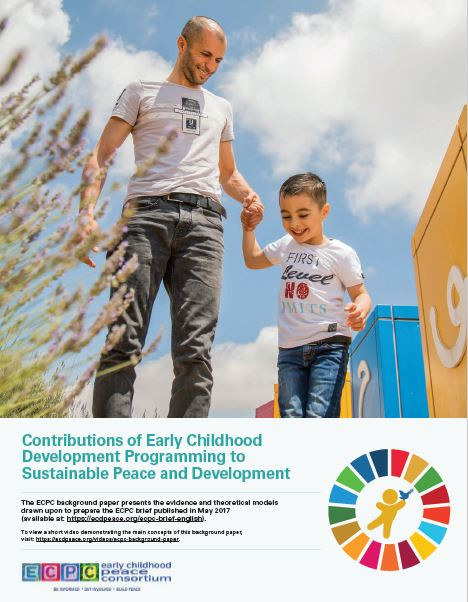 Contributions of Early Childhood Development Programming to Sustainable Peace and Development Année de publication: 2018 Auteur: Chelsea K. Donaldson | Friedrich W. Affolter | Liliana Angelica Ponguta | Rima Salah | Pia R. Britto | James Leckman | Paul Connolly | Siobhan Fitzpatrick | Pauline Walmsley By intervening early and engaging with children’s families, ECD services offer a unique opportunity to make a cost-effective and sustainable impact on interrupting cycles of poverty and violence. Given that efforts towards sustainable peace must encompass all sectors and address all societal levels, there is a crucial need for implementing “multi-level ECD services” that center on the whole child and engage his or her surrounding ecological context. These comprehensive ECD services can not only improve child development outcomes, but also strengthen competencies in caregivers, address stressors and conflict drivers in the community and build institutional capacities to reduce structural violence. The purpose of this background paper is to merge insights from both micro and macro-level perspectives to demonstrate how ECD services can be leveraged to sustainable peace and development. While peacebuilding experts have traditionally focused on macro-level strategies such as government reform or economic rehabilitation interventions, ECD practitioners have focused primarily on micro-level interventions of individual children and families without much exploration of how ECD services can be leveraged to mitigate risks of conflict and transform relationships across communities and regions.
  Early Childhood Education in Tajikistan Année de publication: 2021 Auteur institutionnel: UNICEF Tajikistan Preschool education is the foundation of lifelong learning and development. The focus on preschool is essential. Access to quality early childhood education (ECE) services not only gives children better chances at success in school, but better learning outcomes in the future. It enhances the efficiency of the school system by reducing repetition and drop-out and improving achievement, especially among girls and marginalized groups. If timely and sufficient investments in early childhood are made, human capital and momentum will grow and provide a great and unique opportunity for the country to improve its future economic prospects.
  I International Congress: Good Training Practices for the Professional Development of Teachers 2023 Année de publication: 2023 Auteur institutionnel: Chile. Ministry of Education | Organization of Ibero-American States for Education, Science and Culture (OEI) This book is the result of the First International Congress of Good Training Practices for the Professional Development of Teachers, held on December 5 and 6, 2023 at the Center for Improvement, Experimentation and Pedagogical Research (CPEIP) of the Ministry of Education of Chile (Mineduc), in conjunction with the Organization of Ibero-American States (OEI). It includes practices for training with a focus on rights and for sustainable development.
 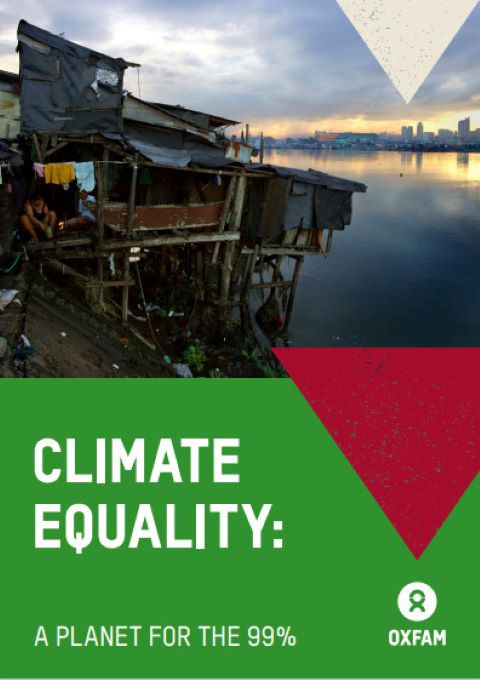 Climate Equality: A Planet for the 99% Année de publication: 2023 Auteur: Ashfaq Khalfan | Astrid Nilsson Lewis | Carlos Aguilar | Max Lawson | Safa Jayoussi | Jacqueline Persson | Nafkote Dabi | Sunil Acharya Auteur institutionnel: Oxfam International The world faces twin crises of climate breakdown and runaway inequality. The richest people, corporations and countries are destroying the world with their huge carbon emissions. Meanwhile, people living in poverty, those experiencing marginalization, and countries in the Global South are those impacted the hardest. Women and girls, Indigenous Peoples, people living in poverty and other groups experiencing discrimination are particularly at a disadvantage. The consequences of climate breakdown are felt in all parts of the world and by most people, yet only the richest people and countries have the wealth, power and influence to protect themselves. With that power comes huge responsibility.If no action is taken, the richest will continue to burn through the carbon we have left to use while keeping the global temperature below the safe limit of 1.5°C, destroying any chance of ending poverty and ensuring equality. The world needs an equal transformation. Only a radical reduction in inequality, transformative climate action and fundamentally shifting our economic goals as a society can save our planet while ensuring wellbeing for all.
  Climate Equality: A PLANET FOR THE 99%; Executive Summary Année de publication: 2023 Auteur: Ashfaq Khalfan | Astrid Nilsson Lewis | Carlos Aguilar | Max Lawson | Safa Jayoussi | Jacqueline Persson | Nafkote Dabi | Sunil Acharya Auteur institutionnel: Oxfam International The world faces twin crises of climate breakdown and runaway inequality.The richest people, corporations and countries are destroying the world with their huge carbon emissions. Meanwhile, people living in poverty, those experiencing marginalization, and countries in the Global South are those impacted the hardest. Women and girls, Indigenous Peoples, people living in poverty and other groups experiencing discrimination are particularly at a disadvantage. The consequences of climate breakdown are felt in all parts of the world and by most people, yet only the richest people and countries have the wealth, power and influence to protect themselves. With that power comes huge responsibility.If no action is taken, the richest will continue to burn through the carbon we have left to use while keeping the global temperature below the safe limit of 1.5°C, destroying any chance of ending poverty and ensuring equality. The world needs an equal transformation. Only a radical reduction in inequality, transformative climate action and fundamentally shifting our economic goals as a society can save our planet while ensuring wellbeing for all.
  Environmental education in action: a story from the Tonle Sap biosphere reserve in Cambodia Année de publication: 2013 Auteur: Keat Kunthea Osmose is a not-for-profit association linking community-based conservation, ecotourism and environmental education in Prek Toal. Osmose has been supported by UNESCO in Phnom Penh in many projects including: production of a poster depicting the flooded forest and plants of the Tonle Sap Biosphere Reserve, handicraft, and particularly, environemental education (EE). EE was initiated in 2000 when Osmose realized there was an increase in the child population and that education was therefore needed in order to protect their natural resources. Promoting sustainable development in Nigeria: via civic education (Journal of education and practice, vol. 5, no 34) Année de publication: 2014 Auteur: Ajibola A. Lukman | Habida Audu Auteur institutionnel: International Institute for Science, Technology and Education Nothing in this world is so powerful as an idea whose time has come. In the face of ethical knowledge, skill disposition and sustainable development in Nigeria, civic education assumed central position. Idea of civic education in Nigerian curriculum is so powerful to the extent that each young Nigerian deserves its knowledge. On this basis, this paper describes civic education as an underpinning factor for individual and social development of our nation. The paper analyzes the fabric between civic education and social development towards blending and interfacing local wisdom with global knowledge, values and skills, which will develop the young Nigerian to become a citizen of this country as well as a citizen of the global village. The paper points to the fact that civic education is central to shaping attitudes and social interaction and both are critical to addressing issues surrounding sustainable development. To this end, the paper concludes that sustainable development requires civic knowledge, civic skills and civic disposition. It is therefore recommended that civic education should be seen as an engine for development in which states, individuals, communities, and businesses partake in providing sustainable development.
  The Critical global educator: global citizenship education as sustainable development Année de publication: 2016 Auteur: Maureen Eills An acknowledged challenge for humanitarian democratic education is its perceived lack of philosophical and theoretical foundation, often resulting in peripheral academic status and reduced prestige. A rich philosophical and theoretical tradition does however exist. This book synthesises crucial concepts from Critical Realism, Critical Social Theory, Critical Discourse Studies, neuro-, psycho-, socio- and cognitive-linguistic research, to provide critical global educators with a Cultural Historical Activity Theory (CHAT) framework for self- and negotiated evaluation.
 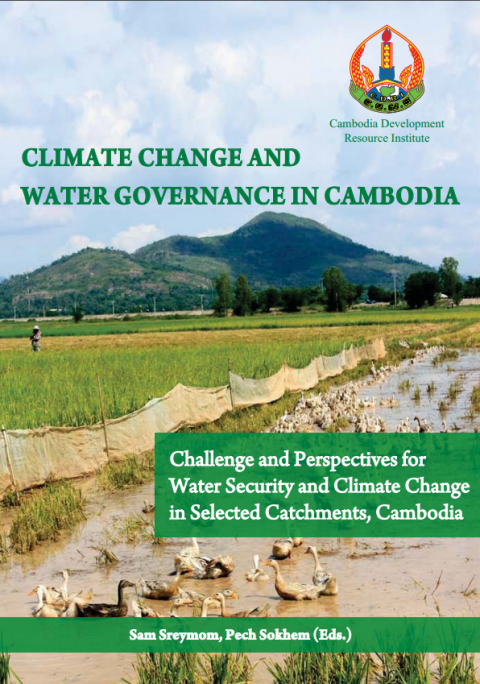 Climate Change and Water Governance in Cambodia: Challenge and Perspectives for Water Security and Climate Change in Selected Catchments, Cambodia Année de publication: 2015 Auteur: Sam Sreymom, Pech Sokhem Auteur institutionnel: Cambodia Development Resource Institute (CDRI) This book is the major output of a three-year research project titled “Climate Change and Water Governance in Cambodia”, supported by the International Development Research Centre (IDRC) of Canada. The book is the result of close collaboration between the Cambodia Development Resource Institute (CDRI), a lead institute, and project partners: the Ministry of Water Resources and Meteorology (MOWRAM), Ministry of Environment (MOE), Tonle Sap Authority (TSA), Royal University of Agriculture (RUA), Institute of Technology of Cambodia (ITC) and the Mekong Programme on Water, Environment and Resilience(M-POWER).The project focussed on three river catchments around the Tonle Sap Lake: Stung Chrey Bak in Kompong Chhnang province, Stung Chinit in Kompong Thom province and Stung Pursat in Pursat province. The main research outcomes encompass (1) better understanding among decision makers, researchers and students of the livelihood implications of hydrological and ecosystem changes caused by changes in climate and human systems in the Tonle Sap Basin, and (2) improved methods of integrating local knowledge and scientific empirical evidence into Cambodia’s policy and planning framework.