
Ressources
Explorez une large gamme de ressources sur le GCED afin d’approfondir votre compréhension et de renforcer vos activités de recherche, de plaidoyer, d’enseignement et d’apprentissage.
195 résultats trouvés
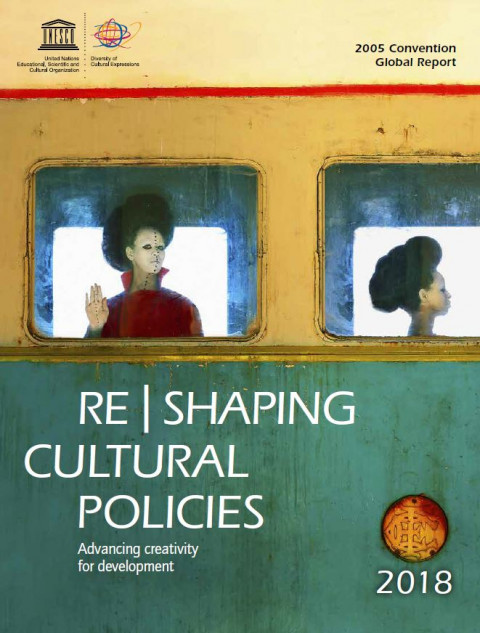 Re|shaping Cultural Policies: Advancing Creativity for Development; 2005 Convention Global Report, 2018 Année de publication: 2018 Auteur institutionnel: UNESCO The Global Report series has been designed to monitor the implementation of the UNESCO Convention on the Protection and Promotion of the Diversity of Cultural Expressions (2005). It also provides evidence of how this implementation process contributes to attaining the United Nations 2030 Sustainable Development Goals and targets.The 2018 Global Report analyses progress achieved in implementing the 2005 Convention since the first Global Report was published in 2015.Grounded in the analysis of the Quadrennial Periodic Reports submitted by Parties to the Convention and relevant new findings, this report examines how the 2005 Convention has inspired policy change at the global and country level in ten areas of monitoring. It puts forward a set of policy recommendations for the future, addressing the adaptation of cultural policies to rapid change in the digital environment, based on human rights and fundamental freedoms.When deployed together, the two editions of the Global Report are beginning to produce new and valuable evidence to inform cultural policy making and advance creativity for development.
  Re|shaping cultural policies: a decade promoting the diversity of cultural expressions for development Année de publication: 2015 Auteur institutionnel: UNESCO This Report presents the work of fourteen independent experts, as well as the Secretary of the Convention and the Principal Editor, who have analysed the implementation of the Convention on the Protection and Promotion of the Diversity of Cultural Expressions. Its purpose is to move forward the process of monitoring the Convention’s implementation that was put in place by a mechanism of Quadrennial Periodic Reports (QPRs) approved by the Convention’s Conference of Parties in 2011. The contributors have consulted the 71 reports submitted by Parties, but have also used data derived from other, non-official sources and have drawn upon their own expert experience.
 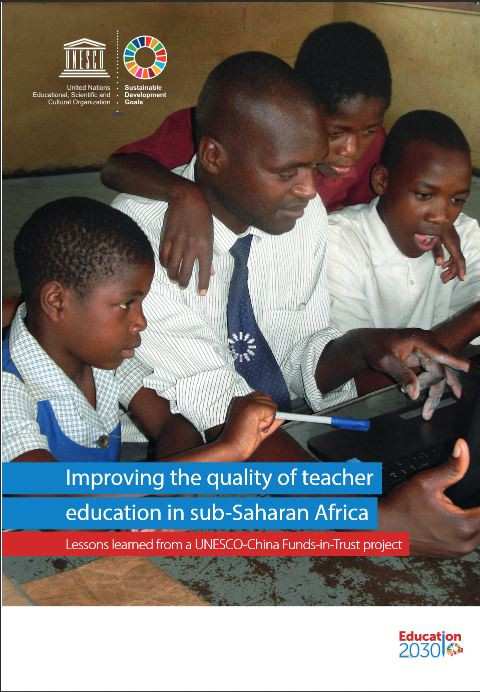 Improving the quality of teacher education in Sub-Saharan Africa: lessons learned from a UNESCO-China Funds-in-Trust project Année de publication: 2018 Auteur institutionnel: UNESCO The booklet describes how the project started, the choice of beneficiary countries, the implementation strategies and its achievements. The different sections numbered one to four describe particular aspects of the project, using country cases to illustrate how the success of the project was due to strong country ownership and leadership. UNESCO, in partnership with the Government of the People’s Republic of China, initiated the project to enhance the institutional capacity and the professional development of teacher educators through ICT-supported learning, teaching and research. This technology aided the transformation of capacity teacher training through digitalization of instructional materials.
  Sustainability Education Principal Training Manual Année de publication: 2012 Auteur institutionnel: UNESCO | Beijing Sustainable Development Education Association | China National Council for Sustainable Development Education Secretariat This article is devoted to explaining the application of sustainable development in China. 可持续发展教育校长培训手册 Année de publication: 2012 Auteur institutionnel: 联合国教科文组织 (UNESCO) | Beijing Sustainable Development Education Association | China National Council for Sustainable Development Education Secretariat 文章旨在解释可持续发展在中国的应用
  Address by Mr Koïchiro Matsuura, Director-General of UNESCO, on the occasion of the International Seminar on Climate Change Education; UNESCO, 27 July 2009 Année de publication: 2009 Auteur institutionnel: UNESCO This document is the address of Mr Mr Koïchiro Matsuura, Director-General of UNESCO, on the occasion of the International Seminar on Climate Change Education; UNESCO, 27 July 2009. He presented the climate change issues and highlighted the importance of education for sustainable future. Learning to mitigate and adapt to climate change: UNESCO and climate change education Année de publication: 2009 Auteur institutionnel: UNESCO This report is a result of the UNESCO International Seminar on Climate Change Education at UNESCO Headquarters in Paris, 27-29 July, 2009. Over the past 30 years, UNESCO has actively contributed to building the global knowledge base on climate change. Primarily through its contribution to climate science (global ocean observation systems, assessment and monitoring) and secondarily by promoting education, capacity development, public awareness and access to information. As Task Manager of Chapter 36 of Agenda 21 – which relates to the promotion of education, public awareness and training – and lead agency for the UN Decade of Education for Sustainable Development (DESD, 2005-2014), the Organization plays a lead role in promoting Education for Sustainable Development (ESD). Climate change is one of the key action themes of the Decade, as was reaffirmed at the World Conference on Education for Sustainable Development held in Bonn in April 2009. Education has a central role to play in understanding, mitigating and adapting to the changing climate. While education at all levels and in both formal and informal settings is needed, instilling climate change awareness and understanding at a young age is ultimately the best way to change behaviours and attitudes. What children learn today will shape tomorrow’s world. Through the New Delhi work programme – which is a flexible programme for country-driven action engaging all stakeholders on education, training and public awareness on climate change, UNESCO supports its Member States to implement Article 6 of the United Nations Framework Convention on Climate Change. Similarly, the UNESCO Enhanced Plan of Action for the Strategy for Action on Climate Change recognizes the importance of and outlines action for education in promoting mitigation of and adaptation to climate change.
  The United Nations world water development report 2016: water and jobs Année de publication: 2016 Auteur institutionnel: UNESCO Three out of four jobs worldwide rely on water. As such, water shortages and lack of access may limit economic growth in the years to come, according to the World Water Development Report 2016. From its collection, through various uses, to its ultimate return to the natural environment, water is a key factor in the development of job opportunities either directly related to its management (supply, infrastructure, wastewater treatment, etc.) or in economic sectors that are heavily water-dependent such as agriculture, fishing, power, industry and health. In its analysis of the economic impact of access to water, the report cites numerous studies that show a positive correlation between investments in the water sector and economic growth. It also highlights the key role of water in the transition to a green economy.
 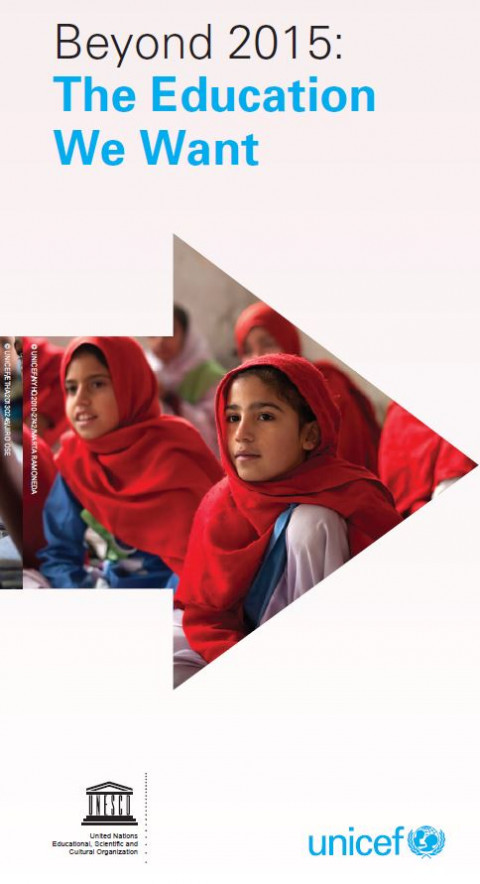 Beyond 2015: the education we want Année de publication: 2014 Auteur institutionnel: UNESCO | United Nations Children's Fund (UNICEF) The post-2015 education agenda should be aspirational, transformative and holistic, and an integral part of the broader post-2015 development agenda. It should be of universal relevance and mobilize all stakeholders in all countries. Education must be a stand-alone goal in the broader post-2015 development agenda and should be framed by a comprehensive overarching goal, with measurable global targets and related indicators. In addition, education must be integrated into other development goals. The future education agenda should be rights-based and reflect a perspective based on equity and inclusion, with particular attention to gender equality and to overcoming all forms of discrimination in and through education, ensuring that no-one is left behind. It must support free and compulsory basic education.It should expand the vision of access for all to reflect relevant learning outcomes through the provision of quality education at all levels, from early childhood to higher education, in safe and healthy environments. It should take a holistic and lifelong learning approach, and provide multiple pathways of learning using innovative methods and information and communication technologies. It should reinforce approaches such as global citizenship education and education for sustainable development, which foster attitudes and behaviours that promote peace, conflict resolution and mutual understanding, tolerance, critical thinking, and respect for cultural diversity and for the environment.
 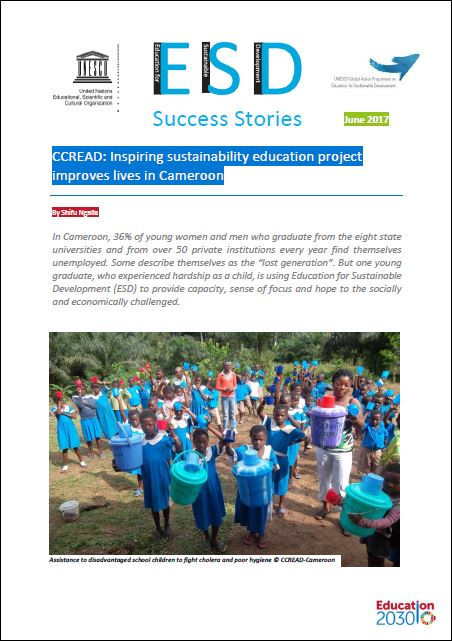 CCREAD: Inspiring Sustainability Education Project Improves Lives in Cameroon Année de publication: 2017 Auteur: Shifu Ngalla Auteur institutionnel: UNESCO This article is about sustainability education project in Cameroon. In Cameroon, 36% of young women and men who graduate from the eight state universities and from over 50 private institutions every year find themselves unemployed. Some describe themselves as the “lost generation”. But one young graduate, who experienced hardship as a child, is using Education for Sustainable Development (ESD) to provide capacity, sense of focus and hope to the socially and economically challenged.