
Ressources
Explorez une large gamme de ressources sur le GCED afin d’approfondir votre compréhension et de renforcer vos activités de recherche, de plaidoyer, d’enseignement et d’apprentissage.
43 résultats trouvés
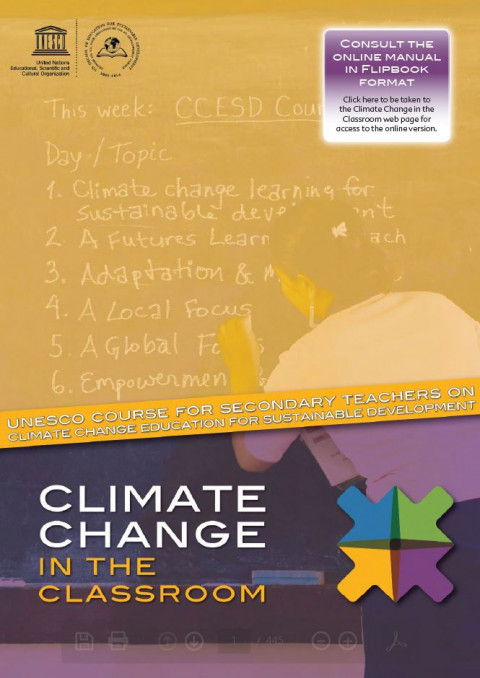 Les changements climatiques dans la salle de classe: Cours de l'UNESCO pour les enseignants du secondaire sur le changement climatique éducation au développement durable Année de publication: 2013 Auteur: David Selby | Fumiyo Kagawa Auteur institutionnel: UNESCO Ce cours a été créé avec l'objectif d'amener le changement climatique l'éducation en dehors de la salle de classe de la science dans les nombreux autres domaines sur lesquels le changement climatique a maintenant un impact, ou aura un impact à l'avenir, comme l'éthique, les études sociales, l'économie, la science politique , parmi d'autres. Les supports de cours sont organisés en quatre parties: 1. Structure du cours et aperçu, cours d'éducation matières quotidiennes 2. Enseignants, Packs 3. Ressources régionales, 4. Quotidiennes Matériel didactique pour les enseignants. Ces matériaux sont décrits plus en détail et sont accessibles à partir du menu démarrer trouvé dans les pages suivantes. Ce cours est conçu pour permettre aux enseignants au niveau secondaire de domaines divers pour introduire l'éducation sur le changement climatique pour le développement durable (ECCDD) à travers le curriculum. L'UNESCO a identifié le développement professionnel des enseignants dans l'éducation pour le développement durable comme priorité absolue dans la reconnaissance du rôle transformateur que les enseignants et les formateurs d'enseignants doivent jouer dans l'éducation de réorientation pour aider à réaliser un avenir durable (UNESCO, 2005, p. 19 ). Mais les bonnes intentions pour le développement professionnel des enseignants sont tombés à court dans la pratique. Bien pris par les amateurs, la formation des enseignants pour le développement durable a rarement été intégré, et où il y a des cours, est souvent abordé dans une discipline, par opposition à un cadre interdisciplinaire (Wals, A., 2009). Si le développement professionnel en éducation pour le développement durable est à un stade adolescent, la formation des enseignants en éducation au changement climatique pour le développement durable est à ses débuts. Par exemple, selon une étude comparative internationale 2009 sur le changement climatique l'éducation et le développement durable dans dix pays, éducation au changement climatique a un statut périphérique dans la recherche et la pratique éducative, et quand elle est adressée, il est seulement dans l'enseignement des sciences (Laessoe, J. Schnack , K., Breiting, S. & Rolls, S., 2009). Il y a un besoin clair et présent pour répondre aux défis du changement climatique par le biais de programmes de formation des enseignants systématiques qui ne se limitent pas à une seule matière. Ce cours de formation des enseignants est une tentative de combler le vide actuel et est en ligne avec l'un des principaux objectifs de l'UNESCO pour le changement climatique éducation pour le développement durable, qui est, pour soutenir la formation des enseignants sur le changement climatique pour le développement durable (UNESCO, 2010, p. 9). Le programme comporte quatre traits distinctifs: 1.Il aide les enseignants à comprendre les causes, la dynamique et les impacts du changement climatique à travers une approche holistique. 2.Les enseignants sont exposés, et de l'expérience, une gamme d'approches et de techniques pédagogiques, qu'ils peuvent utiliser dans leur propre milieu scolaire. Cela comprend l'engagement d'eux-mêmes et de leurs élèves à l'école ensemble et approches écoles en communauté. 3.Les enseignants développeront leurs capacités pour faciliter base communautaire d'apprentissage des élèves. 4. Les enseignants développeront les capacités de tournées vers l'avenir et de transformation pour faciliter l'atténuation des changements climatiques, l'adaptation et l'apprentissage de la réduction des risques de catastrophe.
  Global Citizenship Education: Topics and Learning Objectives Année de publication: 2015 Auteur institutionnel: UNESCO This publication, titled Global Citizenship Education: Topics and learning objectives, is the first pedagogical guidance from UNESCO on global citizenship education. It is the result of an extensive research and consultation process with experts from different parts of the world. This guidance draws on the UNESCO publication Global Citizenship Education: Preparing learners for the challenges of the 21st century and the outcomes of three key UNESCO events on global citizenship education: the Technical Consultation on Global Citizenship Education (September 2013), as well as the First and Second UNESCO Fora on Global Citizenship Education, organized in December 2013 and January 2015 respectively. Before it was finalized, the guidance was field-tested by education stakeholders in selected countries in all regions to ensure its relevance in different geographical and socio-cultural contexts. Following the foundational work of UNESCO to clarify the conceptual underpinnings of global citizenship education and provide policy and programmatic directions, this document has been developed in response to the needs of Member States for overall guidance on integrating global citizenship education in their education systems. It presents suggestions for translating global citizenship education concepts into practical and age-specific topics and learning objectives in a way that allows for adaptation to local contexts. It is intended as a resource for educators, curriculum developers, trainers as well as policy-makers, but it will also be useful for other education stakeholders working in non-formal and informal settings.
  Éducation à la citoyenneté mondiale: thèmes et objectifs d'apprentissage Année de publication: 2015 Auteur institutionnel: UNESCO Le présent ouvrage, intitulé Éducation à la citoyenneté mondiale : Thèmes et objectifs d’apprentissage, est le premier guide pédagogique de l’UNESCO sur l’éducation à la citoyenneté mondiale. Il est le fruit d’un processus approfondi de recherche et de consultation avec des spécialistes de différentes régions du monde. Ce guide s’inspire de la publication de l’UNESCO intitulée Éducation à la citoyenneté mondiale : Préparer les apprenants aux défis du XXIe siècle ainsi que des résultats de trois événements clés de l’UNESCO sur l’éducation à la citoyenneté mondiale : la Consultation technique sur l’éducation à la citoyenneté mondiale (septembre 2013) et les premier et deuxième Forums de l’UNESCO sur l’éducation à la citoyenneté mondiale, organisés en décembre 2013 et en janvier 2015. Avant sa finalisation, le guide a été expérimenté sur le terrain par des acteurs de l’éducation dans différents pays de chaque région, afin de veiller à ce qu’il soit adapté à des contextes géographiques et socioculturels divers. Inspirée des travaux de base de l’UNESCO visant à clarifier les fondements conceptuels de l’éducation à la citoyenneté mondiale, et à fournir des orientations politiques et programmatiques, cette publication a été élaborée pour répondre aux besoins des États membres, en leur donnant des indications générales sur l’intégration de l’éducation à la citoyenneté mondiale dans leurs systèmes éducatifs. Elle propose des moyens de transposer l’éducation à la citoyenneté mondiale dans des thèmes et des objectifs d’apprentissage pratiques et tenant compte de l’âge de l’apprenant, qui puissent être adaptés aux contextes locaux. Cette publication a été conçue pour servir de document de référence aux éducateurs, aux concepteurs de programmes éducatifs, aux formateurs et aux décideurs, mais elle sera également utile à d’autres acteurs de l’éducation travaillant dans des contextes non formels et informels.
  Educación para la ciudadanía mundial: temas y objetivos de aprendizaje Année de publication: 2015 Auteur institutionnel: UNESCO La educación para la ciudadanía mundial aspira a ser un factor de transformación, inculcando los conocimientos, las habilidades, los valores y las actitudes que los educandos necesitan para poder contribuir a un mundo más inclusivo, justo y pacífico.La presente publicación, titulada Educación para la ciudadanía mundial: Temas y objetivos de aprendizaje, es la primera guía de la UNESCO al respecto. Se presentan sugerencias para plasmar los conceptos de la educación para la ciudadanía mundial en temas y objetivos de aprendizaje específicos para cada grupo de edad de un modo que facilita su adaptación a las circunstancias locales. Es un recurso para los educadores, los responsables de la elaboración de programas de estudios, los instructores y los encargados de la formulación de políticas, pero también será de utilidad para otros copartícipes en la educación que trabajan en contextos no formales e informales.
 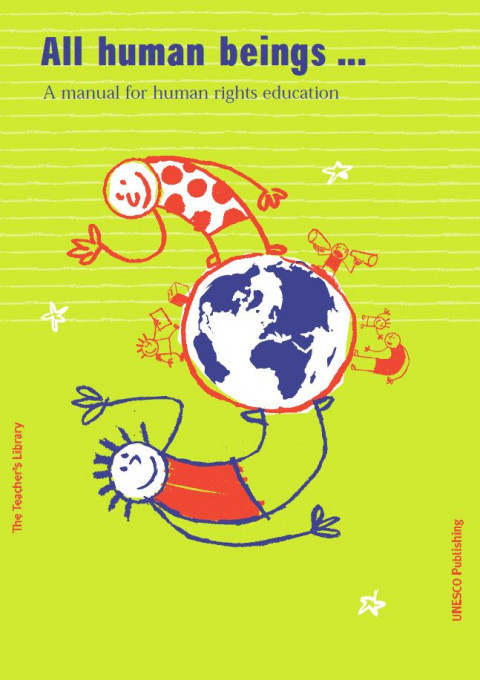 All human beings... a manual for human rights education Année de publication: 1998 Auteur: Kaisa Savolainen | Francine Best | Patrice Meyer-Bisch | Betty Reardon Auteur institutionnel: UNESCO The World Conference on Human Rights (Vienna, 1993) took the position that human rights education, training and public information were essential in order to create and promote stable and harmonious relations among different communities and to foster mutual understanding, tolerance and peace.UNESCO has prepared this Manual for Human Rights Education as a contribution to the fiftieth anniversary of the Universal Declaration of Human Rights on 10 December 1998 and to the United Nations Decade for Human Rights Education (1995–2004). While intended mainly for educators, it may also be useful to secondary-school students and in the context of non-formal education.The Manual is the result of teamwork, with participation by numerous educators and experts from various regions of the world. A preliminary version was submitted to the delegates of UNESCO Member States at the 29th session of the Organization’s General Conference and has since been tested in several schools throughout the world.The Manual is addressed to primary- and secondary-school teachers and to instructors in non-formal education for children and adults. It is a teaching aid providing both theory and practical advice. However, parts of it can be used directly, without any teacher, by young people from the age of 14 upwards.Part 1 sets out an approach to the concepts essential if human rights education is to be rigorous, have a scientific basis, expand knowledge and promote thought. This part is to be read by teachers who wish to impart human rights education. It can be understood by secondary students aged 14 and over. It incorporates the basic components of the Declaration and Integrated Framework of Action on Education for Peace, Human Rights and Democracy (1994).Part 2 is addressed to schoolteachers and those in positions of responsibility. It is essentially a tool for teaching. It opens up avenues, makes suggestions and gives advice on how all educational disciplines can embrace the objectives inherent in human rights education. Obviously all teachers are free, in the light of their own cultures and individual pedagogical choices, to invent and create approaches and situations different from those suggested here.Part 3 presents a number of pedagogical examples that have been tried out and that provide an approach for educational work concerning a specific right. The plan follows that of the Universal Declaration of Human Rights, which is quoted and referred to at length. This part may be regarded as an educational demonstration of the features of this declaration, the fiftieth anniversary of which is being celebrated by UNESCO and the United Nations in 1998.All teachers and organizers can be guided by the experiments presented here to encourage information, training and reflection. There is no need to follow any particular order. As the need arises, a particular right (such as the right to health care or the right to live in a well-balanced environment) can be introduced before or after another right, or the focus may be on a single right.The Manual does not seek to be exhaustive but rather to propose material which can be developed and supplemented in an ongoing process. It will be for educators and learners, in their own cultural contexts, to discover how human rights can acquire meaning in their daily lives. Tous les êtres humains ... un manuel pour l'éducation aux droits de l'homme Année de publication: 1998 Auteur: Kaisa Savolainen | Francine Best | Patrice Meyer-Bisch | Betty Reardon Auteur institutionnel: UNESCO La Conférence Mondiale sur les Droits de l'Homme (Vienne, 1993) a pris la position que l'éducation aux droits de l'homme, la formation et l'information du public sont essentiels afin de créer et de promouvoir des relations stables et harmonieuses entre les différentes communautés et de favoriser la compréhension mutuelle, la tolérance et la paix. L'UNESCO a préparé ce manuel pour l'éducation aux droits de l'homme en tant que contribution au cinquantième anniversaire de la Déclaration Universelle des Droits de l'Homme, le 10 Décembre,1998 et à la Décennie des Nations Unies pour l'Éducation aux Droits Humains (1995-2004). Bien que destiné principalement aux éducateurs, il peut également être utile pour les élèves du secondaire et dans le cadre de l'éducation non formelle. Le manuel est le résultat du travail d'équipe, avec la participation de nombreux éducateurs et experts de différentes régions du monde. Une version préliminaire a été soumis aux délégués des Etats membres de l'UNESCO à la 29e session de la Conférence générale de l'Organisation et a depuis été testé dans plusieurs écoles à travers le monde. Le manuel est adressé au primaire et les enseignants du secondaire et aux instructeurs dans l'éducation non formelle pour les enfants et les adultes. Il est un outil pédagogique fournissant à la fois la théorie et des conseils pratiques. Toutefois, certaines parties peuvent être utilisées directement, sans enseignant, par les jeunes dès l'âge de 14 vers le haut. Partie 1 énonce une approche des concepts essentiels si l'éducation aux droits de l'homme est d'être rigoureux, ont une base scientifique, développer les connaissances et promouvoir la pensée. Cette partie doit être lu par les enseignants qui souhaitent donner une éducation aux droits de l'homme. Il peut être compris par les élèves du secondaire âgés de 14 ans et plus. Il intègre les composants de base de la Déclaration et Cadre d'action intégré concernant l'éducation pour la paix, droits de l'homme et la démocratie (1994). Partie 2 est adressée aux enseignants et ceux des postes de responsabilité. Il est essentiellement un outil pour l'enseignement. Il ouvre des pistes, fait des suggestions et donne des conseils sur la façon dont toutes les disciplines d'enseignement peuvent embrasser les objectifs inhérents à l'éducation des droits de l'homme. Il est évident que tous les enseignants sont libres, à la lumière de leurs propres cultures et les choix pédagogiques individuels, d'inventer et de créer des approches et des situations différentes de celles suggérées ici. Partie 3 présente un certain nombre d'exemples pédagogiques qui ont été expérimentées et qui fournissent une approche pour le travail éducatif concernant un droit spécifique. Le plan suit celle de la Déclaration universelle des droits de l'homme, qui est cité et renvoyé à la longueur. Cette partie peut être considérée comme une démonstration éducative des caractéristiques de cette déclaration, le cinquantième anniversaire de ce qui est célébrée par l'UNESCO et l'Organisation des Nations Unies en 1998. Tous les enseignants et les organisateurs peuvent être guidés par les expériences présentées ici pour encourager l'information, la formation et de réflexion. Il n'y a pas besoin de suivre un ordre particulier. Comme le besoin, un droit particulier (tel que le droit aux soins de santé ou le droit de vivre dans un environnement bien équilibré) peut être introduit avant ou après un autre droit, ou la mise au point peut être sur une seule droite. Le manuel ne cherche pas à être exhaustive, mais plutôt de proposer du matériel qui peut être développée et complétée en un processus continu. Ce sera pour les éducateurs et les apprenants, dans leurs propres contextes culturels, de découvrir comment les droits humains peuvent acquérir un sens dans leur vie quotidienne.
  YouthXchange guidebook series: climate change and lifestyles Année de publication: 2011 Auteur: Adam Cade | Rob Bowden Auteur institutionnel: UNESCO | United Nations Environment Programme (UNEP) Climate Change and Lifestyles is the first in a series of guidebooks supporting the UNESCO/ UNEP YouthXchange (YXC) Initiative, which was created in 2001 to promote sustainable lifestyles among youth (15-24 years) through education, dialogue, awareness raising and capacity building. The series is being produced for young people and people working with youth, such as educators, teachers, trainers and youth leaders in both developed and developing countries. Almost half of the world’s population is under the age of 25, and nearly 90 per cent of them live in developing countries. Youth is a critical stakeholder in the global economy and will be the main actor and motor for change in the near future. Thus, the energy, motivation and creativity of youth are essential assets to stimulating change. Aims of the YXC Guidebook on Climate Change and Lifestyles: • Explore the links between lifestyles and climate change; • Help young people consider the actions they should take towards more sustainable lifestyles; • Support courses and actions that promote greater understanding of climate change and lifestyles among youth. The guidebook: • Considers the causes and effects of climate change and its human impacts and responses, while connecting them to lifestyle choices and the technical and social infrastructures of a society; • Provides scientific, political, economic, social, ethical and cultural perspectives on climate change; • Explains complex issues in accessible language supported by facts, graphics, images, examples and web links; • Develops the critical skills young people need to make personal choices to address the challenges of climate change. Série de guides YouthXchange: le changement climatique et les modes de vie Année de publication: 2011 Auteur: Adam Cade | Rob Bowden Auteur institutionnel: UNESCO | United Nations Environment Programme (UNEP) Le Changement climatique et modes de vie est la première d'une série de guides qui soutiennent le YouthXchange (YXC) Initiative UNESCO / PNUE, qui a été créé en 2001 pour promouvoir les modes de vie durables chez les jeunes (15-24 ans) par l'éducation, le dialogue, la sensibilisation et le renforcement des capacités . La série est en cours de production pour les jeunes et les personnes qui travaillent avec les jeunes, tels que les éducateurs, les enseignants, les formateurs et les leaders de la jeunesse dans les pays développés et en développement. Près de la moitié de la population mondiale est âgée de moins de 25 ans, et près de 90 pour cent d'entre eux vivent dans des pays en développement. La jeunesse est un acteur essentiel dans l'économie mondiale et sera le principal acteur et moteur de changement dans un proche avenir. Ainsi, l'énergie, la motivation et la créativité des jeunes sont des atouts essentiels pour stimuler le changement. Objectifs du YXC Guide sur les changements climatiques et styles de vie: • Explorer les liens entre les modes de vie et les changements climatiques; • Aider les jeunes gens considèrent les actions qu'ils doivent prendre vers des modes de vie plus durables; • des cours et des actions qui favorisent une meilleure compréhension des changements climatiques et des modes de vie chez les jeunes de soutien. Le guide: • considère les causes et les effets du changement climatique et de ses impacts humains et les réponses, tout en les reliant à des choix de vie et les infrastructures techniques et sociales d'une société; • Fournit scientifique, politique, économique, social, éthique et perspectives culturelles sur le changement climatique; • Explique les questions complexes dans un langage aCECssible étayée par des faits, des graphiques, des images, des exemples et des liens Web; • Développe les compétences essentielles les jeunes ont besoin de faire des choix personnels pour relever les défis du changement climatique.
  A Pedagogical Guide on Global Citizenship Education in Korean Context Année de publication: 2015 Auteur institutionnel: APCEIU APCEIU has published a pedagogical guide on Global Citizenship Education (GCED) for Korean readers, which is the Korean adaptation of the UNESCO pedagogical guide, GCED: Topics and Learning Objectives (a.k.a. TLOs).Following the recently launched Korean translation of the TLOs, this Korean adaptation contextualizes the TLOs in Korean education, aligns its terminologies with Korean curriculum, and provides further explanations for Korean readers. This guide was developed by professors in the field of teacher education, primary and secondary school teachers, and curriculum developers with special expertise in GCED/EIU.It is hoped that this guide will help Korean educators and key stakeholders better understand GCED as a new pedagogy and also reflect on traditional teaching-learning experiences in various respects. Éducation Mondiale à la citoyenneté: Sujets et objectifs d'apprentissage Année de publication: 2015 Auteur institutionnel: APCEIU APCECI a publié un guide pédagogique sur l'éducation à la citoyenneté Mondiale (ECM) pour les lecteurs coréens, qui est l'adaptation coréenne du guide pédagogique de l'UNESCO, ECM: Sujets et objectifs d'apprentissage (TLO) alias.Après la traduction coréenne a récemment lancé le TLO, cette adaptation coréenne contextualise les TLO dans l'éducation coréenne, aligne ses terminologies avec curriculum coréen, et fournit d'autres explications pour les lecteurs coréens. Ce guide a été élaboré par des professeurs dans le domaine de la formation des enseignants, les enseignants des écoles primaires et secondaires, et les développeurs de programmes d'études avec une expertise particulière dans ECM / ECI.Il est à espérer que ce guide aidera les éducateurs coréens et les principaux intervenants de mieux comprendre ECM comme une nouvelle pédagogie et de réfléchir également sur les expériences d'enseignement et d'apprentissage traditionnelles à divers égards.