
Ressources
Explorez une large gamme de ressources sur le GCED afin d’approfondir votre compréhension et de renforcer vos activités de recherche, de plaidoyer, d’enseignement et d’apprentissage.
33 résultats trouvés
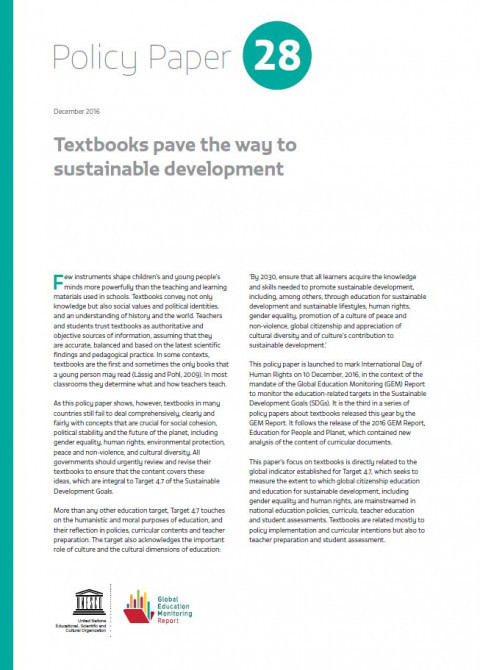 Textbooks pave the way to sustainable development (Policy paper 28) Année de publication: 2016 Auteur institutionnel: UNESCO This paper’s focus on textbooks is directly related to the global indicator established for Target 4.7, which seeks to measure the extent to which global citizenship education and education for sustainable development, including gender equality and human rights, are mainstreamed in national education policies, curricula, teacher education and student assessments. Textbooks are related mostly to policy implementation and curricular intentions but also to teacher preparation and student assessment. Rapport mondial de suivi sur l'éducation: document d'orientation Année de publication: 2016 Auteur institutionnel: UNESCO This paper’s focus on textbooks is directly related to the global indicator established for Target 4.7, which seeks to measure the extent to which global citizenship education and education for sustainable development, including gender equality and human rights, are mainstreamed in national education policies, curricula, teacher education and student assessments. Textbooks are related mostly to policy implementation and curricular intentions but also to teacher preparation and student assessment. Informe de seguimiento de la educatión en el mundo: documento de política Année de publication: 2016 Auteur institutionnel: UNESCO This paper’s focus on textbooks is directly related to the global indicator established for Target 4.7, which seeks to measure the extent to which global citizenship education and education for sustainable development, including gender equality and human rights, are mainstreamed in national education policies, curricula, teacher education and student assessments. Textbooks are related mostly to policy implementation and curricular intentions but also to teacher preparation and student assessment.
 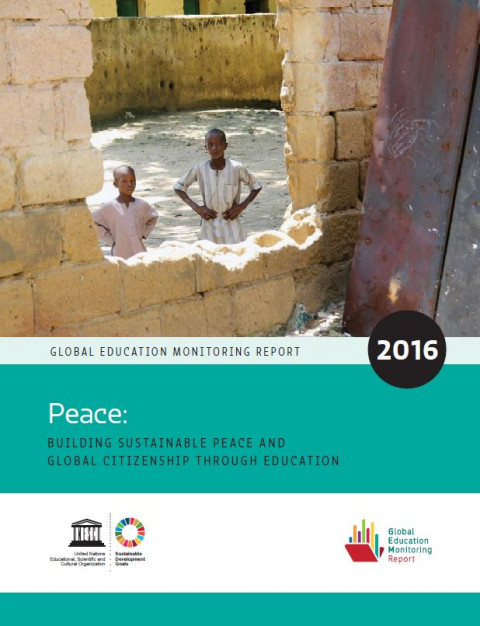 Peace: building sustainable peace and global citizenship through education;Global education monitoring report summary 2016 Année de publication: 2017 Auteur institutionnel: UNESCO The 2016 GEM Report, the first of a new 15-year series, shows that education will not deliver its full potential to catapult the world forward unless rates of improvement dramatically shift, and education systems consider sustainable development in the way services are delivered. This Peace: Building sustainable peace and global citizenship through education publication is a select extract from the full 2016 Global Education Monitoring (GEM) Report: Education for people and planet: Creating sustainable futures for all. It contains two chapters from that full Report – one on peace, political participation and access to justice and the other on education for global citizenship and sustainable development — , along with the associated policy recommendations and a short section of a recent GEM Report Policy Paper Textbooks pave the way to sustainable development.
  Fostering peaceful co-existence through analysis and revision of history curricula and textbooks in Southeast Europe: preliminary stocktaking report Année de publication: 2006 Auteur: Jean Damascène Gasanabo | Jade Maître Auteur institutionnel: UNESCO To accomplish this aim, the study reviews policies and processes for developing history curricula and producing history textbooks in ten participating countries: Albania, Bosnia and Herzegovina, Bulgaria, Croatia, Greece, Romania, Montenegro, Serbia, Slovenia and The Former Yugoslav Republic of Macedonia (FYROM). The resulting report has been compiled for the dual purpose of (1) presenting a composite picture of the educational policies and practices in these countries with regard to history teaching and textbook production, distribution and use; (2) laying the groundwork for the development of national and/or sub-regional initiatives aimed at improving the processes currently in place. Favoriser la coexistence pacifique par l'analyse et la révision des programmes et manuels d'histoire en Europe du Sud-Est: rapport préliminaire d'inventaire Année de publication: 2006 Auteur: Jean Damascène Gasanabo | Jade Maître Auteur institutionnel: UNESCO Pour atteindre cet objectif, l'étude examine les politiques et les processus d'élaboration des programmes d'histoire et de la production de manuels d'histoire dans dix pays participants: Albanie, Bosnie-Herzégovine, Bulgarie, Croatie, Grèce, Roumanie, Monténégro, Serbie, Slovénie et l'ancienne République yougoslave de Macédoine (ARYM). Le rapport qui en résulte a été compilé dans le double but de (1) présentant une image composite des politiques et pratiques éducatives dans ces pays en ce qui concerne l'enseignement de l'histoire et de la production de manuels scolaires, la distribution et l'utilisation; (2) jeter les bases pour le développement d'initiatives nationales et / ou sous-régionaux visant à améliorer les processus actuellement en place. Etude comparative de manuels scolaires: document de travail dans le cadre du dialogue Euro-Arabe, rapport de synthèse Année de publication: 2015 Auteur: Jacqueline Costa-Lascoux | Janine d'Artois Pursuant to the Charter of the United Nations and the Constitution of UNESCO, calling for peace between peoples and respect for cultural diversity, several National Commissions for UNESCO have taken the initiative to create the conditions for a Euro-Arab dialogue in the field of education. The French and Moroccan National Commissions, in particular, have decided to launch studies to highlight stereotypes, misunderstandings and subliminal bias about Arab countries in European textbooks and about European countries in textbooks in the Arab world. First, these studies were conducted by researchers focusing on their own countries' textbooks in order to analyse how the history of the countries on "the other side of the Mediterranean" was represented. Second, a common methodology was developed to allow comoparative approaches favourable to Euro-Arab dialogue. This was to address any mutual bias or misrepresentations that may exist between the two regions and to work togehter to find ways of preventing and combating them. The originality of the approach was to conduct a critical analysis of textbooks published in each country and then underetake a comparative study to be used as the basis for common recommendations. Participants in this project initiated by the National Commissions defined three main objectives: 1. To strengthen dialogue, laying the foundations for learning to live together, based on mutual respect. 2. To help National Commissions for UNESCO, experts, institutions and non-governmental organizations (NGOs) to find ways to work together in areas of research of common interest. 3. To contribute to UNESCO's efforts to develop a stretegy relating to textbooks, to improve the quality of education for peace, human rights, mutual understanding and intercultural dialogue. دراسة مقارنة للكتب املدرسية وثيقة عمل في إطار الحوار األوروبي - العربي Année de publication: 2015 Auteur: Jacqueline Costa-Lascoux | Janine d'Artois Pursuant to the Charter of the United Nations and the Constitution of UNESCO, calling for peace between peoples and respect for cultural diversity, several National Commissions for UNESCO have taken the initiative to create the conditions for a Euro-Arab dialogue in the field of education. The French and Moroccan National Commissions, in particular, have decided to launch studies to highlight stereotypes, misunderstandings and subliminal bias about Arab countries in European textbooks and about European countries in textbooks in the Arab world. First, these studies were conducted by researchers focusing on their own countries' textbooks in order to analyse how the history of the countries on "the other side of the Mediterranean" was represented. Second, a common methodology was developed to allow comoparative approaches favourable to Euro-Arab dialogue. This was to address any mutual bias or misrepresentations that may exist between the two regions and to work togehter to find ways of preventing and combating them. The originality of the approach was to conduct a critical analysis of textbooks published in each country and then underetake a comparative study to be used as the basis for common recommendations. Participants in this project initiated by the National Commissions defined three main objectives: 1. To strengthen dialogue, laying the foundations for learning to live together, based on mutual respect. 2. To help National Commissions for UNESCO, experts, institutions and non-governmental organizations (NGOs) to find ways to work together in areas of research of common interest. 3. To contribute to UNESCO's efforts to develop a stretegy relating to textbooks, to improve the quality of education for peace, human rights, mutual understanding and intercultural dialogue.
  Comparative study of textbooks: working document in the framework of the Euro-Arab Dialogue; summary report Année de publication: 2015 Auteur: Jacqueline Costa-Lascoux | Janine d'Artois Pursuant to the Charter of the United Nations and the Constitution of UNESCO, calling for peace between peoples and respect for cultural diversity, several National Commissions for UNESCO have taken the initiative to create the conditions for a Euro-Arab dialogue in the field of education. The French and Moroccan National Commissions, in particular, have decided to launch studies to highlight stereotypes, misunderstandings and subliminal bias about Arab countries in European textbooks and about European countries in textbooks in the Arab world. First, these studies were conducted by researchers focusing on their own countries' textbooks in order to analyse how the history of the countries on "the other side of the Mediterranean" was represented. Second, a common methodology was developed to allow comoparative approaches favourable to Euro-Arab dialogue. This was to address any mutual bias or misrepresentations that may exist between the two regions and to work togehter to find ways of preventing and combating them. The originality of the approach was to conduct a critical analysis of textbooks published in each country and then underetake a comparative study to be used as the basis for common recommendations. Participants in this project initiated by the National Commissions defined three main objectives: 1. To strengthen dialogue, laying the foundations for learning to live together, based on mutual respect. 2. To help National Commissions for UNESCO, experts, institutions and non-governmental organizations (NGOs) to find ways to work together in areas of research of common interest. 3. To contribute to UNESCO's efforts to develop a stretegy relating to textbooks, to improve the quality of education for peace, human rights, mutual understanding and intercultural dialogue.
  Optimising learning, education and publishing in Africa: the language factor; a review and analysis of theory and practice in mother-tongue and bilingual education in sub-Saharan Africa Année de publication: 2011 Auteur: Adama Ouane | Christine Glanz Auteur institutionnel: UNESCO Institute for Lifelong Learning (UIL) | Association for the Development of Education in Africa (ADEA) This analytical review consists of three sections. The first section lays the theoretical foundations and is covered by Ekkehard Wolff and Kathleen Heugh: 1) language politics and planning in the light of development and 2) theories of bi- and multilingual education models and their implementation in the African context. A second section analyses teaching practices and classroom interaction in schools in two chapters by Birgit Brock-Utne and Hassana Alidou. This is followed by a review of the use of African languages in literacy and non-formal education by Hassana Alidou1 . Next, a review study by Kathleen Heugh addresses the critical issue of costs by assessing the costs related to implementing mother tongue and strong bilingual education programmes. Finally, the third section explores the role of locally-based multilingual publishing in supporting and promoting African languages and developing the language industries and the creative sector. Here, Yaya Satina Diallo from Guinea and Peter Reiner2 from Namibia shed light on the promise and pitfalls of publishing in African languages.Each of these sections focuses on theoretical frameworks and specific strategies designed to optimise learning and education in multilingual Africa. The language issue is dealt with at the levels of: policy and development; costing and financing; educational reform and governance; education models; classroom interaction; formal and non-formal education settings; literacy and publishing.