
Ressources
Explorez une large gamme de ressources sur le GCED afin d’approfondir votre compréhension et de renforcer vos activités de recherche, de plaidoyer, d’enseignement et d’apprentissage.
141 résultats trouvés
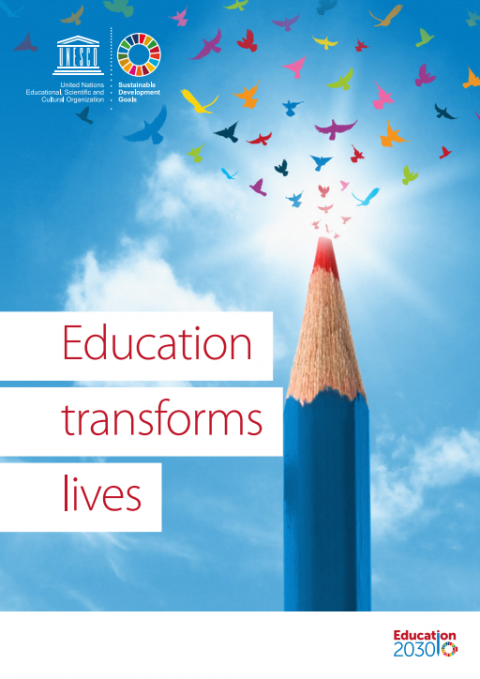 Education Transforms Lives Année de publication: 2017 Auteur institutionnel: UNESCO This brochure explores UNESCO’s role in leading and coordinating the Education 2030 Agenda, which is part of a global movement to eradicate poverty through 17 Sustainable Development Goals by 2030. Education, essential to achieve all of these goals, has its own dedicated Goal 4, which aims to “ensure inclusive and equitable quality education and promote lifelong learning opportunities for all”. UNESCO is the United Nations’ specialized agency for education and the Education Sector provides global and regional leadership in education and responds to contemporary global challenges through education with a special focus on gender equality and Africa. L’éducation transforme la vie Année de publication: 2017 Auteur institutionnel: Organisation des Nations Unies pour l'éducation, la science et la culture (UNESCO) Grâce au nouveau Programme audacieux de développement durable entériné par la communauté internationale en septembre 2015, le monde s’est fixé pour objectif d’éradiquer la pauvreté à l’horizon 2030 à travers 17 Objectifs de développement durable (ODD). Ces objectifs ambitieux ont été adoptés à l’unanimité par les 193 États membres de l’Organisation des Nations Unies. C’est à ces derniers qu’incombe en premier lieu la responsabilité de les réaliser. L’éducation, cruciale pour atteindre l’ensemble des ODD, bénéficie d’un objectif dédié, l’ODD 4, visant à « assurer l’accès de tous à une éducation de qualité, sur un pied d’égalité, et promouvoir les possibilités d’apprentissage tout au long de la vie ».L’UNESCO est la seule agence des Nations Unies chargée de tous les aspects de l’éducation et possède également un réseau mondial d’instituts et de bureaux spécialisés. C’est pourquoi elle s’est vue confier la direction et la coordination de cet objectif, aux côtés de ses partenaires, par le biais de l’agenda Éducation 2030.
 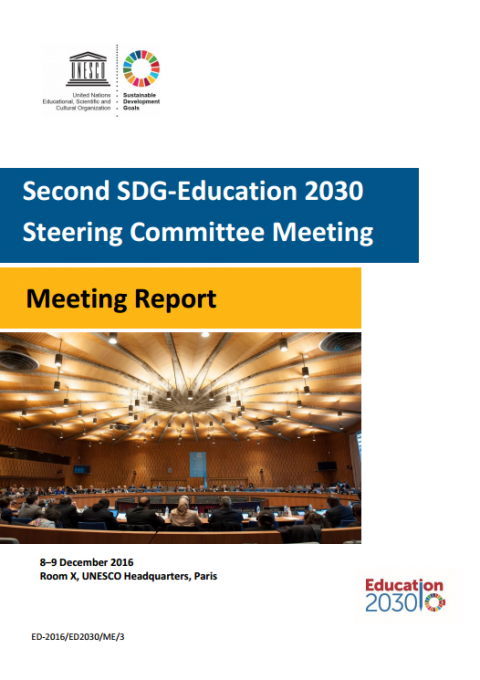 Second SDG-Education 2030 Steering Committee: meeting report Année de publication: 2016 Auteur institutionnel: UNESCO The present report provides the SDG-Education 2030 SC meeting programme, a short summary of key outcomes and decisions, as well as a second part including a more detailed summary of deliberations reflecting the themes, issues and understandings emerging from the discussions.
  SDG-Education 2030 Steering Committee: Terms of Reference Année de publication: 2016 Auteur institutionnel: UNESCO This paper is the terms of reference of the SDG-Education 2030 Steering Committee.
  Panorámica regional: América Latina y el Caribe Année de publication: 2011 Auteur institutionnel: UNESCO The past decade has seen mixed progress towards Education for All (EFA) in Latin America and the Caribbean. More children are participating in pre-school education, many countries have achieved universal primary education and more students are moving from primary to secondary education. Gender parity has been achieved at the primary level in the majority of countries and adult literacy rates are improving. The region invests a relatively high share of national income in education and external aid to basic education has increased in recent years. However, challenges remain. The Caribbean has seen a decline by nearly one-tenth in primary enrolment ratios and 2.9 million children were not enrolled in school in the region as a whole in 2008. Some 36 million adults are still illiterate and levels of learning achievement are low in many countries. The 2011 EFA Global Monitoring Report puts the spotlight on armed conflict and one of its most damaging yet least reported consequences: its impact on education. Conflict-affected states have some of the world’s worst indicators for education. The Report documents the scale of this hidden crisis in education, looks at its underlying causes and explores the links between armed conflict and education. It also presents recommendations to address identified failures that contribute to the hidden crisis. It calls on governments to demonstrate greater resolve in combating the culture of impunity surrounding attacks on schoolchildren and schools, sets out an agenda for fixing the international aid architecture and identifies strategies for strengthening the role of education in peacebuilding.
  Regional overview: Latin America and the Caribbean Année de publication: 2011 Auteur institutionnel: UNESCO The past decade has seen mixed progress towards Education for All (EFA) in Latin America and the Caribbean. More children are participating in pre-school education, many countries have achieved universal primary education and more students are moving from primary to secondary education. Gender parity has been achieved at the primary level in the majority of countries and adult literacy rates are improving. The region invests a relatively high share of national income in education and external aid to basic education has increased in recent years. However, challenges remain. The Caribbean has seen a decline by nearly one-tenth in primary enrolment ratios and 2.9 million children were not enrolled in school in the region as a whole in 2008. Some 36 million adults are still illiterate and levels of learning achievement are low in many countries. The 2011 EFA Global Monitoring Report puts the spotlight on armed conflict and one of its most damaging yet least reported consequences: its impact on education. Conflict-affected states have some of the world’s worst indicators for education. The Report documents the scale of this hidden crisis in education, looks at its underlying causes and explores the links between armed conflict and education. It also presents recommendations to address identified failures that contribute to the hidden crisis. It calls on governments to demonstrate greater resolve in combating the culture of impunity surrounding attacks on schoolchildren and schools, sets out an agenda for fixing the international aid architecture and identifies strategies for strengthening the role of education in peacebuilding. Aperçu régional: Amérique latine et les Caraïbes Année de publication: 2011 Auteur institutionnel: UNESCO La dernière décennie a vu des progrès mitigés vers l'Education Pour Tous (EPT) en Amérique latine et dans les Caraïbes. Plus d'enfants participent à l'éducation préscolaire, de nombreux pays ont réalisé l'enseignement primaire universel et plus d'étudiants sont en mouvement du primaire au secondaire. La parité des sexes a été atteint au niveau primaire dans la majorité des pays et les taux d'alphabétisation des adultes sont l'amélioration. La région investit une part relativement élevée du revenu national dans l'éducation et l'aide extérieure à l'éducation de base a augmenté ces dernières années. Cependant, les défis demeurent. Les Caraïbes ont connu une baisse de près d'un dixième des taux de scolarisation primaire et 2,9 millions d'enfants ne sont pas inscrits à l'école dans la région dans son ensemble en 2008. Quelque 36 millions d'adultes sont encore analphabètes et les niveaux de résultats de l'apprentissage sont faibles dans de nombreux pays . Rapport Mondial de Suivi sur L'EPT 2011 met l'aCECnt sur les conflits armés et l'un de ses plus dommageables conséquences encore moins signalés: son impact sur l'éducation. États touchés par un conflit ont certains des pires indicateurs au monde pour l'éducation. Le rapport documente l'ampleur de cette crise cachée de l'éducation, se penche sur ses causes sous-jacentes et explore les liens entre les conflits armés et l'éducation. Il présente également des recommandations aux échecs d'adresses identifiées qui contribuent à la crise cachée. Il appelle les gouvernements à démontrer une plus grande détermination dans la lutte contre la culture de l'impunité des attaques contre des écoliers et des écoles environnantes, établit un ordre du jour pour la fixation de l'architecture de l'aide internationale et identifie des stratégies pour renforcer le rôle de l'éducation dans la paix. Educación para Todos (EPT) en América Latina y el Caribe: Balance y Desafíos post-2015, 30-31 de Octubre del 2014, Lima, Perú: Declaración de Lima Année de publication: 2014 Auteur institutionnel: Organización de las Naciones Unidas para la Educación, la Ciencia y la Cultura (UNESCO) The Ministers of Education of Latin America and the Carribean (LAC), high-level government officials, UN agencies, representatives of civil society organizations and development partners, gathered at th meeting on "Education for All (EFA) in Latin America and the Carribean: Assessment of progress and post-2015 challenges", in Lima, Peru, from 30 to 31 October 2014. Having deliberated on progress towards EFA in the region, the Muscat Agreement adopted at the Global EFA Meeting (GEM) in Muscat, Oman, 12-14 May 2014, and the outcome document of the UN General Assembly Open Working Group for Sustainable Development Goals, and having examined the unfinished EFA tasks in the region, as well as the challenges and priorities that will configure the post-2015 education agenda for the region, the Lima Statement was adopted. L'Education pour tous (EPT) en Amérique latine et dans les Caraïbes: Évaluation des Progrès et Enjeux de l'après-2015, 30-31 Octobre 2014, Lima, Pérou: Déclaration de Lima Année de publication: 2014 Auteur institutionnel: Organisation des Nations Unies pour l'éducation, la science et la culture (UNESCO) The Ministers of Education of Latin America and the Carribean (LAC), high-level government officials, UN agencies, representatives of civil society organizations and development partners, gathered at th meeting on "Education for All (EFA) in Latin America and the Carribean: Assessment of progress and post-2015 challenges", in Lima, Peru, from 30 to 31 October 2014. Having deliberated on progress towards EFA in the region, the Muscat Agreement adopted at the Global EFA Meeting (GEM) in Muscat, Oman, 12-14 May 2014, and the outcome document of the UN General Assembly Open Working Group for Sustainable Development Goals, and having examined the unfinished EFA tasks in the region, as well as the challenges and priorities that will configure the post-2015 education agenda for the region, the Lima Statement was adopted. Education for All (EFA) in Latin America and the Caribbean: Assessment of Progress and Post-2015 Challenges, 30-31 October 2014, Lima, Peru: Lima Statement Année de publication: 2014 Auteur institutionnel: UNESCO The Ministers of Education of Latin America and the Carribean (LAC), high-level government officials, UN agencies, representatives of civil society organizations and development partners, gathered at th meeting on "Education for All (EFA) in Latin America and the Carribean: Assessment of progress and post-2015 challenges", in Lima, Peru, from 30 to 31 October 2014. Having deliberated on progress towards EFA in the region, the Muscat Agreement adopted at the Global EFA Meeting (GEM) in Muscat, Oman, 12-14 May 2014, and the outcome document of the UN General Assembly Open Working Group for Sustainable Development Goals, and having examined the unfinished EFA tasks in the region, as well as the challenges and priorities that will configure the post-2015 education agenda for the region, the Lima Statement was adopted.