
Ressources
Explorez une large gamme de ressources sur le GCED afin d’approfondir votre compréhension et de renforcer vos activités de recherche, de plaidoyer, d’enseignement et d’apprentissage.
141 résultats trouvés
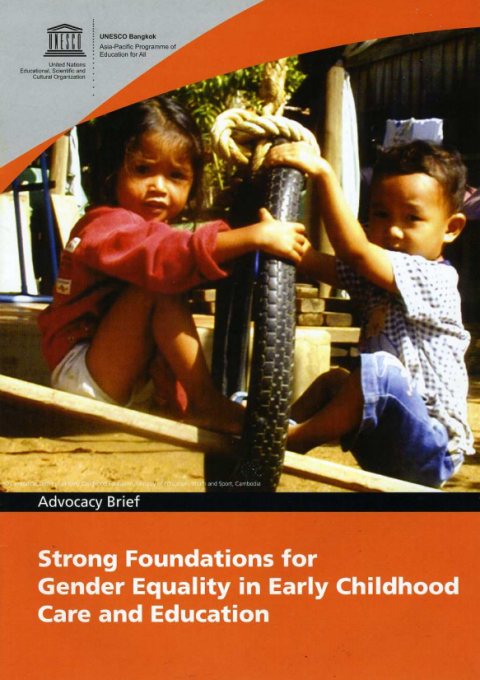 Strong foundations for gender equality in early childhood care and education: advocacy brief Année de publication: 2007 Auteur institutionnel: UNESCO The term Early Childhood Care and Education (ECCE) refers to services for children from birth to eight years of age. These include educating parents in how to care for their children and help them learn, as well as providing community-run and formal preschool programmes for pre-primary school-aged boys and girls. Given the varying needs of children from birth to eight years, educators have found it best to have different policies and strategies for children below and above three years of age. This brief focuses on the gender issues in the services provided for children who are three years of age or older in the Asia-Pacific region. Its scope is informed by UNESCO's commitment to holistic pre-primary services for this age group. The goal is to provide early childhood education that helps girls and boys succeed in primary school and in learning throughout their lives. The brief starts by looking into the growth of ECCE in the Asia-Pacific region and what is driving this growth. It explores why gender responsiveness is important in early childhood education, gives practical examples of what this looks like, and discusses the challenges of providing ECCE that equally values and benefits each girl and each boy. Flowing from this, the brief concludes with recommendations on how to make ECCE more gender responsive De solides fondations pour l'égalité des sexes dans les soins de la petite enfance et de l'éducation: le plaidoyer bref Année de publication: 2007 Auteur institutionnel: UNESCO Le terme de l’éducation et la protection de la petite enfance (EPPE) fait référence aux services pour les enfants de la naissance à huit ans. Ceux-ci incluent l'éducation des parents dans la façon de prendre soin de leurs enfants et de les aider à apprendre, ainsi que de fournir des programmes formels préscolaires gérés par la communauté et pour les garçons et les filles d'âge scolaire pré-primaire. Compte tenu des divers besoins des enfants de la naissance à huit ans, les éducateurs ont trouvé préférable d'avoir des politiques et des stratégies pour les enfants de moins et de plus de trois ans. Ce bref se concentre sur les questions de genre dans les services fournis aux enfants qui sont de trois ans ou plus dans la région Asie-Pacifique. Son champ d'application est informé par l'engagement de l'UNESCO aux services pré-primaires holistiques pour ce groupe d'âge. L'objectif est de fournir une éducation de la petite enfance qui aide les filles et les garçons à réussir à l'école primaire et dans l'apprentissage tout au long de leur vie. Les brèves commence par la recherche dans la croissance de l'EPPE dans la région Asie-Pacifique et ce qui est le moteur de cette croissance. Il explore pourquoi le genre de réaction est important dans l'éducation de la petite enfance, donne des exemples concrets de ce que cela ressemble, et examine les défis de fournir EPPE que de façon égale les valeurs et les avantages de chaque fille et chaque garçon. Découlant de cela, le mémoire se termine par des recommandations sur la façon de rendre sensible EPPE plus le sexe.
  Regional overview: Central and Eastern Europe and Central Asia Année de publication: 2015 Auteur institutionnel: UNESCO Central and Eastern Europe (CEE) and Central Asia (CA) have both made significant advances towards Education for All (EFA) since 1999. However, the 2015 EFA Global Monitoring Report shows that despite progress, Education For All remains unfinished business, including in Central and Eastern Europe and in Central Asia. This must be taken into account in the post-2015 agenda. Региональный обзор: Центральная и Восточная Европа и Центральная Азия Année de publication: 2015 Auteur institutionnel: UNESCO В настоящем региональном обзоре, где рассматривается прогресс, достигнутый с 2000 г., кратко излагаются ответы на важнейшие вопросы, которым посвящен Всемирный доклад по мониторингу (ВДМ) ОДВ за 2015 г. В ВДМ за 2015 г. показано, что, несмотря на прогресс, цели образования для всех еще не до конца достигнуты, в том числе в Центральной и Восточной Европе и Центральной Азии.
  Regional Consultation Meeting on SDG4-Education 2030: Europe and North America Region, Paris, 24-25 October Année de publication: 2016 Auteur institutionnel: UNESCO Réunion de consultation régionale sur l'ODD 4: Education 2030, Etats d'Europe et d'Amérique du Nord, Paris, 24-25 octobre 2016 Année de publication: 2016 Auteur institutionnel: UNESCO
 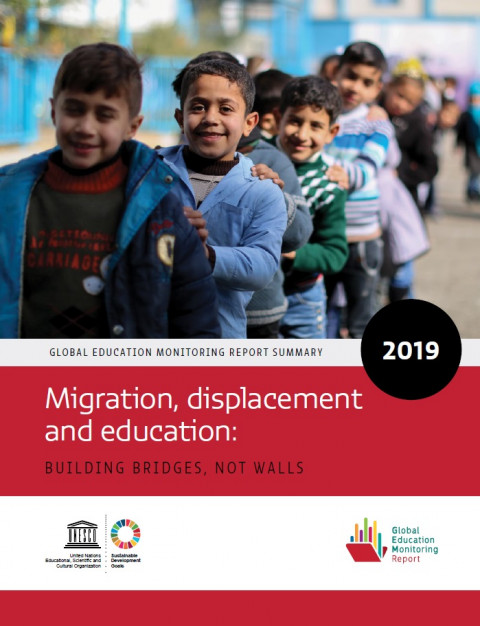 [Summary] Global Education Monitoring Report Summary 2019: Migration, Displacement and Education: Building Bridges, Not Walls Année de publication: 2018 Auteur institutionnel: UNESCO | Global Education Monitoring Report Team This Report points directly to a major challenge: How can teachers be supported to practise inclusion? It offers us fascinating insights into humanity and the age-old phenomenon of migration. I invite you to consider its recommendations and to act on them. This report is a vital toolkit for these compacts. It covers policy issues that address seasonal migrants, rural school consolidation, intercultural curricula, refugee inclusion in national education systems and elimination of segregation, qualifications recognition, targeting of school funding, more effective humanitarian education aid and teacher preparedness for diverse classrooms in emergency, protracted and “new normal” contexts. This summary of the 2019 GEM Report calls on countries to see education as a tool to manage migration and displacement and an opportunity for those needing one. [Резюме] РЕЗЮМЕ ВСЕМИРНОГО ДОК ЛАДА ПО МОНИТОРИНГ У ОБРАЗОВАНИЯ 2019 г .: Миграция, перемещенные лица и образование: наводить мосты, а не возводить препятствия Année de publication: 2018 Auteur institutionnel: UNESCO | Global Education Monitoring Report Team В докладе четко указан один из главных вызовов: как обеспечить поддержку учителей в их инклюзивной работе. В нем увлекательно рассказывается об истории человечества и о феномене миграции, существующем с незапамятных времен. Я приглашаю вас рассмотреть содержащиеся в нем рекомендации и действовать в соответствии с ними. Настоящий доклад является важнейшим информационным источником для этих договоров, охватывающим вопросы политики, которые, среди прочего, касаются сезонных мигрантов, объединения сельских школ, межкультурных учебных программ, включения беженцев в национальные системы образования и борьбы с сегрегацией, признания квалификаций, целенаправленного финансирования школ, более эффективной гуманитарной помощи образованию и подготовленности учителей к работе в классах с разнообразным составом учащихся в чрезвычайных ситуациях, в условиях затянувшегося кризиса и в новых обстоятельствах, характерных для сегодняшнего дня. Настоящий доклад также содержит обращенный к странам призыв рассматривать образование как средство для регулирования миграции и перемещений и как возможность для тех, кто в этой возможности нуждается. [요약문] 세계 교육 현황 보고서 요약본: 이주, 강제이주와 교육: 장벽이 아닌 가교 만들기 Année de publication: 2018 Auteur institutionnel: 유네스코 | 세계교육현황보고서팀 『2019 세계 교육 현황 보고서』는 국경 내 및 국경 간, 자발적이거나 강제적인, 고용이나 교육을 위한 모든 인구 이동에 따른 이주 및 강제이주에 교육이 미치는 영향을 검토한다. 이 보고서는 또한 2030 지속가능발전의제에서 교육의 진전 상황도 평가한다. 다양성이 증가하면서 이 보고서는 교육이 어떻게 포용적인 사회를 구축하고, 어떻게 사람들이 관용을 넘어서서 함께 사는 법을 배울 수 있는지를 분석한다. 교육을 평등하게 제공하면 다리를 건설하지만, 교육을 불평등하게 제공하면 이주민, 난민 및 수용국 지역사회 사이에 벽을 쌓는다.이주민과 난민에 대한 두 가지 새로운 글로벌 콤팩트는 교육의 역할을 인식하고 ‘어느 누구도 뒤처지지 않게 한다’는 전 세계적인 약속과 일치하는 목표를 설정한다. 이 보고서는 이 글로벌 콤팩트를 위한 중요한 툴킷(toolkit)으로 다양한 정책 이슈를 다루고 있다. 즉, 계절 이주자, 농촌 학교 통합, 문화간 교육과정, 국가 교육제도에 난민 포용 및 분리 폐지, 자격 인정, 학교 기금 목표 설정, 보다 효과적인 인도주의적 교육 원조, 그리고 위기 상황, 장기화된 상황, ‘뉴 노멀(new normal)’ 상황에서 다양한 교실을 위한 교사의 준비 등을 포함한다. 이 GEM 보고서 요약본은 국가들이 교육을 이주와 강제이주를 관리하는 도구로 보고, 이를 필요로 하는 사람들을 위한 기회로 간주할 것을 요구한다.
  Mainstreaming SDG4-Education 2030 in sector-wide policy and planning: technical guidelines for UNESCO field offices Année de publication: 2016 Auteur institutionnel: UNESCO Mainstreaming SDG4-Education 2030 in sector-wide policy and planning offers technical guidelines for UNESCO field offices to ensure adequate technical support to national authorities. The guidelines take into account the different profiles of countries’ need and capacities, thus avoiding a one-size-fits-all approach. The document contains resources and pointers that can be combined and tailored to fit the particular context of each country. In all cases, UNESCO is expected to ensure that all the relevant information about SDG4-Education 2030 is properly disseminated in these guidelines. Field staff will adapt the guidelines provided here to the country they are serving to ensure that UNESCO plays its role as the leading United Nations agency in the field.