
Ressources
Explorez une large gamme de ressources sur le GCED afin d’approfondir votre compréhension et de renforcer vos activités de recherche, de plaidoyer, d’enseignement et d’apprentissage.
20 résultats trouvés
 حقوق المرآة السياسية في الإسلام ودورها في المجال السياسي Année de publication: 2020 Auteur: Hussein Zubair Thalj Al-Fahdawi | Mayada Ali Abdel Nabi Karim الحمد لله الذي بنعمته تتم الصالحات وتجبر العثرات وتنال المكرمات وصلى الله على البشير النذير والسراج المنير وعلى آله وصحبه أجمعين . وقد كان من توفيق الله تعالى لي أن توصلت من خلال دراستي هذه إلى بعض النتائج أوجزها فيما يلي: كرم الإسلام إنسانية الإنسان فرفعها الى اسمى الدرجات ولم يفرق فيها بين الرجل والمرأة، ب ل جعل الانسان )رجلا وامرأة( اهم ما في هذا الكون، ولما كانت المرأة نصف المجتمع البشري وهي الأم والأخت والزوجة والبنت، فمن الطبيعي ان تشارك الرجل مشاركة كاملة في كل مظاهر الكرامة الإنسانية، والإسلام الزم الرجل والمرأة ان يتعلما وان يتفهما كل شيء ويتفقها في الدين والعلم، والزمهما بالجهاد السلمي لنشر العقيدة والمعاني السامية كلا في الحقل الذي يستطيع العمل فيه . اتضح من العرض السابق أن المشاركة المتزايدة للنساء في العمل السياسي تمثل عاملا محوريا لارتقاء بالمساواة بين الجنسين وتمكين المرأة، فالمرأة المشاركة في العمل السياسي . وأن مجالات العمل السياسي كافة يباح شرعا أن يتولاها من هو أهل لها رجلا كان أو امرأة، كما إن نظرة الإسلام للمرأة منبثقة من نظرة الإسلام للإنسان المكرم فلا تمايز ولا اختلاف، وأحكام الشريعة تقرر فيها المساواة وتحقيق العدالة والأصل هو تساوي المرأة والرجل في أصل الخلقة والتكاليف الشرعية، وما اختلف بينهما هو استثناء للأصل، وما كان استثناء فإنه لا يصح القياس علي ه .وأخيرا إنَّ ما في هذه البحث من صواب؛ فهو من الله عز وجل، وإنَّ كل ما فيها من خلل وقصور؛ فهو من نفسي ومن الشيطان، ولا يسعني في ختام هذه البح ث المتواضع إلا أن أحمد الله تعالى؛ فالحمد لله رب العلمين والصلاة والسلام على نبينا محمد وعلى آلهِ وصحبه ومن والاه إلى يوم الدين
 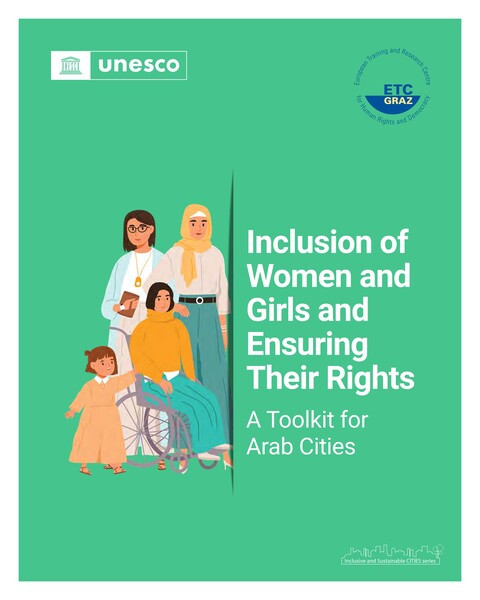 Inclusion of Women and Girls and Ensuring Their Rights: A Toolkit for Arab Cities Année de publication: 2023 Auteur institutionnel: UNESCO Cairo | European Training and Research Centre for Human Rights and Democracy (Austria) Even though women and girls represent close to or more than half of the population of most Arab cities, they are one of the groups that are historically and structurally excluded from decision-making and development planning in the cities. They face many barriers in accessing cities services, and inequality participating in cities activities. Developed on the basis of a virtual regional consultation workshop, as well as in-depth interviews with cities officials and representatives from the Coalition of Arab Cities against Racism, Discrimination, Xenophobia and Intolerance, this Toolkit provides tools and practical advice to enable Arab cities achieve a better inclusion of women and girls, and ensure their full right to benefit from local development programs. The toolkit mainly targets local authorities in Arab cities including Mayors, Members of Municipality Councils, Municipal executives, and Entities concerned with the design, implementation, follow-up, and evaluation of local projects and programs. “Since wars begin in the minds of men andwomen it is in the minds of men and womenthat the defences of peace must be constructed”Inclusion of women and girls in Arab cities: challenge or opportunity?This publication is the result of a joint effort involving the European Training and Research Centre for Human Rights and Democracy in Graz, UNESCO Coalition of Arab Cities against Racism, Discrimination, Xenophobia and Intolerance, and UNESCO Cairo Office. إدماج وضمان حقوق النساء والفتيات: دليل المدن العربية Année de publication: 2023 Auteur institutionnel: UNESCO Cairo | European Training and Research Centre for Human Rights and Democracy (Austria) إدماج النساء والفتيات في المدن العربية، تح ٍد أم فرصة؟يشكل إدماج النساء والفتيات عنصرا محوريا في مسألة الإدماج الحضري. فعلى الرغم من أن النساء والفتياتي مثلن ما يقرب من أو يزيد عن نصف السكان في أغلب المدن العربية، فإنهن من أكثرالفئات المستبعدة تاريخيا وهيكلًيا من عملية صنع القرار والتخطيط الإنمائي في المدن العربية. ويواجهن العديد من العوائقل لاستفادة من خدمات المدن ويعانين من عدم المساواة فيفرص المشاركة في أنشطتها.كان إعداد هذا الدليل على أساس ورشة عمل استشارية إقليمية افتراضية، بالإضافة إلى مقابلات متعمقة مع مسؤولي المدن وممثلي تحالف المدن العربية ضد العنصرية والتمييز وكراهية الأجانب والتعصب. ويوفر الدليل أدوات ونصائح عملية لتمكين المدن العربية من تحقيق إدماج النساء والفتيات بشكل أفضل، وضمان حقهن الكامل في الاستفادة من برامج التنمية المحلية.يستهدف هذا الدليل بشكل أساسي السلطات المحلية في المدن العربية بما في ذلك رؤساء البلديات وأعضاء المجالس البلدية والمديرين التنفيذيين في البلديات والهيئات المعنية بتصميم المشاريع والبرامج المحلية وتنفيذها ومتابعتها وتقييمها.يأتي هذا المنشور نتيجة جهد مشترك ساهم فيه كل من المركز الأوروبي للتدريب والبحوث لحقوق الإنسان والديمقراطية في جراتس، وتحالف اليونسكو للمدن العربية ضد العنصرية والتمييز وكراهية الأجانب والتعصب، ومكتب اليونسكو بالقاهرة.
 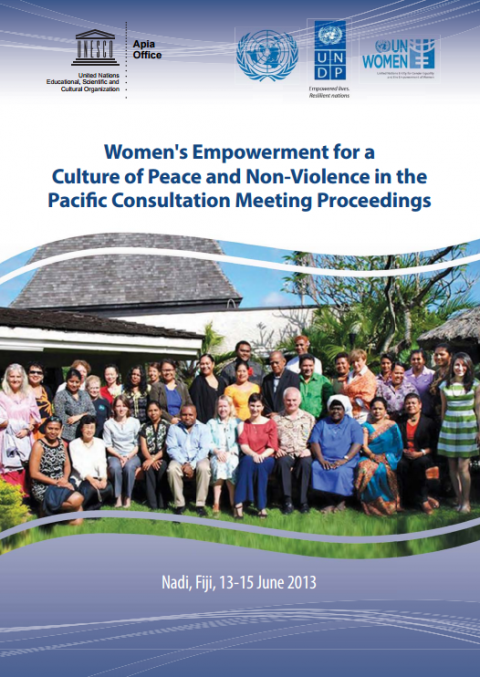 Women's empowerment for a culture of peace and non-violence in the pacific consultation meeting proceedings Année de publication: 2013 Auteur institutionnel: UNESCO Apia The Consultation on Women’s Empowerment for a Culture of Peace and Non Violence in the Pacific was held in Nadi, Fiji, from 13 to 15 June 2013. The consultation was an interagency collaboration between the United Nations Educational, Scientific and Cultural Organization (UNESCO), the United Nations Entity for Gender Equality and the Empowerment of Women (UN WOMEN) and the United Nations Development Programme (UNDP) Pacific Centre as part of the United Nations strategy “Delivering as One”. This collaboration focused on efforts to design, promote and strengthen a culture of peace in the Pacific at the country and regional levels. The consultation brought together 30 senior representatives, including development professionals and community members, from governments, regional organizations, women’s organizations, faith-based groups, academic institutions and development partners from the Cook Islands, Fiji, Kiribati, Palau, Papua New Guinea, Samoa, Solomon Islands, Tonga and Vanuatu. The consultation ended with an agreement on a range of actions that could be adopted at the local, national and regional levels to promote increased dialogue between leaders and policy makers on the contributions that culture and heritage can make to addressing issues of gender inequality and reducing GBV. The outcome statement identifies the importance of building positive cultural models, using a range of key factors, including female leaders, faith-based leaders and traditional leaders as well as political leaders and parties. The statement also emphasized education as a means of promoting a culture of peace and non-violence. The consultation’s outcome statement noted that the school curriculum should place a stronger emphasis on values, gender equality, sexual and reproductive health and rights, and the building of positive cultural models. The follow up actions identified include increasing public awareness on achieving equality for Pacific women, including women at the grassroots level, in bringing peace to conflict-affected communities; targeting young people as the next generation of leaders; using the arts and cultural and sports events to break down gender stereotypes; actions relating to economic empowerment, access to justice and service delivery; and intangible cultural heritage capacity building incorporating substantive gender equality components. L'autonomisation des femmes pour une culture de paix et de non-violence dans la procédure de réunion de consultation pacifique Année de publication: 2013 Auteur institutionnel: UNESCO Apia La Consultation sur l'Autonomisation des Femmes pour une Culture de la Paix et de la Non-Violence dans le Pacifique a eu lieu à Nadi, Fidji, du 13 au 15 Juin 2013. La consultation a été une collaboration interinstitutions entre la culture (UNESCO) Organisation des Nations Unies pour l'éducation, la science et l'Entité des Nations Unies pour l'égalité des sexes et l'autonomisation des femmes (ONU Femmes) et le Programme des Nations Unies pour le développement (PNUD) Centre du Pacifique dans le cadre de la stratégie des Nations Unies «Delivering as One». Cette collaboration a porté sur les efforts pour concevoir, promouvoir et renforcer une culture de paix dans le Pacifique au niveau national et régional. La consultation a réuni 30 représentants de haut niveau, y compris les professionnels du développement et des membres de la communauté, des gouvernements, des organisations régionales, des organisations de femmes, les groupes religieux, les institutions académiques et les partenaires de développement des îles Cook, Fidji, Kiribati, Palau, Papouasie-Nouvelle-Guinée, Samoa , Îles Salomon, Tonga et Vanuatu. La consultation a pris fin avec un accord sur une série d'actions qui pourraient être adoptées aux niveaux local, national et régional pour promouvoir le dialogue accru entre les dirigeants et les décideurs politiques sur les contributions que la culture et le patrimoine peuvent apporter à résoudre les problèmes d'inégalité entre les sexes et la réduction de GBV . L'énoncé de résultat souligne l'importance de la construction de modèles culturels positifs, en utilisant une gamme de facteurs clés, y compris les femmes leaders, des dirigeants religieux et les chefs traditionnels ainsi que des dirigeants et partis politiques. La déclaration a également souligné l'éducation comme un moyen de promouvoir une culture de paix et de non-violence. La déclaration des résultats de la consultation a noté que le programme scolaire devrait mettre davantage l'aCECnt sur les valeurs, l'égalité des sexes, la santé et les droits sexuels et de la reproduction, et la construction de modèles culturels positifs. Les actions de suivi identifiées comprennent la sensibilisation du public sur la réalisation de l'égalité pour les femmes du Pacifique, y compris les femmes au niveau local, pour ramener la paix dans les communautés touchées par le conflit; ciblant les jeunes comme la prochaine génération de leaders; en utilisant les arts et et des événements culturels de sport pour briser les stéréotypes de genre; les actions relatives à l'autonomisation économique, l'accès à la justice et la prestation des services; et immatériel renforcement des capacités du patrimoine culturel incorporant fond composantes égalité entre les sexes.
  وعي المرأة السعودية بحقوق العاملة المنزلية Année de publication: 2016 Auteur: Haya Saleh Saud Al Harbi Auteur institutionnel: King Saud University تهدف الدراسة على التعرف على مدى وعي المرأة السعودية بحقوق العاملة المنزلية المادية والنفسية والحية والاجتماعية. توصلت الدراسة الى اتفاق بأن العاملة يجب أن تحصل على غرفة مناسبة للإقامة وعلى المأكل الصحي، ومعاملتها بالطريقة الصحيحة. الدراسة تعطى فكرة واضحة لمدى فهم المرأة السعودية لاحتياجات العاملة المنزلية. The Saudi Woman Awareness about the Rights of the Housemaid Année de publication: 2016 Auteur: Haya Saleh Saud Al Harbi Auteur institutionnel: King Saud University The study aims to identify the extent of Saudi women's awareness of the physical, psychological, live and social rights of the domestic worker. The study reached an agreement that the worker should get a suitable room for accommodation and a healthy food, and treat her in the right way. The study gives a clear idea of the extent to which Saudi women understand the needs of the domestic worker.
 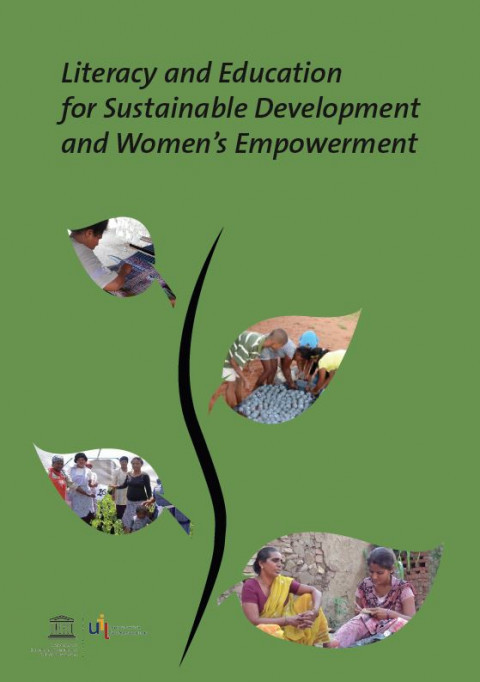 Literacy and education for sustainable development and women's empowerment Année de publication: 2014 Auteur: Anna Robinson-Pant Auteur institutionnel: UNESCO Institute for Lifelong Learning (UIL) The fact that women constitute two-thirds of the world’s non-literate population has been a cause for concern for several decades now. Despite a number of high-profile literacy interventions specifically targeting women – including UNESCO’s LIFE initiative – the disparity between male and female literacy rates persists in many countries of the world (UIL, 2013). This starting point for thinking about women’s literacy has however often led to a narrow focus on literacy access and outcomes. Whilst educational policy makers and planners have attempted to identify and overcome barriers to women’s participation, researchers have directed their attention to measuring the social and economic benefits of women’s literacy (see Robinson-Pant, 2004). Statistical correlations have been presented as evidence of the impact of women’s literacy: for instance, in Pakistan, women with a high level of literacy earned 95% more than women with no literacy skills yet there was only a 33% differential amongst men (UNESCO 2012: 196).Barriers to participation have been analysed in terms of structural (timing, location, women-only versus mixed gender) and social (marriage, poverty, language hierarchies) factors (see Ballara 1991). Within such analysis however, little attention has been given to the social processes associated with literacy learning and development. By contrast, this paper sets out to take a wider lens on literacy in order to explore not only ‘what works’ in practical terms of encouraging women to participate programmes, but also to look at how and why literacy programmes can contribute to sustainable development and processes of empowerment. Taking this perspective on women’s literacy involves asking alternative questions from the more usual ‘how can we make more women literate?’ Approaching literacy through the lens of sustainable development and women’s empowerment means that we develop a more nuanced understanding of how different kinds of literacy emerge from or support different development approaches and how women engage with such processes of change.How is literacy related to sustainable development programmes? What does empowerment mean to different women in different situations? What kind of research evidence and knowledge are literacy programmes and policy building on? How can adult learning facilitate economic, social and environmental change? These larger questions will guide the conceptual exploration of sustainable development, women’s empowerment and literacy, as well as the review of literacy programmes presented in this paper. The starting assumption is that only by looking in depth at the processes of literacy learning and development practice can we begin to address the challenge of narrowing the gender gap in literacy attainment.
  Alfabetización para el desarrollo sostenible y el empoderamiento de las mujeres Année de publication: 2014 Auteur: Anna Robinson-Pant Auteur institutionnel: UNESCO Institute for Lifelong Learning (UIL) The fact that women constitute two-thirds of the world’s non-literate population has been a cause for concern for several decades now. Despite a number of high-profile literacy interventions specifically targeting women – including UNESCO’s LIFE initiative – the disparity between male and female literacy rates persists in many countries of the world (UIL, 2013). This starting point for thinking about women’s literacy has however often led to a narrow focus on literacy access and outcomes. Whilst educational policy makers and planners have attempted to identify and overcome barriers to women’s participation, researchers have directed their attention to measuring the social and economic benefits of women’s literacy (see Robinson-Pant, 2004). Statistical correlations have been presented as evidence of the impact of women’s literacy: for instance, in Pakistan, women with a high level of literacy earned 95% more than women with no literacy skills yet there was only a 33% differential amongst men (UNESCO 2012: 196). Barriers to participation have been analysed in terms of structural (timing, location, women-only versus mixed gender) and social (marriage, poverty, language hierarchies) factors (see Ballara 1991). Within such analysis however, little attention has been given to the social processes associated with literacy learning and development. By contrast, this paper sets out to take a wider lens on literacy in order to explore not only ‘what works’ in practical terms of encouraging women to participate programmes, but also to look at how and why literacy programmes can contribute to sustainable development and processes of empowerment. Taking this perspective on women’s literacy involves asking alternative questions from the more usual ‘how can we make more women literate?’ Approaching literacy through the lens of sustainable development and women’s empowerment means that we develop a more nuanced understanding of how different kinds of literacy emerge from or support different development approaches and how women engage with such processes of change. How is literacy related to sustainable development programmes? What does empowerment mean to different women in different situations? What kind of research evidence and knowledge are literacy programmes and policy building on? How can adult learning facilitate economic, social and environmental change? These larger questions will guide the conceptual exploration of sustainable development, women’s empowerment and literacy, as well as the review of literacy programmes presented in this paper. The starting assumption is that only by looking in depth at the processes of literacy learning and development practice can we begin to address the challenge of narrowing the gender gap in literacy attainment. Alphabétisation et éducation pour le développement durable et l'autonomisation des femmes Année de publication: 2014 Auteur: Anna Robinson-Pant Auteur institutionnel: UNESCO Institute for Lifelong Learning (UIL) The fact that women constitute two-thirds of the world’s non-literate population has been a cause for concern for several decades now. Despite a number of high-profile literacy interventions specifically targeting women – including UNESCO’s LIFE initiative – the disparity between male and female literacy rates persists in many countries of the world (UIL, 2013). This starting point for thinking about women’s literacy has however often led to a narrow focus on literacy access and outcomes. Whilst educational policy makers and planners have attempted to identify and overcome barriers to women’s participation, researchers have directed their attention to measuring the social and economic benefits of women’s literacy (see Robinson-Pant, 2004). Statistical correlations have been presented as evidence of the impact of women’s literacy: for instance, in Pakistan, women with a high level of literacy earned 95% more than women with no literacy skills yet there was only a 33% differential amongst men (UNESCO 2012: 196). Barriers to participation have been analysed in terms of structural (timing, location, women-only versus mixed gender) and social (marriage, poverty, language hierarchies) factors (see Ballara 1991). Within such analysis however, little attention has been given to the social processes associated with literacy learning and development. By contrast, this paper sets out to take a wider lens on literacy in order to explore not only ‘what works’ in practical terms of encouraging women to participate programmes, but also to look at how and why literacy programmes can contribute to sustainable development and processes of empowerment. Taking this perspective on women’s literacy involves asking alternative questions from the more usual ‘how can we make more women literate?’ Approaching literacy through the lens of sustainable development and women’s empowerment means that we develop a more nuanced understanding of how different kinds of literacy emerge from or support different development approaches and how women engage with such processes of change. How is literacy related to sustainable development programmes? What does empowerment mean to different women in different situations? What kind of research evidence and knowledge are literacy programmes and policy building on? How can adult learning facilitate economic, social and environmental change? These larger questions will guide the conceptual exploration of sustainable development, women’s empowerment and literacy, as well as the review of literacy programmes presented in this paper. The starting assumption is that only by looking in depth at the processes of literacy learning and development practice can we begin to address the challenge of narrowing the gender gap in literacy attainment.