
Ressources
Explorez une large gamme de ressources sur le GCED afin d’approfondir votre compréhension et de renforcer vos activités de recherche, de plaidoyer, d’enseignement et d’apprentissage.
66 résultats trouvés
 Peculiarities of Environmental Education of Youth in the Republic of Kazakhstan Année de publication: 2018 Auteur: Agila Sh. Nurgabylova In the modern era of mankind’s existence, a productive solution to the vital environmental issues and problems faced by the world community is largely correlated with the success of environmental education and the upbringing of the future generation. In this regard, the pedagogical and social aspects of environmental education and the education of young people is the main issue in the period of modernization of education in the Republic of Kazakhstan. Особенности экологического образования молодежи в республике Казахстан Année de publication: 2018 Auteur: Agila Sh. Nurgabylova В современную эпоху существования человечества продуктивное решение жизненно важных экологических вопросов и проблем, с которыми сталкивается мировое сообщество, во многом соотносится с успешностью экологического образования и воспитания будущего поколения. В этой связи педагогические и социальные аспекты экологическое образование и воспитание молодежи стоит главным вопросом в период модернизации образования в Республике Казахстан.
 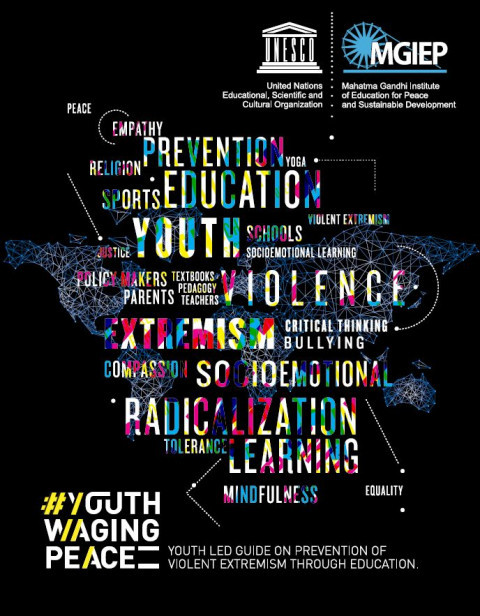 Youth Led Guide on Prevention of Violent Extremism through Education Année de publication: 2017 Auteur: Carolyn Nash | Yulia Nesterova | Kenneth Primrose | Wing Yu Alice Chan | Rios, Paul A. Chan | María José Velásquez Flores | Aniqah Zowmi Auteur institutionnel: Mahatma Gandhi Institute of Education for Peace and Sustainable Development (MGIEP) In September 2016, the education sector from the UNESCO headquarters and the UNESCO category 1 research Institute, the UNESCO Mahatma Gandhi Institute of Education for Peace and Sustainable Development(MGIEP) organised the first International Conference on Prevention of Violent Extremism through Education: Taking Action, in New Delhi, India. The usual plethora of reports and guides produced by experts on the subject, roundtables and expert panels were organised.But something different also happened. UNESCO MGIEP brought 50 youth from across the world rigorously selected through six week online discussion on the subject to participate in a first of its kind, “Talking Across Generations on Education (TAGe)” event. This event organised as a plenary session—not a side or lunch event—brought together these youth in a non-hierarchical “flat” dialogue with about 12 senior policymakers on the challenges and opportunities the youth see in preventing violent extremism through education.The conference culminated with the presentation of a “Youth Action Plan” containing three clear tangible action points. One action point was the development of a youth-led guide on Prevention of Violent Extremism through Education. This Guide is the result of that call to action.The Institute circulated a global call to youth who were willing to take up the challenge of producing the Guide. After a rigorous search based on a well-defined set of criteria, two coordinating lead authors were identified. These authors were then tasked to find the remaining authors who they saw fit to contribute to the Guide and this team then reached out to the wider group of youth to solicit their experiences and guidance in producing the Guide. The youth have done their part. They have reached out to more than 2,000 young people from more than 50 countries, collated their ideas and experiences and finally featured more than 150 unique voices into this document.
  Global Citizenship Education in Canada and the U.S.: From Nation-Centric Multiculturalism to Youth Engagement Année de publication: 2020 Auteur: Sarah Ranco | Alexis Gilmer | Colleen Loomis Auteur institutionnel: Cham Springer This chapter examines the historical and current uses of global citizenship education (GCE) in Canada and the U.S. in public schools from primary through secondary levels, with attention to Canada as well as similarities and differences within and across the two countries. The authors assess how social and political contexts have influenced the definition and operationalization of multiculturalism, civic studies, and global studies in curricula, noting that the neo-liberal perspective has focused on making people an economic powerhouse rather than socially concerned global citizens. In their examination of educational approaches that relate to GCE, the authors present decolonizing pedagogies, the multiculturalism approach in Canada, as well as culturally responsive and anti-racist pedagogies. To illustrate these issues, the authors offer an example in the Canadian context and raise the need to prevent GCE from becoming yet another tool for hegemony by the Global North on the Global South, as dominant groups have long defined citizenship. They conclude by proposing that to realize GCE in these two countries, teacher/practitioner and local, national, and international actors must engage youth, and in doing so, power imbalances that prohibit becoming global citizens will be addressed.
  Education and Social Cohesion in Latin America: A Micro-political Perspective Année de publication: 2014 Auteur: Silvina Gvirtz | Jason Beech Auteur institutionnel: Universidad de San Andrés | Arizona State University This article analyses the relation between education and social cohesion in Latin America from a micropolitical perspective. Even though we acknowledge the relevance of the macro and mezzo levels, we argue that the political decisions that are made at the school level are crucial to understand the contribution of educational systems to social cohesion. We suggest that the relation between social cohesion and school micropolitics can be analysed in two dimensions: the first is related to the access and permanence of children in school, while the second is related to the curriculum. The article concentrates on the second level by analysing the relation between the curriculum and social cohesion from a local, a national, and a global perspective. Educación y Cohesión Social en América Latina: Una Mirada desde la Micropolítica Escolar Année de publication: 2014 Auteur: Silvina Gvirtz | Jason Beech Auteur institutionnel: Universidad de San Andrés | Arizona State University Este artículo ofrece una serie de reflexiones acerca de la relación entre educación y cohesión social en América Latina en la actualidad, tomando como eje la micropolítica de la escuela. Sin desconocer la importancia de los niveles macro e intermedio, se sugiere que las decisiones políticas que se toman en el nivel escolar son fundamentales para entender la contribución que hace el sistema educativo a la cohesión social. Sostenemos que existen dos niveles para pensar la cohesión social en la micropolítica de la escuela en América Latina: uno vinculado al acceso y permanencia de los niños y jóvenes en la institución y uno curricular. Tomando como eje el segundo de los niveles mencionados, proponemos que en términos del alcance de la cohesión social, la relación entre este concepto y la escuela puede ser pensada en tres dimensiones: la global, la nacional y la local.
  Young People: Protagonists of Democratic Transformation Année de publication: 2024 Auteur institutionnel: Organization of Ibero-American States for Education, Science and Culture (OEI) The involvement of young people in democracy is essential for the development and sustainability of our societies. Recognizing the value of their contribution as agents of change, the Citizen Academy project in Panama launched the course "The Role of Youth in Democracy." This educational tool is offered free of charge through the platform www.academiaciudadana.org. The initiative, promoted by the Organization of Ibero-American States (OEI), is the result of a collaboration with the Electoral Tribunal, Fundamorgan and the Panamanian Debate Association (Aspade), and aims to promote a more just and equitable society through civic education for the new generations. Daniela Hidalgo, institutional coordinator of Aspade, explains how they seek to transform youth participation in the democratic life of the Central American country. Los jóvenes: Protagonistas de la transformación democrática Année de publication: 2024 Auteur institutionnel: Organización de Estados Iberoamericanos para la Educación, la Ciencia y la Cultura (OEI) La implicación de los jóvenes en la democracia es esencial para el desarrollo y la sostenibilidad de nuestras sociedades. Reconociendo el valor de su contribución como agentes de cambio, el proyecto Academia Ciudadana en Panamá lanzó el curso "El Rol de la Juventud en la Democracia". Este instrumento educativo se ofrece de manera gratuita a través de la plataforma www.academiaciudadana.org. La iniciativa, impulsada por la Organización de Estados Iberoamericanos (OEI), es resultado de una colaboración con el Tribunal Electoral, Fundamorgan y la Asociación Panameña de Debate (Aspade), tiene como objetivo fomentar una sociedad más justa y equitativa mediante la educación cívica de las nuevas generaciones. Daniela Hidalgo, es coordinadora institucional de Aspade, y nos explica cómo se busca transformar la participación juvenil en la vida democrática del país centroamericano.
 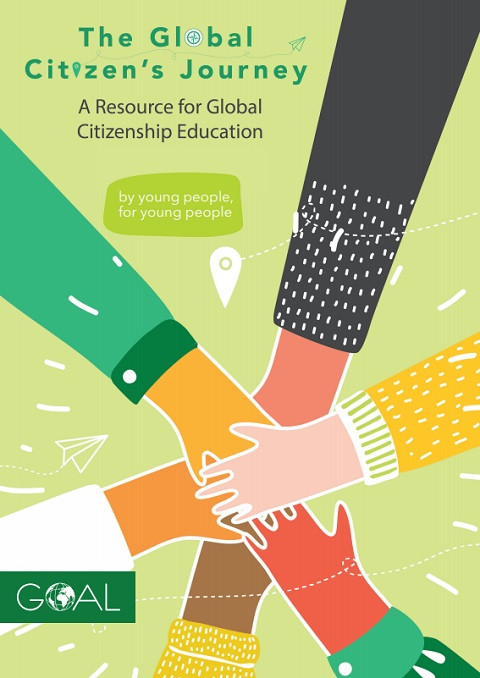 The Global Citizen's Journey: A Resource for Global Citizenship Education Année de publication: 2021 Auteur institutionnel: GOAL Global This resource for Global Citizenship Education is designed by our Global Youth Programme for educators and leaders of 14–18-year-olds all over the world. Centring on the themes of interconnectedness, development, power and inequality this free, downloadable booklet of activities encourages critical thinking, reflection, and empower the pursuit of positive change.To find out more, watch our introductory video here.
 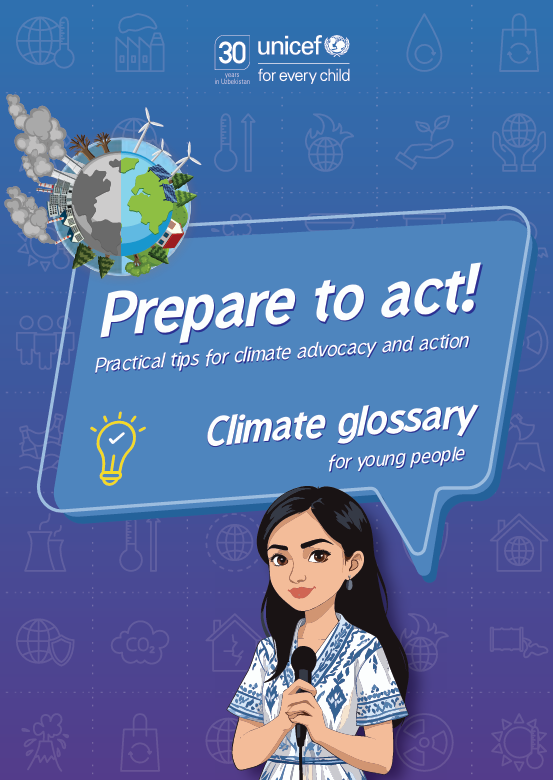 Prepare to Act!: Practical Tips for Climate Advocacy and Action; Climate Glossary for Young People Année de publication: 2024 Auteur institutionnel: UNICEF Uzbekistan The Toolkit for Young Climate Activists in Uzbekistan was created by young people who, like you, are concerned about our planet's situation and who, as activists, have faced many challenges when advocating and taking action. Main goal is to share clear, concise, easily understandable information that describes the course of global, regional and national climate action, in order to prepare you for full and informed participation.