
Ressources
Explorez une large gamme de ressources sur le GCED afin d’approfondir votre compréhension et de renforcer vos activités de recherche, de plaidoyer, d’enseignement et d’apprentissage.
1,329 résultats trouvés
 Teaching and Learning Transformative Engagement Année de publication: 2019 Auteur institutionnel: UNESCO While there is a large body of literature on citizenship and civic education, there is less clarity about the meaning of ‘responsible transformative engagement’ for young learners in relation to GCED and ESD – notably, the types of transformative engagement and the meaning of ‘responsible’. Understanding better the connection between learners’ engagement and education can clarify the knowledge, skills and competencies that schools may provide, as well as how the role of education can vary depending on context. In this light, this paper explores the meaning of ‘responsible transformative engagement’ with a view to clarifying the role of education in ways that may be reflected by UNESCO and other education stakeholders. Enseigner et apprendre l'engagement transformatif Année de publication: 2019 Auteur institutionnel: Organisation des Nations Unies pour l'éducation, la science et la culture (UNESCO) Si les ouvrages consacrés à la citoyenneté et à l’éducation civique foisonnent, le sens d’un « engagement transformatif responsable » pour de jeunes apprenants dans le contexte de l’ECM et de l’EDD est moins clairement défini, notamment les types d’engagement transformatif et la notion de « responsabilité ». Mieux comprendre le lien entre l’engagement des apprenants et l’éducation permet de clarifier les connaissances, aptitudes et compétences que l’école peut enseigner, ainsi que le rôle variable que peut jouer l’éducation selon le contexte. Dans cette optique, le présent document s’interroge sur le sens d’un « engagement transformatif responsable » en vue d’apporter des éclaircissements sur le rôle de l’éducation qui peuvent être pris en compte par l’UNESCO et d’autres acteurs de l’éducation. Enseñando y aprendiendo para una participación transformadora Année de publication: 2019 Auteur institutionnel: Organización de las Naciones Unidas para la Educación, la Ciencia y la Cultura (UNESCO) Si bien existe una extensa bibliografía sobre educación cívica y ciudadana, hay menos claridad acerca del significado del concepto de una "participación transformadora responsable" de jóvenes estudiantes en relación con la ECM y la EDS, en particular, los tipos de participación transformadora y la definición del término "responsable". Comprender mejor la relación entre la participación de los estudiantes y la educación puede contribuir a mejorar la definición de los conocimientos, aptitudes y competencias que las escuelas pueden enseñar, así como las maneras en que el papel de la educación puede variar según el contexto. En este sentido, el presente documento explora el significado de una "participación transformadora responsable", con miras a explicar el papel de la educación de formas que puedan reflejar la UNESCO y otros actores de la educación
  Her education, our future: snapshots of UNESCO's work Année de publication: 2019 Auteur institutionnel: UNESCO This collection provides snapshots of some of UNESCO’s efforts to empower women and girls through education. It highlights core areas of work undertaken, as profiled on the next page. The aim is to give the reader a flavour of what it is that UNESCO, including its 53 field offices and specialized institutes, is doing to transform her education and our future.
 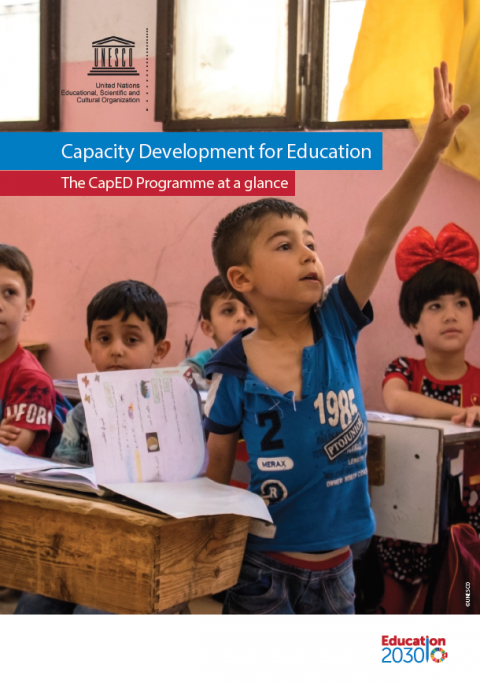 Capacity Develoment for Education: the CapED Programme at a glance Année de publication: 2019 Auteur institutionnel: UNESCO Education has the power to transform lives and is at the heart of UNESCO’s mission to build peace, eradicate poverty and drive sustainable development. Right now, 750 million adults – two-thirds women – still lack basic literacy skills. Around 264 million children and youth are out of school and the international community must have almost 69 million new teachers to reach the 2030 education goals. These challenges can be tackled effectively through education reforms. However, these can only take place when countries have the capacities to put this change into action. As well as trained staff, countries need efficient organizational processes, functioning institutions and the tools and resources to design, implement and manage tailored education policies and plans. This is where the CapED Programme steps in. By mobilizing UNESCO’s global network, the Programme provides selected countries with a cohesive package of support. It works alongside stakeholders to reinforce national capacities to undertake evidence-based education reforms that fit into their national priorities and respond to SDG4 commitments, in order to offer quality education opportunities to all.
  Education transforms lives: empowering people and ensuring inclusiveness and equality Année de publication: 2019 Auteur institutionnel: UNESCO This brochure compiles the main elements of progress on Sustainable Development Goal 4 (SDG 4) highlighted in the submission by UNESCO, on behalf of the SDG-Education 2030 Steering Committee, to the Office of the Under-Secretary-General, Department of Economic and Social Affairs (DESA) on the occasion of the High-level Political Forum (HLPF) 2019 - Empowering people and ensuring inclusiveness and equality. L'éducation transforme la vie: autonomiser les individus et assurer l'inclusion et l'égalité Année de publication: 2019 Auteur institutionnel: UNESCO Cette brochure rassemble les principaux éléments des progrès accomplis dans la réalisation de l'objectif 4 du développement durable (ODD 4) mis en évidence dans la communicationprésentée par l'UNESCO, au nom du Comité directeur de l'ODD-Éducation 2030, au Bureau du Secrétaire général adjoint aux affaires économiques et sociales (DESA) à l'occasion du Forum politique de haut niveau (HLPF) 2019 –Donner aux populations les moyens d'agir et assurer l'intégration. La educación transforma vidas: empoderar a las personas y garantizar la inclusión y la igualdad Année de publication: 2019 Auteur institutionnel: UNESCO Este folleto recopila los principales elementos de progreso en relación con el Objetivo de Desarrollo Sostenible 4 (ODS 4) destacados en la presentación de la UNESCO, en nombre del Comité Directivo del ODS-Educación 2030, a la Oficina del Secretario General Adjunto del Departamento de Asuntos Económicos y Sociales (DESA) con motivo del Foro Político de Alto Nivel (HLPF) 2019 - Empoderar a las personas y garantizar la inclusión y la igualdad.
  Indigenous peoples’ right to education Année de publication: 2019 Auteur institutionnel: UNESCO This document follows a previous series of thematic mappings on the implementation of the right to education regarding specifically Girls’ and Women’s Right to Education, the Right to Education for Persons with Disabilities, and the Right to Education and the Teaching Profession. It compiles practical examples related to indigenous people’s right to education, extracted from reports submitted by Member States within the framework of the Ninth Consultation on the implementation of the 1960 Convention and Recommendation against Discrimination in Education. It is intended to serve as a practical tool for both information sharingandadvocacy.
 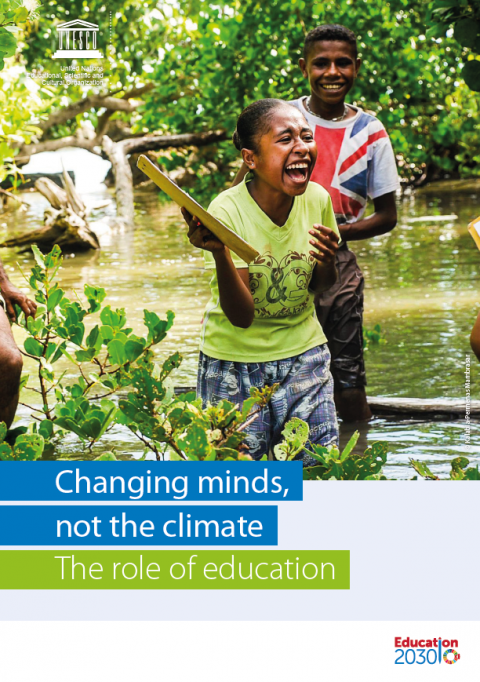 Changing minds, not the climate: the role of education Année de publication: 2017 Auteur institutionnel: UNESCO Education is the most powerful element in preparing societies for the global challenges that climate change brings. It equips individuals, communities and the wider world with the understanding, skills and attitudes to engage in shaping green, low emission and climate-resilient societies. Education for Sustainable Development (ESD) is not an ‘extra’ but rather an integral part of any strategy to combat the effects of climate change, put into practice a global agreement and achieve the Sustainable Development Goals (SDGs). It acts to raise awareness and change behaviours and attitudes and enables people to make informed decisions about their lives. The heads of UNESCO and UNFCCC agree that “education provides the skills people need to thrive in the new sustainable economy, working in areas such as renewable energy, smart agriculture, forest rehabilitation, the design of resource-efficient cities, and sound management of healthy ecosystems. Perhaps most important, education can bring about a fundamental shift in how we think, act, and discharge our responsibilities toward one another and the planet.” ESD is increasingly recognized around the world as a key enabler for a more sustainable future.