
Ressources
Explorez une large gamme de ressources sur le GCED afin d’approfondir votre compréhension et de renforcer vos activités de recherche, de plaidoyer, d’enseignement et d’apprentissage.
1,330 résultats trouvés
 어린이집 · 유치원 교사가 알아야 할 디지털 시민성과 교육 Année de publication: 2019 Auteur: 김양은 | 최숙 | 박상호 | 장준영 | 박정원 Auteur institutionnel: 방송통신위원회 | 한국정보화진흥원 본 자료는 어린이집, 유치원 교사가 아이들과 함께 디지털시민역량을 키워나가도록 개념, 해외사례, 교육자료 등을 소개하는 가이드북이다.
  2020 미디어교육 우수사례 공모전 수상작 모음집 Année de publication: 2021 Auteur institutionnel: 시청자미디어재단 「2020 미디어 교육 우수사례 공모전」은 전국 미디어교육의 다양한 사례 발굴 및 격려를 통해 미디어교육에 대한 인식을 제고하고, 건강한 미디어 문화를 확산하기 위해 마련한 행사입니다. 지난해 12월 4일 본선심사를 통해 선발된 최종 10개의 수상작을 첨부로 공유드리니, 학교 및 사회미디어교육의 다양한 사례 분석에 참고하시기 바랍니다.※ 수상작 모음집은 분량 관계상 공모전 제출서류 및 발표자료 일부를 발췌하여 제작하였으며, 해당 내용과 사진은 시청자미디어재단의 동의없이 무단으로 사용할 수 없음을 알려드립니다.
  Right to Education and Schooling in Latin America Année de publication: 2020 Auteur: Mariela Alejandra Acevedo | Felicitas Acosta | Myriam Feldfeber | Pablo Imen | María Mercedes Palumbo | Fernanda Saforcada | Soledad Vercellino Auteur institutionnel: Universidad Nacional de General Sarmiento | Consejo Latinoamericano de Ciencias Sociales (CLACSO) The extension of the right to education in Latin America is part of the contemporary debate about schooling. The educational reforms of the latter part of the 20th century and the beginning of the 21st century in the region accompanied this debate: enactment of new laws, changes in the structure of educational systems, curricular reforms, revision of classroom teaching, modification of the teacher training are some of the ways these reforms take. Changes in education systems are also affected by the emergence of new actors, topics and forms of intervention: from standardized international tests and the participation of civil society and non-governmental organizations, to the introduction of content related to issues of gender and sexuality. This book brings together works that attempt to account for the set of changes mentioned, from different perspectives: historical, political, philosophical and pedagogical. It also brings together the award-winning articles from the CLACSO-UNGS essay contest on the right to education within the framework of the Education Axis of the Democracies in Revolution / Revolutions in Democracy program. Derecho a la educación y escolarización en América Latina Année de publication: 2020 Auteur: Mariela Alejandra Acevedo | Felicitas Acosta | Myriam Feldfeber | Pablo Imen | María Mercedes Palumbo | Fernanda Saforcada | Soledad Vercellino Auteur institutionnel: Universidad Nacional de General Sarmiento | Consejo Latinoamericano de Ciencias Sociales (CLACSO) La extensión del derecho a la educación en América Latina forma parte del debate contemporáneo acerca de la escolarización. Las reformas educativas de la última parte del siglo XX y comienzos del siglo XXI en la región acompañaron dicho debate: sanción de nuevas leyes, cambios en la estructura de los sistemas educativos, reformas curriculares, revisión de la enseñanza en el aula, modificación de la formación docente son algunas de las maneras que adoptan estas reformas. Las modificaciones en los sistemas educativos también se encuentran atravesadas por la emergencia de nuevos actores, temas y formas de intervención: desde las pruebas internacionales estandarizadas, la participación de la sociedad civil y las organizaciones no gubernamentales, hasta la introducción de contenidos vinculados con cuestiones de género y sexualidad. Este libro reúne trabajos que intentan dar cuenta del conjunto de cambios mencionados desde diferentes perspectivas: histórica, política, filosófica y pedagógica. Reúne también los artículos premiados del concurso de ensayos CLACSO-UNGS sobre el derecho a la educación en el marco del Eje Educación del programa Democracias en revolución/Revoluciones en democracia.
  Philippine Education for All 2015 review report Année de publication: 2015 A country's vision of inclusive growth and development entails investment in human capital, particularly through the provision of quality basic education, competitive technical vocational skills training, and relevant and responsive higher education as stated in the Philippine Development Plan 2011-2016. The current administration has placed a high regard for education and has pushed for educational reforms that promote inclusive education especially for the marginalized. Education, being the priority of the government, has produced active public-private partnerhsips over the years both at the national and the school levels. The fruits of the past and the current EFA-related programs and projects resulted in increased performance of the country in most of the EFA indicators. However, at this time, which require greater efforts to accelerate and reach national EFA targets by 2015. L'éducation philippine pour tous 2015 Rapport d'examen Année de publication: 2015 La vision d'un pays de la croissance et le développement inclusif implique l'investissement dans le capital humain, en particulier grâce à la fourniture de l'éducation de base de qualité, la formation technique concurrentielle des compétences professionnelles et pertinentes, et l'enseignement supérieur répondant comme indiqué dans le Plan de développement 2011-2016. L'administration actuelle a placé une grande estime pour l'éducation et a poussé des réformes éducatives qui favorisent l'éducation inclusive en particulier pour les groupes marginalisés. L'éducation, étant la priorité du gouvernement, a produit partnerhsips public-privé actifs au cours des années, tant au niveau de l'école nationale et. Les fruits du passé et les programmes EPT liés actuels et les projets ont donné lieu à une performance accrue du pays dans la plupart des indicateurs de l'EPT. Cependant, à ce moment, ce qui nécessite davantage d'efforts pour accélérer et atteindre les objectifs de l'EPT nationaux d'ici à 2015.
  School-related violence and bullying on the basis of Sexual Orientation and Gender Identity or Expression (SOGIE): synthesis report on China, the Philippines, Thailand and Viet Nam Année de publication: 2018 Auteur institutionnel: UNESCO Bangkok School related violence and bullying is a problem in all countries. UNESCO is committed to ensuring that all children and young people have access to safe, inclusive, health-promoting learning environments as part of its strategy on education for health and well-being. This synthesis report on school related violence and bullying on the basis of Sexual Orientation and Gender Identity or Expression (SOGIE), covering China, the Philippines, Thailand and Viet Nam, was developed to broaden awareness and understanding about this issue, while also identifying best practices and policies. It also aims to mobilize support for advocacy among educators, research institutions, policy makers and activists at the national and regional levels.
  Global Gender Gap Report 2021: Insight Report, March 2021 Année de publication: 2021 Auteur institutionnel: World Economic Forum The report is a measure of gender gap on four parameters: economic participation and opportunity, educational attainment, health and survival, and political empowerment. The index has benchmarked 156 nations across the globe in 2021. The data show that it will take 135.6 years to bridge the gender gap worldwide and the pandemic has impacted women more severely than men. The gap is the widest on the political empowerment dimension with economic participation and opportunity being next in line. However, the gap on educational attainment and health and survival has been practically bridged.
 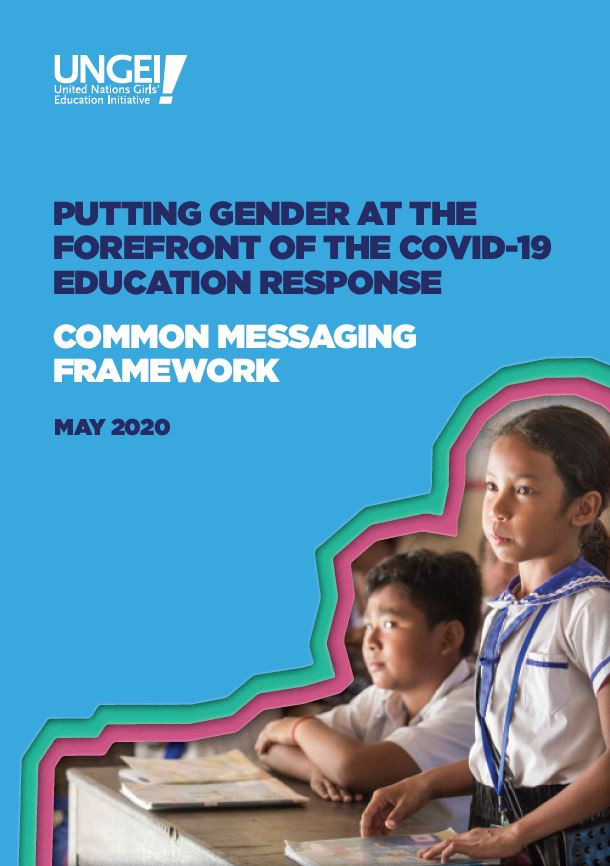 Putting Gender at the Forefront of the COVID-19 Education Response: Common Messaging Framework Année de publication: 2020 Auteur institutionnel: United Nations Girls' Education Initiative (UNGEI) Nationwide school closures as part of measures to prevent the spread of COVID-19 have disrupted the education of an entire generation of children and youth. Previous health emergencies demonstrate that girls are disproportionately affected, with the effects of gender inequality and unequal power structures exacerbated in times of crisis. This Common Messaging Framework, developed with UNGEI partner and ally organisations, can be used as an advocacy tool to leverage the power of collective action to position gender at the forefront of the COVID-19 response and enhance coherence in advocacy and communications efforts. Mettre le genre au premier plan de la réponse éducative au COVID-19: Cadre de messagerie commun Année de publication: 2020 Auteur institutionnel: United Nations Girls' Education Initiative (UNGEI) Les fermetures d’écoles à l’échelle nationale dans le cadre des mesures visant à prévenir la propagation du COVID-19 ont perturbé l’éducation de toute une génération d’enfants et de jeunes. Les urgences sanitaires antérieures démontrent que les filles sont touchées de manière disproportionnée, les effets de l’inégalité entre les sexes et des structures de pouvoir inégales étant exacerbés en temps de crise.En tant que partenariat mondial dédié à la promotion de l’égalité des sexes dans et à travers l’éducation, nous devons tirer parti de la puissance de l’action collective pour placer le genre au premier plan de la réponse COVID-19 et renforcer la cohérence dans le plaidoyer et la communication entre les organisations partenaires et alliées.Cette initiative de messagerie commune représente une opportunité stratégique pour favoriser le dialogue et attirer l’attention sur les impacts sexospécifiques de COVID-19, plaider en faveur de stratégies pour répondre aux dimensions sexospécifiques de cette crise et envisager la réouverture en toute sécurité des écoles à travers une perspective sexospécifique.