
Ressources
Explorez une large gamme de ressources sur le GCED afin d’approfondir votre compréhension et de renforcer vos activités de recherche, de plaidoyer, d’enseignement et d’apprentissage.
3,182 résultats trouvés
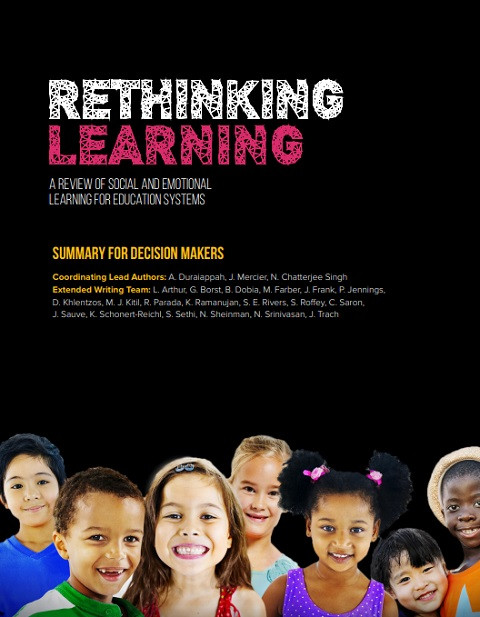 [Summary] Rethinking Learning: A Review of Social and Emotional Learning for Education Systems; Summary for Decision Makers Année de publication: 2020 Auteur institutionnel: Mahatma Gandhi Institute of Education for Peace and Sustainable Development (MGIEP) The publication, titled “Rethinking Learning: A Review of Social and Emotional Learning (SEL) for Education Systems” was worked upon from 2018 to 2020. The purpose of this publication was to review the latest research on SEL and to present scientific evidence for why SEL is key to education, and by that corollary, to achieving the United Nations (UN) Sustainable Development Goals (SDGs), specifically SDG 4, Target 7 that focuses on building peaceful and sustainable societies through education.This summary, aimed at decision makers, synthesises and integrates the main findings, challenges and recommendations from the eight chapters of the full Review. The key questions that guided the Review were: (i) What constitutes an SEL intervention; (ii) Why and when SEL interventions are necessary; (iii) The science and evidence supporting SEL interventions; (iv) How can SEL be implemented; and (iv) The cost and benefits of SEL interventions.
  Lack of Modern Students' Well-Ordered Public Life and the Construction Way—From the Perspective of Schools' Civic Education Année de publication: 2019 Auteur: Gao Fengqing Auteur institutionnel: Shanxi Academy of Educational Sciences | Shanxi Educational Association Public life is a practical communication activity for citizens that takes place in the public sphere to promote public awareness, public affairs and public morality. The lack of students’ public life is likely to lead to the lack of relationship in schools’ civic education, the weakening of students’ micro-public space consciousness and publicity in the Internet age, and the removal of cultural intimacy of civic education. Schools’ civic education should be based on the construction of the whole social public space, so that students’ public life will be organically linked with the global social public space. Schools should solve the conflicts between public expression and individual discourse expression by activating the student citizenship, pay attention to the shaping of students’ cultural emotions through public life experience of national history and Confucianism, and promote the achievement of students’ social emotions and social consensus. 当代学生良序公共生活的匮乏及构建途径: 基于学校公民教育视角 (教育理论与实践; Vol. 39, No. 16) Année de publication: 2019 Auteur: Gao Fengqing Auteur institutionnel: Shanxi Academy of Educational Sciences | Shanxi Educational Association 公共生活是发生在公共领域中的以促进公共意识、公共事务和公共道德品行养成的公民实践交往活动,学生公共生活的匮乏容易造成学校公民教育的关系性存在缺失、互联网时代学生微公共空间意识和公共性的弱化、消解公民教育的文化亲密性。学校公民教育应立足建构全域的社会公共空间,使学生公共生活与全域的社会公共空间形成有机联系,通过激活学生公民身份解决公共表达和个体话语表达的冲突,重视国家历史和儒家立场的公共生活经验对学生文化情感的形塑,促进学生社会情感和社会共识的达成。
  Educar para la vida: El desarrollo de las habilidades socioemocionales y el rol de los docentes Année de publication: 2020 Auteur: Elena Arias Ortiz | Diana Hincapié | Diana Paredes Auteur institutionnel: Inter-American Development Bank Esta nota técnica presenta un diagnóstico sobre la incorporación de las habilidades socioemocionales en 12 países de América Latina y el Caribe, y la formación que reciben los docentes para desarrollar estas habilidades en los estudiantes. Si bien se han registrado avances, resaltamos los principales desafíos que se deben enfrentar para desarrollar las habilidades socioemocionales.
  Research on National Education Strategies From the Perspective of Multi-Ethnic National Identity Construction (Heilongjiang National Series; No.1) Année de publication: 2019 Auteur: Du Richen | Zhang Jingyue Auteur institutionnel: Heilongjiang National Research Institute Civic education is an important means to enhance national identity. The idea of modern civic education originated in the West, and after historical development, it has formed three main ideas of civic education, liberalism, communitarianism and multiculturalism. In terms of the practice of enhancing national identity through civic education, both native and immigrant ethnic groups enhance national identity through national education. As China is a multi-ethnic country, the theory and practice of foreign citizenship education have important reference and enlightenment significance for our country to enhance national identity. 多民族国家认同建构视野下的国民教育策略研究 (黑龙江民族丛刊; No. 1) Année de publication: 2019 Auteur: Du Richen | Zhang Jingyue Auteur institutionnel: Heilongjiang National Research Institute 公民教育是增进国家认同的重要手段。现代公民教育理念发端于西方,经过历史发展,已经 形成了自由主义、社群主义和多元文化主义等三种主要公民教育理念。从公民教育增进国家认同的实践来 看,原生型民族国家和移民型民族均通过国民教育增强国家认同。中国作为一个多民族国家,国外公民教育 的理论与实践对于我国增进国家认同具有重要的借鉴与启示意义。
  Youth Participation and Global Citizenship: Challenges and Recommendations for Future Youth School Forums Année de publication: 2016 Auteur: Anna Jarkiewicz | Joanna Leek Auteur institutionnel: Oxfam GB | University of S odz (Poland) The overall purpose of this report is to identify the needs of the Future School Youth Forums on youth participation and global citizenship education. The study synthesizes information from Cyprus, Italy, Lithuania, Poland and the United Kingdom in order to understand similarities and differences, and compare them with wider European trends to understand transversal needs across Europe. It discusses in greater detail the current application of global citizenship youth forums and global citizenship/youth participation in each of the 5 countries – and therefore across 7 national systems (as Wales and Scotland have their own systems), and also transversally across Europe. The report will help Partners to better understand the project’s needs, so that they can design project outputs more effectively.
  The Status and Issues of Peace Education: Focussing on Its Interactions with Unification Education Année de publication: 2019 Auteur: Jeongah Cho | Ellie Kim | Ahyoung Moon | Boyoung Yoon Auteur institutionnel: Korea Institute for National Unification To lay the groundwork to explore the accessibility of peace education and unification education in an era of peace cooperation on the Korean Peninsula, this study takes a look at the history of peace education and the current situation and issues of both peace education and unification education. Against the backdrop of the division on the Korean Peninsula, unification education and peace education have been established as educational sectors of conflict resolution between the North and the South and of means of mediation for violence caused by the division. The two sectors have developed commonalities along the way. The origin of peace education and unification education is rooted on the division of the Korean Peninsula and the subsequent unification issues. In the current educational practices, there are different characteristics and emphasis in terms of the direction, contents, and subject of education between peace education and unification education. Efforts of creating “peace·unification education” are recently being made which focuses more on issues of peace than existing unification education. Peace education and unification education exhibit differences when it comes to the relationship between peace and unification in realizing a peaceful Korean Peninsula, whether unification is justified as an ultimate goal, how issues of ‘positive peace’ and security are handled, and how much initiatives the learners have. This study asserts that the issues between peace education and unification education should be clarified and that the two sectors should expand the overlapping areas under the principal of dealing with unification issues on the basis of value of peace. 평화교육의 실태와 쟁점: 통일교육과의 접점을 중심으로 Année de publication: 2019 Auteur: 조정아 | 김엘리 | 문아영 | 윤보영 Auteur institutionnel: 통일연구원 이 연구는 한반도 평화협력의 시대에 평화교육과 통일교육의 접근 가능성을 모색하기 위한 기초작업이다. 평화교육의 역사를 고찰하고 평화 교육과 통일교육 실태와 쟁점을 살펴보았으며, 이에 기초하여 평화교육과 통일교육의 과제를 도출하였다. 통일교육과 평화교육은 분단의 역사 속에서 분단과 남북 간의 대립, 분단으로 인한 폭력과 비평화를 해소하기 위한 교육으로 자리매김하였고, 그 과정에서 접점을 형성하고 공동의 영역을 만들어왔다. 평화교육의 역사 고찰에서 나타난 바와 같이, 한국의 평화교육은 그 태생에서부터 분단의 극복과 민족화해라는 문제를 중심에 놓았다. 한국에서 평화교육은 우리 사회의 폭력의 주요한 원인 중 하나인 분단문제를 고민하지 않고 이루어질 수는 없는 것이었다. 그 점에서 평화교육과 통일교육은 태생에서부터 한반도의 분단과 통일이라는 출발점을 공유하고 있다. 그럼에도 불구하고, 평화교육이라는 이름으로 불리는 교육실천과 통일교육이라는 이름으로 불리는 교육실천의 현재 모습 속에는 교육의 방향성, 내용, 주체 등의 측면에서 서로 다른 특성과 강조점이 나타난다. 특히 통일교육 영역에서 최근 평화‧ 통일교육이라는 명칭으로 기존 통일교육과의 차별화를 시도하고 있지만, 한반도 평화에서 통일의 위상, 통일의 당위성 문제, 적극적 평화와 안보문제, 학습자의 주도성 등을 다루는 관점에서 평화교육과의 차이가 존재한다. 이에, 이 연구에서는 평화교육과 통일교육 중 어느 하나가 다른 쪽을 대체하거나 양자를 통합해야 한다고 주장하기보다는, 평화교육과 통일 교육이 양자의 문제의식을 공유하면서 한반도 분단과 통일문제를 평화의 관점과 가치에 입각해서 다루어야 한다고 보았다. 이를 위한 정책과 평화교육의 실태와 쟁점: 통일교육과의 접점을 중심으로 제로 ① 교육 방향성 정립과 이를 위한 사회적 논의, ② 역량중심으로 평화교육 및 통일교육 내용체계 개편, ③ 민간 영역의 자율성 확대와 거버넌스 구축, ④ 시대적 과제와 평화지향성을 반영한 통일교육 관계 법령 정비를 제시하였다.
  Time to Reach for the Moon: The EU Needs to Step up Action and Lead the Transformation to Sustainability; Civil Society SDG Monitoring Report Année de publication: 2020 Auteur: Sylvia Beales | George Gelber Auteur institutionnel: SDG Watch Europe | Make Europe Sustainable for All This report explains why the EU’s SDG reporting creates an illusion of sustainability and makes concrete proposals for meaningful monitoring to become a stronger foundation for transformative policies. The report flags up serious gaps, bringing them to life with 17 individual stories. It also offers 17 solutions, real-life examples of progressive policies, innovative initiatives and truly sustainable business models.