
Ressources
Explorez une large gamme de ressources sur le GCED afin d’approfondir votre compréhension et de renforcer vos activités de recherche, de plaidoyer, d’enseignement et d’apprentissage.
3,158 résultats trouvés
 Holocaust & Human rights education center This curriculum guide was developed by a group of master teachers who have studied and taught the Holocaust in the context of history and the language arts. The New York State Core Curriculum and Learning Standards in English Language Arts and Social Studies have guided our selection of activities, historical documents and assessment tools. All materials and activities have been field-tested; they are challenging, age-appropriate and well suited to the needs of a diverse student population. Centre d'éducation Holocauste et Droits de l'homme Ce guide pédagogique a été développé par un groupe de maîtres enseignants qui ont étudié et enseigné l'Holocauste dans le contexte de l'histoire et les arts du langage. Le curriculum de l'État de New York de base et les normes d'apprentissage en English Language Arts et études sociales ont guidé notre sélection d'activités, des documents historiques et des outils d'évaluation. Tous les matériaux et les activités ont été testées sur le terrain; ils sont difficiles, adaptés à l'âge et bien adapté aux besoins d'une population étudiante diversifiée.
  Understanding Matters: Holocaust Curricula and the Social Studies Classroom Over the past two decades, interest in Holocaust education has grown substantially as individual states, starting in the 1980s, began to mandate and/or recommend Holocaust studies as part of the social studies curriculum. As a result, these mandates and/or interest in the Holocaust have spawned any number of curriculum products, some of which seek less to help the student of history acquire an understanding of this historical event, and more in terms of dictating to the social studies student what he or she should understand. Hence, the purpose of this paper is to critique Holocaust curricula that have been developed under the auspices of a state department of education (SDE) or endorsed by a SDE, as we believe that teachers unfamiliar with the Holocaust will turn to these products as sources of authority. We base this critique on what we refer to as three approaches or considerations to understanding history—the body of work on historical thinking which we view as the underpinning of historical empathy and positionality, historical empathy as articulated by Elizabeth Yeager, O.L. Davis, Jr., and Stuart Foster, and the guidelines on teaching the Holocaust developed for the U.S. Holocaust Memorial Museum by William Parsons and Samuel Totten. These three elements, each in their own way, help us to understand the challenge for teachers and students whose foundation for understanding the Holocaust may solely rest upon curriculum products whose curricular aims and/or design often obstruct the quest to “understand,” e.g., lack of historical accuracy, lack of depth, and historical gaps. (By the author)
 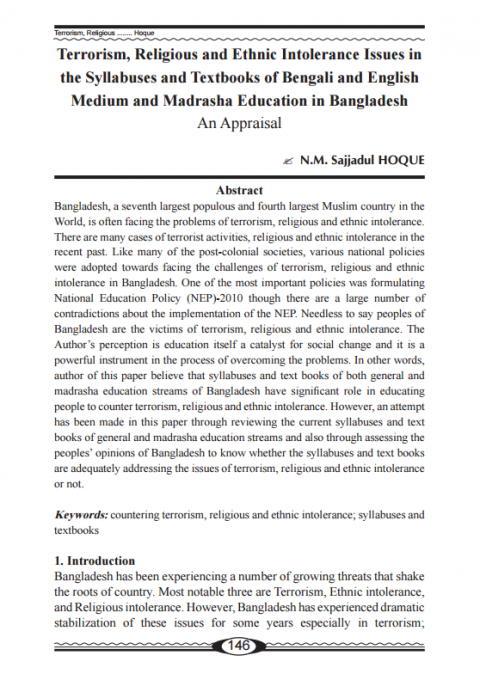 Terrorism, Religious and Ethnic Intolerance Issues in the Syllabuses and Textbooks of Bengali and English Medium and Madrasah Education in Bangladesh an Appraisal Année de publication: 2014 Auteur: NM Sajjadul Hoque The author argues that education is a catalyst for social change and a powerful instrument for overcoming social and security problems. In other words, the author believes that syllabuses and textbooks of both the general and madrasa education streams of Bangladesh have a significant role in educating people to counter terrorism as well as religious and ethnic intolerance. This paper attempts, however, by reviewing the current syllabuses and textbooks of general and madrasa education streams, and also by assessing peoples’ opinions in Bangladesh, to know whether the syllabuses and text books are adequately addressing, or not, the issues of terrorism and religious and ethnic intolerance. Terrorism, Religious and Ethnic Intolerance Issues in the Syllabuses and Textbooks of Bengali and English Medium and Madrasah Education in Bangladesh an Appraisal Année de publication: 2014 Auteur: NM Sajjadul Hoque L'auteur fait valoir que l'éducation est un catalyseur du changement social et un instrument puissant pour surmonter les problèmes sociaux liés à la sécurité. En d'autres termes, l'auteur estime que les programmes et les manuels scolaires de l’enseignement général et de la madrasa au Bangladesh ont un rôle important à jouer dans la lutte contre le terrorisme, l'intolérance religieuse et ethnique, à travers l'éducation. Ce document s’efforce, toutefois, d’examiner, si les programmes et les manuels abordent de manière adéquate, ou non, les questions du terrorisme et de l'intolérance religieuse et ethnique. L’auteur évalue les programmes actuels et les manuels en cours d’utilisation dans les établissements d’enseignement général et dans les madrasas, ainsi que les points de vue des Bangladeshis.
  Breaking Historical Silence through Cross-cultural collaboration: Latvian curriculum writers and United States Holocaust Memorial Museum fellows In response to the need for Holocaust curricula in Latvia, Latvians and Americans worked collaboratively to overcome the historical silence surrounding this event. During their project, Latvian curriculum writers worked with teachers and scholars at the United States Holocaust Memorial Museum. This descriptive analysis of the Latvians' experience with Museum Fellows revealed opportunities to learn from each other the complexities of teaching the Holocaust in a country viewed by some as collaborators and still somewhat anti-Semitic. Findings included depth of guidance, values, and limits of innovative teaching methods, cross-cultural benefits, and continued collaboration. Recommendations for future efforts by post-Communist countries and American partners to develop curriculum on teaching a most complex and contentious aspect of history such as the Holocaust conclude the study. (By the author)
  “We did also save people”: A Study of Holocaust Education in Romania After Decades of Historical Silence Année de publication: 2008 Auteur: Thomas Misco This research study seeks to understand the current state of Holocaust education in Romanian classrooms and the variety of forces that influence its treatment. By identifying obstacles, challenges, and successes, this study provides a generative knowledge base for curriculum proposals, symposia, and other initiatives that seek to disrupt reticence on this topic. Given the wide range of possible influences on Holocaust instruction, this study employs ethnographic methods to seek out constructed meanings among students, teachers, subject matter, and numerous forces within the milieu. The findings reveal some promise for addressing this history in schools, including teacher autonomy, institutional support, and teacher trainings. Yet Romania faces a number of challenges, such as the legacy of communism, the role of Antonescu in the curriculum, few opportunities to address controversies, limited instructional time, and other institutional and community forces. Holocaust education is a relatively new phenomenon in Romania and understanding its evolution can inform other societies and cultures that are working to introduce Holocaust studies or controversial issues into their curricula. As more post-Soviet and post-communist states attempt to build pluralistic, tolerant and open-minded societies, their treatment of historical silences and the renegotiation of their past become critical features for the development of democratic citizens. (By the author)
  "Nobody Told Us about What Happened": The Current State of Holocaust Education in Romania This research study sought to understand the current state of Holocaust education in Romanian classrooms and how sociocultural and institutional forces influence its treatment. By identifying the obstacles, challenges, and successes of Holocaust education in Romania, this study can both disseminate the techniques and conditions that bring about meaningful Holocaust education and provide a generative knowledge base for curriculum proposals, symposia and other initiatives that seek to disrupt reticence on this topic. Given their recent accession to the European Union, this is a timely study that also examines Romania's educational efforts concerning the development of democratic skills and dispositions, many of which often result from addressing controversial topics and closed areas, including the Holocaust in Romania. Holocaust education is a relatively new phenomenon in Romania and studying its inception can offer insights for other societies and cultures that are working to introduce Holocaust or controversial issues into their middle and high school curricula. As more post-Soviet and post-communist states attempt to build pluralistic, tolerant, and open-minded societies their treatment of historical silences and the renegotiation of their past become critical features for the development of democratic citizens. Holocaust education is well-qualified to meet the demands of citizenship education as it helps to promote tolerant societies free from prejudice, racism and bigotry, while simultaneously promoting the inclusivity of others, justice-oriented dispositions and commitments to peace (Salmons, 2003). (By the author)
  Education for Citizenship in the Caribbean: A Study on Curricular Policy and Teacher Training in Cuba, Haiti and the Dominican Republic Année de publication: 2005 Auteur: Cheila Valera Acosta Auteur institutionnel: UNESCO International Bureau of Education (IBE) | Facultad Latinoamericana de Ciencias Sociales (FLACSO) This study aims to describe teacher training and curricular policy for the primary and secondary levels in relation to education for citizenship in Cuba, Haiti and the Dominican Republic and make practical recommendations for improvements in the quality of design and implementation of these initiatives in the three countries.The following are some of the conclusions: At the start of the twenty-first century, Cuba, the Dominican Republic and Haiti share a context in which the processes of democratization have encountered obstacles connected with their colonial heritage, the hegemony of the European nations and the influence and direct interference from United States geopolitical, economic and cultural power.These democracies have developed from long and violent political dictatorships, which established authoritarian and restrictive institutional mechanisms for the day-to-day administration of public affairs. Public policies on education for citizenship should therefore take account of the contradictions faced by the democratizing processes and of the complex cultural impact on the development of social identities brought about by the phenomenon of mass migration.These issues and the tensions arising from social and economic inequalities are inadequately addressed in the three countries’ curricula and teacher training policies.There are legal bases integrating education for citizenship as part of the State’s educational responsibilities in all three countries. Education for citizenship is intended as a specific subject for the primary and secondary school levels.Educational proposals are required that can provide the population with greater understanding of community life, skills for confronting traditional ideological indoctrination, and for learning to live together while recognizing differences, and for helping to educate the imagination for a broader view of human affairs and our responsibilities with regard to them.The actors involved in teacher training in the three countries consider it a key tool for the democratic development of societies. Their main criticisms indicate that there is a need to improve the contents and the approaches to teacher training so that they can respond to the current challenges of these societies from an interdisciplinary standpoint consistent with the stated educational goals. Education à la citoyenneté dans les Caraïbes: une étude sur la politique des programmes et la formation des enseignants à Cuba, en Haïti et en République Dominicaine Année de publication: 2005 Auteur: Cheila Valera Acosta Auteur institutionnel: UNESCO International Bureau of Education (IBE) | Facultad Latinoamericana de Ciencias Sociales (FLACSO) Cette étude vise à décrire la formation des enseignants et de la politique des programmes d'études pour les niveaux primaire et secondaire par rapport à l'éducation à la citoyenneté à Cuba, en Haïti et en République dominicaine et faire des recommandations pratiques pour l'amélioration de la qualité de la conception et la mise en œuvre de ces initiatives dans les trois pays .Voici quelques-unes des conclusions:Au début du XXIe siècle, Cuba, la République Dominicaine et Haïti partagent un contexte dans lequel les processus de démocratisation ont rencontré des obstacles liés à leur héritage colonial, l'hégémonie des nations européennes et l'influence et l'ingérence directe de Etats-Unis puissance géopolitique, économique et culturelle.Ces démocraties ont développé des dictatures politiques longues et violentes, qui ont établi des mécanismes institutionnels autoritaires et contraignantes pour l'administration des affaires publiques au jour le jour. Les politiques publiques en matière d'éducation à la citoyenneté doivent donc tenir compte des contradictions rencontrées par les processus de démocratisation et de l'impact culturel complexe sur le développement des identités sociales provoquées par le phénomène de la migration de masse.Ces questions et les tensions résultant des inégalités sociales et économiques ne sont pas suffisamment abordés dans les programmes scolaires et la formation des enseignants des politiques des trois pays.Il y a des bases juridiques intégrant l'éducation à la citoyenneté dans le cadre des responsabilités éducatives de l'Etat dans les trois pays. Education à la citoyenneté est conçue comme un sujet spécifique pour les niveaux primaire et secondaire.propositions pédagogiques sont nécessaires qui peuvent fournir à la population avec une plus grande compréhension de la vie communautaire, les compétences pour faire face à l'endoctrinement idéologique traditionnelle, et pour apprendre à vivre ensemble, tout en reconnaissant les différences, et pour aider à éduquer l'imagination pour une vision plus large des affaires humaines et nos responsabilités en ce qui concerne eux.Les acteurs impliqués dans la formation des enseignants dans les trois pays considèrent comme un outil clé pour le développement démocratique des sociétés. Leurs principales critiques indiquent qu'il ya un besoin d'améliorer le contenu et les approches de la formation des enseignants afin qu'ils puissent répondre aux défis actuels de ces sociétés à partir d'un point de vue interdisciplinaire cohérent avec les objectifs éducatifs énoncés