
Ressources
Explorez une large gamme de ressources sur le GCED afin d’approfondir votre compréhension et de renforcer vos activités de recherche, de plaidoyer, d’enseignement et d’apprentissage.
3,158 résultats trouvés
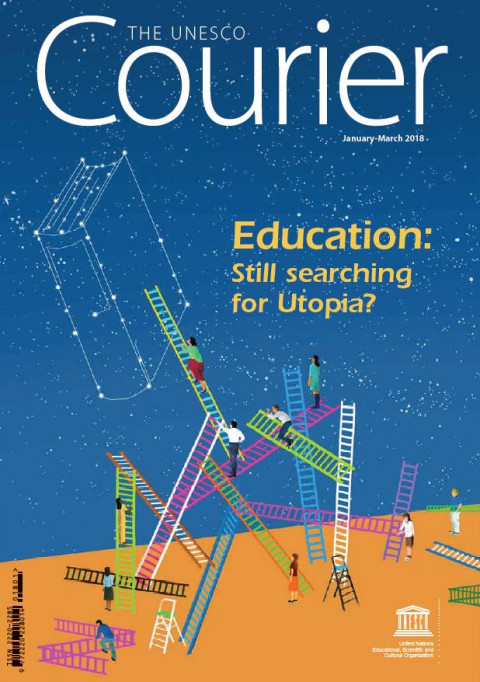 Education: en quête d'une utopie nécessaire (Le Courrier de l’UNESCO no. 1, Janvier-Mars 2018) Année de publication: 2018 Auteur institutionnel: Organisation des Nations Unies pour l'éducation, la science et la culture (UNESCO) À une époque où la tension ne cesse de croître, où les droits de l'homme, la liberté d'expression, la paix et l'avenir de la planète semblent plus que jamais remis en question, le pouvoir de transformation véhiculé par l'éducation revêt une importance cruciale.L’éducation est une « utopie nécessaire », elle est « un atout indispensable pour permettre à l’humanité de progresser vers les idéaux de paix, de liberté et de justice sociale », lit‑on dans le rapport historique de l’UNESCO, L’éducation : un trésor est caché dedans, élaboré par la Commission internationale sur l'éducation pour le XXIe siècle, présidée en 1996 par Jacques Delors.L'éducation n'y est présentée ni comme miracle, ni comme baguette magique, mais comme le meilleur moyen de favoriser un climat permettant à l'humanité de s’améliorer.Notre humanité est confrontée à un paradoxe très étrange : la population mondiale n’a jamais été aussi instruite, alors que, selon l’Institut de statistiques de l’UNESCO, 263 millions d’enfants et de jeunes ne sont pas scolarisés, que 617 millions d’enfants et d’adolescents dans le monde n’atteignent pas le seuil minimal de compétence en lecture et en mathématiques, qu’au moins 750 millions d’adultes sont analphabètes, et que les filles demeurent plus susceptibles que les garçons de ne jamais mettre les pieds dans une classe. Cependant l’éducation est toujours appelée à remédier aux inégalités, à la pauvreté, au terrorisme et aux conflits. Elle est considérée comme une des clés essentielles de la citoyenneté mondiale et du développement durable, deux domaines d’action de l’UNESCO, qui a aussi pour mandat de diriger l’agenda mondial Éducation2030 en veillant tout particulièrement à ce que personne ne soit laissé pour compte.Sous le titre « Éducation : en quête d'une utopie nécessaire », Le Courrier de l'UNESCO porte un regard panoramique sur l'éducation dans le monde et explore comment elle peut répondre à certains grands défis. La Educación, una utopia necesaria (El Correo de la UNESCO no.1, Enero-Marzo 2018) Année de publication: 2018 Auteur institutionnel: Organización de las Naciones Unidas para la Educación, la Ciencia y la Cultura (UNESCO) El poderoso vector de transformación que es la educación reviste una importancia fundamental en estos tiempos en que parecen ponerse en tela de juicio más que nunca los derechos humanos, la libertad de expresión, la paz y el futuro de nuestro planeta.La educación es una “utopía necesaria” y “constituye un instrumento indispensable para que la humanidad pueda progresar hacia los ideales de paz, libertad y justicia social”, tal como se afirma en el histórico informe “La educación encierra un tesoro”, presentado a la UNESCO en 1996 por la Comisión Internacional sobre la Educación para el siglo XXI presidida por Jacques Delors.La educación, según ese informe, no es un remedio milagroso ni un mágico “ábrete sésamo”, sino una vía mejor que otras para lograr que la humanidad sea mejor.Nuestra época afronta una situación extremadamente paradójica. Mientras que el nivel de instrucción de la población mundial ha alcanzado su más alto nivel histórico, todavía quedan en el mundo 263 millones de niños y adolescentes sin escolarizar y otros 617 millones no logran alcanzar un nivel mínimo de competencia en lectura, escritura y matemáticas. Además, hay 750 millones de adultos analfabetos y actualmente la posibilidad de que las niñas y las jóvenes no pisen jamás una escuela es mucho más alta que en el caso de los varones. Ahora bien, la educación sigue siendo un instrumento indispensable para reducir las desigualdades, la pobreza, elterrorismo y los conflictos armados, así como un factor clave para la mentalización de las personas con vistas a que lleguen a “ciudadanos del mundo” y coadyuven a al desarrollo sostenible. La educación para la ciudadanía y para el desarrollo sostenible son dos ámbitos de acción de la UNESCO, que además tiene el mandato de liderar la agenda mundial Educación 2030, procurando en especial que los sistemas educativos no dejen a nadie atrás.Bajo el título “La educación, una utopía necesaria”, El Correo de la UNESCO traza una panorámica de determinados aspectos de la educación en el mundo, así como de la manera en que ésta puede responder a algunos de los grandes retos planteados a la humanidad.
  Rising Beyond: Aiming towards a Brighter Future Année de publication: 2021 Auteur: Aarya Chavda As children, how do we truly define a better understanding towards the right to choose, right to dream and right to self-express? This book emphasizes on the true meaning that there is no duty more important than ensuring that children’s rights are respected.
 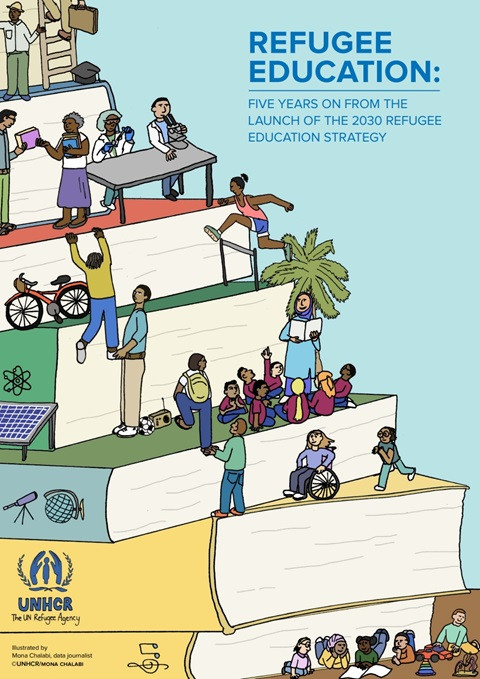 Refugee Education; Five Years on from the Launch of the 2030 Refugee Education Strategy Année de publication: 2024 Auteur: Cirenia Chavez Villegas | Kate Bond Auteur institutionnel: UN. Office of the United Nations High Commissioner for Refugees (UNHCR) The 2024 UNHCR Refugee Education Report draws on data from more than 65 countries worldwide to provide the most detailed picture yet of the state of refugee education and enrolment. The report reflects on the 2030 Refugee Education Strategy (launched in 2019) and where notable progress has been made as well as areas where greater investment and enhanced collaboration are needed to meet the strategic objectives of the Strategy.
  Educational Route: Lessons Learned Année de publication: 2024 Auteur institutionnel: Save the Children This report, prepared by Save the Children in partnership with HIAS and funded by ECHO, sets out the main lessons learned from the Educational Route project, which has had areas of intervention in Mexico, Panama, Costa Rica, Guatemala, Honduras and El Salvador. The objective of the project has been to contribute to reducing barriers to access to education for children, adolescents and families on the move along the Central American migratory routes. Within the framework of the project, a methodological package has been created containing an evaluation tool “HALDO on the move” (Holistic Assessment of Learning and Development Outcomes) that allows different humanitarian actors to quickly assess the educational level of children and adolescents and record their data on a platform in order to offer an emergency education response adapted to real learning needs, as well as achieve greater coordination to promote educational continuity along the route. Ruta educativa: Lecciones aprendidas Année de publication: 2024 Auteur institutionnel: Save the Children El presente informe, elaborado por Save the Children en alianza con HIAS y financiado por ECHO, expone las principales lecciones aprendidas del proyecto Ruta Educativa, que ha tenido como zonas de intervención México, Panamá, Costa Rica, Guatemala, Honduras y El Salvador. El objetivo del proyecto ha sido contribuir a reducir las barreras de acceso a la educación de niños, niñas, adolescentes y familias en movimiento en las rutas migratorias centroamericanas, y en el marco del mismo se ha creado un paquete metodológico que contiene una herramienta de evaluación “HALDO on the move” (Holistic Assessment of Learning and Development Outcomes) que permite a los diferentes actores humanitarios evaluar rápidamente el nivel educativo de los niños, niñas y adolescentes y registrar sus datos en una plataforma con el fin de ofrecer una respuesta de educación en emergencias adaptada a las necesidades de aprendizaje reales, así como lograr una mayor coordinación para promover la continuidad educativa a lo largo de la ruta.
  Safe Schools Declaration Année de publication: 2015 Auteur institutionnel: Global Coalition to Protect Education from Attack (GCPEA) The Safe Schools Declaration is an intergovernmental political commitment that was developed at an international conference held in Oslo, Norway, on 28-29 May 2015. The Declaration allows countries the opportunity to express their political support for the protection of students, teachers and schools during times of armed conflict; the importance of the continuation of education during armed conflict; and the implementation of the Guidelines for Protecting Schools and Universities from Military Use during Armed Conflict. Declaración sobre escuelas seguras Année de publication: 2015 Auteur institutionnel: Global Coalition to Protect Education from Attack (GCPEA) La Declaración sobre Escuelas Seguras es un compromiso político intergubernamental que se construyó en el marco de una conferencia internacional celebrada en Oslo, Noruega, el 28-29 de mayo de 2015.La Declaración permite a los países la oportunidad de expresar su apoyo político para la protección de los estudiantes, maestros y escuelas durante tiempos de conflicto armado; la importancia de la continuación de la educación durante los conflictos armados y la aplicación de las Directrices para Proteger Escuelas y Universidades de Uso Militar durante Conflicto Armado.
  Gender-Based Hate Crime Année de publication: 2021 Auteur institutionnel: Organization for Security and Co-operation in Europe (OSCE) Gender-based hate crimes are a consequence of gender inequalities and disproportionately affect women, as well as anyone perceived as not complying with prevailing gender norms. Gender-based hate crimes often seek to intimidate and suppress ways of life or expressions of identity that are perceived as not complying with traditional gender norms. They have a significant, long-lasting impact on the victims, and undermine security and social cohesion by perpetuating gender inequalities. The existence of such crimes also underscores wider trends of intolerance towards other groups. Everyone has a role to play in countering this and all forms of intolerance.
  Education in a Post-COVID World: Additional Considerations (In-Progress Reflection; No.43, 2021) Année de publication: 2021 Auteur: Renato Opertti Auteur institutionnel: UNESCO International Bureau of Education (IBE) This discussion document analyses some implications of the ideas proposed in the seminal UNESCO document “Education in a post-COVID world: Nine ideas for public action” (2020). Based on the work of the International Commission on the Futures of Education, the documents’ contributors included prominent figures with a wide range of professional and policy experience who hail from various regions of the world. The set of nine interconnected ideas illuminates the way forward toward the transformation of education and education systems and a reimagined future seen through a progressive lens. On one hand, it reaffirms basic principles, understandings, and commitments with regard to education as a global common good and universal human right; it also articulates the need to both reinvent multilateralism for a new global order and, crucially, to mobilize ideas and funding for transforming education. On the other hand, the document advocates for a comprehensive educational agenda, including the following critical issues: (i) visualizing educators as decision-makers in educational systems; (ii) appreciating students as active actors with rights; (iii) recognizing the value and specificity of the school space; (iv) addressing the dilemmas around technology’s ability to serve as an equalizer of opportunities; and (v) revisiting educational content for the sustainability of younger generations.