
Ressources
Explorez une large gamme de ressources sur le GCED afin d’approfondir votre compréhension et de renforcer vos activités de recherche, de plaidoyer, d’enseignement et d’apprentissage.
3,158 résultats trouvés
 L’éducation dans un monde post-Covid: considérations supplémentaires (Réflexion en cours; No. 43, 2021) Année de publication: 2021 Auteur: Renato Opertti Auteur institutionnel: UNESCO International Bureau of Education (IBE) Ce document de discussion analyse certaines implications des idées proposées dans le document initial « L’éducation dans un monde post-COVID : Neuf idées pour l’action publique » (2020) produit par la Commission internationale sur les futurs de l’éducation. Parmi les contributeurs de ce document figurent des experts éminents ayant une large expérience professionnelle et politique, provenant de diverses régions du monde. L’ensemble de ces neuves idées interconnectées éclaire la voie à suivre pour transformer l’éducation et les systèmes éducatifs et concevoir l’avenir dans une optique progressiste. D’une part, il réaffirme les principes de base, la compréhension et les engagements concernant l’éducation en tant que bien commun mondial et droit de l’homme universel ; il exprime également la nécessité de réinventer le multilatéralisme pour un nouvel ordre mondial et, surtout, de mobiliser des idées et des fonds pour transformer l’éducation. D’autre part, le document plaide en faveur d’un programme éducatif global, incluant les questions critiques suivantes: (i) visualiser les éducateurs comme des décideurs dans les systèmes éducatifs ; (ii) considérer les étudiants comme des acteurs actifs ayant des droits ; (iii) reconnaître la valeur et la spécificité de l’espace scolaire ; (iv) aborder les dilemmes autour de la capacité de la technologie à combler les inégalités ; et (v) revoir les contenus d’enseignement pour la durabilité des jeunes générations. Educación en un mundo post-COVID: consideraciones adicionales (Reflexiones en Progreso; No.43, 2021) Année de publication: 2021 Auteur: Renato Opertti Auteur institutionnel: UNESCO International Bureau of Education (IBE) Este documento de discusión analiza algunas implicaciones de las ideas propuestas en el documento seminal “Educación en un mundo post-COVID: Nueve ideas para la acción pública” (2020) producido por la Comisión Internacional sobre el Futuro de la Educación. Entre los colaboradores del informe se encuentran destacadas figuras con una amplia experiencia profesional y política procedentes de diversas regiones del mundo. El conjunto de nueve ideas interconectadas ilumina el camino a seguir hacia la transformación de la educación y los sistemas educativos y hacia un futuro reinventado visto a través de una lente progresista. Por un lado, reafirma los principios, entendimientos y compromisos básicos con respecto a la educación como bien común global y derecho humano universal. También, articula la necesidad tanto de reinventar el multilateralismo para un nuevo orden global como, fundamentalmente, de movilizar ideas y financiación para transformar la educación. Por otro lado, el documento aboga por una agenda educativa integral que incluya los siguientes aspectos críticos: (i) visualizar a los educadores como tomadores de decisiones en los sistemas educativos; (ii) valorar a los estudiantes como agentes activos con derechos; (iii) reconocer el valor y la especificidad del espacio escolar; (iv) abordar los dilemas en torno a la capacidad de la tecnología para servir como igualadora de oportunidades; y (v) revisar los contenidos educativos para la sostenibilidad de las generaciones más jóvenes.
  New Citizenship, Culture of Peace and Democratic Integration: Pedagogical Guidelines and Didactic Proposals Année de publication: 2015 Auteur institutionnel: Argentina. Ministry of Education | Chile. Ministry of Education This document is an input that, in the form of a guide of pedagogical guidelines and teaching proposals, seeks to support the development of the objectives of the New Citizenship, Culture of Peace and Democratic Integration Program, promoted by the Ministry of Education of Argentina and the Ministry of Education of Chile. The first section corresponds to an introductory section, which communicates the principles on which the program is based. The second section is made up of the axes and chapters that structure the guide. Each axis (four in total) is subdivided into two chapters, articulated around the topic that the axis addresses and which is briefly presented at the beginning of it. Nueva ciudadanía, cultura de paz e integración democrática: Lineamientos pedagógicos y propuestas didácticas Année de publication: 2015 Auteur institutionnel: Argentina. Ministry of Education | Chile. Ministry of Education El presente documento es un insumo que, bajo la forma de una guía de lineamientos pedagógicos y propuestas didácticas, busca apoyar el desarrollo de los objetivos del Programa Nueva Ciudadanía, Cultura de Paz e Integración Democrática, que promueven el Ministerio de Educación de Argentina y el Ministerio de Educación de Chile. La primera sección corresponde a un apartado introductorio, que comunica los principios en que se basa el programa. La segunda sección está conformada por los ejes y capítulos que estructuran la guía. Cada eje (cuatro en total) está subdividido en dos capítulos, articulados en torno al tema que el eje releva y que es presentado, brevemente, al inicio de este.
  尊重个体的人: 国际法视野下国际理解教育的核心 (现代教育论丛; No.1, 2023) Année de publication: 2023 Auteur: 涂诗万 | 陈晶莹 国际理解教育中存在“一”与“多”之间的紧张关系。如果回到国际理解教育的源头——国际法,就能找到“一”与“多”之间的结合点,从而可化解它们之间的紧张。在教育目的方面,多项国际法明确规定培养和增进对人权和人的基本自由的尊重是现代教育应有的目的。从教育内容方面看,国际理解教育中的人权教育、多元文化教育、全球视野教育和民族文化认同教育都体现了国际法中尊重个体的人的原则。在教育方法方面,现代教育所倡导的向教师赋权、“学生中心”、自由交流和人道的惩罚都体现了国际法中尊重个体的人的原则。总之,国际理解教育就是要理解国际上共同理解的原则和价值。毫无疑问,国际法正是国际上共同理解的原则和价值的“公约数”。而对每个人的人权和基本自由的尊重则是这个“公约数”的核心。真正落实“尊重个体的人”的原则要求我们把自己作为方法,通过构建意义丰富的自治型的小共同体实施教育。
  他异与共同价值: 全球化时代国际理解教育的范式转型与价值转向 (现代教育论丛; No.2, 2023) Année de publication: 2023 Auteur: 叶雅萱 当前,全球化的日益深入使文化交往成为必然之事,而文化差异又难以避免地客观存在着。在这一背景下,充满异质性的多元文化如何共存与发展则成为全球化新时期各文化主体共同面对的重要课题。国际理解教育致力于通过促进文化理解使各文化共存成为可能。关于文化理解,有“不同”与“陌异”两种常见的认识范式,二者分别以内在性和外在性的眼光看待文化间关系。基于此二者的国际理解教育则分别走向普世主义与相对主义两种截然不同的价值立场,皆存在一定的教育隐忧。而“他异”的文化理解范式则可能成为超越两者、扭转国际理解教育困境的出口。“他异”的认识范式主张以兼具外在性与伦理性的眼光看待文化间关系,建立起互为他者的伦理共在关系。基于此,国际理解教育转向具有关系性、生成性的共同价值立场,重视文化主体间在对话与交往中建构让多元文化得以共存与发展的价值共识。
  Arts Education for the Children of the Arab World as a Mediator for Development and the Axis of International Understanding: The Child's Song Année de publication: 2014 Auteur: Amal Sadiq Auteur institutionnel: Arab Council for Childhood and Development (ACCD) This paper focuses on art education and music in the Arab world and its link to development. The paper goes on critical understanding on how music and art can educate children for international understanding. تعليم الفنون لأطفال العالم العربى وسيط للتنمية ومحور التفاهم الدولى : أغنية الطفل Année de publication: 2014 Auteur: Amal Sadiq Auteur institutionnel: Arab Council for Childhood and Development (ACCD) تركز الورقة على التربية الفنية والموسيقى في الوطن العربي وصلتها بالتنمية. تتناول الورقة فهمًا نقديًا لكيفية تعليم الموسيقى والفن للأطفال من أجل التفاهم الدولي.
 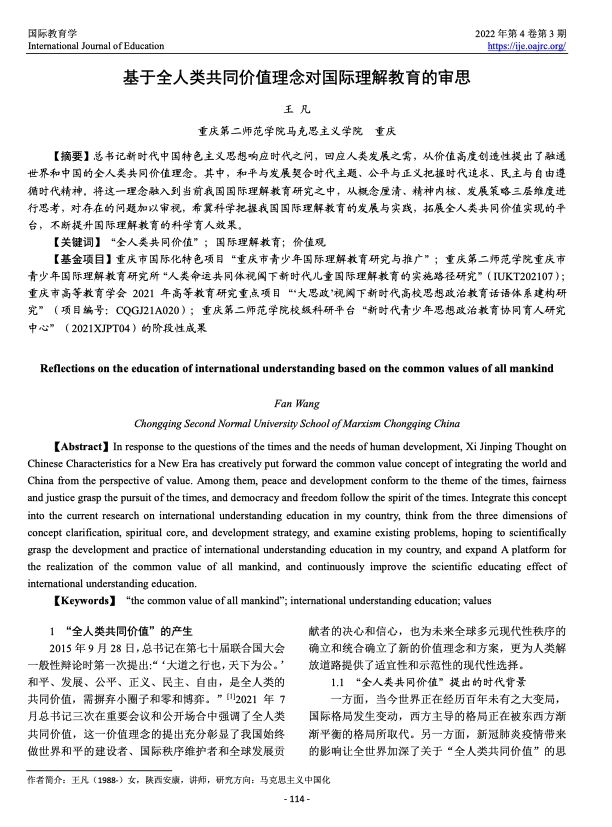 基于全人类共同价值理念对国际理解教育的审思 Année de publication: 2022 Auteur: 王凡 总书记新时代中国特色主义思想响应时代之问,回应人类发展之需,从价值高度创造性提出了融通世界和中国的全人类共同价值理念。其中,和平与发展契合时代主题、公平与正义把握时代追求、民主与自由遵循时代精神。将这一理念融入到当前我国国际理解教育研究之中,从概念厘清、精神内核、发展策略三层维度进行思考,对存在的问题加以审视,希冀科学把握我国国际理解教育的发展与实践,拓展全人类共同价值实现的平台,不断提升国际理解教育的科学育人效果。
  Bringing Living Heritage to the Classroom in Asia-Pacific: A Resource Kit Année de publication: 2022 Auteur institutionnel: UNESCO Bangkok | APCEIU | International Information and Networking Centre for Intangible Cultural Heritage in the Asia-Pacific Region (ICHCAP) Integrating living heritage in school teaching and learning can enhance education quality, enliven the experiences of students and teachers, and contribute to keeping this heritage alive for current and future generations. In addition, as the ongoing COVID-19 pandemic has also demonstrated, living heritage can play an important role in ensuring the well-being and resilience of communities. UNESCO encourages countries to safeguard living heritage through formal and non-formal education. From the end of 2019 to early 2022, UNESCO has been working with partners to implement a pilot project “Teaching and Learning with Living Heritage in Schools” in six countries in Asia and the Pacific - including Cambodia, Kazakhstan, Kyrgyzstan, Nepal, Republic of Korea and Thailand. Over 1900 students from 21 schools had the opportunity to participate in these innovative classes. Throughout the process, 86 teachers, with more than two thirds being women, have developed and tested 101 lesson plans and activities. This Resource Kit provides step-by-step guidance and key resources on why and how to integrate living heritage in lessons and extracurricular activities in schools. Whoever you are – policy-maker, school director, teacher, student, parent, heritage practitioner – you have a vital role to play in this process.