
Ressources
Explorez une large gamme de ressources sur le GCED afin d’approfondir votre compréhension et de renforcer vos activités de recherche, de plaidoyer, d’enseignement et d’apprentissage.
3,158 résultats trouvés
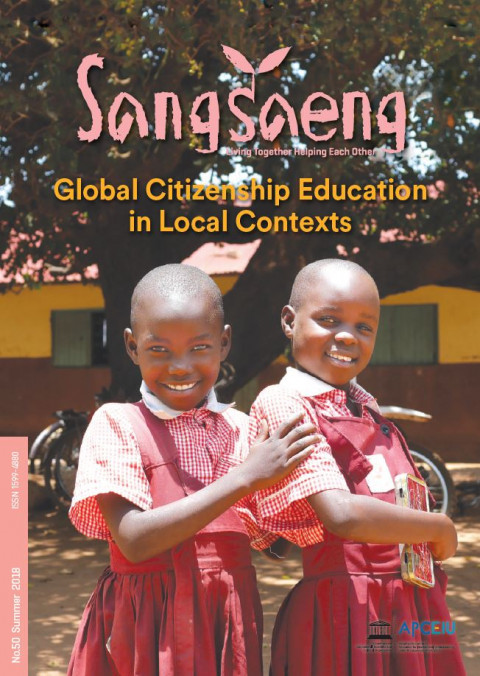 지역적 맥락 속에서의 세계시민교육 (상생 제50호 2018년 여름호) Année de publication: 2018 Auteur institutionnel: 유네스코 아시아태평양 국제이해교육원 3 발간사4 스페셜 칼럼: 학습자들의 머리와 마음을 사로잡는 교육8 포커스: 지역적 맥락 속에서 이루어지는 세계시민교육8 난관 속에서 세계시민교육을 수용하기12 교사들에게 가르치는 세계시민교육15 세계시민교육을 통해 제정된 캄보디아 역사교육과정19 미래의 지도자들의 마음 속에 평화의 방벽 쌓기 22 스페셜 리포트: 왜 학교에서 만화를 활용하는 것일까?26 모범사례26 좀비 재앙을 넘어서30 공간을 뜻깊은 배움의 장소로 탈바꿈하다34 인터뷰: 카메라 렌즈를 거쳐, 아프리카로부터 우리의 마음에게38 APCEIU에 보내는 편지 : 세계시민교육을 통해 친환경적이고, 평화롭고, 정의로운 세상으로 나아가기 40 유스 네트워크: 배우고, 주고 받고, 성장하고, 행동하는 청년들43 내 기억 속의 평화: 자기 땅에서 환영 받지 못하는 국가47 아시아-태평양 국가 지역 이해하기: 타투 : 태평양 지역에서의 여정50 교육원 활동
  ACER-APCEIU 세계시민교육 모니터링 가이드: 교사, 학교 관리자, 교육행정가를 위한 안내서 Année de publication: 2025 Auteur: Rachel Parker | Amy Berry | Payal Goundar | Karena Menzie-Ballantyne Auteur institutionnel: 호주교육연구위원회 | 유네스코 아시아태평양 국제이해교육원 『ACER-APCEIU 세계시민교육 모니터링 가이드: 교사, 학교 관리자, 교육행정가를 위한 안내서』는 APCEIU와 ACER가 2022년부터 2024년까지 3년에 걸쳐 호주, 라오스, 필리핀, 한국의 파트너들과 함께 수행한 공동연구의 결과물인 『ACER-APCEIU Global Citizenship Education Monitoring Toolkit for Teachers, Schools and System Leaders』를 한국의 맥락에 맞게 번역한 국문판이다.이 가이드는 다양한 수준의 교육 이해관계자가 세계시민교육에서 자신의 위치를 진단하고 목표와 계획을 수립하며, 실행과 평가를 지속적으로 이어가도록 설계된 탐구 순환 모형을 제시하며, 이를 각자의 맥락에 맞게 실천할 수 있도록 구체적인 지침과 방법을 안내한다.이 가이드의 주요 활용자는 정책 입안자, 교육부 및 교육청 등 유관 기관의 교육행정가, 학교장과 학교감 등 교육 리더십을 가진 이들뿐 아니라 정규·비정규 교육 전반에서 세계시민교육을 실천하는 모든 교사를 포함한다.
  Supporting Change in Practice: Case Studies on the Use of the ACER-APCEIU Global Citizenship Education Monitoring Toolkit: Country Case-Republic of Korea Année de publication: 2025 Auteur: Suyeon Park | Sunmi Ji | Yoonyoung Lee Auteur institutionnel: APCEIU APCEIU is pleased to announce the release of its new publications, Supporting Change in Practice: Case Studies on the Use of the ACER-APCEIU Global Citizenship Education Monitoring Toolkit, which shares key findings from the research conducted in Australia and the Republic of Korea. The two reports, based on case studies from two countries, build upon the three-phase Asia-Pacific GCED Monitoring Project (2022–2024) jointly undertaken by ACER and APCEIU to strengthen monitoring and evaluation of GCED and support progress toward SDG 4.7 across the region. The three phases of the initiative identified enabling conditions for GCED, validated the regional GCED Monitoring Framework, and developed the ACER-APCEIU GCED Monitoring Toolkit. The reports for each phase can be found here: Phase I, Phase II, and Phase III. The newly released reports move the project forward by examining how the Toolkit can be practically applied in real educational settings. The study aimed to examine how the Toolkit could be used to support collaboration among key education stakeholders—teachers, school leaders, and education supervisors—in 1) goal setting, 2) planning, 3) implementing, and 4) reflecting on GCED practices. Through this process, the research sought to understand how the Toolkit could help strengthen the connection between policy commitments and everyday educational practice, supporting teachers, school leaders, and system leaders to embed GCED more systematically and sustainably within their existing framework. Both studies conducted in Australia and the Republic of Korea have been guided by the following research questions: 1. How does the GCED Monitoring Toolkit support key stakeholder groups to collaboratively embed GCED in policy and practice? a. What aspects of the Toolkit enable or challenge stakeholders to achieve their GCED goals and objectives? b. How do key stakeholders perceive its usefulness? 2. Are there any aspects of the Toolkit that stakeholders would change to improve its usefulness in supporting the implementation and contextualisation of GCED in policy and practice?The reports demonstrate how a GCED Monitoring Toolkit can be translated into actionable processes within real educational settings. It offers valuable insights for policymakers, school leaders, teachers, and researchers aiming to monitor and strengthen GCED implementation and systematically embed GCED within their educational ecosystems.
  Supporting Change in Practice: Case Studies on the Use of the ACER-APCEIU Global Citizenship Education Monitoring Toolkit; Country Case-Australia Année de publication: 2025 Auteur: Rachel Parker | Karena Menzie-Ballantyne Auteur institutionnel: APCEIU APCEIU published Supporting Change in Practice: Case Studies on the Use of the ACER-APCEIU Global Citizenship Education Monitoring Toolkit, which shares key findings from the research conducted in Australia and the Republic of Korea. The two reports, based on case studies from two countries, build upon the three-phase Asia-Pacific GCED Monitoring Project (2022–2024) jointly undertaken by ACER and APCEIU to strengthen monitoring and evaluation of GCED and support progress toward SDG 4.7 across the region. The three phases of the initiative identified enabling conditions for GCED, validated the regional GCED Monitoring Framework, and developed the ACER-APCEIU GCED Monitoring Toolkit. The reports for each phase can be found here: Phase I, Phase II, and Phase III.The reports move the project forward by examining how the Toolkit can be practically applied in real educational settings. The study aimed to examine how the Toolkit could be used to support collaboration among key education stakeholders—teachers, school leaders, and education supervisors—in 1) goal setting, 2) planning, 3) implementing, and 4) reflecting on GCED practices. Through this process, the research sought to understand how the Toolkit could help strengthen the connection between policy commitments and everyday educational practice, supporting teachers, school leaders, and system leaders to embed GCED more systematically and sustainably within their existing framework. Both studies conducted in Australia and the Republic of Korea have been guided by the following research questions: How does the GCED Monitoring Toolkit support key stakeholder groups to collaboratively embed GCED in policy and practice? a. What aspects of the Toolkit enable or challenge stakeholders to achieve their GCED goals and objectives? b. How do key stakeholders perceive its usefulness?Are there any aspects of the Toolkit that stakeholders would change to improve its usefulness in supporting the implementation and contextualisation of GCED in policy and practice?The reports demonstrate how a GCED Monitoring Toolkit can be translated into actionable processes within real educational settings. It offers valuable insights for policymakers, school leaders, teachers, and researchers aiming to monitor and strengthen GCED implementation and systematically embed GCED within their educational ecosystems.
  Educator's Guide to Global Citizenship Education: From Asia-Pacific Perspectives Année de publication: 2025 Auteur: Athapol Anunthavorasakul | Keith C. Barton | Sicong Chen | Suzanne S. Choo | Thippapan Chuosavasdi | Li-Ching Ho | Aigul Kulnazarova | Mousumi Mukherjee | Mousumi Roy | Tania Saeed | Tanya Wendt Samu | Kyujoo Seol | Jun Teng Auteur institutionnel: APCEIU Educators’ Guide to Global Citizenship Education from Asia-Pacific Perspectives is designed to translate rich discussions from Rethinking Global Citizenship Education from Asia-Pacific Perspectives (2024) into a more accessible resource for educators. This Guide supports educators by presenting scholarly insights in practical and actionable ways. Serving as a bridge between theory and practice, it helps educators grasp key ideas of global citizenship education (GCED) from Asia-Pacific perspectives, reflect on their relevance to their own contexts, and apply them through concrete activities, stories, cases examples, and instructional strategies. This Guide, which is grounded in the diverse philosophies, religions, and lived realities of the Asia-Pacific region, is intended to serve as a practical companion that helps educators understand GCED from a decolonial perspective, adapt its ideas to their own contexts, and translate it all into meaningful learning experiences for their learners. It is our sincere hope that this Guide fosters ongoing dialogue, experimentation, and collaboration, and that it contributes to nurturing learners who think critically, act with empathy and justice, and participate responsibly in shaping a more harmonious and sustainable world.
  2021 쌤컨퍼런스 결과보고서 Année de publication: 2021 Auteur institutionnel: 유네스코 아시아태평양 국제이해교육원 쌤 컨퍼런스(SSAEM Conference)는 「다문화가정 대상국가와의 교육교류사업」 종합 성과보고회로서, 교류국가 교육부 관계자를 비롯한 국내·외 사업 참가교사가 사업 참가 경험 및 활동을 소개하는 소통의 장이다. 현장과 온라인 동시에 진행되는 하이브리드 형식으로 개최된 2021 쌤 컨퍼런스에서는, 8개국 교육부 관계자의 사업 성과 공유 패널토론, 21년도 사업에 참가한 국내외 교사의 사례 발표 등이 진행되었다. 또한 2021 쌤 컨퍼런스를 통해 향후 사업에 대한 비전 수립 등이 이루어졌다. 유튜브게 게시된 컨퍼런스 영상은 누계 2000여명의 시청자 수를 기록하였다.
  다문화가정 대상국가와의 교육교류사업 2022년도 사업 최종보고서 Année de publication: 2022 Auteur institutionnel: 유네스코 아시아태평양 국제이해교육원 2012년부터 시작되어 2022년에 11년 차를 맞이한 「다문화가정 대상국가와의 교육교류사업」 은, 2020년도 팬데믹으로 인해 물리적 교류가 불가능한 상황에서 비대면 온라인 교육교류의 형태로 진행되었다. 2022년도 교육교류 추진 실적 및 결과, 교육활동 결과물 등이 수록되어있다.
  다문화가정 대상국가와의 교육교류사업: 2021년도 최종 결과보고서 Année de publication: 2021 Auteur institutionnel: 유네스코 아시아태평양 국제이해교육원 2012년부터 시행되어 2021년에 10년차를 맞은 「다문화가정 대상국가와의 교육교류사업」은 팬데믹 상황으로 인해 비대면 온라인 교육교류 방식으로 이루어졌다. 본 보고서에는 2021년도 교육교류 추진 실적과 결과, 교육활동 결과물 등이 수록 되었다.
  2021 다문화가정 대상국가와의 교육교류사업 성과분석: 글로벌 역량과 디지털 리터러시 역량을 중심으로 Année de publication: 2021 Auteur: 박주형 | 문찬주 Auteur institutionnel: 유네스코 아시아태평양 국제이해교육원 본 보고서는 2021년 온라인으로 시행한 「다문화가정 대상국가와의 교육교류사업」의 참가자를 대상으로 교육교류사업의 핵심성과인 글로벌 역량과 디지털 리터러시 역량의 향상도를 측정하여 제시하고 있다.
  2021 다문화가정 대상국가와의 교육교류사업 성과분석: 성과측정도구 개발 Année de publication: 2021 Auteur: 박현정 | 박민호 | 권현주 Auteur institutionnel: 유네스코 아시아태평양 국제이해교육원 이 보고서는 유네스코 아태교육원이 시행하는 「다문화가정 대상국가와의 교육교류사업」의 성과를 측정하는데 있어 보다 적합한 ‘글로벌 역량’ 측정 도구를 개발하고자 진행된 연구 내용을 담고 있다.