
Ressources
Explorez une large gamme de ressources sur le GCED afin d’approfondir votre compréhension et de renforcer vos activités de recherche, de plaidoyer, d’enseignement et d’apprentissage.
3,128 résultats trouvés
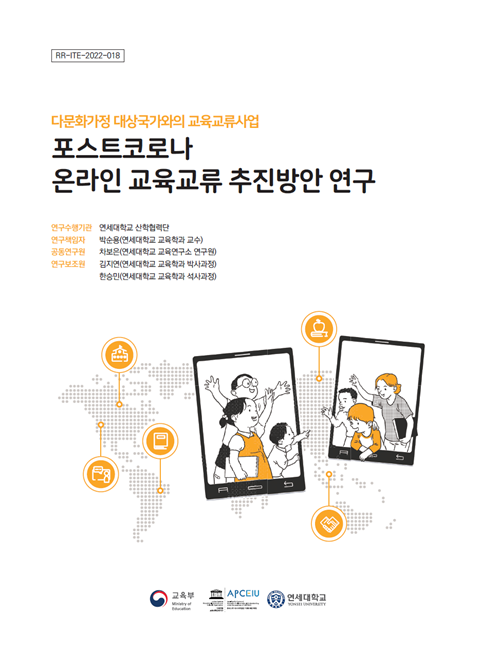 2022 다문화가정 대상국가와의 교육교류사업 성과분석: 포스트코로나 온라인 교육교류 추진방안 연구 Année de publication: 2022 Auteur: 박순용 | 차보은 Auteur institutionnel: 연세대학교 산학협력단 | 유네스코 아시아태평양 국제이해교육원 이 연구는 ‘다문화가정 대상국가와의 온라인 교육교류사업’의 사업성과를 점검하고 미래지향 적인 교육교류사업으로의 재구조화와 방향성 제시를 위해 진행되었다. 연구의 주요 내용은 온라인 교육교류 현황을 분석하고, 온라인 교육교류에 참여한 국내·외 참여교사의 경험을 인터뷰한후 면밀히 분석하여 포스트-코로나-19 온라인 교육교류 추진방안을 위한 방향과 과제를 모색하는 것이다. 이를 위해 문헌연구와 더불어 다수의 국내·외 참가교사들에 대해 대면 초점집단면담(FGI)과 비대면 1대1 온라인 심층면담을 진행하였고 온라인 교육교류사업의 보완과 개선에 대한 가감 없는 의견을 수집하였다. 수집된 질적 자료를 토대로 분석한 내용을 통해 향후 국제 교육교류사업이 소기의 목적을 달성하기 위해 적용이 권고되는 몇 가지 정책 제안을 하였다.
  2022 다문화가정 대상국가와의 교육교류사업 성과분석: 성과분석 및 성과측정도구 타당화 연구 Année de publication: 2022 Auteur: 박현정 | 박민호 | 신중휘 Auteur institutionnel: 유네스코 아시아태평양 국제이해교육원 이 연구는 ‘다문화가정 대상국가와의 교육교류사업’성과평가를 위하여 개발된 ‘글로벌 역량’ 측정 도구를 타당화하고, 측정 도구를 활용하여 성과를 분석하는 데 목적이 있다. 이 연구에 앞서 2020~2021년에 걸쳐 기존의 성과평가를 보다 효율적으로 운영할 수 있으며, 교육교류사업의 목적 및 성격이 잘 반영된 평가 지표를 개발하는 것을 목표로 먼저 문항을 개발하였 다.한편, 2020년에는 COVID-19 팬데믹으로 인하여 온라인 교류 사업만이 소규모로 진행되었고, 2021년 역시 COVID-19 팬데믹이 지속되어 교육교류사업이 온라인 교류 형태로 진행되었기에 온라인 교류의 맥락으로 성과측정 도구를 수정하였기 때문에 도구의 타당화는 제한 적인 상황이었다.따라서 2022년 연구에서는 온라인 교류에 참가한 교사 및 학생을 대상으로 지난 2년간 개발ˑ수정된 성과측정 도구를 최종적으로 타당화하고, 교육교류사업의 성과분석에 활용하였다.
  Korea-Japan Teacher's Network on GCED 2023: Final Report Année de publication: 2023 Auteur institutionnel: APCEIU APCEIU launched the Korea-Japan Teachers’ Network on GCED in 2021, and since then, participating teachers from Japan and Korea have engaged in varied activities, including collaborative lesson plan development, online seminars, joint classroom projects, and student exchanges. In 2023, the first in-person training workshop was held in the Republic of Korea. Designed to deepen the understanding of GCED/peace education of participants, strengthen their capacities to foster global citizenship through education, share good practices and cases, and plan for future collaboration, the Workshop was attended by 33 Korean and Japanese teachers who have actively engaged in Network activities, including teacher-student exchange.
  7th Meeting of UNESCO Category 2 Centres in Education: Meeting Report Année de publication: 2023 Auteur institutionnel: APCEIU This meeting report provides the summary of the 7th Meeting of UNESCO Category 2 Centres in Education held on 7 November 2023 in Paris, France. It offers an overview of the presentations delivered by Category 2 Centres in Education, outlining their programmes and activities for the upcoming years, specifically for 2024.
  2023 Youth Leaders' Mentorship & Local GCED Project: Activity Report Année de publication: 2023 Auteur institutionnel: APCEIU This report summarizes 10 GCED projects implemented in different parts of the world by the alumni of APCEIU’s Youth Leadership Workshop on GCED in 2023. Ranging from community advocacy for global citizenship to youth-led campaign projects, 10 GCED initiatives have been taken by 10 young leaders in their own communities in Asia, Europe, Africa, Latin America, and the Caribbean. APCEIU offers GCED training programmes targeting youth leaders around the globe to encourage them to achieve the SDGs through global citizenship and GCED. Since 2015, the Youth Leadership Workshop on GCED has been held every year in the Republic of Korea, inviting 50 young global leaders to take part in an intensive training programme where they share their actions, deepen their knowledge on global/local issues, enhance their motivation to take actions for a change, and establish the young leaders’ network on GCED. Since 2021, it has been shifted to a comprehensive training programme composed of online training workshops, mentorship, and local project implementation.
  5th Annual Meeting of the GCED Actors' Platform: Meeting Report Année de publication: 2023 Auteur institutionnel: APCEIU This meeting report provides the summary of the 5th Annual Meeting of the GCED Actors' Platform held on 20 October 2023. The report outlined the presentations from UNESCO, regional coordinators from 4 Regional GCED Networks (Arab States, Asia-Pacific, Latin America and the Caribbean and Sub-Saharan Africa), including their achievements in advancing GCED in their respective regions over the past year and discussion on potential ways to strengthen GCED implementation on both regional and global levels.
  Report on Roundtable for Advocating Global Citizenship Education and Climate Change Education Année de publication: 2023 Auteur institutionnel: APCEIU This report shares the overview of the Roundtable for Advocating Global Citizenship Education and Climate Change Education, held on Saturday, 11 November 2023. The event was co-organized by the Permanent Delegation of the Republic of Korea to UNESCO, Office for Climate Education, Asia-Pacific Centre of Education for International Understanding (APCEIU) in partnership with the Group of Friends for Solidarity and Inclusion with GCED (Afghanistan, Armenia, Austria, Bangladesh, Canada, Colombia, Italy, Jordan, Kenya, Kuwait, Philippines, Republic of Korea, Saudi Arabia, Senegal, Serbia, Nigeria and Oman), in support of the Korean National Commission for UNESCO and the French National Commission for UNESCO. This report shares the summary of the event, particularly the presentations on GCED activities and Climate Change Education by experts from Uganda, the Republic of Korea, and France to promote the values and initiatives of GCED and CCE.
  아태지역 관점에서 세계시민역량 정의: 예비연구 Année de publication: 2023 Auteur: 임현묵 | 박선운 | 이무성 | 고석영 Auteur institutionnel: 유네스코 아시아태평양 국제이해교육원 본 연구는 아태지역의 맥락과 관심에 비춰 세계시민역량을 해석하고 재개념화하는 작업을 준비하는 데에 목적이 있다. 이를 위해 세계시민역량에 관한 국내외 기존 문헌을 검토하면서, 재개념화 작업에 참여할 연구자를 파악하기 위해 아태지역의 연구 현황을 분석한다. 이와 함께 세계시민교육이 국제사회의 주요 의제로 포함된 2015년 이후 아태교육원이 지금까지 수행한 여러 세계시민교육 역량강화 프로그램의 주제와 내용을 분석하여 아태교육원이 추구하는 세계시민역량의 핵심을 밝히고자 한다.
  Common Curriculum Guide for Peace Education in Northeast Asia Année de publication: 2023 Auteur: Sicong Chen | Kevin Kester | Jeongmin Eom Auteur institutionnel: APCEIU Inspired by the recommendations from the study, Peace Education in Northeast Asia: A Situational Analysis (APCEIU, 2021), APCEIU coordinated a project to develop a common curriculum for peace education in Northeast Asia. This initiative was undertaken in partnership with UNESCO Multisectoral Regional Office for East Asia, UNESCO Chair on Peace Studies at Nanjing University, UNESCO Chair on Education for Peace, Social Justice and Global Citizenship at Kyushu University, Peace Education Commission of the Peace Studies Association of Japan, Japan Association for International Education, and Korean Society of Education for International Understanding. This guide serves as a framework for supporting peace education in diverse communities across Northeast Asia. Its primary function is to aid in the design and development of peace education programs tailored to various contexts within the region. It is our sincere hope that this guide will serve as a catalyst, encouraging and assisting more teachers and practitioners in the region to actively participate in our collective efforts to foster peace in and through education.
  한국 평화교육의 비판적 검토: 유네스코 평화교육의 관점에서 Année de publication: 2020 Auteur: 앨런 스미스 | 강순원 | 오덕열 Auteur institutionnel: 유네스코 아시아태평양 국제이해교육원 본 연구는 평화・자유・정의・연대・문화적 다양성・관용・지속가능 발전 등 보편적 가치를 토대로 한 유네스코 평화교육이 동북아시아의 특수성을 반영한 지역 평화교육의 토대로 작용할 수 있다는 가정에서 출발한다. 본 연구에서는 우선 유네스코 및 유럽평의회가 제2차 세계대전 이후, 특히 냉전과 탈냉전 시대를 통해 발전시킨 평화교육을 개괄적으로 소개하는 한편, ‘평화・통일교육’으로 일컬어지기도 하는 한국 평화교육을 광범위하고 심도 있게 분석하고 있다. 평화교육으로서의 통일교육이 어떻게 유네스코 평화교육에 접목하는 것, 현재 통일교육의 범주에서 이루어지고 있는 평화・통일교육의 현황을 중심으로 향후 평화교육 과제를 제시하는 것에 목적을 둔다.