
Ressources
Explorez une large gamme de ressources sur le GCED afin d’approfondir votre compréhension et de renforcer vos activités de recherche, de plaidoyer, d’enseignement et d’apprentissage.
3,126 résultats trouvés
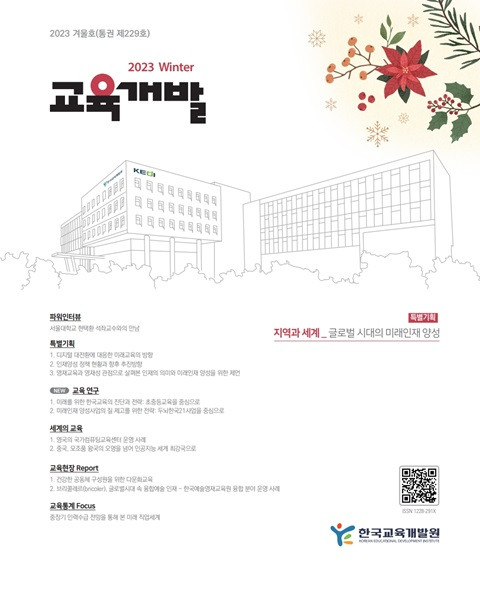 지역과 세계: 글로벌 시대의 미래인재 양성 (교육개발; 2023년 겨울호, Vol. 229) Année de publication: 2023 Auteur institutionnel: 한국교육개발원 파워인터뷰서울대학교 현택환 석좌교수와의 만남 특별기획지역과 세계 _ 글로벌 시대의 미래인재 양성1.디지털 대전환에 대응한 미래교육의 방향2.인재양성 정책 현황과 향후 추진방향3.영재교육과 영재성 관점으로 살펴본 인재의 의미와 미래인재 양성을 위한 제언 NEW 교육 연구1. 미래를 위한 한국교육의 진단과 전략: 초중등교육을 중심으로2. 미래인재 양성사업의 질 제고를 위한 전략: 두뇌한국21사업을 중심으로 세계의 교육1. 영국의 국가컴퓨팅교육센터 운영 사례2. 중국, 모조품 왕국의 오명을 넘어 인공지능 세계 최강국으로 교육현장 Report 1. 건강한 공동체 구성원을 위한 다문화교육2. 브리콜레르(bricoler), 글로벌시대 속 융합예술 인재 - 한국예술영재교육원 융합 분야 운영 사례 교육통계 Focus중장기 인력수급 전망을 통해 본 미래 직업세계
  Annual Report 2018 : UNESCO INSTITUTE FOR LIFELONG LEARNING Année de publication: 2019 Auteur institutionnel: UNESCO Institute for Lifelong Learning (UIL) UIL’s 2018 Annual Report shows how, last year, our work contributed to fulfilling our mission to support better policy-making and strengthen the capacities of UNESCO Member States in the field of lifelong learning. UIL’s vision is for all children, youth and adults to benefit from quality lifelong learning, within the framework of sustainable development and peace, and we pursue it in the context of the United Nations 2030 Agenda for Sustainable Development, particularly Sustainable Development Goal (SDG) 4 on quality education and lifelong learning. Its publications are a valuable resource for education researchers, planners, policy-makers and practitioners.
  Implementation of the Sustainable Development Goal 4 in Korea Année de publication: 2019 Auteur institutionnel: Korean National Commission for UNESCO | Korean Educational Development Institute (KEDI) This report takes stock of progress made in Korea towards achieving SDGs and sheds light on major policy implications for its further implementation. The first chapter will touch on the background and objectives, the second on the monitoring of SDG4-Education 2030 at the global level, the third on the implementation structure of SDG4-Education 2030 in Korea, the fourth on the progress made toward meeting SDG4, and the fifth on the conclusion. 한국의 SDG4 이행 현황 연구 Année de publication: 2019 Auteur institutionnel: 한국교육개발원 | 유네스코한국위원회 SDG4 목표 달성을 위한 체계와 한국의 이행 현황 및 과제에 대한 연구 결과 보고서이다. 이 연구는 우리나라에서 추진된 지속가능발전목표의 이행 현황을 파악하는 한편, 그 주요성과 및 이슈를 분석하여 향후 지속가능발전목표의 이행을 위한 정책적 시사점을 도출하는 데 목적이 있다. 구체적으로 본 보고서에서는 다음과 같은 내용을 다룬다.첫째, 국내 SDG4-교육2030 이행 메커니즘을 소개한다. 둘째, SDG4 세부목표별 글로벌·주제별 통계 및 지표 작성 현황을 분석한다. 셋째, SDG4 세부 목표별 현안 진단과 국가지속발전목표 수립, 국내 이행을 위한 과제 등을 제시한다.
  각국의 세계 시민 교육 관련 현황 Année de publication: 2015 Auteur: 조지민 | 곽영순 | 김영춘 | 김정효 | 김진숙 | 배주경 | 윤영순 | 이미영 | 이혜원 | 임은영 | 정은주 | 정혜경 | 최인선 | 김미지 Auteur institutionnel: 한국교육과정평가원 본 보고서는 우리 정책 및 연구에 필요한 유용한 기초 자료로 활용할 수 있도록 세계 각국의 세계시민교육 관련 자료를 수집·분석하여 그 현황을 정리한 것이다. 뉴질랜드, 독일, 러시아, 멕시코, 미국, 싱가포르, 아일랜드, 영국, 일본, 중국, 캐나다, 프랑스, 핀란드의 세계시민교육 관련 교육 과정 및 학습 사례 등을 살펴 볼 수 있다.
 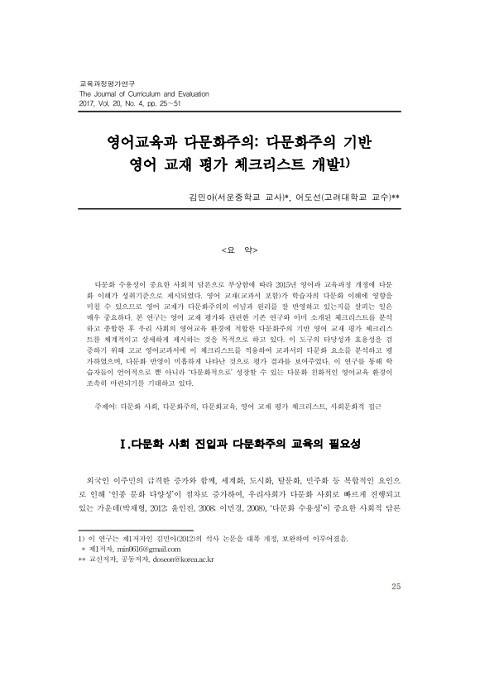 Multicultural Education through ELT Textbooks: Developing a Checklist for English Materials Evaluation Based on Multiculturalism (The Journal of Curriculum and Evaluation; Vol. 20, No. 4) Année de publication: 2017 Auteur: Minah Kim | Doseon Eur Auteur institutionnel: Korea Institute for Curriculum and Evaluation (KICE) Multicultural education is recommended as an effort to resolve significant social challenges in Korea. This is reflected in the 2015 reform of national curriculum and instruction as it promotes cultural diversity and competence. As English textbooks are widely used in EFL classrooms in Korea by both students and teachers, it is useful to examine how much English textbooks are multiculturalism-friendly and -responsive. This study has 3 parts: 1) It makes a critical review of previous research on English textbooks evaluation checklists, 2) it then synthesizes them and proposes a new tentative multiculturalism-based criteria for English textbooks evaluation, and finally, 3) it applies the new subset of the criteria to an English textbook used in EFL classrooms in Korea to test its validity and practicality. Developing a multiculturalism-responsive criteria for English textbooks evaluation will provide multiculturalism-friendly classroom environments in which EFL learners can grow not only linguistically but also 'multiculturally'. 영어교육과 다문화주의: 다문화주의 기반 영어 교재 평가 체크리스트 개발 (교육과정평가연구; Vol. 20, No. 4) Année de publication: 2017 Auteur: 김민아 | 어도선 Auteur institutionnel: 한국교육과정평가원 다문화 수용성이 중요한 사회적 담론으로 부상함에 따라 2015년 영어과 교육과정 개정에 다문화 이해가 성취기준으로 제시되었다. 영어 교재(교과서 포함)가 학습자의 다문화 이해에 영향을 미칠 수 있으므로 영어 교재가 다문화주의의 이념과 원리를 잘 반영하고 있는지를 살피는 일은 매우 중요하다. 본 연구는 영어 교재 평가와 관련한 기존 연구와 이미 소개된 체크리스트를 분석 하고 종합한 후 우리 사회의 영어교육 환경에 적합한 다문화주의 기반 영어 교재 평가 체크리스트를 체계적이고 상세하게 제시하는 것을 목적으로 하고 있다. 이 도구의 타당성과 효용성을 검증하기 위해 고교 영어교과서에 이 체크리스트를 적용하여 교과서의 다문화 요소를 분석하고 평 가하였으며, 다문화 반영이 미흡하게 나타난 것으로 평가 결과를 보여주었다. 이 연구를 통해 학 습자들이 언어적으로 뿐 아니라 ‘다문화적으로’ 성장할 수 있는 다문화 친화적인 영어교육 환경이 조속히 마련되기를 기대하고 있다.
 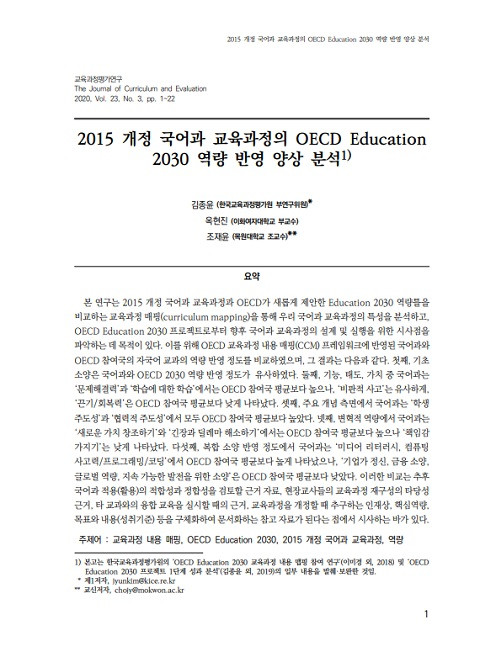 Analysis of the 2015 Revised Korean Languages Curriculum in Terms of the OECD Education 2030 Competencies (Journal of Curriculum and Evaluation; Vol. 23. No. 3) Année de publication: 2020 Auteur: Jongyun Kim | Hyounjin Ok | Jaeyoon Cho Auteur institutionnel: Korea Institute for Curriculum and Evaluation (KICE) The purpose of this study is to analyze the characteristics of the Korean language curriculum through curriculum content mapping (CCM) in the OECD Education 2030 project, which is later compared with the international curricular of the national languages. The CCM framework consists of a “competency code” that presents OECD competencies and a “content code” that contains the content of the curriculum. In this study, the degree of the competencies in the Korean language curriculum is analyzed and compared with the international curricular in terms of the OECD perspective. The result is analyzed as follows. First, foundational literacies of Korean were similar to the international national language curricular. Second, in the competencies of skills, attitudes and values, “problem-solving” and “learning about learning” were higher in the Korean language curriculum than the OECD average, “critic thinking” was similar to, and “persistence” was lower than the OECD average. Third, in terms of key concepts, both “student agency” and “co-agency” were higher in the Korean language curriculum. Fourth, “creating values” and “solving dilemmas” in terms of the degree of reflection of CCM framework competency related to transformational competencies, the Korean Language was higher than the average of OECD member countries in terms of “creating new values” and “resolving tensions and dilemmas” were higher but “taking responsibilities” were lower than the OECD countries. Fifth, the competencies in the compound literacies were also compared. These comparison results provide as reference materials that describes the suitability of the Korean language curriculum and contributes to future revisions of the Korean language curriculum for the students in 2030s. 2015 개정 국어과 교육과정의 OECD Education 2030 역량 반영 양상 분석 (교육과정평가연구; Vol. 23, No. 3) Année de publication: 2020 Auteur: 김종윤 | 옥현진 | 조재윤 Auteur institutionnel: 한국교육과정평가원 본 연구는 2015 개정 국어과 교육과정과 OECD가 새롭게 제안한 Education 2030 역량틀을 비교하는 교육과정 매핑(curriculum mapping)을 통해 우리 국어과 교육과정의 특성을 분석하고, OECD Education 2030 프로젝트로부터 향후 국어과 교육과정의 설계 및 실행을 위한 시사점을 파악하는 데 목적이 있다. 이를 위해 OECD 교육과정 내용 매핑(CCM) 프레임워크에 반영된 국어과와 OECD 참여국의 자국어 교과의 역량 반영 정도를 비교하였으며, 그 결과는 다음과 같다. 첫째, 기초 소양은 국어과와 OECD 2030 역량 반영 정도가 유사하였다. 둘째, 기능, 태도, 가치 중 국어과는 ‘문제해결력’과 ‘학습에 대한 학습’에서는 OECD 참여국 평균보다 높으나, ‘비판적 사고’는 유사하게, ‘끈기/회복력’은 OECD 참여국 평균보다 낮게 나타났다. 셋째, 주요 개념 측면에서 국어과는 ‘학생 주도성’과 ‘협력적 주도성’에서 모두 OECD 참여국 평균보다 높았다. 넷째, 변혁적 역량에서 국어과는 ‘새로운 가치 창조하기’와 ‘긴장과 딜레마 해소하기’에서는 OECD 참여국 평균보다 높으나 ‘책임감 가지기’는 낮게 나타났다. 다섯째, 복합 소양 반영 정도에서 국어과는 ‘미디어 리터러시, 컴퓨팅 사고력/프로그래밍/코딩’에서 OECD 참여국 평균보다 높게 나타났으나, ‘기업가 정신, 금융 소양, 글로벌 역량, 지속 가능한 발전을 위한 소양’은 OECD 참여국 평균보다 낮았다. 이러한 비교는 추후 국어과 적용(활용)의 적합성과 정합성을 검토할 근거 자료, 현장교사들의 교육과정 재구성의 타당성 근거, 타 교과와의 융합 교육을 실시할 때의 근거, 교육과정을 개정할 때 추구하는 인재상, 핵심역량, 목표와 내용(성취기준) 등을 구체화하여 문서화하는 참고 자료가 된다는 점에서 시사하는 바가 있다.
  학교 미디어교육을 위한 교과 교육과정 개선 방안 연구 Année de publication: 2021 Auteur: 장의선 Auteur institutionnel: 한국교육과정평가원 | 대한민국 교육부 본 연구의 목적은 디지털 환경으로 변화하는 미디어 리터러시 개념을 탐색하고 국내외 동향 및 선행연구를 분석하여 각 교과에서 담당할 수 있는 미디어 교육에서의 역할을 모색함으로써 향후 학교급별・교과별 체계적인 미디어 리터러시 교육을 위한 실제적 개선 방안 마련에 있다. 본 연구에서는 먼저 미디어 리터러시와 관련하여 국내외 연구 동향 및 선행연구를 분석하고 교과별 반영 실태를 조사하였다. 다음으로 선행연구에 터해 도출된 디지털 미디어 리터러시 역량에 대한 타당화를 수행하였으며, 이러한 결과를 바탕으로 디지털 미디어 리터러시의 구성 역량을 교과 교육과정에 반영할 수 있는 방안을 제시하였다. 본 저작물은 교육부에서 2021년 작성하여 공공누리 제 4유형으로 개방한 ‘학교 미디어교육을 위한 교과 교육과정 개선 방안 연구 (장의선)’을 이용하였으며 해당 저작물은 온나라 정책연구(www.prism.go.kr)에서 무료로 다운받으실 수 있습니다.