
Ressources
Explorez une large gamme de ressources sur le GCED afin d’approfondir votre compréhension et de renforcer vos activités de recherche, de plaidoyer, d’enseignement et d’apprentissage.
3,158 résultats trouvés
 Mieux comprendre les enjeux climat & développement : Kit pédagogique Année de publication: 2017 Auteur institutionnel: Agence Française de Développement (AFD) | Kurioz Ce document s'adresse aux acteurs éducatifs et plus précisément aux enseignants du CM1 à la terminale. À travers des fiches thématiques et des séances clé en main, ce kit propose des clés de compréhension sur les sujets de l’accès à l’eau, de l’agriculture durable, du climat, des migrations et de l’éducation.
  Éducation, formation professionnelle et emploi: Boîte à outils genre Année de publication: 2015 Auteur: Laetitia Antonowicz Auteur institutionnel: Agence Française de Développement (AFD) Le genre est à la fois un concept et un outil d’analyse. En tant que concept, il désigne ensemble deux entités : le féminin et le masculin ou encore les hommes et les femmes. Les inégalités de genre se manifestent dans tous les aspects de l’éducation, des infrastructures aux programmes, des politiques de vie scolaire aux outils didactiques, de la pédagogie au corps enseignant. Souvent les inégalités sont au détriment des filles, parfois au détriment des garçons. Les inégalités sont complexes: les filles peuvent avoir une espérance de vie scolaire supérieure aux garçons tout en ayant moins de chance que ces derniers d’accéder à l’éducation en premier lieu. Les garçons peuvent être plus nombreux à accéder au secondaire, mais également plus nombreux à ne pas terminer leur cycle d’étude ou à ne pas obtenir le niveau minimum dans certaines matières. Les inégalités se retrouvent dans l’accès, le maintien et l’achèvement. Elles se retrouvent également dans l’accès à l’emploi. Elles varient en fonction des cycles d’éducation, de l’âge des apprenants et des pays.
  Renforcer l’engagement citoyen pour la transition écologique, solidaire et démocratique en France et dans le monde à horizon 2030 : Le rôle essentiel de l’éducation à la citoyenneté et à la solidarité internationale Année de publication: 2021 Auteur institutionnel: Groupe de concertation sur l’Éducation à la citoyenneté et à la solidarité internationale (ECSI) | Agence Française de Développement (AFD) Le groupe de concertation sur l’Éducation à la citoyenneté et à la solidarité internationale (ECSI) est un espace de dialogue et de partage d’expériences créé en 2017. Il réunit des représentants d’associations, de quatre ministères, de l’Agence française de développement, de collectivités territoriales et de réseaux régionaux multi-acteurs. Ces institutions et organisations représentent une grande diversité d’approches, d’actions et de publics, et se retrouvent dans une mission commune : favoriser la contribution individuelle et collective à la construction d’une société juste, solidaire et durable par l’éducation et l’ECSI.Les membres de ce groupe ont produit un argumentaire commun, finalisé en novembre 2020, détaillant les raisons pour lesquelles l’ECSI doit constituer une priorité des politiques publiques et une composante essentielle des actions des organisations.
  Global Media and Information Literacy Assessment Framework: Country Readiness and Competencies Année de publication: 2013 Auteur institutionnel: UNESCO The MIL Assessment Framework can foster lifelong learning initiatives by building on the relationship between information, media, digital, and ICT literacies, along with societal transformations, education, workforce, policy and decision making processes, economic growth and democracy. The overall goal of the publication is to guide UNESCO’s Member States throughout the assessment of country readiness and competencies regarding the media and information literacy of citizens, in particular teachers in service and in training. The document is particularly aimed at the following stakeholders: policy makers and decision makers; national officers responsible for statistical data collection and analysis; educational policy makers and planners working in formal and informal education settings; teacher training institutions and teachers. It is also of relevance to the professional information and communication community, and has wide applicability for civil society at large.
 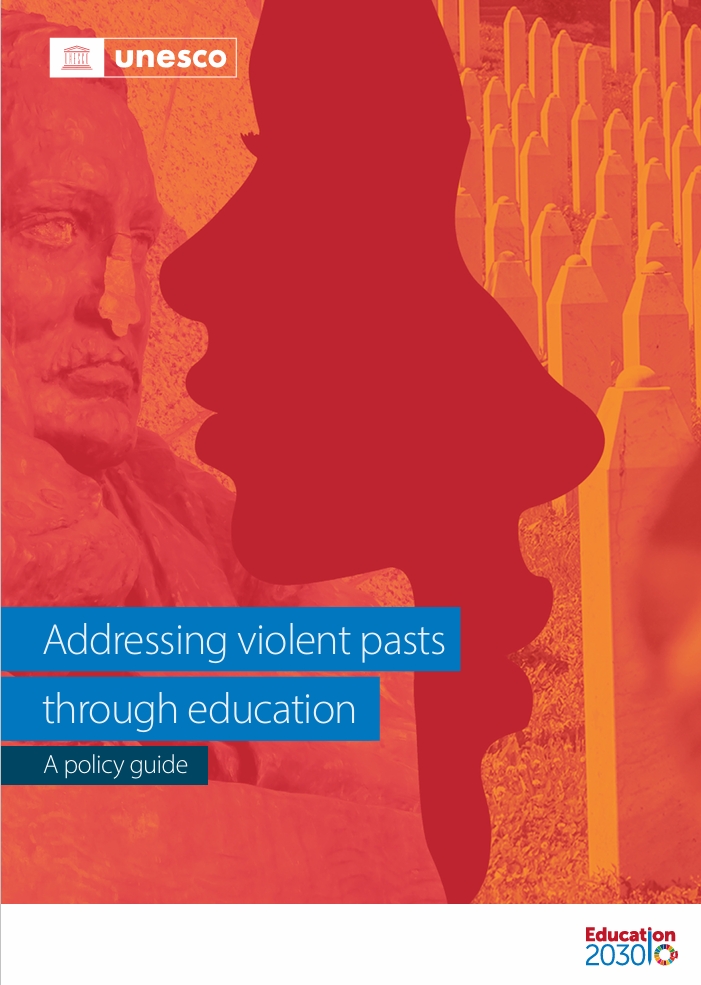 Addressing Violent Pasts Through Education: A Policy Guide Année de publication: 2025 Auteur institutionnel: UNESCO Teaching about violent pasts and their legacies is a powerful way to foster sustainable peace.Education can build a nuanced understanding of complex histories, raise awareness of the roots and legacies of violence, nationally and internationally, and sensitize learners for their own agency as actors of change for reconciliation and conflict prevention.Educating about violent pasts is a challenging yet critical endeavour for policy-makers globally. It entails tailored approaches and an important support for educators to address traumatic pasts sensitively and to navigate related emotions and narratives successfully.Building on UNESCO’s programme on Global Citizenship Education, this guide offers education policy-makers a set of strategies, principles, and education practices to effectively integrate education about violent pasts into local education systems. It suggests a comprehensive approach that spans formal and informal education and aligns with the 2023 Recommendation on Education for Peace, Human Rights and Sustainable Development, opening new perspectives on history education, dialogue, and conflict transformation.
 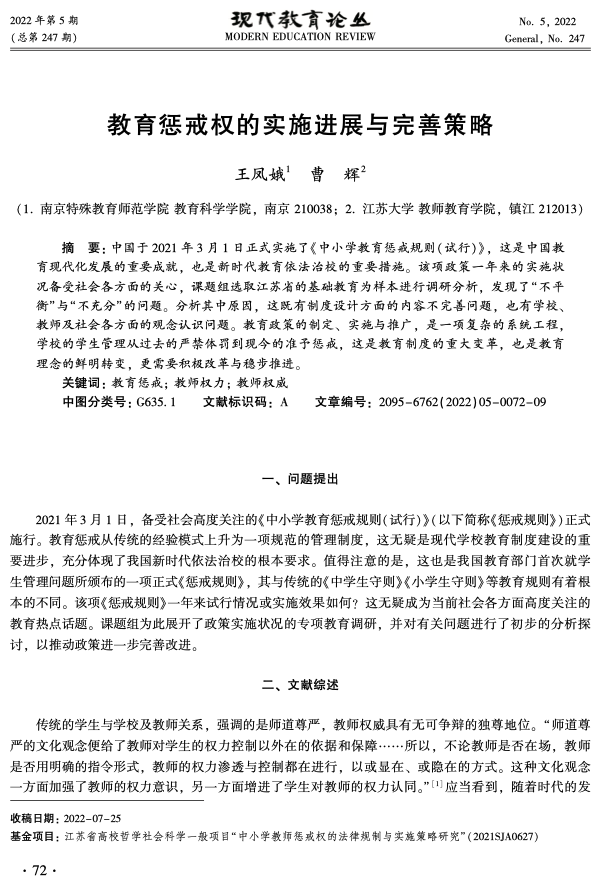 教育惩戒权的实施进展与完善策略 Année de publication: 2022 Auteur: 王凤娥 | 曹辉 中国于 2021年 3月 1日正式实施了《中小学教育惩戒规则(试行)》,这是中国教育现代化发展的重要成就,也是新时代教育依法治校的重要措施。该项政策一年来的实施状况备受社会各方面的关心,课题组选取江苏省的基础教育为样本进行调研分析,发现了"不平衡"与"不充分"的问题。分析其中原因,这既有制度设计方面的内容不完善问题,也有学校、教师及社会各方面的观念认识问题。教育政策的制定、实施与推广,是一项复杂的系统工程,学校的学生管理从过去的严禁体罚到现今的准予惩戒,这是教育制度的重大变革,也是教育理念的鲜明转变,更需要积极改革与稳步推进。
 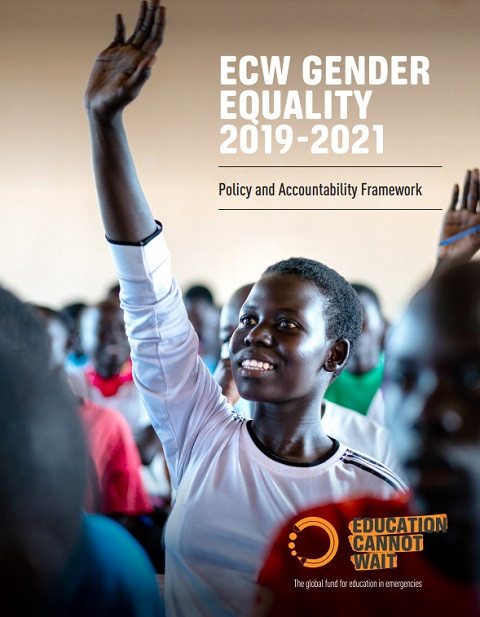 ECW Gender Equality 2019-2021: Policy and Accountability Framework Année de publication: 2020 Auteur institutionnel: Education Cannot Wait (ECW) This report presents Education Cannot Wait (ECW)'s gender equality policy, which leverages action and contributes toward coordinated strategies going beyond parity in enrollment. ECW's gender equality policy aims to provide girls and boys with equal access to education during crises, create spaces that allow learning to happen safely and without fear and ensure educational systems empower girls and boys. The Gender and Policy Accountability framework lays out the organizational strategies, explains the implementation process and outlines the compliance regulations that ECW implements to ensure girls and boys in emergencies and protracted crises have access to equitable and inclusive education. Égalité des genres dans le cadre des activités d’ECW 2019-2021: Politique et cadre de responsabilité Année de publication: 2020 Auteur institutionnel: Education Cannot Wait (ECW) Éducation sans délai s’est engagé à soutenir la prestation de services d’éducation inclusive et de qualité auprès de 9 millions d’enfants et de jeunes parmi les plus touchés par une situation d’urgence ou de crise prolongée d’ici à 2021. La Politique ECW pour l’égalité des genres vise à détailler, en s’appuyant sur les normes internationales, les aspirations du fonds en matière d’égalité des genres et d’autonomisation des femmes et des filles. Igualdad de género en el marco de las actividades para 2019-2021 de ECW : Política y marco de rendición de cuentas Année de publication: 2020 Auteur institutionnel: Education Cannot Wait (ECW) ECW se ha comprometido a respaldar la provisión de educación inclusiva y de calidad a 9 millones de niñas, niños y jóvenes afectados por emergencias y crisis prolongadas no más tarde de 2021. La finalidad de la Política de Igualdad de Género de ECW, que se apoya en normas y estándares internacionales2 , consiste en estructurar la visión del Fondo para promover la igualdad de género y el empoderamiento de las mujeres y las niñas.
 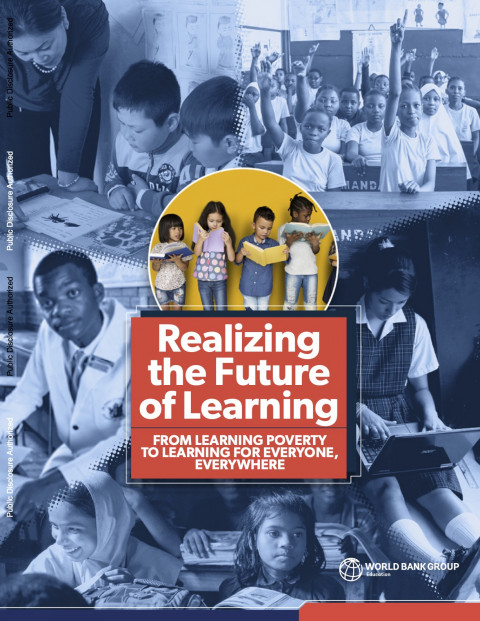 Realizing the Future of Learning: From Learning Poverty to Learning for Everyone, Everywhere Année de publication: 2020 Auteur: Jaime Saavedra | Cristian Aedo | Omar Arias | Adelle Pushparatnam | Halsey Rogers | Marcela Gutierrez Bernal Auteur institutionnel: World Bank Education is a right with immense inherent value. As an essential building block for a country’s human capital, it is also a key driver of growth, competitiveness, and economic development. For societies to be inclusive and fair, they need to prepare all their children to succeed as citizens and give them the tools to participate in their countries’ development. This has become increasingly challenging, because students must have the skills and competencies to adapt and be successful in a rapidly changing, uncertain world, especially as the world grapples with the effects of the COVID19 pandemic. At the same time, our understanding of how children best learn and what the most effective education delivery mechanisms are has grown. Armed with this knowledge, countries that are serious about living up to this challenge will invest in their people to build their human capital; take action to show that learning really matters to them; and commit not only the financial, but also the political and managerial resources necessary to build an education system that serves all with quality. Urgent action is needed to realize a new vision for education: one in which learning happens for everyone, everywhere. Too many education systems are not delivering even basic skills for all children, let alone preparing them for the demanding world they will live in as adults. As the World Bank expands its support for countries to invest more, and more effectively, in education, it has developed a renewed policy approach to address the educational challenges of today while helping countries lay the groundwork to seize tomorrow’s opportunities. The Bank’s 2018 World Development Report urged action to address the global learning crisis and examined the policies needed to tackle it (World Bank 2018a). To support efforts to improve foundational learning, last year the Bank launched a global target: to cut the Learning Poverty rate—the fraction of 10-year-olds in low- and middle-income countries who cannot read and understand an age-appropriate text—at least in half by 2030 (World Bank 2019a). It was also a recognition of the severity of the learning crisis that we are living through: that more than half of children lack these fundamental skills at the end-of-primary age shows that their future is at stake. And now the pandemic has generated a crisis within a crisis.