
Ressources
Explorez une large gamme de ressources sur le GCED afin d’approfondir votre compréhension et de renforcer vos activités de recherche, de plaidoyer, d’enseignement et d’apprentissage.
3,126 résultats trouvés
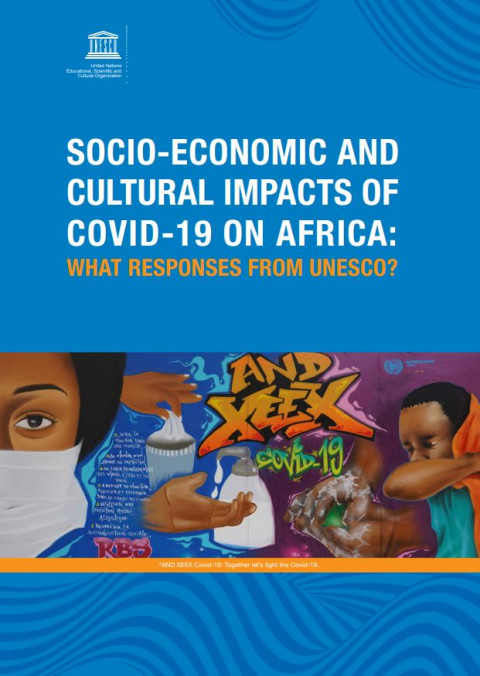 Incidences socio-économiques et culturelles de la COVID-19 sur l'Afrique: quelles réponses de l'UNESCO?? Année de publication: 2020 Auteur institutionnel: UNESCO Ce document de politique analyse les incidences socioéconomiques et culturelles de la maladie sur l’Afrique dans son ensemble, aussi bien par les effets immédiats que les conséquences présentes et futures de la pandémie, y compris sur le tissu sociétal africain, susceptible d’entraîner une fracture de la relation de confiance entre les États et leurs citoyens, et au sein des communautés elles-mêmes. Ce faisant, elle met en lumière les principales mesures adoptées par les pays africains pour juguler la crise et ses effets socio-économiques et culturelles. Tout en s’engageant dans l’action et dans la réflexion sur les conséquences présentes et futures de la pandémie, l’UNESCO entend ainsi contribuer de manière substantielle aux débats en cours en Afrique à travers en l’articulation d’une réponse stratégique pour apporter sa contribution aux efforts collectifs mondiaux et régionaux de lutte contre la pandémie.
  Culture | 2030 Indicators: Thematic Indicators for Culture in the 2030 Agenda Année de publication: 2019 Auteur institutionnel: UNESCO The Culture|2030 Indicators is a framework of thematic indicators whose purpose is to measure and monitor the progress of culture’s enabling contribution to the national and local implementation of the Goals and Targets of the 2030 Agenda for Sustainable Development (SDGs). The methodology is developed to assist countries and cities with very different capacities regarding the collection of data and cultural statistics. The evidence gathered will inform policies and decisions as well as operational actions enabling greater investments in culture as a sector of activity and a greater recognition of its transversal role across other sectors.
  Teacher Policy Development Guide Année de publication: 2019 Auteur institutionnel: UNESCO | International Task Force on Teachers for Education 2030 Countries will need to have a broad perspective on teacher issues in order to meet Sustainable Development Goal 4 and address the provisions on Teachers in the Incheon Declaration with the Framework for Action of Education 2030. A system to orient the elaboration and/or review of national teacher policies will be a useful tool. The International Teacher Task Force builds on its comparative advantage as a global multiple-stakeholder alliance joining hands to address the global teacher challenges, to offer the present Teacher Policy Development Guide.Users will find relevant definitions of concepts, description of the different dimensions of teacher issues and how they correlate, and suggestions of phases in the process of developing a national teacher policy. Of utmost importance is the involvement of all stakeholders, especially the teachers, in the process.
 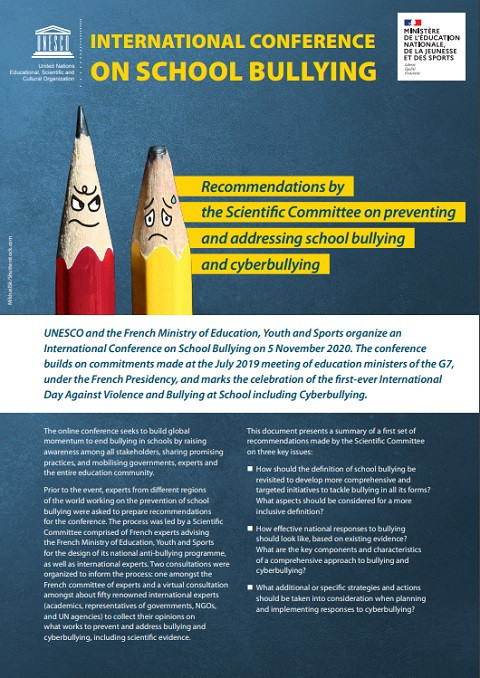 International Conference on School Bullying: Recommendations by the Scientific Committee on Preventing and Addressing School Bullying and Cyberbullying Année de publication: 2020 Auteur institutionnel: UNESCO | France. Ministère de l'éducation nationale, de la jeunesse et des sports UNESCO and the French Ministry of Education, Youth and Sports organize an International Conference on School Bullying on 5 November 2020. The conference builds on commitments made at the July 2019 meeting of education ministers of the G7, under the French Presidency, and marks the celebration of the first-ever International Day Against Violence and Bullying at School including Cyberbullying.This document presents a summary of a first set of recommendations made by the Scientific Committee on three key issues:- How should the definition of school bullying be revisited to develop more comprehensive and targeted initiatives to tackle bullying in all its forms? What aspects should be considered for a more inclusive definition?- How effective national responses to bullying should look like, based on existing evidence? What are the key components and characteristics of a comprehensive approach to bullying and cyberbullying?- What additional or specific strategies and actions should be taken into consideration when planning and implementing responses to cyberbullying? Conférence internationale sur la lutte contre le harcèlement entre élèves: Recommandations du Comité scientifique sur la lutte contre le harcèlement et cyber-harcèlement Année de publication: 2020 Auteur institutionnel: Organisation des Nations Unies pour l'éducation, la science et la culture (UNESCO) | France. Ministère de l'éducation nationale, de la jeunesse et des sports L’UNESCO et le Ministère français de l’Éducation nationale, de la Jeunesse et des Sports organisent une Conférence internationale sur la lutte contre le harcèlement entre élèves le 5 novembre 2020. La conférence s’appuie sur les engagements pris lors de la réunion des ministres de l’Éducation du G7 sous la présidence française en juillet 2019, et marque la célébration de la première Journée internationale contre la violence et le harcèlement à l’école, y compris le cyber-harcèlement.Ce document présente un résumé d’une première série de recommandations formulées par le Comité scientifique sur trois questions clés :- Comment revisiter la définition du harcèlement en milieu scolaire afin d’élaborer des réponses plus complètes et mieux ciblées pour lutter contre le harcèlement sous toutes ses formes ? Quels sont les aspects à prendre en considération pour une définition plus inclusive ?- Sur la base des données existantes, à quoi devraient ressembler des réponses nationales efficaces au harcèlement ? Quelles sont les principales composantes et caractéristiques d’une approche holistique pour lutter contre le harcèlement et le cyber-harcèlement ?- Quelles stratégies et actions supplémentaires ou spécifiques devraient être prises en considération lors de la planification et de la mise en œuvre des réponses au cyber-harcèlement ?
  Addressing Anti-semitism in Schools: Training Curriculum for Primary Education Teachers Année de publication: 2020 Auteur institutionnel: UNESCO | OSCE. Office for Democratic Institutions and Human Rights (ODIHR) This OSCE/ODIHR and UNESCO co-publication aims to help primary school teachers to prevent and respond to anti-Semitism. The curriculum, intended for teacher trainers, is designed to be comprehensive, robust, practical and adaptable. It suggests concrete ways to address anti-Semitism and counter prejudice in and through education, while promoting human rights, global citizenship education, and gender equality.The co-publication is part of a series of four training curricula, designed for trainers of (1) primary school teachers, (2) secondary school teachers, (3) vocational school teachers, and (4) school directors.
 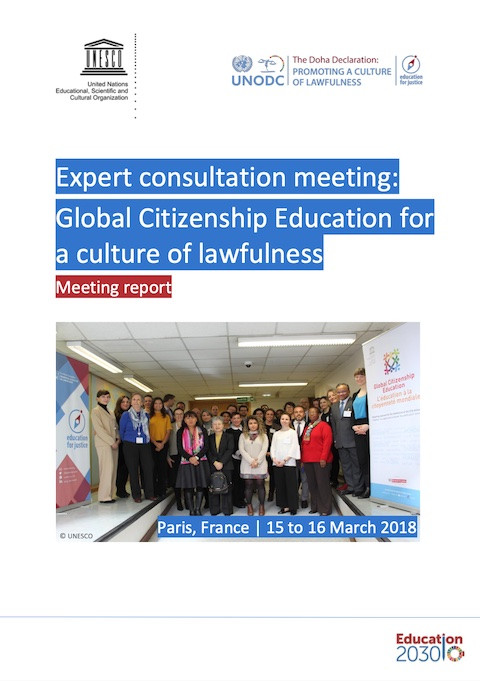 Expert Consultation Meeting: Global Citizenship Education for a Culture of Lawfulness; Meeting Report Année de publication: 2018 Auteur institutionnel: UNESCO | UN. Office on Drugs and Crime (UNODC) In the context of a UNESCO/UNODC partnership on “Global Citizenship Education for a Culture of Lawfulness”, an expert consultation meeting was held in Paris on March 15 and 16 of 2018. The purpose of the partnership is to strengthen the capacities of educational systems to promote the rule of law. To this end, the partnership aims to empower and equip learners to act and engage in society as constructive and ethically responsible agents of change, supporting peace, justice, and strong institutions. This notably contributes to the achievement of the 2030 Agenda for Sustainable Development, and in particular Sustainable Development Goals 4 and 16. Additionally, the partnership intends to enable learners to be both motivated and capable to respond resiliently to crime and violence. The meeting had three broad objectives: To help clarify the conceptual foundation of the partnership; to identify the measures that can be taken in the education sector to promote a culture of lawfulness; and to identify effective educational approaches. Thus, the meeting is meant to elucidate core concepts and identify promising educational approaches in the promotion of a culture of lawfulness by asking fundamental questions, including: What constitutes the rule of law and a culture of lawfulness? How do we create demand for the rule of law? How do we ensure learners apply these principles? How do we ensure they survive in a context where there is no rule of law?
  Social Contract Pedagogy: A Dialogical and Deliberative Model for Global Citizenship Education (Background paper for the Futures of Education initiative) Année de publication: 2020 Auteur: Richard Desjardins | Carlos Alberto Torres | Susan Wiksten Auteur institutionnel: UNESCO We propose that together Social Contract Pedagogy (SCP) and Global Citizenship Education (GCE) offer a comprehensive vision including key principles and core elements that are important for rethinking education and shaping the future of the world. We introduce the novel concept of Social Contract Pedagogy (SCP) as a means to adapt the social contract in liberal democracies which has been (conceptually) located at the level of the state, to the level of the classroom and other pedagogically relevant contexts. A key feature of this pedagogy is the negotiation of values and norms in ways that maintain cohesion and inclusion and avoids too much power in the hands of sectarian extremes (of any kind) which tend to impose their views on others, oppress and exclude. This includes using fake news, denying scientific debates and/or any extremely politicized interpretations of evidence and facts to obfuscate or deny consequences of individual and group choices and behavior, but also ‘othering’ of any kind whether from the political right or the political left. In our view, this is an essential premise for the education of democratic citizens. Citizenship education of this kind is seen as essential for the survival and growth of liberal democracies in the future.
  Making the Case For Inclusive Quality Physical Education Policy Development: A Policy Brief Année de publication: 2021 Auteur: Nancy McLennan Auteur institutionnel: UNESCO This evidence-based policy brief presents the benefits of investing in inclusive quality physical education (QPE) policy development. Content draws directly on findings from in-country interventions which demonstrate the value of inter-sectoral partnerships in QPE policy development and the delivery of low cost/high impact QPE programming which stands to accelerate post-COVID recovery efforts. A series of practical recommendations are included for public and private stakeholders in the sport-education ecosystem, alongside resources to support the implementation of recommendations. En defensa de un desarrollo inclusivo de políticas de educación física de calidad: Informe de políticas Année de publication: 2021 Auteur: Nancy McLennan Auteur institutionnel: Organización de las Naciones Unidas para la Educación, la Ciencia y la Cultura (UNESCO) Este informe presenta los beneficios de la inversión en el desarrollo de políticas inclusivas de educación física de calidad (EFC). Su contenido se funda directamente en evidencias observadas durante intervenciones en países que demuestran la importancia de las asociaciones intersectoriales en el desarrollo de políticas de EFC y en la ejecución de programas de EFC de bajo costo y alto impacto que ayudarán a agilizar los esfuerzos de recuperación tras la COVID. Se incluye una serie de recomendaciones para socios de los sectores público y privado en el ecosistema deportivo – educativo, así como también recursos para apoyar la aplicación de las recomendaciones.