
Ressources
Explorez une large gamme de ressources sur le GCED afin d’approfondir votre compréhension et de renforcer vos activités de recherche, de plaidoyer, d’enseignement et d’apprentissage.
3,126 résultats trouvés
 Youth Engagement to Counter Violent Extremism and Radicalization that Lead to Terrorism: Report on Findings and Recommendations from an OSCE Secretariat - OSCE ODIHR Expert Roundtable Année de publication: 2013 Auteur institutionnel: Организация по безопасности и сотрудничеству в Европе (ОБСЕ) This report is based on the results of a joint meeting of experts in a round-table format of the OSCE Secretariat and the OSCE Office for Democratic Institutions and Human Rights on October 23-24, 2012 in Vienna, Austria.This report should not be considered official OSCE recommendations on the basis of an agreed decision or the official position of the OSCE Secretariat, the OSCE Office for Democratic Institutions and Human Rights, or any OSCE participating State. It presents opinions individually expressed by the participants in the expert meeting in a round-table format. Вовлечение молодежи в усилия по противодействию насильственному экстремизму и радикализации, ведущим к терроризму: Отчет о выводах и рекомендациях Année de publication: 2013 Auteur institutionnel: Организация по безопасности и сотрудничеству в Европе (ОБСЕ) Данный отчет составлен по итогам совместного заседание экспертов в формате «круглого стола» Секретариата ОБСЕ и Бюро ОБСЕ по демократическим институтам и правам человека 23-24 октября 2012 года в Вене, Австрия.Настоящий отчет не следует считать официальными рекомендациями ОБСЕ на основании согласованного решения или официальной позицией Секретариата ОБСЕ, Бюро ОБСЕ по демократическим институтам и правам человека или какого-либо государства-участника ОБСЕ. В нем представлены мнения, индивидуально выраженные участниками заседания экспертов в формате «круглого стола».
  Report of the Committee on the Rights of the Child (General Assembly Official Records Sixty-fifth Session Supplement No. 41) Année de publication: 2010 Auteur institutionnel: UN. Committee on the Rights of the Child (UN. CRC) This report reviews the efforts of the Committee on the Rights of the Child, published in 2010. The report is considered a tool to review the Convention on the Rights of the Child and what has been done to achieve it. تفرير لجنة حقوق الطفل: الوثائق الرسمية الجمعية العامة الدورة الخامسة والستون الملحق رقم ٤١ Année de publication: 2010 Auteur institutionnel: UN. Committee on the Rights of the Child (UN. CRC) يستعرض التقرير جهود لجنة حقوق الطفل والمنشور في 2010. وبعتبر التقرير أداة لاستعرض اتفاقية حقوق الطفل وما تم من اعمال لتحقيقها.
  Domestic Violence Année de publication: 2013 Auteur: Sabha Ghora Auteur institutionnel: Naif Arab University for Security Sciences (NAUSS) This article deals with domestic violence and its forms and goes on to discuss hitting children as one of the types of domestic violence. And how hitting children leads to intertwining problems in a child's life. العنف الأسري Année de publication: 2013 Auteur: Sabha Ghora Auteur institutionnel: Naif Arab University for Security Sciences (NAUSS) يتطرق المقال للعنف الأسري وأشكاله. ويستطرد في نقاش ضرب الاطفال كأحد أنواع العنف الأسري. وكيف يقود ضرب الأطفال لمشاكل متداخلة في حياة الطفل.
  Learning About Human Rights in the Primary School Année de publication: 2013 Auteur institutionnel: Amnesty International UK This booklet provides a sample of our human rights education resources produced for primary schools. It helps provide pupils with an understanding of their own human rights and the values and attitudes that underpin them. It will help to foster attitudes of respect and an appreciation of the uniqueness of each individual. Pupils will also develop skills to enable them to take action to defend human rights.You will find a set of 10 interactive lessons for children – five for age 5+ (England and Northern Ireland: Key Stage 1; Wales: Foundation Phase; Scotland: Early and First Level) and five for age 7-11 (England, Nothern Ireland and Wales: Key Stage 2; Scotland: Second Level). Please photocopy and adapt these exercises for your own classroom use.All the activities are designed to encourage pupils to take a basic starting point, often based on something close to home or an event or situation they’ve experienced or can relate to, and then develop it. Pupils are then invited to expand their understanding beyond themselves and to begin to think outwards and towards others, whether locally, nationally or globally.The final activity, Taking action for human rights, explains how schools can sign up to the Junior Urgent Action Network. It’s an opportunity for children to become more actively involved with Amnesty International’s human rights work through our letter-writing campaign. In addition, you can download free resources on a range of human rights issues and order free posters for your school from www.amnesty.org.uk/resources-schools.
 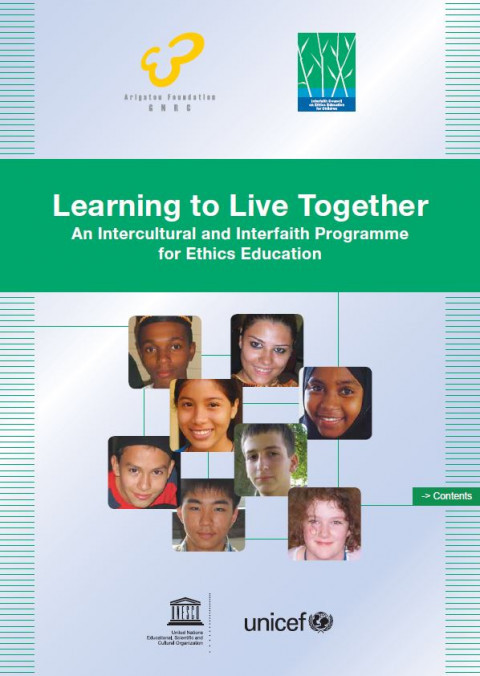 Learning to live together: an intercultural and interfaith programme for ethics education Année de publication: 2008 Auteur institutionnel: Interfaith Council on Ethics Education for Children | Arigatou Foundation (Switzerland) Learning to Live Together has been developed for use in different religious and secular contexts as a resource for everyone concerned with promoting ethics and values. The objective has been to develop a resource that is relevant on a global level and yet flexible enough to be interpreted within different cultural and social contexts. The resource has been tested in many different regions and cultural contexts to assure that it is relevant in regional and local contexts (see ‘We did it like this’, p.187).Test workshops have been held in 10 different countries, where the GNRC was able to bring together various religious and secular organisations working with children. During the test workshops, this resource manual was used to the benefit of more than 300 children and youth, representing African Traditional Religions, Bahá’í Faith, Buddhism, Christianity, Hinduism, Islam, Judaism, members of Brahma Kumaris and a number of people of secular thinking. Test workshops as well as input and comments from experts in the area of education, ethics, spirituality, intercultural and interfaith learning and child rights have contributed important experiences and opportunities for learning for the development of this resource. Learning to Live Together is already having an impact. In a GNRC programme in Israel, the resource material was used during a six-day journey made by a group of Jewish, Christian, and Muslim youth to the historical sites of Israel and Palestine, all of which have symbolic relevance to the conflict in their region. At each stop, youth participants discussed their values and their differing perceptions of their shared history.Learning to Live Together is an adaptable resource that can be used with children from many different cultural, religious and social contexts to nurture common values and a mutual respect for different backgrounds and traditions. The resource provides space for enhancing children’s innate potential for spirituality and hope for a better world, as a contribution to changing the situation for children worldwide. The Users Guide provides all necessary information for its use. UNESCO and UNICEF have been closely involved in developing Learning to Live Together and have endorsed the material as an important contribution to a quality education, which takes a multicultural and multi-religious society into consideration. UNESCO’s Guidelines for Intercultural Education underpin the philosophy and the approach of the resource: “Religious education can be described as learning about one’s own religion or spiritual practices, or learning about other religions or beliefs. Interfaith education, in contrast, aims to actively shape the relations between people from different religions”.
  ANALYSIS of the Rules for the Prevention of Bullying of a Child, Approved by Order No. 506 of the Minister of Education of the Republic of Kazakhstan dated December 21, 2022 Année de publication: 2022 Auteur: Шайдуллина Венера Камилевна Auteur institutionnel: Кадыр-касиет The focus of this document is to assess the potential effectiveness of the measures provided for by the Rules to counter child bullying. The analysis made it possible to formulate a number of practical recommendations for improving legislation in this area. Анализ Правил профилактики травли (буллинга) ребенка, утвержденных Приказом Министра просвещения Республики Казахстан от 21 декабря 2022 года № 506 Année de publication: 2022 Auteur: Шайдуллина Венера Камилевна Auteur institutionnel: Кадыр-касиет Фокус настоящего документа – оценка потенциальной эффективности предусмотренных Правилами мер по противодействию травле ребенка. Проведенный анализ позволил сформулировать ряд практических рекомендаций по совершенствованию законодательства в рассматриваемой сфере.