
Ressources
Explorez une large gamme de ressources sur le GCED afin d’approfondir votre compréhension et de renforcer vos activités de recherche, de plaidoyer, d’enseignement et d’apprentissage.
3,500 résultats trouvés
 Commission Canadienne des Droits de la Personne Auteur institutionnel: Commission Canadienne des Droits de la Personne La Commission canadienne des droits de la personne est l'organisme de surveillance des droits de la personne à l'échelon fédéral. La Commission est indépendante du gouvernement et agit dans l'intérêt public. Elle contribue à ce que chaque personne au Canada soit traitée équitablement, peu importe son identité. Elle est responsable de représenter l'intérêt public et de demander des comptes au gouvernement du Canada quant aux enjeux de droits de la personne. Sur cette page, vous trouverez des ressources pour mettre en place une politique inclusive dans vos secteurs de travail notamment sur la prévention du racisme, de l'intolérance religieuse et des droits aux travailleurs en situation de handicap The Canadian Human Rights Commission is Canada's human rights watchdog. We work for the people of Canada and operate independently from the Government. The Commission helps ensure that everyone in Canada is treated fairly, no matter who they are. We are responsible for representing the public interest and holding the Government of Canada to account on matters related to human rights. On this page, you'll find resources to help you implement an inclusive policy in your areas of work, including the prevention of racism, religious intolerance and the rights of workers with disabilities.
  Kiffe Ta Race Année de publication: 2018 Auteur institutionnel: Binge Audio Pourquoi le mot « race » est-il tabou ? Qu’en est-il quand on est, à la fois, victime de discriminations raciales et sexuelles ? Comment assumer son identité plurielle ? Un mardi sur deux, Rokhaya Diallo et Grace Ly reçoivent un·e invité·e pour explorer les questions raciales sur le mode de la conversation et du vécu. Why is the word "race" taboo? What happens when you are both a victim of racial and sexual discrimination? How do you come to terms with your plural identity? Every other Tuesday, Rokhaya Diallo and Grace Ly welcome a guest to explore racial issues in a conversational, real-life setting.
  Qui a peur des Juifs ? Antisémitisme, la tentation perpétuelle Année de publication: 2023 Auteur institutionnel: Illana Weizman Dans cette série podcast, la sociologue Illana Weizman questionne les expériences juives et l’hostilité subie par cette population en compagnie d’intellectuel-les, d’artistes, de chercheurs-euses, de militant-es ou de politiques rencontré·es des deux côtés de la frontière franco-suisse.Où en est la lutte contre l’antisémitisme aujourd’hui? Quand les courants antiracistes prônent l’écoute des concernés, n’est-il pas temps de l’appliquer pleinement aux Juifs? In this podcast series, sociologist Illana Weizman discusses the Jewish experience and the hostility suffered by this population in the company of intellectuals, artists, researchers, activists and politicians from both sides of the Franco-Swiss border. When anti-racist currents advocate listening to those concerned, isn't it time to apply this fully to Jews?
  中小学生课业负担加重的社会 : 教育传导机制与治理路径 (现代教育论丛 第256期) Année de publication: 2024 Auteur: 刘建银 Auteur institutionnel: 华南师范大学 个体社会经济地位的提升越来越依赖学校教育获得,劳动力市场的分割将竞争 集中在普通学校教育体系内的优质资源,社会公平诉求又将选拔标准单一化为书本可测知识 成绩的排名,不可避免出现考试难度越来越大、学习进度越来越超前、时间越来越长、负担 越来越重的后果。过重课业负担对学习韧性和身心健康的影响令人担忧。减轻过重课业负担 是一场持久战,需要继续强化“双减”治理、明确长期可持续学习的价值导向、重构多样化 教育体系以及推动主要劳动力市场选人机制转型,进而走出“治理—恶化—再治理—再恶化” 的莫比乌斯循环。
 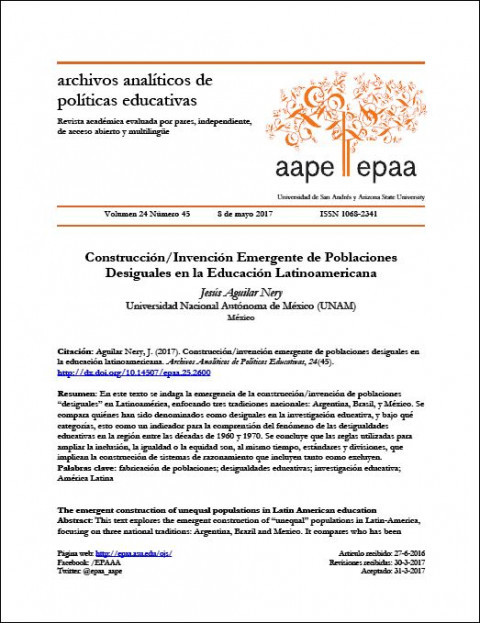 Construction / Emerging Invention of Unequal Populations in Latin American Education Année de publication: 2017 Auteur: Jesús Aguilar Nery Auteur institutionnel: Universidad de San Andrés | Arizona State University This text explores the emergent construction of “unequal” populations in Latin-America, focusing on three national traditions: Argentina, Brazil and Mexico. It compares who has been named as unequal in educational research and under what categories, and treats this comparison as an indicator for understanding the phenomenon of educational inequalities in the region between 1960 and 1970. It is concluded that the rules used to enforce inclusion, equality and equity are, at the same time, standards and divisions that involve the construction of systems of reasoning that also simultaneously include and exclude. Construcción/Invención Emergente de Poblaciones Desiguales en la Educación Latinoamericana Année de publication: 2017 Auteur: Jesús Aguilar Nery Auteur institutionnel: Universidad de San Andrés | Arizona State University En este texto se indaga la emergencia de la construcción/invención de poblaciones “desiguales” en Latinoamérica, enfocando tres tradiciones nacionales: Argentina, Brasil, y México. Se compara quiénes han sido denominados como desiguales en la investigación educativa, y bajo qué categorías, esto como un indicador para la comprensión del fenómeno de las desigualdades educativas en la región entre las décadas de 1960 y 1970. Se concluye que las reglas utilizadas para ampliar la inclusión, la igualdad o la equidad son, al mismo tiempo, estándares y divisiones, que implican la construcción de sistemas de razonamiento que incluyen tanto como excluyen.
 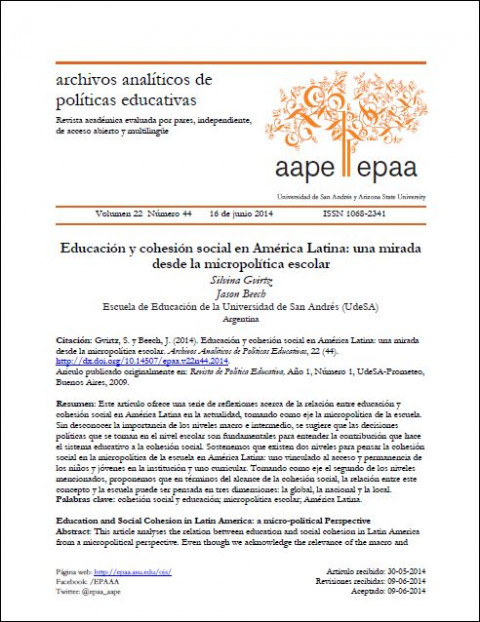 Education and Social Cohesion in Latin America: A Micro-political Perspective Année de publication: 2014 Auteur: Silvina Gvirtz | Jason Beech Auteur institutionnel: Universidad de San Andrés | Arizona State University This article analyses the relation between education and social cohesion in Latin America from a micropolitical perspective. Even though we acknowledge the relevance of the macro and mezzo levels, we argue that the political decisions that are made at the school level are crucial to understand the contribution of educational systems to social cohesion. We suggest that the relation between social cohesion and school micropolitics can be analysed in two dimensions: the first is related to the access and permanence of children in school, while the second is related to the curriculum. The article concentrates on the second level by analysing the relation between the curriculum and social cohesion from a local, a national, and a global perspective. Educación y Cohesión Social en América Latina: Una Mirada desde la Micropolítica Escolar Année de publication: 2014 Auteur: Silvina Gvirtz | Jason Beech Auteur institutionnel: Universidad de San Andrés | Arizona State University Este artículo ofrece una serie de reflexiones acerca de la relación entre educación y cohesión social en América Latina en la actualidad, tomando como eje la micropolítica de la escuela. Sin desconocer la importancia de los niveles macro e intermedio, se sugiere que las decisiones políticas que se toman en el nivel escolar son fundamentales para entender la contribución que hace el sistema educativo a la cohesión social. Sostenemos que existen dos niveles para pensar la cohesión social en la micropolítica de la escuela en América Latina: uno vinculado al acceso y permanencia de los niños y jóvenes en la institución y uno curricular. Tomando como eje el segundo de los niveles mencionados, proponemos que en términos del alcance de la cohesión social, la relación entre este concepto y la escuela puede ser pensada en tres dimensiones: la global, la nacional y la local.
 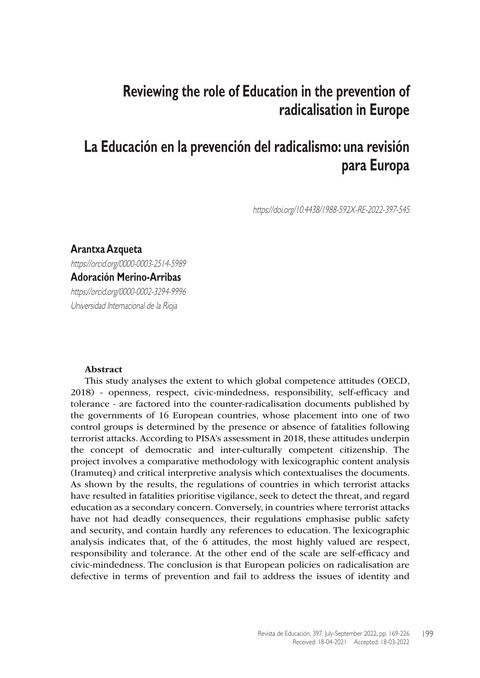 La educación en la prevención del radicalismo: una revisión para Europa Année de publication: 2022 Auteur: Arantxa Azqueta | Adoración Merino-Arribas Auteur institutionnel: Spain. Ministry of Education Esta investigación analiza si las actitudes de la competencia global (OECD, 2018) -apertura, respeto, conciencia cívica, responsabilidad, autoeficacia y tolerancia- se recogen en los documentos gubernamentales sobre prevención del radicalismo de 16 países europeos, aglutinados en dos grupos control, en función de la presencia o ausencia de víctimas mortales en los atentados. Estas actitudes, evaluadas por PISA en 2018, definen a una ciudadanía democrática e interculturalmente competente. Se emplea una metodología comparativa con un análisis de contenido lexicográfico mediante el software Iramuteq junto al análisis crítico-interpretativo que contextualiza los documentos.
 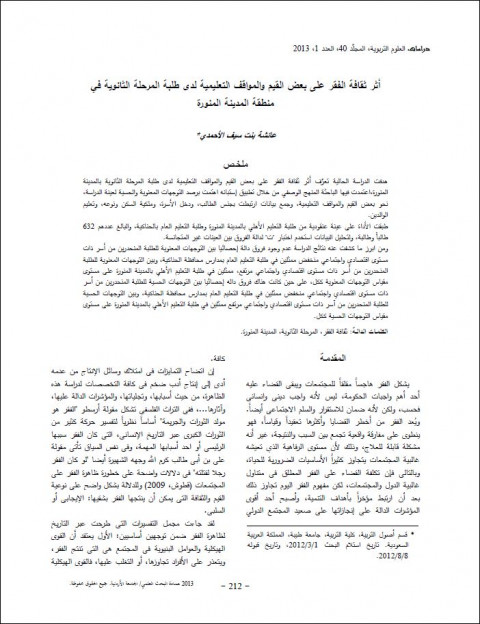 Poverty Culture Impact on Some Educational Values and Attitudes of Secondary Stage Students in Al-Madinah Al-Munawarah Province Année de publication: 2013 Auteur: Aysha Al-Ahmadi Auteur institutionnel: University of Jordan The study aimed at identifying the impact of the culture of poverty on some educational values and attitudes of high school students in Madinah. The researcher adopted the descriptive approach through the application of a questionnaire concerned with monitoring the moral and sensory trends of the study sample. The questionnaire was developed towards measuring some educational values and attitudes, and collecting data related to the student’s gender and family income Ownership and type of housing, and parenting education.