
Ressources
Explorez une large gamme de ressources sur le GCED afin d’approfondir votre compréhension et de renforcer vos activités de recherche, de plaidoyer, d’enseignement et d’apprentissage.
3,537 résultats trouvés
 Fondations durables: Un Guide d’enseignement des objectifs de développement durable Année de publication: 2018 Auteur: Keana Rellinger | Grace Van Mil Auteur institutionnel: Manitoba Council for International Cooperation (MCIC) Ce guide est conçu pour les éducateurs ou toute personne qui aimerait enseigner aux jeunes les objectifs de développement durable des Nations Unies. Les objectifs de développement durable – également connus sous l’acronyme ODD ou les objectifs mondiaux – couvrent un large éventail de questions relatives à la durabilité, et mettent en lumière les zones de priorité internationale pour mettre fin à la pauvreté et à la faim, améliorer la santé et l’éducation, rendre les villes plus durables et combattre le changement climatique. Ce guide vous donne des informations claires, des ressources pédagogiques et d’autres soutiens pour appuyer vos efforts d’éducation et de motivation des jeunes pour qu’ils appuient les objectifs de développement durable et se sentent inspirés à transformer leur appui en action. Ce guide explore aussi comment vous pouvez incorporer à vos cours les divers sujets couverts par chaque objectif dans de multiples matières.
  디지털 소통로(law): 안전·배려·공감의 디지털 세상 만들기; 중·고등용 Année de publication: 2020 Auteur: 정소연 | 김영준 | 김동하 | 최용철 | 김정호 | 송한준 | 김기환 | 이동준 | 장선영 | 허천영 | 허재벽 | 황규상 Auteur institutionnel: 대한민국 법무부 보호정책과 이 교재는 청소년들이 실제 궁금해 하고, 피해가 자주 발생하는 디지털 성범죄, 사이버 폭력, 인터넷 금융범죄, 디지털 저작권 등 4개 분야와 디지털 에티켓을 각각의 사례로 구성하였고, 사례에 해당하는 법조문과 판례를 통해 디지털 범죄에 대한 경각심을 일깨울 뿐 아니라, 피해자들을 위한 구제 방법과 관계기관의 지원 대책 등을 종합적으로 안내하고 있다. 디지털 공간에서 발생하는 각종 범죄의 재발 방지와 피해 예방을 위해 발간된 청소년용 디지털 법교육 교재이다.
 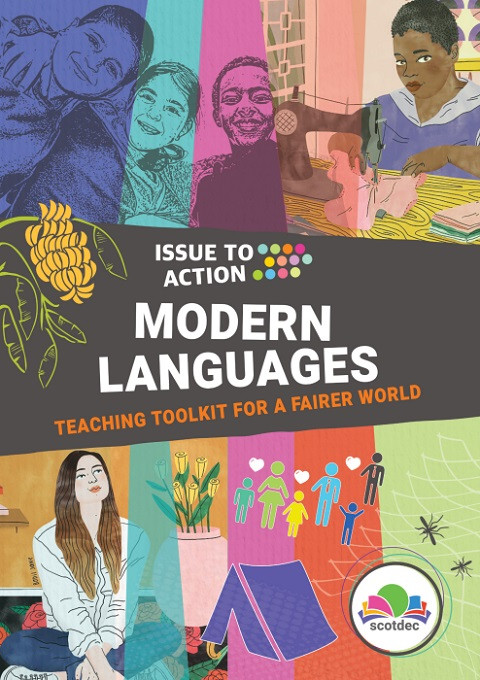 Issue to Action: Modern Languages; Teaching Toolkit for a Fairer World Année de publication: 2020 Auteur: Megan Clark | Irina Gancheva | Laura Morris | Peigi Morrison Auteur institutionnel: Scotdec | European Union (EU) Global Citizenship Education is essential in enabling young people to access and participate in shaping modern society. All teachers and subjects have a role to play in educating young people to enable them to participate as fully as possible in building a fair and just world for all. A Global Citizenship approach to Modern Languages enable young people to gain insights into other ways of thinking and other views of the world. With a focus on diversity and equality, the many and varied Spanish and French speaking cultures in Africa and South America, can provide a rich learning context. The materials in this resource have been written by Modern Languages teachers and tested in Scottish classrooms. They provide an opportunity to learn common vocabulary in new contexts and consider global issues such as migration and gender equality from different perspectives.
  Education for Social Change: The Global Learning Programme in the North of Ireland (Policy and Practice: A Development Education Review; Vol. 23, Autumn) Année de publication: 2016 Auteur: Stephen McCloskey Auteur institutionnel: Centre for Global Education (CGE) The Global Learning Programme (GLP) is a four-year initiative funded by the UK government that aims ‘to support schools to teach about global poverty and international development, with a particular focus on upper primary and early secondary school’ (DfID, 2013). The overarching outcome for the project in Northern Ireland is ‘increased and improved delivery of development education in 50% of grant aided primary, secondary and special schools’. It seeks ‘to embed development education and global citizenship as regular practice across curriculum subjects and through whole school initiatives’. The GLP in the north of Ireland is managed by the Centre for Global Education and this article outlines the programme of support provided to schools including Continuing Professional Development (CPD), twilight training, senior leadership seminars and a designated website. The article will also describe the mixed methods approach used to evaluate the impact of the GLP on schools and, in particular, its effectiveness in implementing global learning in the classroom. The article will summarise research findings to date and what they reveal about how teachers have perceived the value of the support provided. The article will conclude by considering the positive impact of the GLP on the wider global education non-governmental sector in Northern Ireland.
 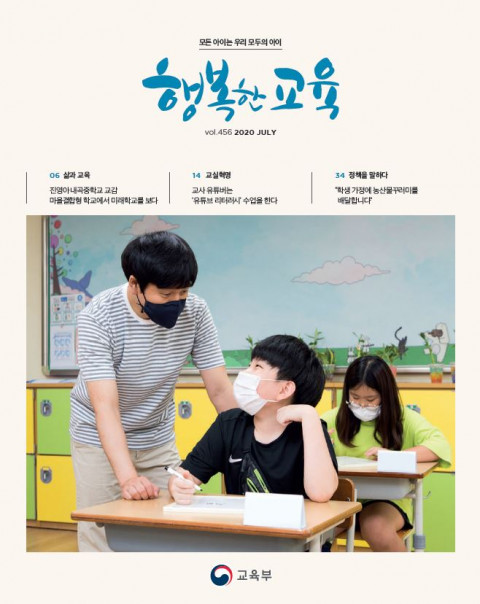 행복한 교육 2020년 7월호 (제456호) Année de publication: 2020 Auteur institutionnel: 대한민국 교육부 특별기획 미래_지능정보사회를 이끌 인재 양성 청사진교육부는 최근 ‘과학·수학·정보·융합교육 종합계획(5개년)’을 발표하며 향후 5년간의 미래 인재 양성에 대한 청사진을 제시했다. 교과 간의 긴밀한 연결과 융합을 바탕으로 정책이 수립되어 시너지 효과가 기대된다. 이번 발표에 따르면, 인공지능(AI), 가상·증강현실(VR·AR) 등 최첨단 에듀테크 기술이 교육 현장에 적극적으로 도입되는데, 대표적으로 최첨단 기술을 적용한 지능형 과학실을 2024년까지 모든 학교에 구축하여 학생들이 첨단 과학을 직접 체험하고 학습할 수 있도록 한다는 계획이다. 교육부의 과학·수학·정보·융합교육 청사진을 살펴본다.정책을 말하다_“학생 가정에 농산물꾸러미를 배달합니다”학교급식의 중단으로 학부모와 농가, 급식업체의 부담이 증가함에 따라 교육부와 농림축산식품부는 시도교육청·지자체와 협력하여 ‘학생 가정 농산물꾸러미 지원사업’을 추진하고 있다. 꾸러미사업에 서울, 대구, 인천, 광주, 대전, 세종, 경기, 강원, 충북, 충남, 전북, 전남, 경북, 경남과 부산 기장군에서 참여하며 499만여 명의 학생 가정에 3만 7천 톤의 농산물을 공급하였다. 일부 지역(울산, 부산, 제주, 세종)에서는 학생 가정 내 경제적 부담을 줄여주고자 잔여 급식예산을 교육재난지원금 등의 형태로 지급하고 있다.
 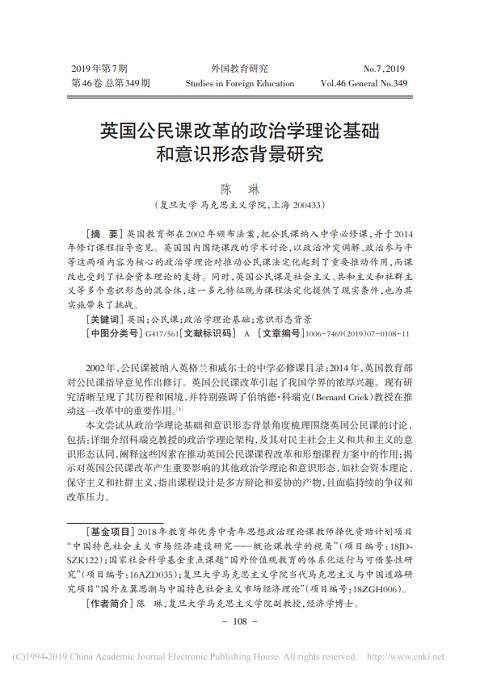 英国公民课改革的政治学理论基础 和意识形态背景研究 (外国教育研究; Vol. 46, No. 7) Année de publication: 2019 Auteur: Chen Lin Auteur institutionnel: Northeast Normal University 英国教育部在2002年颁布法案,把公民课纳入中学必修课,并于2014年修订课程指导意见。英国国内围绕课改的学术讨论,以政治冲突调解、政治参与平等这两项内容为核心的政治学理论对推动公民课法定化起到了重要推动作用,而课改也受到了社会资本理论的支持。同时,英国公民课是社会主义、共和主义和社群主义等多个意识形态的混合体,这一多元特征既为课程法定化提供了现实条件,也为其实施带来了挑战。
 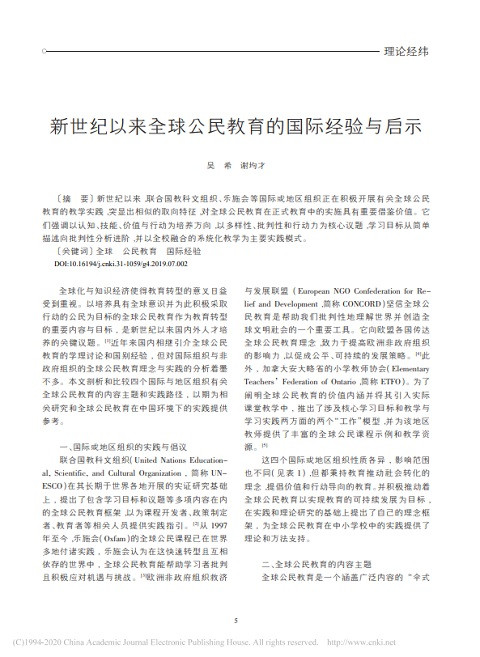 The International Experience and Enlightenment of Global Citizenship Education In the New Century (Journal of Shanghai Education Research) Année de publication: 2019 Auteur: Wuxi | Thomas Tse Auteur institutionnel: Shanghai Educational Research Since the beginning of the new century, international or regional organizations such as UNESCO and Oxfam have been actively carrying out teaching practices related to global citizenship education, highlighting similar orientation characteristics and providing important reference value for the implementation of global citizenship education in formal education. They emphasize cognition, skill, value and action as the training direction, take diversity, criticalness and action as the core topic, learn objective from simple description to critical analysis, and take integrated systematic teaching as the main practice mode. 新世纪以来全球公民教育的国际经验与启示 (上海教育科研) Année de publication: 2019 Auteur: Wuxi | Thomas Tse Auteur institutionnel: Shanghai Educational Research 新世纪以来,联合国教科文组织、乐施会等国际或地区组织正在积极开展有关全球公民 教育的教学实践,突显出相似的取向特征,对全球公民教育在正式教育中的实施具有重要借鉴价值。它 们强调以认知、技能、价值与行动为培养方向,以多样性、批判性和行动力为核心议题,学习目标从简单 描述向批判性分析进阶,并以全校融合的系统化教学为主要实践模式。
 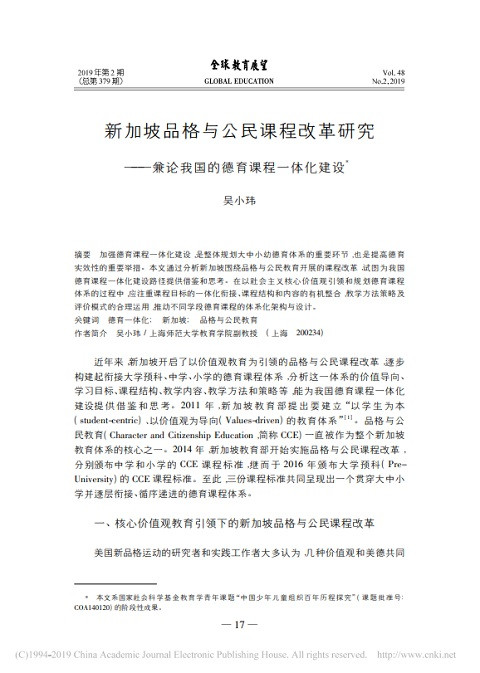 Study on Singapore’s Character and Citizenship Education Curriculum Reform: Discuss the Design of the Integration of Moral Education Curriculum from Primary School to University (Global Education; Vol. 48, No. 2) Année de publication: 2019 Auteur: Wu Xiaowei Auteur institutionnel: East China Normal University Strengthening the integration of moral education curriculum is an important part of the overall planning of a moral education system from primary school to university, which also is an important method to improve the effectiveness of moral education. Singapore’s curriculum reform reviving around character and citizenship education can provide reference and enlightenment for the integration of moral curriculum from primary school to university in China. Using the socialist core values to lead and plan the moral education curriculum system, we should focus on the systematic of curriculum objectives, the organic integration of curriculum structure and content, the rational use of teaching methods and strategies and evaluation models, so as to promote the coordinated connection and development of moral education courses from primary school to university. 新加坡品格与公民课程改革研究: —兼论我国的德育课程一体化建设 (全球教育展望; Vol. 48, No. 2) Année de publication: 2019 Auteur: Wu Xiaowei Auteur institutionnel: East China Normal University 加强德育课程一体化建设,是整体规划大中小幼德育体系的重要环节,也是提高德育实效性的重要举措。本文通过分析新加坡围绕品格与公民教育开展的课程改革,试图为我国德育课程一体化建设路径提供借鉴和思考。在以社会主义核心价值观引领和规划德育课程体系的过程中,应注重课程目标的一体化衔接、课程结构和内容的有机整合,教学方法策略及评价模式的合理运用,推动不同学段德育课程的体系化架构与设计。