
Ressources
Explorez une large gamme de ressources sur le GCED afin d’approfondir votre compréhension et de renforcer vos activités de recherche, de plaidoyer, d’enseignement et d’apprentissage.
3,500 résultats trouvés
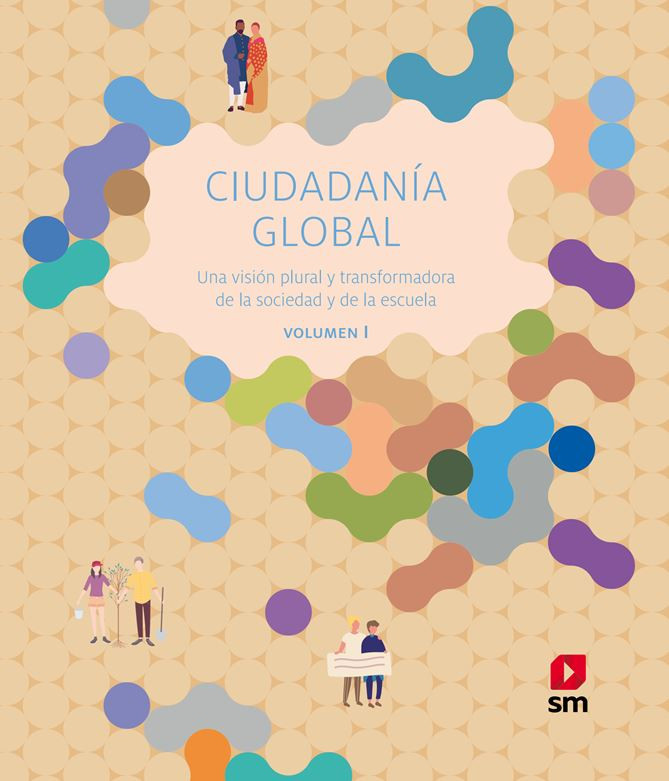 Global Citizenship: A plural and Transformative Vision of Society and School; Volume Ⅰ Année de publication: 2020 Auteur: Rafael Díaz-Salazar | Alfonso Díez Prieto | Antonio Roura | Begoña Carmona | Carme García Yeste | Carmen Magallón | César García-Rincón | Florencio Luengo | Gema Celorio | Gonzalo Fanjul | Juan Iglesias | Juan Pablo Rayo | Luis González Reyes | Manuela Mesa | María Laín | Mónica Cantón de Celis | Pedro Sáez | Pilar Álvarez Cifuentes | Rafael Feito | Regina Gairal | Santiago Álvarez Cantalapiedra | Victoria Camps | Violeta Velasco | Yayo Herrero | Augusto Ibañez Auteur institutionnel: SM Foundation The objective of this work, which brings together the voices of great specialists, reinforced by the vision of the school itself, is to promote and channel the debate on global citizenship towards an education oriented to the care of the person, society and nature. Understood in this way, education for global citizenship can help us form fulfilled people, prepared to intervene positively in a world in continuous change, and capable of adopting a sustainable way of life for ourselves, those around us and those who will succeed us. Ciudadanía Global: Una visión plural y transformadora de la sociedad y de la escuela; Volumen Ⅰ Année de publication: 2020 Auteur: Rafael Díaz-Salazar | Alfonso Díez Prieto | Antonio Roura | Begoña Carmona | Carme García Yeste | Carmen Magallón | César García-Rincón | Florencio Luengo | Gema Celorio | Gonzalo Fanjul | Juan Iglesias | Juan Pablo Rayo | Luis González Reyes | Manuela Mesa | María Laín | Mónica Cantón de Celis | Pedro Sáez | Pilar Álvarez Cifuentes | Rafael Feito | Regina Gairal | Santiago Álvarez Cantalapiedra | Victoria Camps | Violeta Velasco | Yayo Herrero | Augusto Ibañez Auteur institutionnel: SM Foundation El objetivo de esta obra, que recoge las voces de grandes especialistas, reforzadas por la visión de la propia escuela, es impulsar y canalizar el debate sobre la ciudadanía global hacia una educación orientada al cuidado de la persona, de la sociedad y de la naturaleza. Entendida así, la educación para la ciudadanía global puede ayudarnos a formar a personas plenas, preparadas para intervenir positivamente en un mundo en continuo cambio, y capaces de adoptar un modo de vida sostenible para nosotros, los que nos rodean y los que nos sucederán.
 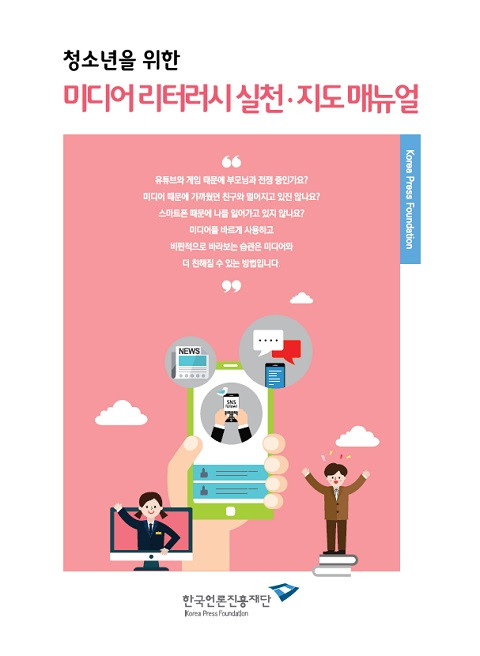 청소년을 위한 미디어 리터러시 실천·지도 매뉴얼 Année de publication: 2018 Auteur: 이연희 Auteur institutionnel: 한국언론진흥재단 본 매뉴얼은 미디어가 무엇인지, 미디어는 나의 삶에서 어떤 위치를 차지하고 있고 어떤 영향을 주고 있는 안내하면서, 청소년이 주체적으로 올바른 미디어 사용을 통해 세상을 바로 보는 힘을 키울 수 있도록 구성하였다.
  미디어 리터러시 교육의 융합적 접근 Année de publication: 2020 Auteur: 진민정 | 김반야 | 박유신 | 최숙 Auteur institutionnel: 한국언론진흥재단 본 연구서에는 미디어 리터러시 교육에서의 융합 논의를 기반으로 미디어 리터러시 교육의 패러다임 전환의 필요성을 더욱 공고히 하고, 국내와 해외의 구체적인 사례와 더불어 현재 학교 수업에서 사용 가능한 프로그램을 제시하며 이를 토대로 융합적 미디어 리터러시 교육의 유형과 나아가 융합적 교육의 실현 방안을 살펴보고자 한다.본 연구에서 말하는 융합적 접근이란 미디어 재현 테크놀로지가 호환되고 통합되면서 변화되는 협의적 의미의 융합이라기보다는 좀 더 총체적인 차원의 미디어 교육 패러다임의 변화를 강조하는 제안이다. 다시 말해, 시대적 한계로 인해 고착된 국내 미디어 교육 현장의 분절성을 극복하고 비판적 리터러시의 제고라는 공통의 목표를 위해 주제 간, 참여 주체들 간, 교육 내용 간, 방식 간의 교차, 공유, 협력으로 공동의 성과를 내는 것을 의미한다.
  미디어교육의 재구조화: 21세기 한국의 미디어교육 영역 및 구성 Année de publication: 2019 Auteur: 양정애 | 김아미 | 박한철 Auteur institutionnel: 한국언론진흥재단 본 연구의 목적은 미디어교육 개념을 현재 미디어환경의 특성에 맞게 업데이트하는 한편, 실제로 이뤄지고 있는 현장의 교육양상을 최대 한 반영해서 좀 더 현실적인 형태로 재구조화하는 데 있다. 이를 위해 1차적으로 는 미디어교육과 관련된 다양한 영역의 관계자들을 광범위하게 섭외해 인터뷰를 실시하고, 이들이 어떤 교육을 하거나 받아왔는지, 이들이 생각하는 미디어교육 은 무엇인지, 미디어교육이 좀 더 체계를 잡으려면 어떠한 노력이 필요하다고 생각하는지 등을 물어보았다. 이와 더불어 기존 문헌상에 나타난 미디어교육 및 미디어 리터러시 개념을 정리함으로써 이론적으로는 미디어교육 개념에 어떠 한 변화가 있었으며, 어떤 하위요소들이 강조돼 왔는지를 함께 검토해 보았다. 이는 미디어교육 개념을 재구조화해 현재 한국 상황에 맞는 미디어교육의 영역들 을 도출하고 구성하는 데 있어 이론적・실제적 양상을 모두 반영하기 위해서이다.
  2021 미디어·정보 리터러시 데이 자료집: 어린이·청소년이 말하는 MIL Année de publication: 2021 Auteur institutionnel: 한국언론진흥재단 | 시청자미디어재단 | 주한미국대사관 | 유네스코한국위원회 | 한국교육학술정보원 본 자료집은 2021 미디어·정보 리터러시 데이 행사(2021. 10.19. 개최) 에서 발표한 어린이·청소년 관련 미디어 리터러시 연구 성과 및 발표 자료를 수록하였다.
 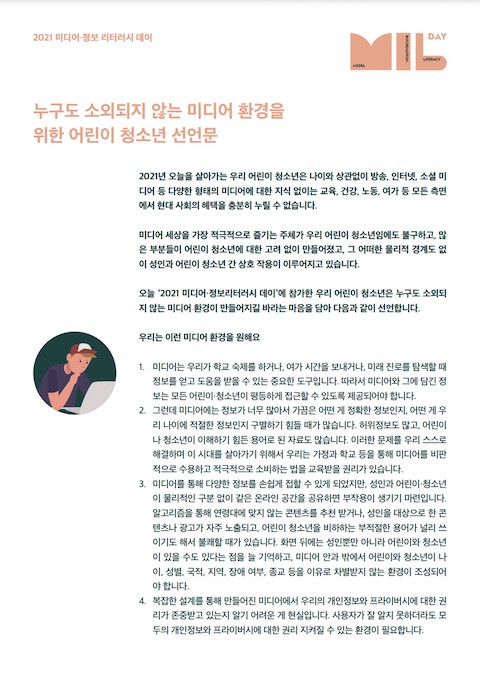 누구도 소외되지 않는 미디어 환경을 위한 어린이 청소년 선언문 Année de publication: 2021 Auteur institutionnel: 한국언론진흥재단 | 시청자미디어재단 | 주한미국대사관 | 유네스코한국위원회 | 한국교육학술정보원 2021 미디어·정보 리터러시 데이 행사(2021. 10.19. 개최)에서 발표된 선언문이다. 본 선언문은 누구나 쉽게 접근할 수 있고, 어린이와 청소년을 존중하고 배려하는 안전한 미디어 세상에 대한 바람을 담았다. 특히, 디지털 기기를 사용할 줄 아는 것과 그 안에 담긴 정보를 잘 선택해 이용하는 것은 매우 다른 능력임을 환기하고, 미디어 정보 리터러시 교육을 강화해줄 것을 주문했다. 선언문 초안 작업에는 초‧중‧고 학생 11명으로 구성된 어린이 청소년 위원회가 직접 참여했으며, 메타버스 플랫폼 게더타운을 통해 의견을 남겨준 전국 초중고등학생 600여명의 의견도 반영되었다.
  Harnessing the Era of Artificial Intelligence in Higher Education: A Primer for Higher Education Stakeholders Année de publication: 2023 Auteur: Bosen Lily Liu | Diana Morales | Jaime Roser-Chinchilla | Emma Sabzalieva | Arianna Valentini | Daniele Vieira do Nascimento | Clarisa Yerovi Auteur institutionnel: UNESCO | UNESCO International Institute for Higher Education in Latin America and the Caribbean (IESALC) The International Institute for Higher Education in Latin America and the Caribbean (UNESCO IESALC) is one of UNESCO’s key education-focused institutes and is the only institute in the United Nations with a specific mandate for higher education. Taking a holistic and integrated intersectoral and cross-sectoral approach to higher education, UNESCO IESALC provides support to Member States through policy-driven and action-oriented research and publications, capacity development, training, advocacy and networking. Following the release of a Quick Start Guide on using ChatGPT and Artificial Intelligence (AI) in higher education, UNESCO IESALC is pleased to offer to the wider community of higher education stakeholders worldwide this Primer on AI and higher education. Providing information and tips for developing further thinking and policies related to the use of AI processes and outcomes in higher education institutions, the Primer is a comprehensive and comprehensible introduction to AI. It also serves as a practical tool for guidance and reference with recommendations for its use in higher education. Oportunidades y desafíos de la era de la inteligencia artificial para la educación superior: Una introducción para los actores de la educación superior Année de publication: 2023 Auteur: Bosen Lily Liu | Diana Morales | Jaime Roser-Chinchilla | Emma Sabzalieva | Arianna Valentini | Daniele Vieira do Nascimento | Clarisa Yerovi Auteur institutionnel: UNESCO | UNESCO International Institute for Higher Education in Latin America and the Caribbean (IESALC) El Instituto Internacional de la UNESCO para la Educación Superior en América Latina y el Caribe (UNESCO IESALC) es uno de los institutos clave de la UNESCO centrado en la educación y es el único instituto de las Naciones Unidas con un mandato específico para la educación superior. Adoptando un enfoque holístico e integrado de manera intersectorial y transectorial de la educación superior, el IESALC presta apoyo a los Estados miembros mediante investigaciones y publicaciones orientadas a la formulación de políticas y a la acción, al desarrollo de capacidades, la formación, la abogacía y la creación de redes. Tras la publicación de una Guía de inicio rápido sobre el uso de ChatGPT y la Inteligencia Artificial (IA) en la educación superior, UNESCO IESALC se complace en ofrecer a la comunidad en general interesada en la educación superior global este Manual en IA y educación superior. Proporcionando información y consejos para el desarrollo de pensamiento y de políticas relacionadas con el uso de la IA en las instituciones de educación superior, este Manual es una introducción comprensible y exhaustiva a la IA. También sirve como herramienta práctica de orientación y referencia con recomendaciones para su uso en la enseñanza superior.
  Addressing Hate Speech Through Education: A Guide for Policy-Makers Année de publication: 2023 Auteur institutionnel: UNESCO | UN. Office on Genocide Prevention and the Responsibility to Protect Hate speech is spreading faster and further than ever before as a result of social media user growth and the rise of populism. Both online and offline, hate speech targets people and groups based on who they are. It has the potential to ignite and fuel violence, spawn violent extremist ideologies, including atrocity crimes and genocide. It discriminates and infringes on individual and collective human rights, and undermines social cohesion. Education can play a central role in countering hateful narratives and the emergence of group-targeted violence. Educational responses to hate speech and all forms of hateful communication include:• Training teachers and learners on the values and practices related to being respectful global and digital citizens;• Adopting pedagogical and whole-school approaches to strengthening social and emotional learning;• Revising and reviewing curricula and educational materials to make them culturally responsive and to include content that identifies hate speech and promotes the right to freedom of expression;This policy guide developed by UNESCO and the United Nations’ Office on Genocide Prevention and the Responsibility to Protect explores these educational responses and provides guidance and recommendations to policy-makers on how to strengthen education systems to counter hate speech.