
Ressources
Explorez une large gamme de ressources sur le GCED afin d’approfondir votre compréhension et de renforcer vos activités de recherche, de plaidoyer, d’enseignement et d’apprentissage.
2,768 résultats trouvés
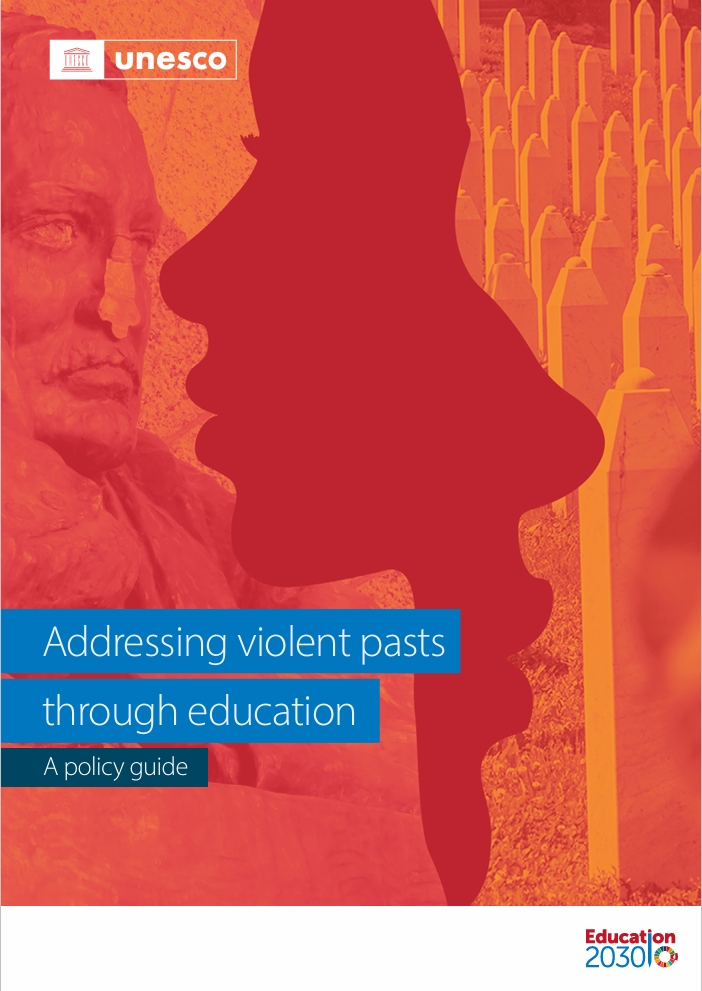 Addressing Violent Pasts through Education: A Policy Guide Année de publication: 2025 Auteur institutionnel: UNESCO Teaching about violent pasts and their legacies is a powerful way to foster sustainable peace.Education can build a nuanced understanding of complex histories, raise awareness of the roots and legacies of violence, nationally and internationally, and sensitize learners for their own agency as actors of change for reconciliation and conflict prevention.Educating about violent pasts is a challenging yet critical endeavour for policy-makers globally. It entails tailored approaches and an important support for educators to address traumatic pasts sensitively and to navigate related emotions and narratives successfully.Building on UNESCO’s programme on Global Citizenship Education, this guide offers education policy-makers a set of strategies, principles, and education practices to effectively integrate education about violent pasts into local education systems. It suggests a comprehensive approach that spans formal and informal education and aligns with the 2023 Recommendation on Education for Peace, Human Rights and Sustainable Development, opening new perspectives on history education, dialogue, and conflict transformation.
 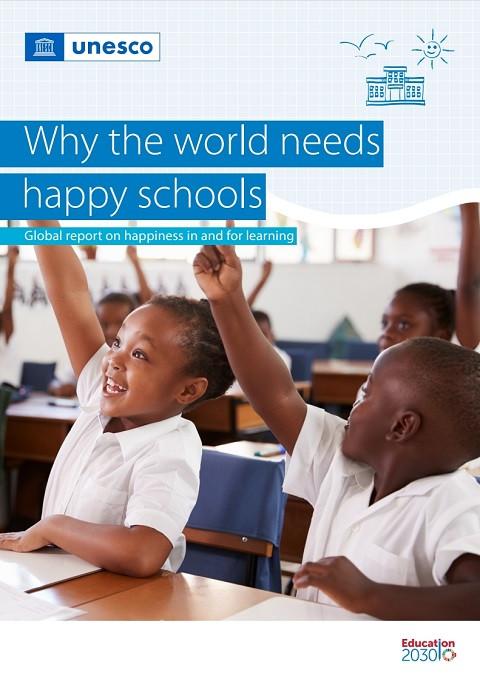 Why the World Needs Happy Schools: Global Report on Happiness In and For Learning Année de publication: 2024 Auteur institutionnel: UNESCO Seeing a teacher smile. Hearing students laugh. Feeling a hug from a friend. Smelling fresh air. Tasting a nutritious school meal. These five senses can stimulate happiness at school and improve the learning experiences, outcomes and well-being of students. Through the ‘Happy Schools’ initiative, UNESCO is placing happiness at the core of the transformation of education. It encourages education systems to recognize happiness as both a means to and a goal of quality learning. The initiative is informed by a growing evidence base linking happiness with better learning, teaching, well-being and overall system resilience. This report presents the UNESCO global Happy Schools framework consisting of 4 pillars – people, process, place and principles – and 12 high-level criteria to guide the transformation of learning. It offers a holistic model for embedding happiness into education policies and cultivating it in schools through systemic changes. The report illustrates how the ‘Happy Schools’ initiative aims to create top-down and bottom-up transformation, encouraging governments to recognize happiness as a core objective of education. It supports the scaling of promising practices of joyful learning from the school to the policy level.
 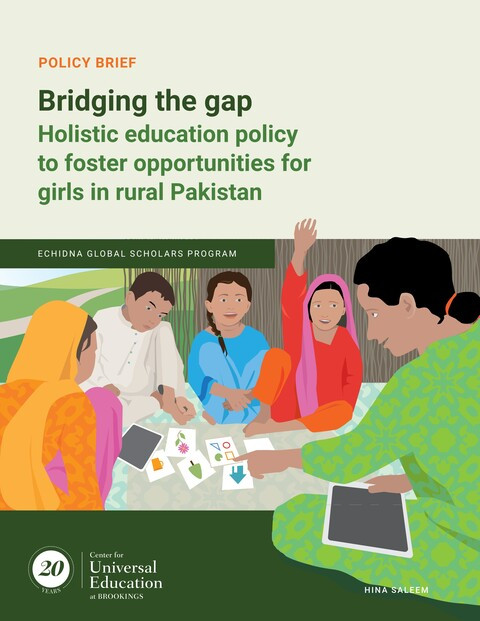 Bridging the Gap: Holistic Education Policy to Foster Opportunities for Girls in Rural Pakistan Année de publication: 2023 Auteur: Hina Saleem Auteur institutionnel: Center for Universal Education at Brookings Seven out of ten girls in rural Sindh are excluded from schooling. This happens for a myriad of reasons and occurs both in the presence and absence of operational school buildings. When schools are present, the challenges that children—especially girls—face due to their economic and social context often go unaddressed; children who are able to enroll in school often find their learning affected by classroom design and practices and experiences that mirror the exclusion they experience outside of school. At the broader level, this exclusion is reflected in limited representation of the needs and aspirations of sizable rural populations in Pakistan’s formal education system and the pathways beyond it. This policy brief presents findings from on-the-ground research in rural settlements in Sindh province that explores the disparities between boys and girls in enrollment and continuation of schooling in addition to overall inadequate education outcomes. It also provides policy recommendations to support all children and particularly girls in meeting their education needs and aspirations. Education policy must respond to these challenges of unmet education needs and aspirations by taking a holistic, welfare-based approach that supports children to overcome the effects of exclusionary conditions to meet their education needs. However, the benefits of such an approach can only be realized if teaching practices and learning experiences are contextualized, build a connection with local knowledge, question root causes of exclusion and support and prepare all children in negotiating pathways beyond education.
  Weaving Education and Equity in Ibero-America Année de publication: 2024 Auteur: Ricardo Cuenca Auteur institutionnel: Organization of Ibero-American States for Education, Science and Culture (OEI) Addressing the complex relationship between education and inequality in Latin America is a challenge. Economic and social disparities create a complex network in the region. Despite progress, access remains an obstacle for many. During its 75-year history, the OEI has been working to break down the barriers that hinder equitable education for all. Ricardo Cuenca, member of the OEI Advisory Board, explains to what extent educational policies can contribute to mitigating these inequalities in Latin America. Tejiendo educación y equidad en Iberoamérica Année de publication: 2024 Auteur: Ricardo Cuenca Auteur institutionnel: Organización de Estados Iberoamericanos para la Educación, la Ciencia y la Cultura (OEI) Abordar la compleja relación entre educación y desigualdad en Iberoamérica es todo un desafío. Las disparidades económicas y sociales tejen un entramado complejo en la región. A pesar de los avances, el acceso sigue siendo un obstáculo para muchos. En esta travesía, la OEI ha venido trabajando durante sus 75 años de historia para derribar las barreras que obstaculizan una formación equitativa para todos. Ricardo Cuenca, miembro del Consejo Asesor de la OEI, nos explica hasta qué punto las políticas educativas pueden contribuir a mitigar esas desigualdades en Iberoamérica.
 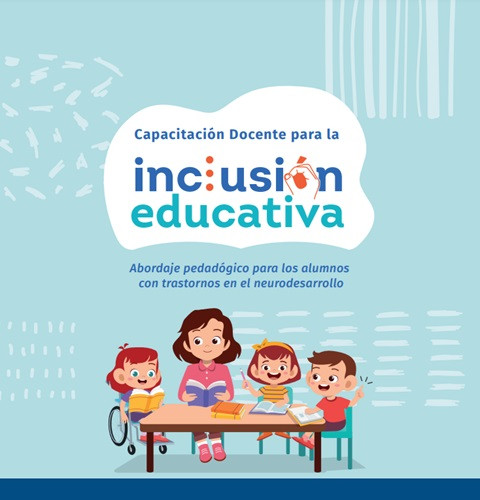 Teacher Training for Educational Inclusion: Pedagogical Approach for Students With Neurodevelopmental Disorders Année de publication: 2024 Auteur institutionnel: Paraguay. Ministry of Education and Science | Organization of Ibero-American States for Education, Science and Culture (OEI) The course aims to design teacher training for educational inclusion with a specific pedagogical approach for students with neurodevelopmental disorders. This course is divided into ten modules, addressing fundamental topics such as: basic notions and concepts of inclusive education, the main paradigms and approaches, the types of accessibility necessary to eliminate barriers to learning and student participation. It also deals with the application of the dimensions of inclusive education (policy, practice and culture) and the exploration of the principles of reasonable adjustments and Universal Design for Learning (UDL). Capacitación docente para la inclusión educativa: Abordaje pedadógico para los alumnos con trastornos en el neurodesarrollo Année de publication: 2024 Auteur institutionnel: Paraguay. Ministry of Education and Science | Organización de Estados Iberoamericanos para la Educación, la Ciencia y la Cultura (OEI) Con el objetivo de diseñar una capacitación docente para la inclusión educativa con un enfoque pedagógico específico para alumnos con trastornos en el neurodesarrollo. Este curso se divide en diez módulos, abordando temas fundamentales como: nociones y conceptos elementales de la educación inclusiva, los principales paradigmas y enfoques, los tipos de accesibilidad necesarios para eliminar barreras en el aprendizaje y la participación de los alumnos. Asimismo, trata de la aplicación de las dimensiones de la educación inclusiva (política, práctica y cultural) y de la exploración de los principios de los ajustes razonables y el Diseño Universal para el Aprendizaje (DUA).
  Index for Inclusion: Developing Learning and Participation in Schools Année de publication: 2015 Auteur: Tony Booth | Mel Ainscow Auteur institutionnel: Organization of Ibero-American States for Education, Science and Culture (OEI) | FUHEM Education This guide provides a set of support materials for self-assessment of all aspects of a school, related to inclusive education, including activities at recess and in the classroom, as well as in the communities and in the context in which it's found. All staff, parents and guardians, as well as the students themselves (whether children, adolescents, or youth) are invited to contribute to the implementation of a plan for inclusion. Guía para la Educación Inclusiva: Desarrollando el aprendizaje y la participación en los centros escolares Année de publication: 2015 Auteur: Tony Booth | Mel Ainscow Auteur institutionnel: Organización de Estados Iberoamericanos para la Educación, la Ciencia y la Cultura (OEI) | FUHEM Education Está guía brinda un conjunto de materiales de apoyo a la autoevaluación de todos los aspectos de un centro escolar, relacionados con la educación inclusiva, incluyendo las actividades en el recreo y en las aulas, así como en las comunidades y en el contexto en el que se encuentra. Se invita a que todo el personal, los padres y tutores, así como los propios estudiantes (sean niños, adolescentes o jóvenes), contribuyan a la implementación de un plan para la inclusión.
  Transforming Education Conference for Humanity: TECH 2017, December 16-18, 2017; Post Event Report Année de publication: 2018 Auteur institutionnel: Mahatma Gandhi Institute of Education for Peace and Sustainable Development (MGIEP) The three-day Transforming Education Conference for Humanity (TECH) 2017 organised by UNESCO Mahatma Gandhi Institute of Education for Peace and Sustainable Development (MGIEP) was held at Novotel Varun Beach, Visakhapatnam City, State of Andhra Pradesh, India from December 16 – 18, 2017. The first edition of TECH focused on digital pedagogies for building peaceful and sustainable societies through 21st century skills, schools and policies, towards achieving the United Nations Sustainable Development Goal 4, Target 7.TECH 2017 was attended by over 1,700 registered participants (including teachers, educators, learners, policy-makers, technology and gaming experts, amongst others) from 75 countries and witnessed highly engaging deliberations on the future of education, particularly on the innovative methods of teaching using technology.The Conference was generously supported by the State Government of Andhra Pradesh, India and the Ministry of Human Resource Development, Government of India and sponsored by Microsoft India (Education Technology Partner), Samsung India, Dassault Systems, Veative (Immersive Learning Partner) and McGraw Hill (Learning Science Partner). The Knowledge Partners of the Conference included NMIMS, Ubisoft, Quebec Government, ISTE, Social Alpha, EDB and IYC.TECH will be held annually over the next five years with a long term aim of affecting global policy change on the usage of digital pedagogies to render quality and inclusive education for all.