
Ressources
Explorez une large gamme de ressources sur le GCED afin d’approfondir votre compréhension et de renforcer vos activités de recherche, de plaidoyer, d’enseignement et d’apprentissage.
2,813 résultats trouvés
 Traces of Memory 2: Short Film Année de publication: 2017 Auteur institutionnel: Londres 38 Second part of the short film based on stories related to London 38, a house used as a place of detention and torture of opponents of the Augusto Pinochet dictatorship. The voices of the protagonists were given to young cartoonists and illustrators for the making of this film. Trazos de memoria 2: Cortometraje Année de publication: 2017 Auteur institutionnel: Londres 38 Segunda parte del cortometraje basado en historias vinculadas a Londres 38, un inmueble utilizado como lugar de detención y tortura de opositores a la dictadura de Augusto Pinochet. Las voces de los protagonistas fueron entregados a dibujantes e ilustradores jívenes, para la realización de esta película.
  My Migrant Object Auteur institutionnel: Museo de la Memoria y los Derechos Humanos Educational material developed by the Museum of Memory and Human Rights from objects associated with stories of exile during the dictatorship of Augusto Pinochet in Chile.
 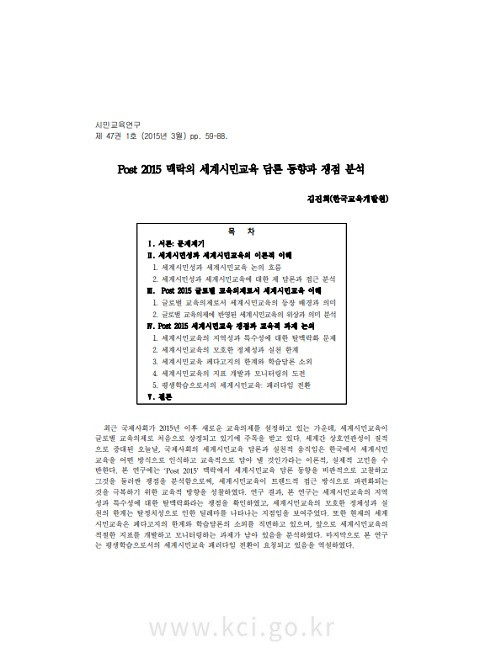 Post 2015 맥락의 세계시민교육 담론 동향과 쟁점 분석 (시민교육연구; Vol. 57, No. 1) Année de publication: 2015 Auteur: 김진희 Auteur institutionnel: 한국사회과교육학회 최근 국제사회가 2015년 이후 새로운 교육의제를 설정하고 있는 가운데, 세계시민교육이 글로벌 교육의제로 처음으로 상정되고 있기에 주목을 받고 있다. 세계간 상호연관성이 질적으로 증대된 오늘날, 국제사회의 세계시민교육 담론과 실천적 움직임은 한국에서 세계시민교육을 어떤 방식으로 인식하고 교육적으로 담아 낼 것인가라는 이론적, 실제적 고민을 수반한다. 본 연구에는 ‘Post 2015’ 맥락에서 세계시민교육 담론 동향을 비판적으로 고찰하고 그것을 둘러싼 쟁점을 분석함으로써, 세계시민교육이 트렌드적 접근 방식으로 파편화되는 것을 극복하기 위한 교육적 방향을 성찰하였다. 연구 결과, 본 연구는 세계시민교육의 지역성과 특수성에 대한 탈맥락화라는 쟁점을 확인하였고, 세계시민교육의 모호한 정체성과 실천의 한계는 탈정치성으로 인한 딜레마를 나타나는 지점임을 보여주었다. 또한 현재의 세계시민교육은 페다고지의 한계와 학습담론의 소외를 직면하고 있으며, 앞으로 세계시민교육의 적절한 지표를 개발하고 모니터링하는 과제가 남아 있음을 분석하였다. 마지막으로 본 연구는 평생학습으로서의 세계시민교육 패러다임 전환이 요청되고 있음을 역설하였다.
 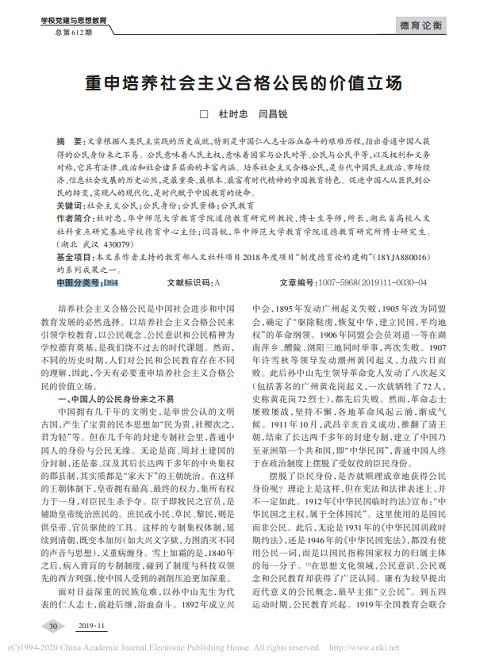 Reaffirm the Value Position of Cultivating Qualified Socialist Citizens (The Party Building and Ideological Education in Schools; No. 612) Année de publication: 2019 Auteur: Du Shizhong | Yan Changrui Auteur institutionnel: Hubei Education Press Based on the historical achievements of human democracy practice, especially the arduous course of Chinese patriots’ bloody struggle, the article points out that the citizenship of ordinary Chinese has not come easily. Citizenship means people’s sovereignty, equality between the state and citizens, equality between citizens and citizens, and symmetry of rights and obligations. It has rich connotations in many aspects of law, politics and society. Cultivating qualified socialist citizens is the historical necessity of the development of contemporary China’s democracy, market economy and information society. It is also the most important, fundamental and zeitgeist characteristic of Chinese education. It is the mission of the times to promote the transformation of the Chinese people from subjects to citizens and realize the modernization. 重申培养社会主义合格公民的价值立场 (学校党建与思想教育; No. 612) Année de publication: 2019 Auteur: Du Shizhong | Yan Changrui Auteur institutionnel: Hubei Education Press 文章根据人类民主实践的历史成就,特别是中国仁人志士浴血奋斗的艰难历程,指出普通中国人获得的公民身份来之不易。公民意味着人民主权,意味着国家与公民对等、公民与公民平等,以及权利和义务对称,它具有法律、政治和社会诸多层面的丰富内涵。培养社会主义合格公民,是当代中国民主政治、市场经济、信息社会发展的历史必然,是最重要、最根本、最富有时代精神的中国教育特色。促进中国人从臣民到公民的转变,实现人的现代化,是时代赋予中国教育的使命。
  Development Education in Theory and Practice: An Educator’s Resource Année de publication: 2016 Auteur: Michal Cenker | Louiza Hadjivasiliou | Patrick Marren | Niamh Rooney Auteur institutionnel: UNIDEV | NGO Support Centre (Cyprus) | Pontis Foundation (Slovakia) | Kimmage Development Studies Centre (Ireland) This publication has been produced to provide a new teaching resource for academics and educators active in the field of Development Education and related disciplines. It covers twelve themes, each chapter includes both a conceptual overview and a teaching methodology section. The conceptual overview introduces the topic, explores the key concepts, theories and current debates. The teaching methodology section gives educators a set of tools that could help them introduce the topic in both formal and non-formal settings.
  Personalized Learning within Teacher Education: A Framework and Guidelines Année de publication: 2020 Auteur institutionnel: UNESCO International Bureau of Education (IBE) This paper explores the theoretical and practice elements that together inform the concept of personalised learning. These insights are then used to develop a Framework for Personalized Learning within Teacher Education. In addition, the final chapter outlines pedagogical strategies to support the development of personalised learning that were tested during the project within the participating universities.The Framework and Guidelines are intended for use by to teacher educators and their students, as well as by teachers and students in schools, to support the on‐going shift towards a personalised learning and collaborative paradigm which forefronts learner agency and autonomy and encourages learners of all ages to assume increased responsibility for their own learning and achievements.
  Education for Develpment (EdD) in a Diverse World: Comparative Study of Education for Global Citizenship (EdGC) in Paraguay and Spain Année de publication: 2017 Auteur: Ángela Alcaide Capilla | María Jesús Martínez Usarralde Auteur institutionnel: University of Valencia According to the summary of the author: "This article aims to collect a comparative analysis regarding Global Citizenship Education in two different contexts: Spain and Paraguay. The objective is to discover the main characteristics of this education, in meaning and practice, focusing on the diversity of views and constraints of reality, which enrich existing theory speeches, opening this field of knowledge to the experience of its application. In fact, this is the objective and the conclusion. The research justifies the value of this information in the field of study, based on interviews with experts from which relevant information that eludes the rhetorical speeches can be extracted." La Educación para el Desarrollo (EpD) en un mundo diverso: estudio comparativo de la Educación para la Ciudadanía Global (EpCG) en Paraguay y España Année de publication: 2017 Auteur: Ángela Alcaide Capilla | María Jesús Martínez Usarralde Auteur institutionnel: University of Valencia Según el resumen de los autores: "El presente artículo pretende acometer un análisis comparado en relación a la Educación para a la Ciudadanía Global en dos contextos diferentes: España y Paraguay. Se pretende con ello reconocer los rasgos principales de esta educación, en significado y práctica, bajo la premisa de destacar la diversidad de visiones y condicionantes de la realidad, que conceden a los discursos ya existentes en la teoría una gran riqueza, abriendo su campo de conocimiento a la experiencia que de su aplicación se extrae. En sí, este es objetivo y conclusión. Con la investigación se justifica el valor que esta información tiene para el campo de estudio, a partir de entrevistas a personas expertas de las que se extrae información relevante que escapa a la retórica."