
Ressources
Explorez une large gamme de ressources sur le GCED afin d’approfondir votre compréhension et de renforcer vos activités de recherche, de plaidoyer, d’enseignement et d’apprentissage.
2,813 résultats trouvés
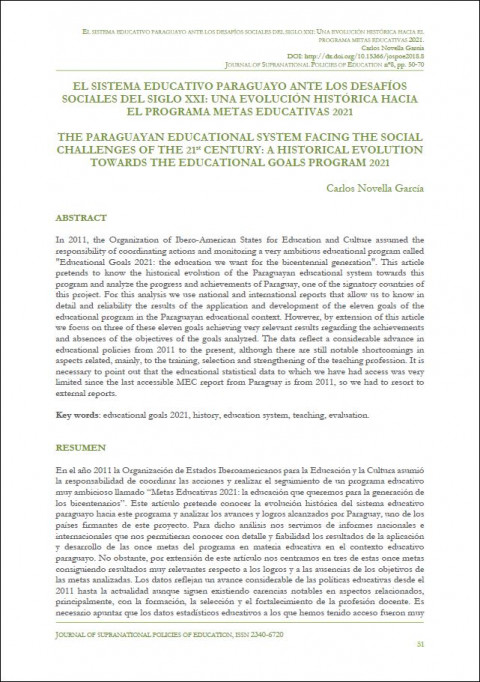 The Paraguayan Educational System Facing the Social Challenges of the 21st Century: A Historical Evolution Towards the Educational Goals Program 2021 Année de publication: 2018 Auteur: Carlos Novella García Auteur institutionnel: Autonomous University of Madrid In the summary the author sustains: "In 2011 the Iberoamerican States Organization for Education and Culture assumed the responsibility of coordinatin the actions and follow a challenging educative programa called "Educative Goals 2021: the education that we want for the generations of the bicentenary". This article pretends to learn the full details of this program and analyze the progresses and achievements made by Paraguay, one of the countries that signed this project. Different national and international reports were analysed in order to know, in detail and in a reliable way, the results of the application and development of the eleven goals of the program regarding education in the Paraguayan context. Nevertheless, due to the extension of this article, the authors focused on three of the eleven goals and obtained very relevant results concerning the absences and achievements of the objectives of these goals. The data evidences considerable progress in the education policies since 2011 although education, selection and professional development of teachers is still lacking development." I would add that the author highlights the importance of an international and Iberoamerican citizenship. El sistema educativo paraguayo ante los desafíos sociales del siglo XXI: una evolución histórica hacia el programa metas educativas 2021 Année de publication: 2018 Auteur: Carlos Novella García Auteur institutionnel: Autonomous University of Madrid En el resumen el autor sostiene: "En el año 2011 la Organización de Estados Iberoamericanos para la Educación y la Cultura asumió la responsabilidad de coordinar las acciones y realizar el seguimiento de un programa educativo muy ambicioso llamado “Metas Educativas 2021: la educación que queremos para la generación de los bicentenarios”. Este artículo pretende conocer con más detalle los fines de este programa y analizar los avances y logros alcanzados por Paraguay uno de los países firmantes de este proyecto. Para dicho análisis nos servimos de informes nacionales e internacionales que nos permitieran conocer con detalle y fiabilidad los resultados de la aplicación y desarrollo de las once metas del programa en materia educativa en el contexto educativo paraguayo. No obstante, por extensión de este artículo nos centramos en tres de estas once metas consiguiendo resultados muy relevantes respecto a los logros y a las ausencias de los objetivos de las metas analizadas. Los datos reflejan un avance considerable de las políticas educativas desde el 2011 hasta la actualidad aunque siguen existiendo carencias notables en aspectos relacionados, principalmente, con la formación, la selección y el fortalecimiento de la profesión docente." Agregaría que el autor subraya la importancia de una ciudadanía internacional e Iberoamericana.
 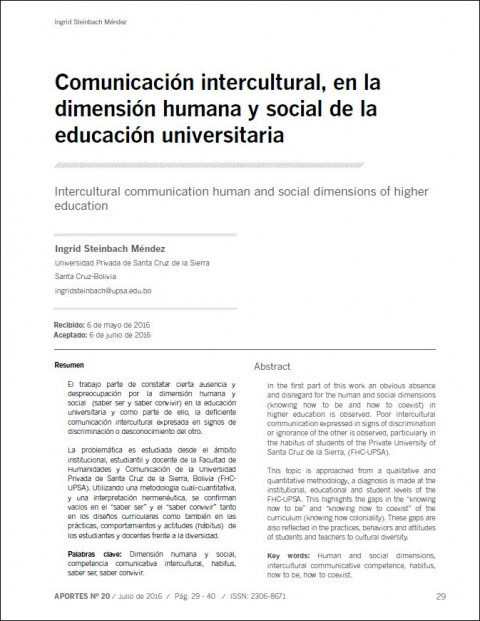 Intercultural Communication Human and Social Dimensions of Higher Education Année de publication: 2016 Auteur: Ingrid Steinbach Méndez Auteur institutionnel: Universidad Privada de Santa Cruz de la Sierra The starting point of this work is verifying the absence of and disregard for the human and social dimensions (knowing how to be and knowing how to coexist) in university education, including deficient intercultural communication manifested in discrimination ora lack of acknowledgement of the other. The problem is studied from the standpoints of the institution, the students and the faculty of the Faculty of Humanities and Communication of the Universidad Privada de Santa Cruz de la Sierra, Bolivia (FHC-UPSA). Using a qualitative quantitative methodology and a hermeneutic interpretation, voids are confirmed in the areas of "knowing how to be" and "knowing how to coexist" in the curricular designs as well as in the practices, behaviors and attitudes (habitus) of the students and faculty when faced with diversity. Comunicación intercultural, en la dimensión humana y social de la educación universitaria Année de publication: 2016 Auteur: Ingrid Steinbach Méndez Auteur institutionnel: Universidad Privada de Santa Cruz de la Sierra El trabajo parte de constatar una ausencia y despreocupación por la dimensión humana y social (saber ser y saber convivir) en la educación universitaria y como parte de ello, la deficiente comunicación intercultural expresada en signos de discriminación o desconocimiento del otro.La problemática es estudiada desde el ámbito institucional, estudiantil y docente de la Facultad de Humanidades y Comunicación de la Universidad Privada de Santa Cruz de la Sierra, Bolivia (FHC-UPSA). Utilizando una metodología cuali-cuantitativa, y una interpretación hermenéutica, se confirman vacíos en el "saber ser" y el "saber convivir" tanto en los diseños curriculares como también en las prácticas, comportamientos y actitudes (hábitus) de los estudiantes y docentes frente a la diversidad.
 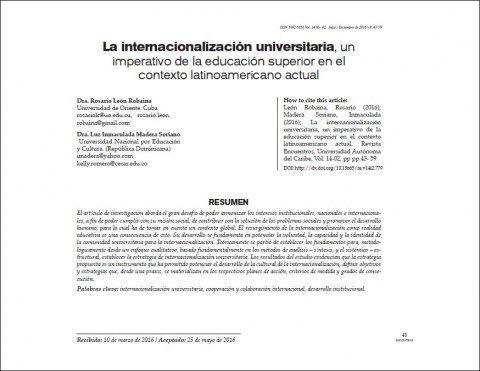 University Internationalization: A Higher Education Imperative in the Latin American Context Année de publication: 2016 Auteur: Rosario Leon Robaina | Luz Inmaculada Madera Soriano According to the author: "The article analyzes the challenge of being able to harmonize institutional, national and international interests, in order to fulfill the social mission of contributing to solving social problems and promoting human development, for which a global context has to be taken into account. The resurgence of educational internationalization is actually a consequence of this. Its development is founded on the will to enhance the capacity and identity of the university community for internationalization. Theoretically, the researchers started setting up the foundations from a qualitative approach, methodologically based on structural and systemic action research to establish the university internationalization strategy. The results show that the proposed strategy is an instrument that has enhanced the development of the internationalization culture, defining objectives and strategies, which from the praxis, are materialized in different action plans, using specific measurement criteria, and levels of achievement" The authors argument that a socially committed globalization is promoted. La internacionalización universitaria: un imperativo de la educación superior en el contexto latinoamericano actual Année de publication: 2016 Auteur: Rosario Leon Robaina | Luz Inmaculada Madera Soriano Segùn el autor: "El artículo de investigación aborda el gran desafío de poder armonizar los intereses institucionales, nacionales e internacionales, a fin de poder cumplir con su misión social, de contribuir con la solución de los problemas sociales y promover el desarrollo humano, para lo cual se ha de tomar en cuenta un contexto global. El resurgimiento de la internacionalización como realidad educativa es una consecuencia de esto. Su desarrollo se fundamenta en potenciar la voluntad, la capacidad y la identidad de la comunidad universitaria para la internacionalización. Teóricamente se partió de establecer los fundamentos para, metodo- lógicamente desde un enfoque cualitativo, basado fundamentalmente en los métodos de análisis – síntesis, y el sistémico – es- tructural, establecer la estrategia de internacionalización universitaria. Los resultados del estudio evidencian que la estrategia propuesta es un instrumento que ha permitido potenciar el desarrollo de la cultura de la internacionalización, definir objetivos y estrategias que, desde una praxis, se materializan en los respectivos planes de acción, criterios de medida y grados de consecución." Argumenta que se promueve una globalización soliidaria.
 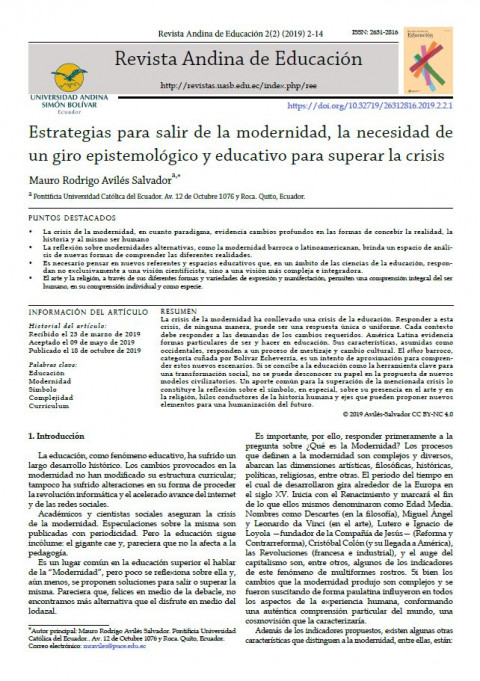 Strategies to Exit Modernity: The Need of an Educative and Epistemological Turn to Overcome the Crisis Année de publication: 2019 Auteur: Mauro Rodrigo Avilés Salvador According to the author: "the crisis of modernity has led to a crisis in education; and by no means can this crisis be tackled in a unique or uniform way. Every context has to respond to the demands of change that are requested. If education is conceived as the key tool for social transformation, its role in promoting new civilization models cannot be neglected. One way of overcoming the crisis may be by reflecting about the symbol, its presence in art and religion, areas that may promote new elements for a future humanization." Then, in the article, from a critical pespective, the author enfatizes the role of Latin America a leader for a "different" kind of change, a change based on the cultural latinamerican ethos. The author quotes Edgar Morin, and mentions the need of a plural education that favours democracy, based on Human Rights. However, although he mentions universal aspects, he does not mention a planetary citizenship and he criticizes the european model. Estrategias para salir de la modernidad: la necesidad de un giro epistemológico y educativo para superar la crisis Année de publication: 2019 Auteur: Mauro Rodrigo Avilés Salvador Según el autor: "la crisis de la modernidad ha conllevado una crisis de la educación. Responder a esta crisis, de ninguna manera, puede ser una respuesta única o uniforme. Cada contexto debe responder a las demandas de los cambios requeridos. Si se concibe a la educación como la herramienta clave para una transformación social, no se puede desconocer su papel en la propuesta de nuevos modelos civilizatorios. Un aporte para la superación de la crisis lo constituye la reflexión sobre el símbolo, sobre su presencia en el arte y en la religión, ejes que pueden proponer nuevos elementos para una humanización del futuro." Luego, en el artículo, desde una perspectiva crítica, el autor enfatiza el rol de América Latina como propiciador de un cambio "diferente", desde el ethos cultural que caracteriza lo "latinamericano". Cita a Edgar Morin y habla de la necesidad de una educación pluaral que favorezca la democracia, basada en los Derechos Humanos. Si bien menciona aspectos universales no menciona una ciudadanía planetaria y critica el modelo europeo.
  The Future of Education and Skills: Education 2030 Année de publication: 2018 Auteur institutionnel: Organisation for Economic Co-operation and Development (OECD) The aim of OECD’s Education 2030: The Future of Education and Skills project is to support countries to find answers to two far-reaching questions: “What knowledge, skills, attitudes and values will today’s students need to shape and thrive their world in 2030?” and “How can instructional systems develop these knowledge, skills, attitudes and values effectively?” This OECD Education 2030 position paper considers the challenges that young people will face; suggests the importance of the concept of learner agency; proposes an overarching learning framework with transformative competencies; reviews the nature of the knowledge, skills, attitudes and values that young people will need; and ends with possible curriculum design principles. It encapsulates the key messages of the project so far. Le Futur de l’éducation et des compétences: Projet Éducation 2030 Année de publication: 2018 Auteur institutionnel: Organisation for Economic Co-operation and Development (OECD) Le projet Le Futur de l’éducation et des compétences : Éducation 2030 a pour objectif d’aider les pays à trouver des réponses à deux questions d’une portée considérable : « De quelles connaissances, compétences, attitudes et valeurs les élèves d’aujourd’hui auront-ils besoin pour réussir leur vie et bâtir le monde de demain ? » et « Comment les systèmes éducatifs peuvent-ils transmettre ces connaissances, compétences, attitudes et valeurs de manière efficace ? » Cette note d’information sur le projet Éducation 2030 de l’OCDE étudie les défis auxquels les jeunes générations vont être confrontées, met en lumière l’idée de capacité d’agir des apprenants, propose un cadre d’apprentissage global reposant sur des compétences transformatives, revient sur la nature des connaissances, des compétences, des attitudes et des valeurs dont les jeunes auront besoin à l’avenir et se conclut par de possibles principes de conception des programmes scolaires. Les principaux messages tirés du projet jusqu’à présent sont également présentés.