
Ressources
Explorez une large gamme de ressources sur le GCED afin d’approfondir votre compréhension et de renforcer vos activités de recherche, de plaidoyer, d’enseignement et d’apprentissage.
2,813 résultats trouvés
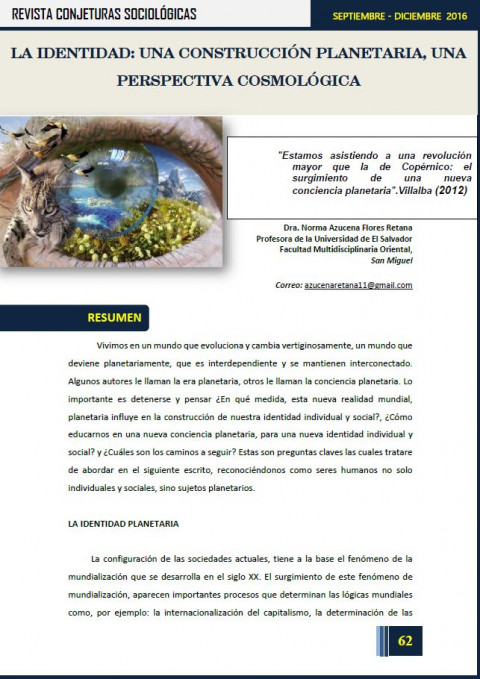 La identidad : una construcción planetaria, una perspectiva cosmológica Année de publication: 2016 Auteur: Norma Azucena Flores Retana En el artículo la autora se pregunta qué es una ciudadanía planetaria y cómo debería fomentarse esta. Comienza haciendo una critica a las perspectivas econocimicistas para luego centrarse en un ideal basado en la solidaridad. En su resumen del artículo dice: "Vivimos en un mundo que evoluciona y cambia vertiginosamente, un mundo que deviene planetariamente, que es interdependiente y se mantienen interconectado. Algunos autores le llaman la era planetaria, otros le llaman la conciencia planetaria. Lo importante es detenerse y pensar ¿En qué medida, esta nueva realidad mundial, planetaria influye en la construcción de nuestra identidad individual y social?, ¿Cómo educarnos en una nueva conciencia planetaria, para una nueva identidad individual y social? y ¿Cuáles son los caminos a seguir? Estas son preguntas claves las cuales tratare de abordar en el siguiente escrito, reconociéndonos como seres humanos no solo individuales y sociales, sino sujetos planetarios. " En el artículo la autora da respuestas y perspectivas amplias a las preguntas que plantea en el resumen.
  Universal Citizenship and Free Human Mobility: A Look from the Thematic Profile of International Scientific Production Année de publication: 2019 Auteur: Leonardo Vicente Vera Viteri, Jimmy Manuel Zambrano Acosta | Dania Deroy Dominguez In the summary the author explains that: "The present article makes an approach to the concept of citizenship as endowing and at the same time denying rights, and how it was extended to all people, including migrants. At the same way, a chronological analysis of the scientific production about Free Citizenship and Human Mobility in Scopus is carried out." In the article the author analyzes these aspects and ends by concluding that the academy may promote universal citizenship. Ciudadanía Universal y Libre Movilidad Humana: una mirada desde el perfil temático de la producción científica internaciona Année de publication: 2019 Auteur: Leonardo Vicente Vera Viteri, Jimmy Manuel Zambrano Acosta | Dania Deroy Dominguez En el resumen el autor explica que: "El presente artículo realiza una aproximación al concepto de ciudadanía como dotadora y a la vez negadora de derechos y la manera en la que se ha ampliado a todas las personas, entre ellos a los migrantes. Igualmente hace un análisis a la producción de conocimiento sobre el tema de Ciudadanía Libre y Movilidad Humana tomando como punto de partida el análisis cronológico de la producción científica indizada en Scopus." En el artículo el autor realiza este análisis y termina concluyendo que la academia puede fomentar la ciudadanía universal.
  Policies in Higher Education Planning: Budget, Strategic Plans and Global Educative Goals Année de publication: 2016 Auteur: Carlos José Giordano | Fernando Tauber | Catalina Caminos Lagorio | Diego Guillermo Delucchi | Roberto Marengo | Horacio Marcelo Martino | Mercedes Molteni | María Isabel Sánchez Arrabal The document is a report from the Universidad Nacional de la Plata (UNLP), Argentina, that tries to explain de development of the Higher education planning policies from an analysis of the budgets and the strategic plans regarding global educative goals that have been accepted to constitute the macroinstitutional ideals of the system. The report tries to promote the circulation of a complex reflection of the place of the Universidad Nacional de la Plata in the Argentinian Higher Education system and of the discussion of the integral development of public policy models in the context of international globalized and cooperative-interinstitutional intentions. Políticas de Planeamiento en la Educación Superior: presupuesto, planes estratégicos y metas educativas globales Année de publication: 2016 Auteur: Carlos José Giordano | Fernando Tauber | Catalina Caminos Lagorio | Diego Guillermo Delucchi | Roberto Marengo | Horacio Marcelo Martino | Mercedes Molteni | María Isabel Sánchez Arrabal El documento es un reporte realizado por la Universidad Nacional de la Plata (UNLP), Argentina, que intenta explicar el desarrollo de políticas el desarrollo de políticas de planeamiento en la Educación Superior desde el análisis de los presupuestos y los planes estratégicos en función de metas educativas globales que han sido consensuadas y aceptadas para constituirse como guías macroinstitucional del sistema. El trabajo intenta poner en circulación una reflexión compleja acerca del lugar de la UNLP en el sistema de Educación Superior argentino y la discusión por los modelos de desarrollo integrales de las políticas públicas en el contexto de las intencionalidades internacionalistas, globalizadoras y cooperativo-interinstitucionalistas.
  The Meaning of Citizenship in Social Inequality Contexts: Guidelines for a Comprehensive Education Année de publication: 2016 Auteur: Alma A Ramírez Iñiguez This article analyses the sense of citizenship education currently regarding the social inequality in the global era. For this, a conceptual framework about citizenship meaning is stablished and the need of a conceptual change is highlighted taking into account the social transformations, the increase of inequality in the worldwide and the neoliberal model hegemony in last decades. Based on this, some relevant Ibero American educational experiences in citizenship education are analyzed and their results are discussed. From this, some key elements involved in education for inclusive citizenship are pointed out as well as their contribution for social inequality decrease. El significado de la ciudadanía en contextos de desigualdad social: pautas para una educación incluyente Année de publication: 2016 Auteur: Alma A Ramírez Iñiguez El presente artículo tiene el propósito de analizar el sentido de la educación para la ciudadanía en la actualidad, tomando en cuenta la desigualdad social existente en la era global. Para ello, se realiza una revisión conceptual sobre el significado de la ciudadanía en nuestros días, destacando la necesidad de un cambio de perspectiva para entender este concepto y considerando las transformaciones sociales de las últimas décadas, así como el predominio del modelo económico neoliberal, el cual ha tenido como consecuencia el incremento de la desigualdad social a nivel mundial. Con base en dicha revisión, se realiza un análisis documental de algunas experiencias educativas iberoamericanas relevantes por su propósito de crear ciudadanía a través de propuestas inclusivas. A partir de este análisis, se discuten los resultados de dichas experiencias, los elementos clave que propician una ciudadanía incluyente desde la educación y sus implicaciones en la reducción de la desigualdad social.
  What is Education for Development? Année de publication: 2019 Auteur institutionnel: UNAQUÍ The blog of Unaquí informs that the Aragones Federation of Solidarity understands that Education for Development (ED) is a process which fosters critical and active global citizenship, that promotes more just, equal and cooperative societies. The blog also informs that the organizations that are part of the FAS believe that they are responsible of the education in order to transform societies, therefore, they created this space, called UNAQUÍ, to promote Education for Development and contribute to the promotion of citizenship.The blog provides information about different projects that are carried out. Qué es Educación para el Desarrollo Année de publication: 2019 Auteur institutionnel: UNAQUÍ El blog de Unaquí informa que desde la Federación Aragonesa de Solidaridad se entiende a la Educación para el Desarrollo (EpD) como un proceso encaminado a generar una ciudadanía global, crítica y activa que esté comprometida en la construcción de una sociedad solidaria, justa y equitativa. También informa que las organizaciones integrantes de la FAS se sienten corresponsables en la tarea de educar para transformar por lo que crearon ese espacio de Educación para el Desarrollo llamado UNAQUÍ para contribuir a la formación integral de la ciudadanía como clave para el Desarrollo. En el blog colocan información sobre distintos proyectos que son llevados a cabo.
 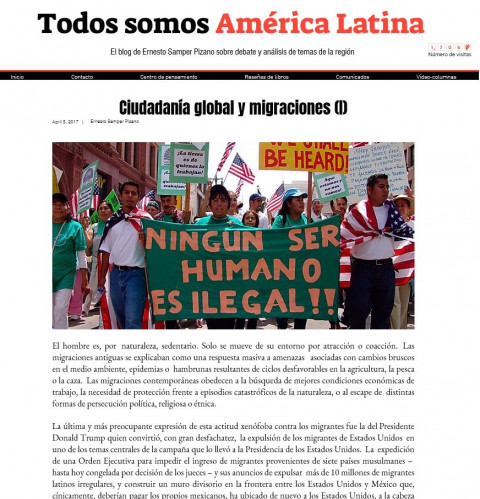 Global Citizenship and Migration Année de publication: 2017 Auteur: Ernesto Samper Pizano The news is a conference proclame in defense of migrants at a global scale. It was elaborated for the World People's Conference that took place in Bolivia in 2017 and it describes, very briefly, the situation of many inmigrants around the world, especially latinamericans.