
Ressources
Explorez une large gamme de ressources sur le GCED afin d’approfondir votre compréhension et de renforcer vos activités de recherche, de plaidoyer, d’enseignement et d’apprentissage.
2,813 résultats trouvés
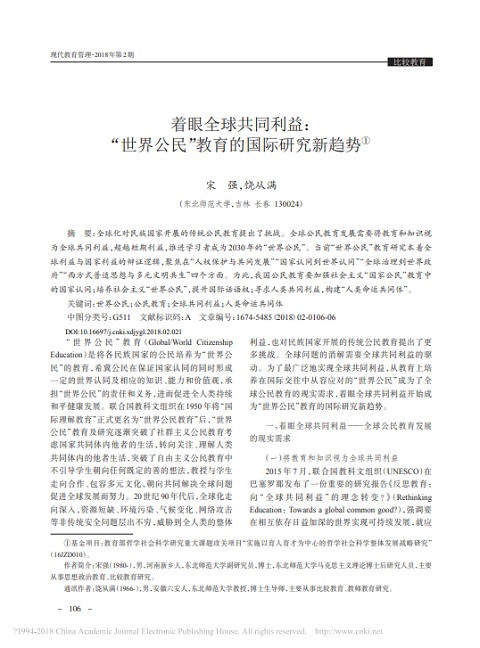 Focus on Global Common Good: The New International Research Trend on World Citizenship Education (Modern Education Management; No. 2) Année de publication: 2018 Auteur: Song Qiang | Rao Congman Auteur institutionnel: Liaoning Institute of Education Globalization has posed challenges for national-states to develop traditional citizenship education. To develop the citizenship education in the world needs to regard education and knowledge as global common good, surpass short-term benefit, and promote learners to be world citizens by 2030. Start with the dialectical logic on global benefit and national benefit, the researches of world citizenship education focus on “human rights protection and joint development”, “from national identity to world identity”, “ from global governance to world government”, and “ western universal mind vs. multi-civilizations intergrowth”. Chinese citizenship education needs to reinforce the national identity in socialism national citizenship education; cultivateing socialism world citizenship and promoteing international discourse power; seek human common good and build community of common destiny for all mankind. 着眼全球共同利益:‘世界公民’教育的国际研究新趋势” (现代教育管理; No. 2) Année de publication: 2018 Auteur: Song Qiang | Rao Congman Auteur institutionnel: Liaoning Institute of Education 全球化对民族国家开展的传统公民教育提出了挑战。全球公民教育发展需要将教育和知识视 为全球共同利益,超越短期利益,推进学习者成为2030年的“世界公民”。当前“世界公民”教育研究本着全 球利益与国家利益的辩证逻辑,聚焦在“人权保护与共同发展”“国家认同到世界认同”“全球治理到世界政 府”“西方式普适思想与多元文明共生”四个方面。为此,我国公民教育要加强社会主义“国家公民”教育中 的国家认同;培养社会主义“世界公民”,提升国际话语权;寻求人类共同利益,构建“人类命运共同体”。
 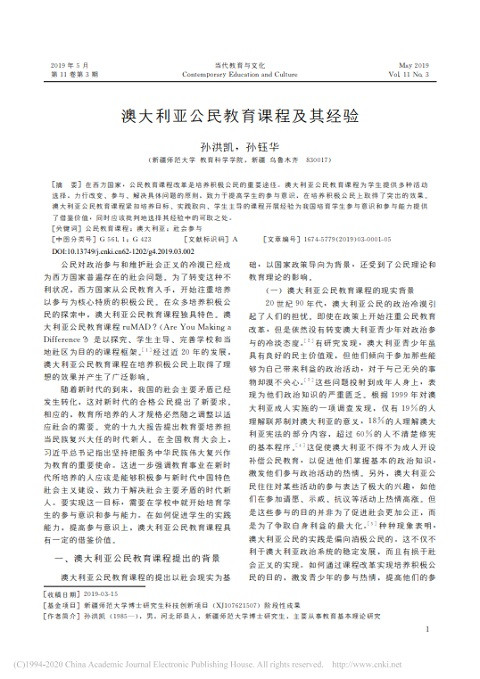 Australian Citizenship Program and Its Experience (Contemporary Education and Culture; Vol. 11, No. 3) Année de publication: 2019 Auteur: Sun Hongkai | Sun Yuhua Auteur institutionnel: Northwest Normal University In Western countries, the reform of Civics and Citizenship Education is an important way to cultivate responsible citizens. The Australian Citizenship Education Program provides students with a variety of activities, and follows the principle of change, engagement and resolution of specific issues. It is committed to raising students’ awareness of engagement and has achieved outstanding results in cultivating responsible citizens. Australian Citizenship Education program is both thainee- and prantice- oriented, which sets a good example for cultivating students’ awareness and ability of engagement in China. At the same time, critical learning is a must. 澳大利亚公民教育课程及其经验 (当代教育与文化; Vol. 11, No. 3) Année de publication: 2019 Auteur: Sun Hongkai | Sun Yuhua Auteur institutionnel: Northwest Normal University 在西方国家,公民教育课程改革是培养积极公民的重要途径。澳大利亚公民教育课程为学生提供多种活动 选择,力行改变、参与、解决具体问题的原则,致力于提高学生的参与意 识,在培养积极公民上取得了突出的效果。澳大利亚公民教育课程紧扣培养目标、实践取向、学生主导的课程开展经验为我国培育学生参与意识和参与能力提供 了借鉴价值,同时应该批判地选择其经验中的可取之处。
  Regional Consultations of the National Human Rights Institutions of Central Asia: Conference Proceedings Année de publication: 2016 Auteur institutionnel: UN. Office of the United Nations High Commissioner for Human Rights (UN. OHCHR) | United Nations Development Programme (UNDP) For the first time, the conference became a platform for consultations of national human rights institutions (NHRIs) of Central Asia to help strengthen partnerships and provide opportunities for mutual support and exchange of expertise. Special attention the role of NHRIs in their interaction with the government and other partners in the country, as well as the role of NHRIs in terms of achieving the Sustainable Development Goals (SDGs). Региональные консультации национальных правозащитных учреждений стран Центральной Азии: Отчет о конференции Année de publication: 2016 Auteur institutionnel: UN. Office of the United Nations High Commissioner for Human Rights (UN. OHCHR) | United Nations Development Programme (UNDP) Конференция впервые стала площадкой для консультаций национальных правозащитных учреждений (НПЗУ) Центральной Азии в целях содействия укреплению партнерских отношений и обеспечения возможностей взаимной поддержки и обмена экспертным опытом. Особое вниманиеуделено роли НПЗУ в их взаимодействии с правительством и другими партнерами в стране, а также роли НПЗУ в части достижения Целей Устойчивого Развития (ЦУР).
  Uzbekistan: Voluntary National Review 2020 Année de publication: 2020 Auteur institutionnel: United Nations (UN) This voluntary review contains information on the implementation of the 2030 Sustainable Development Goals by the Republic of Uzbekistan, objectives and directions for further activities. Special attention is paid to SDG 4 "Education", where the priority is to improve the quality and coverage of education at all levels, as well as the development of the lifelong education system. Узбекистан: Добровольный национальный обзор 2020 Année de publication: 2020 Auteur institutionnel: United Nations (UN) Данный добровольный обзор содержит в себе информацию по выполнению Республикой Узбекистан целей устойчивого развития 2030, задачи и направления дальнейшей деятельности. Отдельное внимание уделено ЦУР 4 "Образование", где приоритетом является повышение качества и охвата образованием на всех уровнях, а также развитие системы непрерывного образования.
 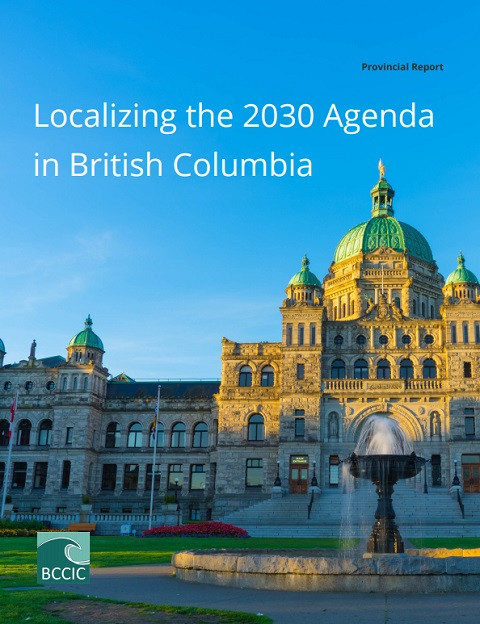 Localizing the 2030 Agenda in British Columbia Année de publication: 2020 Auteur: Zosa De Sas Kropiwnicki-Gruber | Dan Harris Auteur institutionnel: British Columbia Council for International Cooperation (BCCIC) This report details a British Columbian civil society response to the Government of Canada’s current interim national Sustainable Development Goals strategy. The report provides feedback on the interim strategy and Canada’s engagement with the United Nations Sustainable Development Goals (SDGs) including recommendations linked to the interim strategy’s key actions. At this time it represents the only provincial scale civil society consultation on the strategy in Canada. The report begins by introducing the origin of the interim national SDG strategy and the rationale for holding the consultation. While the following section on “What we heard” captures common themes on how to improve the strategy and Canada’s engagement with the SDGs, the report then concludes with recommendations synthesized from these suggestions on the ways in which we can strengthen and enact the interim national SDG strategy.
 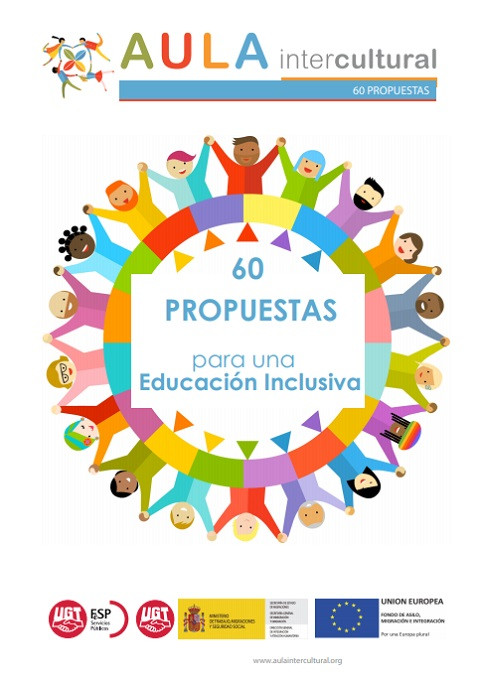 60 Proposals for Inclusive Education Année de publication: 2019 Auteur institutionnel: Secretaría de Mujer y Políticas Sociales FeSP UGT | European Union (EU) This publication presents 60 ideas for achieving an inclusive education. Although the concept has traditionally been associated with an educational response that integrates children with special abilities into schools; The term is broader, and refers to a progressive transformation of educational systems aimed at achieving a quality education that guarantees all students access to culture and provides them with basic training and education in equality and adapted to diversity that we are in the classrooms.