
Ressources
Explorez une large gamme de ressources sur le GCED afin d’approfondir votre compréhension et de renforcer vos activités de recherche, de plaidoyer, d’enseignement et d’apprentissage.
2,768 résultats trouvés
 Exploring ICCS 2016 to measure progress toward target 4.7 Année de publication: 2018 Auteur: Sandoval-Hernández.Andrés, Miranda.Daniel Auteur institutionnel: Global Education Monitoring Report Team The objective of this report is to analyse data from the last cycle of the International Civic and Citizenship Study (ICCS 2016) (Schulz et al., 2017)in order to demonstrate its potential for monitoring specific aspects of the SDG target 4.7. Furthermore, given the theme of the 2019 Global Education Monitoring (GEM) Report, this document will pay special attention to those questions addressed to students, teachers and school principals that are directly related to immigration.
 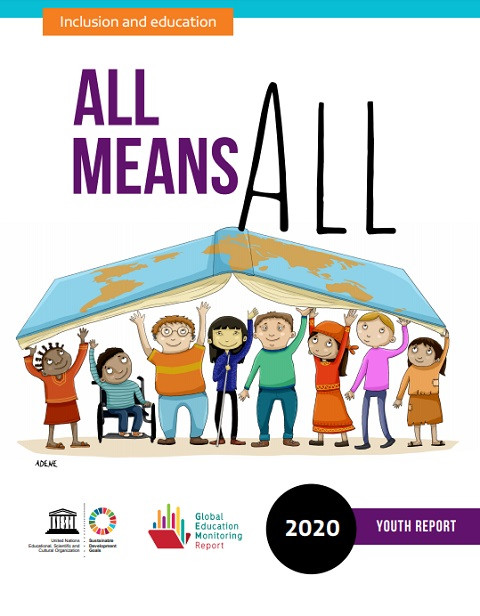 Youth Report 2020: Inclusion and Education; All Means All Année de publication: 2020 Auteur institutionnel: UNESCO | Global Education Monitoring Report Team This Youth Report is designed to help you learn about the social, economic and cultural factors that cause vulnerable children, youth and adults to be discriminated against and marginalized in education. It tells the stories of the people who fight to ensure that everyone is included in education, and of those who fought to uphold their own right to education. It brings to life the recommendations of the 2020 Global Education Monitoring Report: Inclusion and education: All means all and calls on youth and teachers to share and discuss the stories and messages, to use them in campaigns and as a teaching tool in class. An open letter to education ministers is included calling, for education systems to be built back more inclusive after the school closures during Covid-19.
 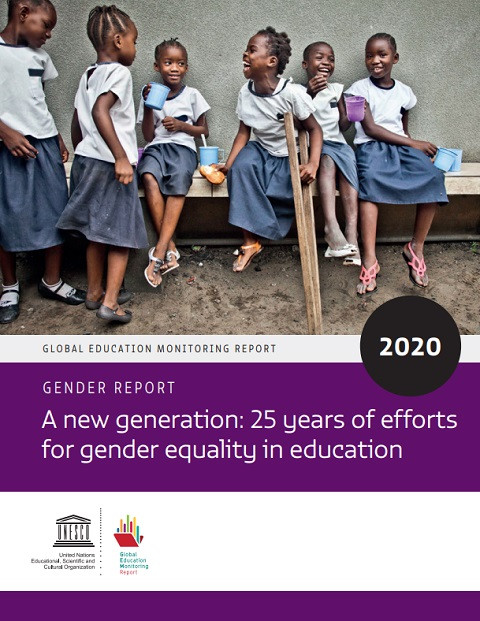 Gender Report 2020: A New Generation; 25 Years of Efforts for Gender Equality in Education (Global Education Monitoring Report) Année de publication: 2020 Auteur institutionnel: UNESCO | Global Education Monitoring Report Team Building on the 2020 Global Education Monitoring Report, this report investigates how inclusion in education can advance gender equality in and through education, which is critical to make progress towards gender equality in society. The goal of gender equality is, of course, not new. It was enshrined in the 1979 Convention on the Elimination of All Forms of Discrimination Against Women and was at the core of the 1995 Beijing Declaration and Platform for Action, whose 25th anniversary is marked in 2020.
 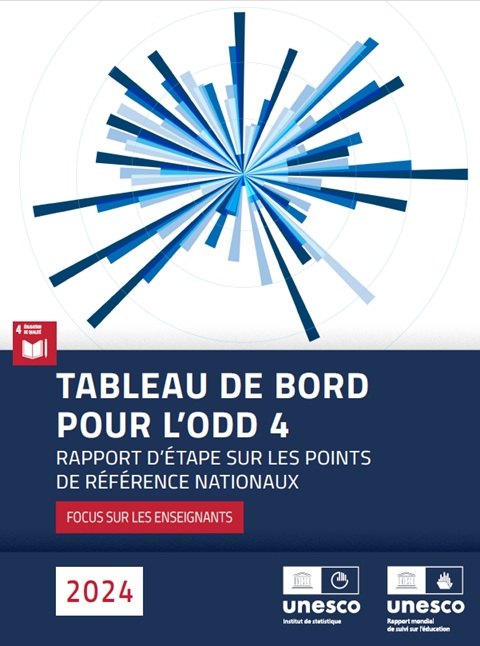 Tableau de bord pour l’ODD 4, rapport d’étape sur les points de référence nationaux: focus sur les enseignants Année de publication: 2024 Auteur institutionnel: Global Education Monitoring Report Team | UNESCO Institute for Statistics (UIS) Il s'agit de la deuxième évaluation des progrès des pays vers les points de référence, ou objectifs nationaux, que les pays ont fixés pour huit indicateurs de l'ODD 4 afin de marquer leur contribution aux objectifs mondiaux. L’évaluation couvre la période depuis 2015 et examine la probabilité que chaque pays atteigne son point de référence pour 2025 ou – lorsqu’un tel objectif n’a pas été fixé – la valeur qu’il aurait atteinte s’il avait progressé au rythme historique (2000–15) des 25 % des pays qui s’améliorent le plus rapidement.Le tableau de bord de l’ODD 4 2024 révèle que les progrès vers les objectifs nationaux sont en retard pour la plupart des indicateurs. Dans deux cas – l’écart entre les genres au détriment des garçons dans l’achèvement du deuxième cycle du secondaire et les dépenses publiques d’éducation en proportion des dépenses publiques totales – les pays reculent même.En revanche, les progrès sont plus rapides pour le huitième indicateur de référence, la connectivité Internet dans les écoles, qui a été ajouté suite à la priorité accordée à la transformation numérique lors du Sommet sur la transformation de l’éducation en 2022. Un tiers des pays ont fixé des objectifs nationaux en 2023 et les progrès sur l’indicateur sont examinés pour la première fois dans cette édition.Les progrès sont également relativement rapides en ce qui concerne le pourcentage d'enseignants possédant les qualifications minimales requises, qui est également l'indicateur central de cette édition. De nouvelles données sont présentées sur les politiques nationales concernant les niveaux de qualification minimaux requis pour accéder à la profession enseignante, les politiques de développement professionnel continu obligatoire et les politiques de formation des enseignants sur la tec
  SDG 4 Scorecard: Progress Report on National Benchmarks; Focus on Teachers Année de publication: 2024 Auteur institutionnel: Global Education Monitoring Report Team | UNESCO Institute for Statistics (UIS) This is the second assessment of country progress towards the benchmarks, or national targets, that countries have set for eight SDG 4 indicators to mark their contribution to the global targets. The assessment covers the period since 2015 and reviews the probability that each country will achieve its 2025 benchmark or – where such a benchmark was not set – the value they would have achieved if they had progressed at the historic (2000–15) rate of the fastest improving 25% of countries.The 2024 SDG 4 Scorecard finds that progress towards national targets is off track for most indicators. In two cases – the gender gap at the expense of boys in upper secondary education completion and public education expenditure as share of total public expenditure – countries are even moving backwards.In contrast, progress is faster in the eighth benchmark indicator, school internet connectivity, which was added following the priority given to digital transformation at the Transforming Education Summit in 2022. One third of countries set national targets in 2023 and progress on the indicator is being reviewed for the first time in this edition.Progress is also relatively fast in the percentage of teachers with minimum required qualifications, which is also the focus indicator of this edition. New evidence is presented on national policies for minimum required qualification levels to enter the teaching profession, compulsory continuous professional development policies, and teacher training policies on technology in education.
  Transformative Learning Journeys: Venturing Into the Wilds of Global Citizenship Education Année de publication: 2021 Auteur institutionnel: Bridge 47 With the intensive courses of the Transformative Learning Journey, Bridge 47 created experimental learning spaces for communities of practitioners, researchers and activists of transformative education from around the world.The courses endeavored to challenge common concepts of Global Citizenship Education, to explore questions like those below and to experiment with different, holistic and potentially more transformative, practices of learning and co-creating.What are the (cultural) root causes of the global multi-crisis?How to decolonize and transform a modern system that is broken beyond fixing?What do we have to learn, unlearn or let go of- individually and collectively - in order to allow, embrace and foster real change? What characterizes transformative learning, and how can education create holistic spaces to trigger, support and accompany such learning processes? How transformative is our own organizational and educational practice?Do we have to re-imagine education and activism and become more radical? Are we asking the right questions?Based on the positive resonance, Bridge 47 wants to share some of the learnings through this publication. The book gives insights into the design, content and methodology of the course. Featuring diverse contributions from participants, it is a mosaic of perspectives and experiences of transformation, decolonization and learning. It also comprises some tools and invitations for reflection. It is not a cohesive prescription of how to facilitate transformative learning – as there is none - but an invitation to relate to and play."This book is dedicated to all the curious people out there who are passionate about education in caring for our world and each other - the dreamers, the healers, the lovers, the teachers for a different future to emerge. It goes to the fighters who are desperate and overwhelmed in face of complex challenges and are worn out by their struggle for justice and change – to find inspiration, energy and courage to treat ourselves gently, to let go and to make space for new things to emerge."
  Tablero de control para el ODS 4: informe sobre el progreso hacia los puntos de referencia nacionales; foco en docentes Année de publication: 2024 Auteur institutionnel: Global Education Monitoring Report Team | UNESCO Institute for Statistics (UIS) Esta es la segunda evaluación del progreso de los países hacia los puntos de referencia, o metas nacionales, que los países han establecido para ocho indicadores del ODS 4 para marcar su contribución a las metas globales. La evaluación cubre el período desde 2015 y revisa la probabilidad de que cada país alcance su punto de referencia para 2025 o, cuando no se haya establecido dicho punto de referencia, el valor que habría alcanzado si hubiera progresado al ritmo histórico (2000–15) del 25 % de los países que mejoran más rápidamente.El Tablero de Control para el ODS 4 de 2024 revela que el progreso hacia las metas nacionales está desviado en la mayoría de los indicadores. En dos casos – la brecha de género a expensas de los niños que terminan la educación secundaria alta y el gasto público en educación como proporción del gasto público total – los países incluso están retrocediendo.Por el contrario, el progreso es más rápido en el octavo indicador de referencia, la conectividad a Internet en las escuelas, que se añadió tras la prioridad otorgada a la transformación digital en la Cumbre sobre la Transformación de la Educación en 2022. Un tercio de los países estableció objetivos nacionales en 2023 y el progreso en el indicador está siendo revisado por primera vez en esta edición.El progreso también es relativamente rápido en el porcentaje de docentes con las calificaciones mínimas requeridas, que también es el indicador central de esta edición. Se presenta nueva evidencia sobre políticas nacionales en cuanto a los niveles mínimos de calificación requeridos para ingresar a la profesión docente, políticas de desarrollo profesional continuo obligatorio y políticas de formación docente sobre tecnología en educación.
 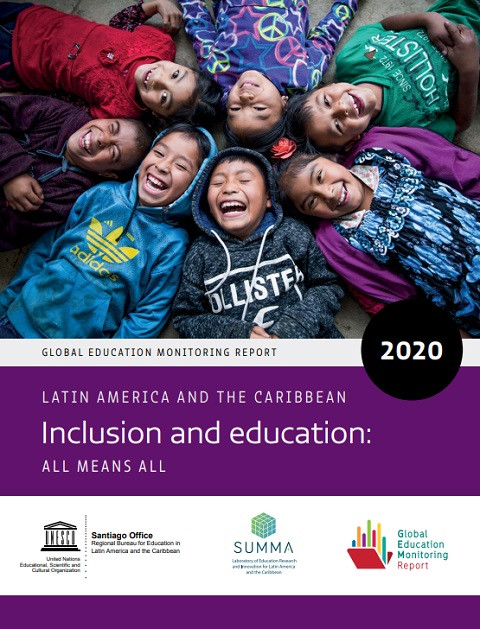 Latin America and the Caribbean 2020: Inclusion and Education; All Means All (Global Education Monitoring Report) Année de publication: 2020 Auteur institutionnel: Global Education Monitoring Report Team | UNESCO | Laboratory of Education Research and Innovation for Latin America and the Caribbean (SUMMA) Latin America and the Caribbean has the largest and most challenging socio-economic inequalities in the world, which have shaped its education systems over the decades. This report looks at everyone both in and excluded from education in the region, pinpointing barriers facing learners, especially when multiple disadvantages intersect. The report also explores challenges in education posed by COVID-19 and the need for urgent action to prevent an exacerbation of inequalities. Produced by the Global Education Monitoring (GEM) Report team, in partnership with the UNESCO Regional Bureau for Education in Latin America and the Caribbean (OREALC) and the Laboratory of Education Research and Innovation for Latin America and the Caribbean (SUMMA), the report assesses key solutions for greater inclusion through several case studies from the region. It provides in-depth analysis on challenges to inclusion in education arising from migration and displacement in Colombia and Costa Rica; remoteness in Brazil and Suriname; disability in Cuba and Nicaragua; gender in Peru and Jamaica; sexual orientation, gender identity and expression in Chile and Mexico; poverty in the Dominican Republic and Honduras; ethnicity in Bolivia and Ecuador; and incarceration in El Salvador and Uruguay. Building on the 2020 Global Education Monitoring Report, this regional edition concludes that strong laws and policies in Latin America and the Caribbean demonstrate a commitment to inclusion, but that the daily realities faced by learners suggest implementation is lagging. Recommendations are aimed at promoting more inclusive education systems to benefit all children and youth, no matter their background, identity or ability. The recommendations provide a systematic framework for identifying and dismantling barriers for vulnerable populations, according to the principle that ‘every learner matters and matters equally’. América Latina y el Caribe 2020: Inclusión y educación; Todos y todas sin excepción (Informe de seguimiento de la educación en el mundo) Année de publication: 2020 Auteur institutionnel: Global Education Monitoring Report Team | UNESCO | Laboratory of Education Research and Innovation for Latin America and the Caribbean (SUMMA) América Latina y el Caribe es la región con las mayores y más tenaces desigualdades socioeconómicas del mundo. Durante decenios estas desigualdades se han reflejado en sus sistemas educativos. El presente informe examina a quiénes incluyen y a quiénes excluyen estos sistemas y llama la atención sobre las barreras que enfrentan los educandos, especialmente cuando están expuestos a múltiples desventajas. El informe también explora los nuevos retos educativos que plantea la pandemia de la Covid-19 y la necesidad de actuar sin dilación para evitar que se agraven las desigualdades. El informe, elaborado por el equipo del Informe de Seguimiento de la Educación en el Mundo (Informe GEM), en colaboración con la Oficina Regional de Educación para América Latina y el Caribe (OREALC/ UNESCO Santiago) y el Laboratorio de Investigación e Innovación en Educación para América Latina y el Caribe -SUMMA, evalúa algunas de las principales iniciativas emprendidas para mejorar la inclusión, basándose en varios estudios de casos de la región. Analiza en profundidad algunos ejemplos de los grandes desafíos que amenazan la inclusión en la educación: migración y desplazamiento en Colombia y Costa Rica; aislamiento rural en el Brasil y Suriname; discapacidad en Cuba y Nicaragua; discriminación de género en el Perú y Jamaica; orientación sexual e identidad y expresión de género en Chile y México; pobreza en la República Dominicana y Honduras; etnicidad en Bolivia y el Ecuador; y jóvenes en situación de privación de libertad en El Salvador y el Uruguay. Esta edición regional del Informe de Seguimiento de la Educación en el Mundo 2020 concluye que, si bien las leyes y políticas de América Latina y el Caribe demuestran la firme determinación de promover la inclusión, la realidad cotidiana de los alumnos y las alumnas sugiere que la aplicación práctica lleva retraso. Se formulan recomendaciones con el objeto de promover sistemas de educación más inclusivos en beneficio de todos los niños, niñas y jóvenes, sin distinción de origen, identidad o capacidad. Las recomendaciones brindan un marco sistemático que permite identificar y eliminar barreras para las poblaciones marginadas, conforme al principio de que “cada alumno es importante y todos los alumnos importan por igual”.
  Global Education Monitoring Report 2024/5: Leadership in Education; Lead for Learning Année de publication: 2024 Auteur institutionnel: Global Education Monitoring Report Team Leadership matters in education. Strong leaders are needed to help institutions, systems and societies change for the better. Strong leaders work in collaboration with other actors towards the same goals. At the school level, they are the principals but also those who surround them, in the school and in the community, in positions of responsibility. At the system level, they are civil servants working as district officers, supervisors or planners. At the societal level, they are political leaders, as well as a very broad range of actors who help shape education goals, from unions and researchers to civil society and the media.Entitled Lead for learning, this report argues that, in pursuing specific goals, education leaders are more than just managers. They are change agents, who need the time, trust and support to focus on setting a vision and developing the people they serve and work with. The report calls for investment in and empowerment of school and system leaders. There should be fair hiring processes and growth opportunities that recognize the full scope of leaders’ roles. Moreover, leadership works best when it is shared, empowering others to lead as they can within their roles.There is no one leadership style that works. Different contexts, capacities and personalities mean that styles vary, and rightfully so. This, combined with the different goals that each leader is trying to achieve, means that their impact is hard to fully assess. Yet, all research points towards the critical need for strong leaders to continuously improve education quality. School leaders are second only to teachers for transforming student outcomes. Meanwhile, politicians wield huge influence in making equitable and inclusive education a national priority.Supporting this seventh Global Education Monitoring Report is a new series of country profiles on PEER, an online resource supporting policy dialogue and describing policies and regulations on school principal selection, preparation and development in the world’s education systems.