
Ressources
Explorez une large gamme de ressources sur le GCED afin d’approfondir votre compréhension et de renforcer vos activités de recherche, de plaidoyer, d’enseignement et d’apprentissage.
2,813 résultats trouvés
 Centre Hubertine Auclert Année de publication: 2010 Auteur: Marie-Pierre Badré Auteur institutionnel: Centre Hubertine Auclert (CHA) L'Égalithèque est une banque de donnée unique en France recensant des milliers de guides, expositions, ouvrages, affiches, vidéos, spectacles vivants, diaporamas, formations, quiz, etc. sur l'égalité femmes-hommes et la lutte contre les violences de genre. Elle propose à la fois les ressources créées par le Centre Hubertine Auclert - publications, campagnes de sensibilisation, malles virtuelles et expositions - ainsi que de nombreuses autres ressources créées par des structures oeuvrant pour l'égalité. Enrichie et actualisée régulièrement par l'équipe du Centre, l'Égalithèque sera très prochainement participative : les membres du Centre pourront soumettre un outil qui sera contrôlé avant d'être référencé. The Égalithèque is a database unique in France, containing thousands of guides, exhibitions, books, posters, videos, live shows, slide shows, training courses, quizzes, etc. on gender equality and the fight against gender violence. It includes resources created by the Centre Hubertine Auclert - publications, awareness-raising campaigns, virtual trunks and exhibitions - as well as many other resources created by structures working for equality. Enriched and updated on a regular basis by the Centre's team, the Égalithèque will soon be participative: Centre members will be able to submit a tool, which will be checked before being referenced.
 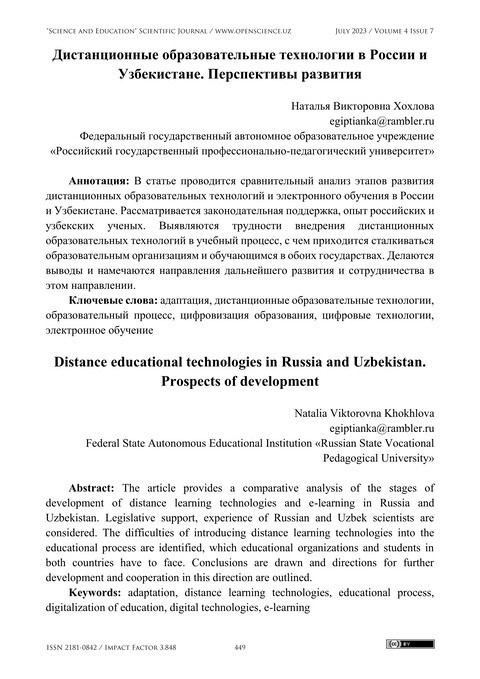 Distance educational technologies in Russia and Uzbekistan: Prospects of development (Science and Education; Vol.4, Issue.7) Année de publication: 2023 Auteur: Наталья Викторовна Хохлова The article provides a comparative analysis of the stages of development of distance learning technologies and e-learning in Russia and Uzbekistan. Legislative support, experience of Russian and Uzbek scientists are considered. The difficulties of introducing distance learning technologies into the educational process are identified, which educational organizations and students in both countries have to face. Conclusions are drawn and directions for further development and cooperation in this direction are outlined. Дистанционные образовательные технологии в России и Узбекистане: Перспективы развития (Science and Education; Vol.4, Issue.7) Année de publication: 2023 Auteur: Наталья Викторовна Хохлова В статье проводится сравнительный анализ этапов развития дистанционных образовательных технологий и электронного обучения в России и Узбекистане. Рассматривается законодательная поддержка, опыт российских и узбекских ученых. Выявляются трудности внедрения дистанционных образовательных технологий в учебном процессе, с чем приходится сталкиваться образовательными организациями и обучающимися в обоих государствах. Делаются выводы и намечаются направления дальнейшего развития и сотрудничества в этом направлении.
 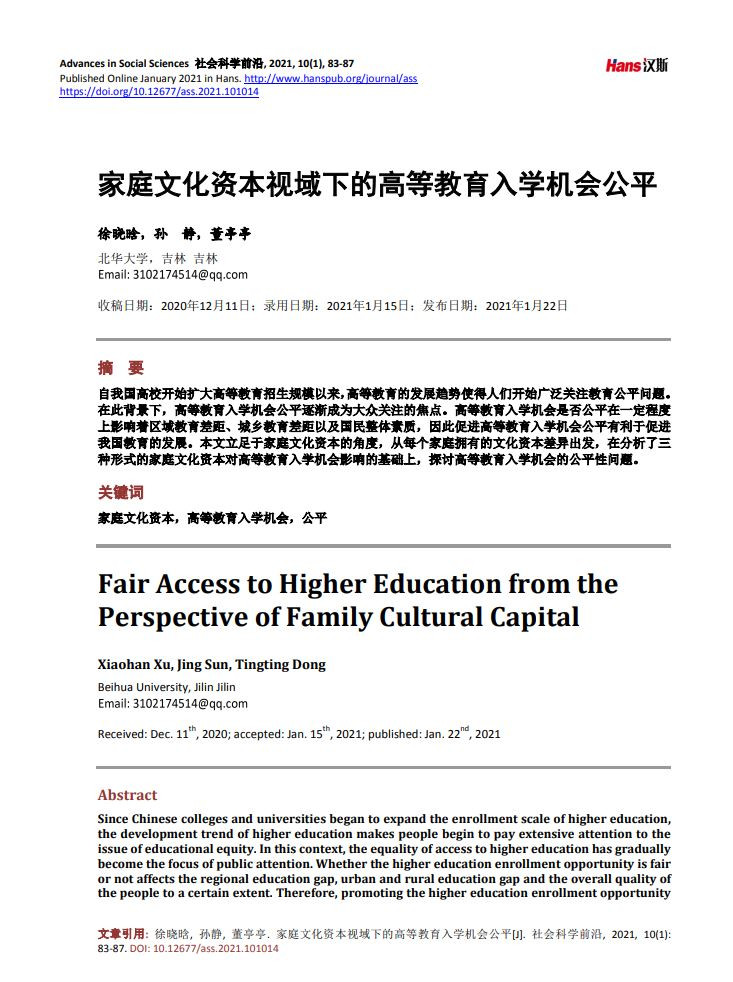 Fair Access to Higher Education from the Perspective of Family Cultural Capital Année de publication: 2021 Auteur: Xu Xiaohan | Sun Jing | Dong Tingting This paper uses Bourdieu's concept of cultural capital to analyse existing inequality to access to higher education in China. 家庭文化资本视域下的高等教育入学机会公平 Année de publication: 2021 Auteur: Xu Xiaohan | Sun Jing | Dong Tingting 本文使用法国学者布迪厄的家庭文化资本概念,分析中国高等教育入学机会中的不公平机制。
 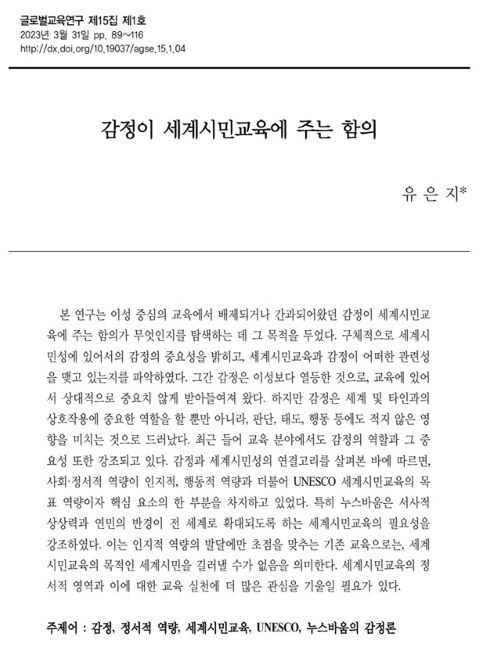 감정이 세계시민교육에 주는 함의 Année de publication: 2023 Auteur: 유은지 Auteur institutionnel: 글로벌교육연구학회 본 연구는 이성 중심의 교육에서 배제되거나 간과되어왔던 감정이 세계시민교육에 주는 함의가 무엇인지를 탐색하는 데 그 목적을 두었다. 구체적으로 세계시민성에 있어서의 감정의 중요성을 밝히고, 세계시민교육과 감정이 어떠한 관련성을 맺고 있는지를 파악하였다. 그간 감정은 이성보다 열등한 것으로, 교육에 있어서 상대적으로 중요치 않게 받아들여져 왔다. 하지만 감정은 세계 및 타인과의 상호작용에 중요한 역할을 할 뿐만 아니라, 판단, 태도, 행동 등에도 적지 않은 영향을 미치는 것으로 드러났다. 최근 들어 교육 분야에서도 감정의 역할과 그 중요성 또한 강조되고 있다. 감정과 세계시민성의 연결고리를 살펴본 바에 따르면, 사회·정서적 역량이 인지적, 행동적 역량과 더불어 UNESCO 세계시민교육의 목표 역량이자 핵심 요소의 한 부분을 차지하고 있었다. 특히 누스바움은 서사적 상상력과 연민의 반경이 전 세계로 확대되도록 하는 세계시민교육의 필요성을 강조하였다. 이는 인지적 역량의 발달에만 초점을 맞추는 기존 교육으로는, 세계시민교육의 목적인 세계시민을 길러낼 수가 없음을 의미한다. 세계시민교육의 정서적 영역과 이에 대한 교육 실천에 더 많은 관심을 기울일 필요가 있다.
 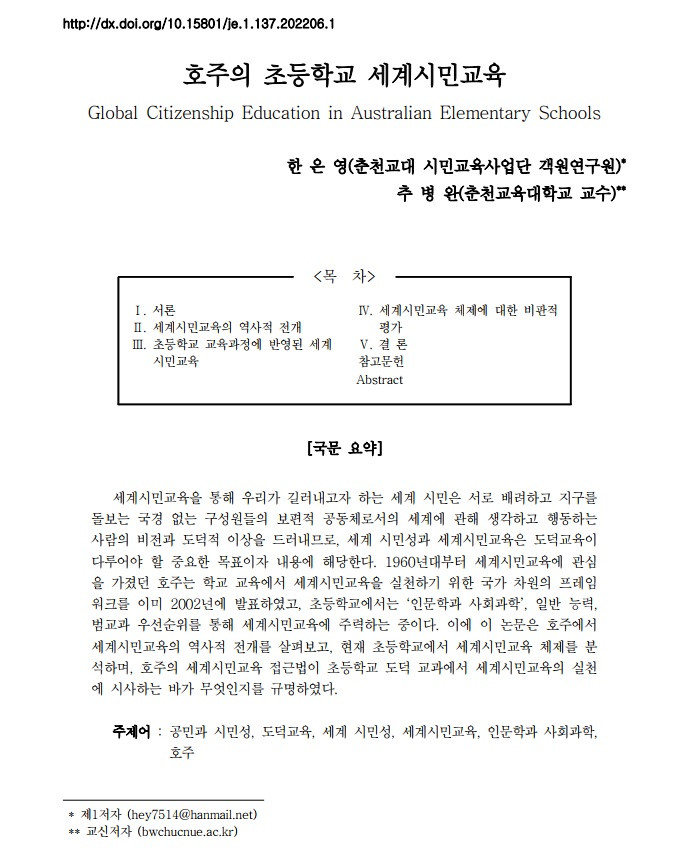 Global Citizenship Education in Australian Elementary Schools(Journal of Ethics; Vol. 137, No 1) Année de publication: 2022 Auteur: 한은영 | 추병완 Auteur institutionnel: 한국윤리학회 Global citizens think and act about the world as a universal community of borderless members who care for each other and are dedicated to taking care of the earth. Considering these visions and moral ideals, global citizenship education is an important goal and content of moral education. However, at present, we do not have a framework for dealing with global citizenship education in moral education. In this regard, Australia is the country we should pay attention to. Australia declared a national statement for global citizenship education in 2002. Since 2009, it has been reflected in the Australian curriculum. This article examines the historical development of global citizenship education in Australia, analyzes the current systems of global citizenship education system in primary schools, and investigates what Australia's approach to global citizenship education suggests for elementary moral education in Korea. In conclusion, we proposed three things. First, we must develop and apply a framework for the practice of global civic education in moral education. Second, we should emphasize the aspects of knowledge and understanding, skills and processing, behavior and participation as well as values and attitudes. Third, we must seek a balance between moderate global citizenship education and critical global citizenship education. 호주의 초등학교 세계시민교육(윤리연구; Vol. 137, No 1) Année de publication: 2022 Auteur: 한은영 | 추병완 Auteur institutionnel: 한국윤리학회 세계시민교육을 통해 우리가 길러내고자 하는 세계 시민은 서로 배려하고 지구를 돌보는 국경 없는 구성원들의 보편적 공동체로서의 세계에 관해 생각하고 행동하는 사람의 비전과 도덕적 이상을 드러내므로, 세계 시민성과 세계시민교육은 도덕교육이 다루어야 할 중요한 목표이자 내용에 해당한다. 1960년대부터 세계시민교육에 관심을 가졌던 호주는 학교 교육에서 세계시민교육을 실천하기 위한 국가 차원의 프레임워크를 이미 2002년에 발표하였고, 초등학교에서는 ‘인문학과 사회과학’, 일반 능력, 범교과 우선순위를 통해 세계시민교육에 주력하는 중이다. 이에 이 논문은 호주에서 세계시민교육의 역사적 전개를 살펴보고, 현재 초등학교에서 세계시민교육 체제를 분석하며, 호주의 세계시민교육 접근법이 초등학교 도덕 교과에서 세계시민교육의 실천에 시사하는 바가 무엇인지를 규명하였다.
  SDG4 이행 촉진을 위한 지표 연구 Année de publication: 2025 Auteur: 박근영 | 주형미 | 문무경 | 오예진 | 류기락 | 조혜승 | 변종임 | Sunmi Ji | 이슬비 | 박기웅 | 안해정 | 서무계 Auteur institutionnel: Korean National Commission for UNESCO 지속가능발전목표(SDGs) 이행의 전환점을 맞아 국내 교육의 현황과 과제를 SDG4 지표를 통해 진단하고 향후 방향을 탐색한 연구 보고서 <목차> 발간사 ‘SDG4 이행 촉진을 위한 지표 연구’ 보고서를 발간하며 서론 현 시점의 SDG4 이행 수준 점검과 개선 방향 탐색의 당위성 SDG 4.1 공평하고 양질의 초·중등 교육 이수 보장에 대한 한국 현황 및 향후 과제 SDG 4.2 영유아 교육과 보육 지표 검토와 향후 과제 SDG 4.3 고등교육의 수월성과 형평성 논의 및 향후 과제 SDG 4.4 고용을 위한 스킬: SDG 4.4의 이행 현황과 과제 SDG 4.5 교육 형평성 실현을 위한 SDG 4.5 지표 검토와 이행 현황 분석 SDG 4.6 한국의 SDG 4.6 이행 현행과 과제: 성인 문해력 SDG 4.7 더불어 살기 위한 학습을 향하여: 세계시민교육 및 지속가능발전교육 이행 현황과 모니터링 개선 방안 탐색 SDG 4.a SDG 4.a.1과 한국 디지털 교육 이행 현황: 접근성, 사용도, 스킬 SDG 4.b 공적개발원조(ODA) 장학금 확대 SDG 4.c 자격을 갖춘 교사의 공급 관련 이행 현황 및 개선 방안 결론 엄격한 현실 인식에 기반한 다음 목표로의 이행 준비
 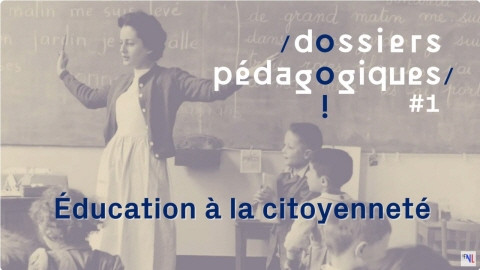 Educational Pack: Claire Ravez, research analyst focused on monitoring and analysis, IFE Année de publication: 2021 Auteur institutionnel: French Institute of Netherlands As a professor of history and geography, Claire Ravez joined the Monitoring and Analysis team of the French Institute of Education within the École normale supérieure de Lyon in 2017.Pedagogical file #1 is dedicated to civic education, with contributions from Claire Ravez, Dominique Schnapper, FEi, and the National Library of France.