
Ressources
Explorez une large gamme de ressources sur le GCED afin d’approfondir votre compréhension et de renforcer vos activités de recherche, de plaidoyer, d’enseignement et d’apprentissage.
2,771 résultats trouvés
 反思教育:向 “全球共同利益” 的理念转变? Année de publication: 2015 Auteur institutionnel: UNESCO 当今世界的错综复杂和矛盾冲突,达到了前所未有的程度。这些变化引发了紧张不安,人们寄希望于教育能够培养个人和社会掌握适应变化并做出反应的能力。本出版物有助于在这一背景下反思教育与学习。本书立足于教科文组织作为全球社会变革观测站的主要任务,目的是促进公共政策辩论。本书呼吁所有利益攸关方开展对话。这是一部在人文主义教育观和发展观的启迪下完成的作品,以尊重生命和人类尊严、权利平等、社会正义、文化多样性、国际团结和为创造可持续的未来承担共同责任为基础,而这些正是人性的基本共同点。本书彰显了教科文组织具有里程碑意义的两部出版物提出的愿景——《学会生存:教育世界的今天和明天》(《富尔报告》,1972年)和《学习:内在的财富》(《德洛尔报告》,1996年)。
  다시 생각하는 교육: 교육은 전지구적 공동재를 향해 가고 있는가? Année de publication: 2018 Auteur institutionnel: 유네스코 유네스코 아시아태평양 국제이해교육원은 유네스코와 공동으로 『다시 생각하는 교육: 교육은 전지구적 공동재를 향해 가고 있는가? (Rethinking Education: Towards a global common good?)』의 한국어판을 발간하였다. 본 한국어판은 영어 포함 13번째로 출간된 번역본이다.이 책은 새로운 전 지구적 학습 환경이 부상하는 가운데 교육의 목적이 무엇인지, 그리고 학습을 어떻게 조직할 것인지에 대해 다시 생각해야 한다고 강조하고 있다. 교육과 발전에 대한 인본주의적 비전에 영감을 받아 발간된 이 책은 복잡한 세계에서 집단적 사회 공동행동의 일환으로 학습목표와 학습조직 간의 조화를 이룩해내기 위해서는 교육과 지식을 전 지구적 공동재로 보아야 한다고 제안한다.
  [Summary] Accountability in Education: Meeting Our Commitments: Global Education Monitoring Report Summary, 2017/8 Année de publication: 2017 Auteur institutionnel: UNESCO This summary of the 2017/8 GEM Report shows the entire array of approaches to accountability in education. It ranges from countries unused to the concept, where violations of the right to education go unchallenged, to countries where accountability has become an end in itself instead of a means to inclusive, equitable and high-quality education and lifelong learning for all.The report emphasizes that education is a shared responsibility. While governments have primary responsibility, all actors – schools, teachers, parents, students, international organizations, private sector providers, civil society and the media – have a role in improving education systems. The report emphasizes the importance of transparency and availability of information but urges caution in how data are used. It makes the case for avoiding accountability systems with a disproportionate focus on narrowly defined results and punitive sanctions. In an era of multiple accountability tools, the report provides clear evidence on those that are working and those that are not. [Résumé] Rendre des Comptes en Matière Déducation: Tenir nos Engagements, Résumé du Rapport Mondial de Suivi sur l'éducation, 2017/8 Année de publication: 2017 Auteur institutionnel: UNESCO La deuxième édition du Rapport mondial de suivi sur l’éducation (Rapport GEM) présente les dernières données disponibles sur les progrès accomplis à l’échelle mondiale dans la réalisation des cibles des objectifs de développement durable des Nations Unies relatives à l’éducation.À l’heure où des centaines de millions de personnes sont encore non scolarisées et où beaucoup quittent l’école sans avoir acquis les compétences fondamentales, il est évident que les systèmes éducatifs sont bien loin d’atteindre les objectifs mondiaux. Les populations marginalisées en supportent actuellement la plupart des conséquences, mais sont également celles qui bénéficieront le plus des résultats obtenus, pour peu que les décideurs prêtent suffisamment d’attention à leurs besoins. Face à de tels défis, et compte tenu des restrictions budgétaires et de l’importance accrue accordée à la rentabilité axée sur les résultats, les pays sont à la recherche de solutions. Parmi celles-ci, une plus forte obligation de rendre des comptesarrive souvent en tête de liste.Le présent résumé du Rapport GEM 2017/2018 passe en revue les différentes approches qui existent en matière de reddition de comptes dans l’éducation, depuis les pays qui ne sont pas familiarisés avec le concept et où les violations du droit à l’éducation sont monnaie courante, jusqu’aux pays où l’obligation de rendre des comptes constitue une fin en soi et non plus un moyen de parvenir à une éducation inclusive, équitable et de qualité et un apprentissage tout au long de la vie pour tous.Le rapport souligne que l’éducation est une responsabilité partagée. Si celle-ci incombe en premier lieu aux gouvernements, tous les acteurs – établissements scolaires, enseignants, parents, élèves, organisations internationales, prestataires du secteur privé, société civile et médias – ont un rôle à jouer dans l’amélioration des systèmes éducatifs. Le rapport insiste sur l’importance de la transparence et de la disponibilité des informations, mais appelle à une utilisation prudente desdonnées. Il préconise d’éviter les systèmes de reddition de comptes qui reposent dans une trop large mesure sur une évaluation restrictive des performances et sur des sanctions punitives. Enfin, à l’heure où les outils de reddition de comptes se multiplient, le rapport démontre clairement quels sont ceux qui sont efficaces et ceux qui ne le sont pas. [Resumen] Rendir Cuentas en el Ámbito de la Educación: Cumplir Nuestros Compromisos, Resumen del Informe de Seguimiento de la Educación en el Mundo, 2017/8 Année de publication: 2017 Auteur institutionnel: UNESCO El segundo Informe de Seguimiento de la Educación en el Mundo (el Informe GEM) presenta las pruebas más recientes de los progresos alcanzados en el mundo en cuanto a la consecución de las metas relativas a la educación de los Objetivos de Desarrollo Sostenible de las Naciones Unidas.Puesto que hay centenares de millones de personas que todavía no están escolarizadas y muchas que no adquieren unas competencias mínimas en la escuela, es evidente que los sistemas educativos no llevan camino de alcanzar los objetivos mundiales. Las personas marginadas son quienes sufren actualmente la mayoría de las consecuencias, pero también son las que más se beneficiarán si los encargados de formular políticas prestan suficiente atención a sus necesidades. Ante estos retos, junto con presupuestos muy ajustados y una mayor importancia concedida a obtener rendimiento del dinero en forma de resultados, los países están buscando soluciones, entre las cuales a menudo la rendición de cuentas ocupa el primer lugar.Este resumen del Informe GEM 2017/18 muestra todos los diversos enfoques de la rendición de cuentas en el ámbito de la educación. Abarca desde los países que no están acostumbrados al concepto, en los que no se cuestionan las violaciones del derecho a la educación, hasta aquellos en los que la rendición de cuentas se ha convertido en un fin en sí misma, en lugar de un medio para alcanzar una educación y un aprendizaje a lo largo de toda la vida para todos que sean inclusivos, equitativos y de gran calidad.En el informe se recalca que la educación es una responsabilidad compartida.Aunque son los gobiernos los principales responsables de ella, a todos los actores – las escuelas, los docentes, los padres, los estudiantes, las organizaciones internacionales, los prestatarios del sector privado, la sociedad civil y los medios de comunicación – les corresponde desempeñar un papel en la mejora de los sistemas educativos. El informe recalca la importancia de la transparencia y la disponibilidad de la información, pero exhorta a manejar con prudencia los datos. Explica por qué debemos evitar unos sistemas de rendición de cuentas que den una importancia desproporcionada a unos resultados definidos de manera demasiado restringida y a sanciones punitivas. En una época en la que existen y se emplean múltiples instrumentos para rendir cuentas, el informe demuestra palmariamente con pruebas empíricas cuáles funcionan y cuáles no dan buenos resultados.
 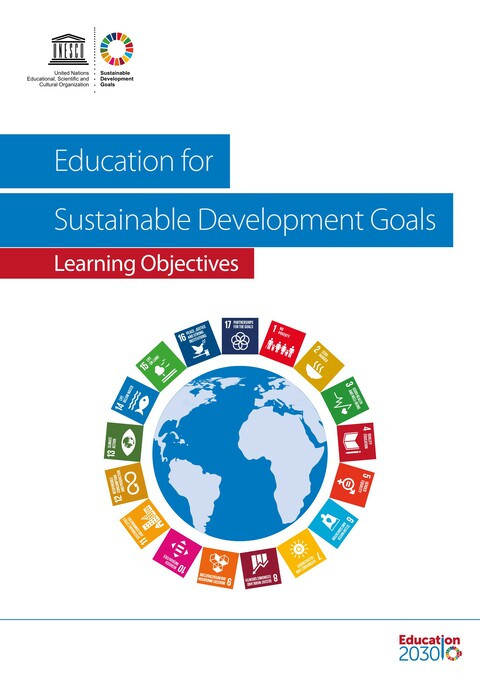 Education for Sustainable Development Goals: Learning Objectives Année de publication: 2017 Auteur institutionnel: UNESCO UNESCO has been promoting Education for Sustainable Development (ESD) since 1992. It led the UN Decade for ESD from 2005 to 2014 and is now spearheading its follow-up, the Global Action Programme (GAP) on ESD. The momentum for ESD has never been stronger. Global issues – such as climate change – urgently require a shift in our lifestyles and a transformation of the way we think and act. To achieve this change, we need new skills, values and attitudes that lead to more sustainable societies. Education systems must respond to this pressing need by defining relevant learning objectives and learning contents, introducing pedagogies that empower learners, and urging their institutions to include sustainability principles in their management structures. The new 2030 Agenda for Sustainable Development clearly reflects this vision of the importance of an appropriate educational response. Education is explicitly formulated as a stand-alone goal – Sustainable Development Goal 4. Numerous educationrelated targets and indicators are also contained within other Sustainable Development Goals (SDGs). Education is both a goal in itself and a means for attaining all the other SDGs. It is not only an integral part of sustainable development, but also a key enabler for it. That is why education represents an essential strategy in the pursuit of the SDGs. This publication is designed as a guide for education professionals on the use of ESD in learning for the SDGs, and consequently to contribute to achieving the SDGs. The guide identifies indicative learning objectives and suggests topics and learning activities for each SDG. It also presents implementation methods at different levels, from course design to national strategies. The guide does not aim to be prescriptive in any way, but to provide guidance and suggestions that educators can select and adapt to fit concrete learning contexts L’éducation en vue des objectifs de développement durable: Objectifs d’apprentissage Année de publication: 2017 Auteur institutionnel: UNESCO L’UNESCO promeut l’éducation en vue du développement durable (EDD) depuis 1992. Après avoir été le chef de file de la Décennie des Nations Unies pour l’éducation au service du développement durable de 2005 à 2014, elle est maintenant le fer de lance du Programme d’action global pour l’éducation en vue du développement durable qui lui a succédé. La dynamique en faveur de l’EDD n’a jamais été aussi forte. Des enjeux planétaires, tels que le changement climatique, exigent d’urgence un changement de nos modes de vie et une transformation de notre façon de penser et d’agir. Pour y parvenir, nous avons besoin de compétences, de valeurs et d’attitudes nouvelles qui conduisent à des sociétés plus viables. Les systèmes éducatifs doivent répondre à ce besoin urgent en définissant des objectifs et des contenus d’apprentissage pertinents, en proposant des pédagogies qui autonomisent les apprenants et en pressant leurs établissements d’intégrer les principes de la durabilité dans leurs structures de gestion. Le nouveau Programme mondial de développement durable à l’horizon 2030 reflète clairement cette vision de l’importance d’une réponse éducative adaptée. L’éducation est explicitement présentée comme un objectif autonome dans l’Objectif de développement durable 4. De nombreux indicateurs et cibles relatifs à l’éducation sont également intégrés à d’autres Objectifs de développement durable (ODD). L’éducation est à la fois un but en soi et un moyen de réaliser tous les autres ODD ; elle est non seulement un élément à part entière du développement durable, mais elle en est également l’un des principaux moteurs. C’est pourquoi l’éducation représente une stratégie essentielle dans la réalisation des ODD. La présente publication est conçue pour guider les professionnels de l’éducation en leur montrant comment faire de l’EDD un apprentissage au service des ODD et donc contribuer à la réalisation de ces objectifs. Il propose une liste indicative d’objectifs d’apprentissage et suggère des thèmes et des activités d’apprentissage pour chaque ODD. Il présente également des méthodes de mise en œuvre aux différents niveaux de l’enseignement, des plans de cours aux stratégies nationales. Ce guide ne se veut en aucun cas prescriptif ; il vise à offrir des conseils et des suggestions que les éducateurs pourront choisir et adapter à des situations d’apprentissage concrètes. Educación para los Objetivos de Desarrollo Sostenible: Objetivos de aprendizaje Année de publication: 2017 Auteur institutionnel: UNESCO Desde 1992, la UNESCO ha promovido la Educación para el Desarrollo Sostenible (EDS). Entre 2005 y 2014, coordinó el Decenio de las Naciones Unidas de la EDS, y ahora está llevando a cabo el programa de seguimiento, el Programa de Acción Mundial sobre la EDS. El impulso de la EDS nunca ha sido más fuerte. Temas mundiales –como el cambio climático- requieren de forma urgente un cambio en nuestros estilos de vida y una transformación en nuestra forma de actuar y pensar. Para lograrlo, necesitamos nuevas competencias, actitudes y conductas que nos conduzcan a sociedades más sostenibles. Los sistemas educativos tienen que responder a esta necesidad a la hora de definir los objetivos y contenidos de aprendizaje pertinentes, introduciendo pedagogías que empoderen a los alumnos e instando a las instituciones a incluir los principios de sostenibilidad en sus estructuras de gestión. La nueva agenda mundial para el desarrollo sostenible 2030 refleja claramente esta visión de la importancia de una respuesta educativa apropiada. La educación está explícitamente formulada como un objetivo independiente en el Objetivo de Desarrollo Sostenible número 4. Metas e indicadores relacionados con la educación también están incluidos en otros ODS. La educación de calidad es tanto una meta en sí misma como un medio para lograr todos los otros ODS, porque es parte integral del desarrollo sostenible y un facilitador clave del mismo. Es por ello que la educación representa una estrategia esencial en la consecución de los ODS. Este documento ha sido diseñado para guiar a los profesionales de la educación en el uso de la EDS en el aprendizaje para los ODS y, en consecuencia, para lograr los ODS. Esta guía identifica objetivos específicos de aprendizaje y sugiere temas y actividades para cada ODS. También presenta métodos de implementación a distintos niveles, desde el diseño de cursos hasta las estrategias nacionales. Este documento no busca de ninguna forma ser prescriptivo, sino servir como una guía y ofrecer sugerencias que los educadores puedan seleccionar y adaptar a contextos específicos de aprendizaje. Цели образования в интересах устойчивого развития: Задачи обучения Année de publication: 2017 Auteur institutionnel: UNESCO ЮНЕСКО занимается поощрением образования в интересах устойчивого развития (ОУР) с 1992 г. Организация сыграла ведущую роль в проведении Десятилетия образования в интересах устойчивого развития Организации Объединенных Наций (2005- 2014 гг.), а сегодня возглавляет усилия, связанные с последующей деятельностью по итогам ДОУР и осуществлением Глобальной программы действий (ГПД) по образованию в интересах устойчивого развития. Потребность в ОУР еще никогда не была настолько актуальной. Глобальные проблемы, такие как изменение климата, диктуют необходимость безотлагательной трансформации нашего образа жизни, нашего менталитета и наших привычек. Для того, чтобы эти изменения стали реальностью, нам нужны новые практические навыки, ценностные ориентиры и поведенческие установки, которые обеспечат построение более устойчивых обществ. Системы образования должны реагировать на эту насущную потребность посредством формулирования соответствующих задач и содержания обучения, применения методик, расширяющих возможности учащихся, активного поощрения своих учреждений к внедрению принципов устойчивого развития в структурах управления образовательных учреждений. Такое понимание значимости адекватного реагирования со стороны систем образования получило наглядное отражение в новой Повестке дня в области устойчивого развития на период до 2030 г. В этом документе образование представлено в виде отдельной цели в области устойчивого развития (ЦУР 4). Целый ряд других целей в области устойчивого развития (ЦУР) также включает задачи и целевые показатели, связанные с образованием. Образование – это одновременно самостоятельная цель и средство для достижения всех остальных ЦУР. Оно является не только неотъемлемой частью, но и ключевым фактором устойчивого развития. В связи с этим оно представляет собой важнейшую область с точки зрения реализации ЦУР. Настоящая публикация призвана стать руководством для специалистов в области образования по вопросам применения принципов ОУР в обучении в интересах достижения целей в области устойчивого развития. Таким образом, она призвана содействовать достижению ЦУР. В этом руководстве сформулированы типовые задачи обучения и предложены темы и практические учебные задания по каждой ЦУР. В нем также представлены методы реализации этих задач на различных этапах - от разработки учебных курсов до формулирования национальных стратегий. Руководство не носит директивного характера, а является методологической основой и предлагает решения, которые могут быть использованы специалистами в области образования и адаптированы ими для конкретных условий обучения.
 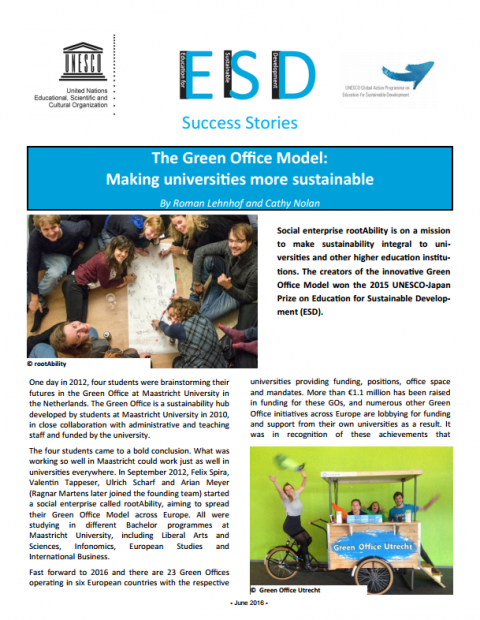 The Green office model: making universities more sustainable Année de publication: 2016 Auteur: Roman Lehnhof | Cathy Nolan Auteur institutionnel: UNESCO ESD Success Stories are showcasing compelling stories with a personal/human dimension from all five UNESCO regions (Africa, Arab States, Asia and Pacific, Europe & North America and Latin America & the Caribbean). The stories illustrate the wide diversity of ESD approaches and initiatives taking place in different parts of the world. They show how involvement with ESD has changed the lives of specific individual persons and how they have become more active in their community. Each story centers on one individual or a group of individuals.The rootAbility, a social enterprise, is planned by four students at Maastricht University, aiming to spread Green Office Model across Europe. The Green Office can effectively drive a dynamic sustainability process in universities and other institutions of higher education by collaboratively working with students and university staffs and integrating sustainability into university’s teaching and research.