
Ressources
Explorez une large gamme de ressources sur le GCED afin d’approfondir votre compréhension et de renforcer vos activités de recherche, de plaidoyer, d’enseignement et d’apprentissage.
2,771 résultats trouvés
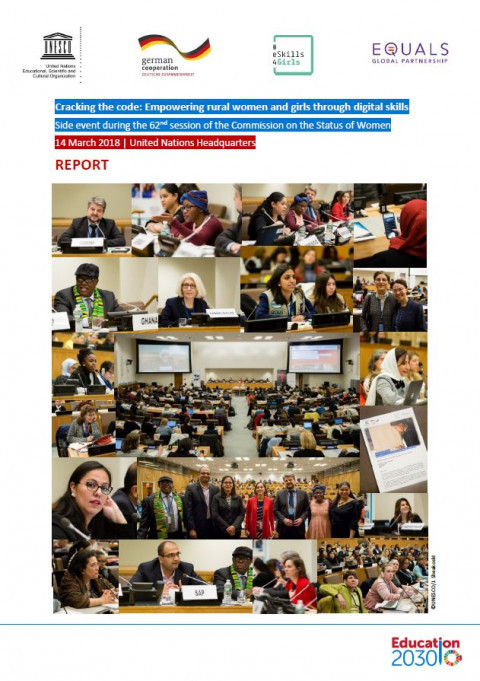 Cracking the Code: Empowering Rural Women and Girls through Digital Skills; Side Event during the 62nd Session of the Commission on the Status of Women, 14 March 2018, United Nations Headquarters: Report Année de publication: 2018 Auteur institutionnel: UNESCO | Germany. Federal Ministry for Economic Cooperation and Development (BMZ) UNESCO and the German Federal Ministry of Economic Cooperation and Development (BMZ) co-organised the side event ‘Cracking the code: Empowering rural women and girls through digital skills’ on 14 March 2018, United Nations Headquarters in New York, on the margins of the 62nd session of the CSW. More than 500 participants participated in the event while a broad global audience followed the discussions through live webcast.This report provides an overview of the discussions and examples of government, civil society organizations, and private sector initiatives to close the gender digital gap and empower rural girls and women to be ICT users, creators and innovators through gender-responsive digital skills training as well as science, technology, engineering and mathematics (STEM) education more broadly.
  Issues and Trends in Education for Sustainable Development Année de publication: 2018 Auteur: Alexander Leicht | Julia Heiss | Wonjung Byun Auteur institutionnel: UNESCO Education for Sustainable Development (ESD) is globally acknowledged as a powerful driver of change, empowering learners to take the decisions and actions needed to build a just and economically viable society respectful of both the environment and cultural diversity.This publication comes at a moment of heightened global interest in addressing sustainability challenges through education in order to achieve the targets of the 2030 Sustainable Development Agenda. ESD is not only recognized as a key enabler of sustainable development but an integral element of all quality education. By exploring key issues related to ESD policy and practice, UNESCO aims to help accelerate the reorientation of education towards achieving a sustainable and resilient world. Enjeux et tendances de l'éducation en vue du développement durable Année de publication: 2018 Auteur: Alexander Leicht | Julia Heiss | Wonjung Byun Auteur institutionnel: Organisation des Nations Unies pour l'éducation, la science et la culture (UNESCO) L’éducation en vue du développement durable (EDD) est universellement considérée comme un puissant vecteur de changement qui donne aux apprenants les moyens de prendre les décisions nécessaires et d’agir pour bâtir une société juste et économiquement viable, respectueuse de l’environnement et de la diversité culturelle. Cet ouvrage paraît dans un contexte mondial marqué par un intérêt accru pour les efforts visant à relever les défis du développement durable par le biais de l’éducation, afin d’atteindre les objectifs du Programme de développement durable à l’horizon 2030. L’EDD est non seulement reconnue comme un moteur indispensable du développement durable, mais aussi comme un élément constitutif d’une éducation de qualité. En explorant les principaux enjeux liés aux politiques et aux pratiques d’EDD, l’UNESCO entend accélérer la réorientation de l’éducation vers un monde plus durable et plus résilient.
  International Task Force on Teachers for Education 2030 Strategic Plan 2018–2021 Année de publication: 2018 Auteur institutionnel: UNESCO With the end of the EFA era, the TTF has decided to articulate its activities around the newly adopted international education goals. The Strategic Plan 2018–2021 builds on the Sustainable Development Goals (SDGs), especially the SDG 4.c target on teachers, and the Education 2030 Incheon Declaration and Framework for Action adopted in 2015. Plan stratégique 2018 - 2021. Équipe spéciale internationale sur les enseignants pour Éducation 2030 Année de publication: 2018 Auteur institutionnel: UNESCO Avec la fin de l'ère EPT, l'Équipe spéciale sur les enseignants a décidé d'articuler ses activités autour des objectifs d'éducation internationale nouvellement adoptés. Le Plan stratégique 2018-2021 se fonde sur les Objectifs de Développement Durable (ODD), en particulier sur la cible 4.c de l'ODD 4 sur les enseignants, ainsi que sur la Déclaration d'Incheon et le Cadre d'action Éducation 2030 adoptés en 2015. Ce nouveau plan stratégique a été informé par une évaluation externe réalisée en 2016-2017. Les conclusions et les recommandations de l'évaluation ont été discutées par le comité directeur du de l'Équipe spéciale sur les enseignants en mai 2017 et donnent certaines des orientations de ce plan stratégique. Plan Estratégico 2018 - 2021. Equipo especial internacional sobre docentes para Educación 2030 Année de publication: 2018 Auteur institutionnel: UNESCO Con el final de la era de la EPT, la TTF ha decidido articular sus actividades en torno a los objetivos educativos internacionales recientemente adoptados.El Plan Estratégico 2018-2021 se basa en los Objetivos de Desarrollo Sostenible (ODS), especialmente en la meta del ODS 4.c sobre docentes, y en la Declaración de Incheon y el Marco de Acción para la realización del Objetivo de Desarrollo Sostenible 4 adoptados en 2015.Este nuevo Plan Estratégico fue informado por una evaluación externa realizada en 2016-2017. Las conclusiones y recomendaciones de la evaluación fueron discutidas por el Comité Directivo de la TTF en mayo de 2017 e impulsan algunas de las direcciones estratégicas de este Plan Estratégico.
  UNESCO ICT Competency Framework for Teachers (ver.3) Année de publication: 2018 Auteur institutionnel: UNESCO UNESCO has developed the ICT Competency Framework for Teachers (ICT CFT) as a tool to guide pre- and in-service teacher training on the use of ICTs across the education system. The ICT CFT is intended to be adapted to support national and institutional goals by providing an up-to-date framework for policy development and capacity building in this dynamic area.The ICT Competency Framework for Teachers (ICT CFT) Version 3 is a response to recent technological and pedagogical developments in the field of ICT and Education, and incorporates in its structure inclusive principles of non-discrimination, open and equitable information accessibility and gender equality in the delivery of education supported by technology. It addresses the impacts of recent technological advances on education and learning, such as Artificial Intelligence (AI), Mobile Technologies, the Internet of Things and Open Educational Resources, to support the creation of inclusive Knowledge Societies. The ICT CFT provides a comprehensive set of competencies teachers need to integrate ICT into their professional practice in order to facilitate students’ achievement of curricular objectives. Strong political commitments and sustained investment in teacher education, and concerted actions between pre- and in-service teacher trainings form the foundation of the successful implementation of this Framework as it is contextualized to national and institutional goals. For this reason, this document underlines the importance of steadfast commitment to supporting teachers’ continuous professional development including through ICT, and includes examples to illustrate how ICT CFT could be used to facilitate teachers’ development in diverse contexts. We look forward to strengthening our collaboration with all stakeholders everywhere to leverage ICT to develop the skills required to thrive within the fast-changing inclusive Knowledge Societies.
 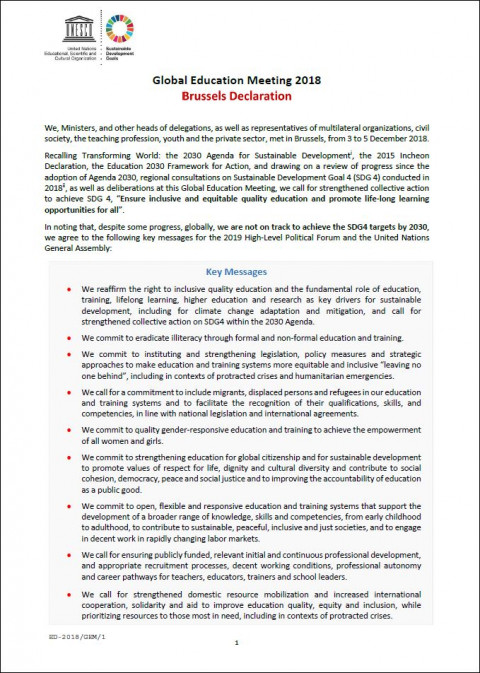 Global Education Meeting 2018: Brussels Declaration Année de publication: 2018 Auteur institutionnel: UNESCO Ministers, and other heads of delegations, as well as representatives of multilateral organizations, civil society, the teaching profession, youth and the private sector, met in Brussels, from 3 to 5 December 2018. This document describes key messsages and commitments for the 2019 High-Level Political Forum and the United Nations General Assembly.
  Guidelines and Recommendations for Reorienting Teacher Education to Address Sustainability Année de publication: 2005 Auteur institutionnel: UNESCO Members of the International Network made recommendations related to reorienting teacher education to address sustainability. The recommendations are pieces of wisdom garnered through the experimentation and hard work of teacher educators.The recommendations concern ministerial and national levels to the local level. The recommendations involve curriculum, pedagogy, policy, practice, programs, rewards, research, information and computer technology, partnerships, networking, communications, etc.Members of the International Network repeatedly mentioned the urgency to act and the need for profound change. While many spoke of the enormity of the task at hand, all who participated were able to make signifi cant and positive inroads. Interested individuals operating within their own spheres of control (e.g., weaving sustainability themes into their own classroom curricula) made great headway reorienting their programs. Also, many institutions were able to develop new courses at both the undergraduate and graduate levels. Problems arose, however, when the Network members advocated for change beyond the sphere of direct control. ESD within teacher-education institutions is currently endorsed by early-adopters. However, it will take concerted effort and resources to establish ESD in curricula, programs, practices, and policies across teacher-education institutions.
  Media and Information Literacy: Reinforcing Human Rights, Countering Radicalization and Extremism (The MILID Yearbook, 2016) Année de publication: 2016 Auteur: Jagtar Singh | Paulette Kerr | Esther Hamburger Auteur institutionnel: UNESCO | Alliance of Civilizations Media and Information Literacy (MIL) is a strong tool, cutting across educational, cultural and social contexts. It can help overcome disinformation, stereotypes and intolerance conveyed through some media and in online spaces. Here, stimulating critical empathy is one of the vital components and there are many stakeholders that have a role to play in this dimension of MIL.This year’s edition is focused on a highly relevant theme of “Media and Information Literacy: Reinforcing Human Rights, Countering Radicalization and Extremism”. It is a relevant reference point to initiate discussion and offer perspectives to stakeholders seeking to apply MIL as a tool to counter violent extremism. There is evident need for evidence-based research, assessment and evaluation that can provide insight into the impact of media and information literacy on societies. UNESCO trusts that this publication will contribute to ongoing scholarship and debate on these key topics.For media and other information providers to serve their purpose, we need critical minds in the public, which means to develop MIL programmes at the national, regional and international levels.