
Ressources
Explorez une large gamme de ressources sur le GCED afin d’approfondir votre compréhension et de renforcer vos activités de recherche, de plaidoyer, d’enseignement et d’apprentissage.
2,769 résultats trouvés
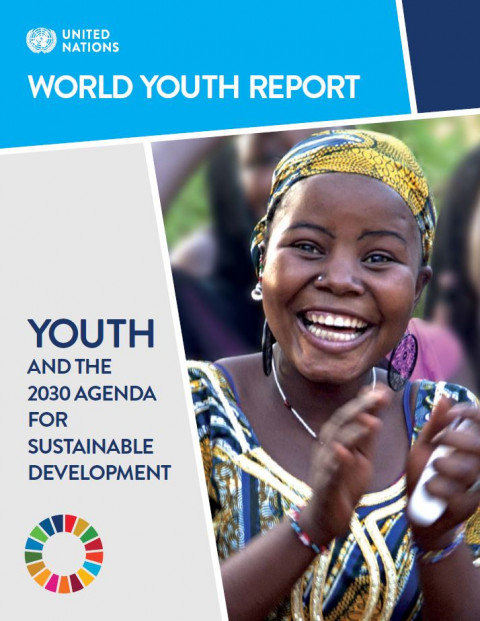 세계청소년보고서: 청소년과 2030 지속가능발전 의제 Année de publication: 2018 Auteur institutionnel: United Nations (UN) UN 경제사회국이 작성한 『세계청소년보고서: 청소년과 2030 지속가능발전 의제(World Youth Report: Youth and the 2030 Agenda for Sustainable Development)』는 청소년 개발에 대한 현재의 노력과 새로운 의제 간의 상호 보완적인 역할을 다루고 있습니다. UN 경제사회국은 경제, 사회 및 환경 분야 글로벌 정책과 국가적 실천 사이의 연결고리를 제공하고 있습니다. 2년마다 발간되는 본 보고서는 회원국 및 기타 이해관계자들이 청소년 문제 해결에 대한 진전 사항을 파악하고, 정책과 현실의 격차를 평가하고, 가능한 정책 대안을 마련하기 위한 정보와 분석 결과를 제공합니다.본 보고서는 2030 지속가능발전 의제 및 관련 프레임워크 이행의 맥락, 특히 제3차 개발재원총회 아디스아바바 행동의제 (Ababa Action Agenda of the Third International Conference on Financing for Development) 및 세계청소년행동계획 (World Programme of Action for Youth) 의 이행과 관련하여 지속가능발전을 위한 청소년의 역할에 대한 통찰을 제시합니다. 2030 의제는 청소년개발 노력을 증진하고 증거기반(evidence ― based) 청소년정책이 청소년 목표 증진에 이바지하는 바를 검토하는 데 있어 중요한 역할을 할 수 있습니다. 본 보고서는 이를 통해 모든 수준에서의 지속가능발전 이행에 있어 결정적으로 중요한 청소년의 역할을 살펴봅니다.
 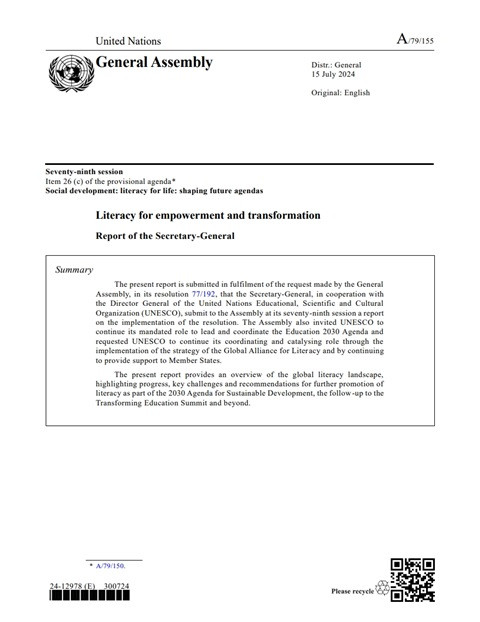 Literacy for Empowerment and Transformation: Report of the Secretary-General Année de publication: 2024 Auteur institutionnel: United Nations | UNESCO The present report is submitted in fulfilment of the request made by the General Assembly, in its resolution 77/192, that the Secretary-General, in cooperation with the Director General of the United Nations Educational, Scientific and Cultural Organization (UNESCO), submit to the Assembly at its seventy-ninth session a report on the implementation of the resolution. The Assembly also invited UNESCO to continue its mandated role to lead and coordinate the Education 2030 Agenda and requested UNESCO to continue its coordinating and catalysing role through the implementation of the strategy of the Global Alliance for Liter acy and by continuing to provide support to Member States. The present report provides an overview of the global literacy landscape, highlighting progress, key challenges and recommendations for further promotion of literacy as part of the 2030 Agenda for Sustainable Development, the follow-up to the Transforming Education Summit and beyond.
 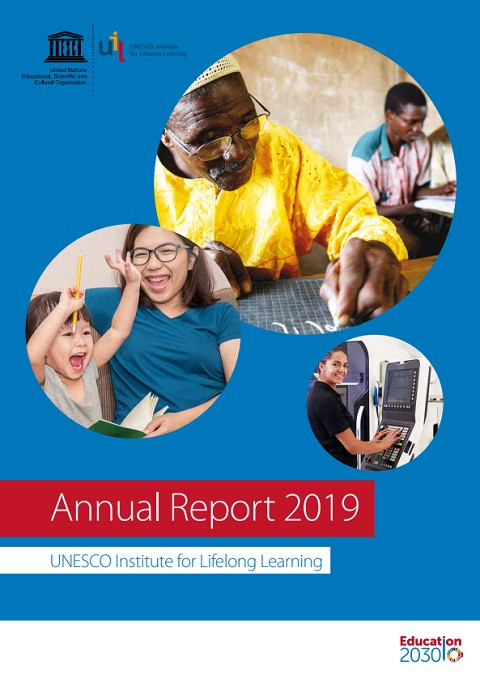 Annual Report 2019: UNESCO Institute for Lifelong Learning Année de publication: 2020 Auteur institutionnel: UNESCO Institute for Lifelong Learning (UIL) This report shows how, in 2019, UIL worked to fulfil its mission, with a focus on youth and adults and a special emphasis on UNESCO’s priority areas of Africa and gender equality. UIL’s vision is for all children, young people and adults to benefit from quality lifelong learning opportunities, within the framework of sustainable development and peace. We promote lifelong learning as the leading educational paradigm for inclusive and sustainable learning societies in the context of the United Nations’ 2030 Agenda for Sustainable Development, which provides an ambitious set of goals and targets for Member States that together form a coherent, universal framework of reference for our activities. Working to this framework, and recognizing lifelong learning’s important transversal role not only with respect to Sustainable Development Goal (SDG) 4 on education but across all 17 SDGs, UIL has made an impact across a range of fronts, including in the areas of policy advice, capacity development, research, monitoring, and networking and advocacy. Rapport annuel 2019: Institut de l’UNESCO pour l’apprentissage tout au long de la vie Année de publication: 2020 Auteur institutionnel: Institut de l’UNESCO pour l’apprentissage tout au long de la vie (UIL) Ce rapport décrit la façon dont l’Institut a opéré en 2019 pour remplir sa mission en concentrant ses activités sur les jeunes et les adultes, et en mettant particulièrement l’accent sur les domaines prioritaires de l’UNESCO que sont l’Afrique et l’égalité des genres. L’UIL nourrit la vision d’un monde où tous les enfants, tous les jeunes et tous les adultes bénéficient d’offres d’apprentissage de qualité tout au long de leur vie, dans le cadre d’un développement durable et dans un monde en paix. Nous assurons la promotion de l’apprentissage tout au long de la vie en tant que paradigme éducatif majeur de sociétés apprenantes inclusives et durables dans le contexte du Programme de développement durable des Nations unies à l’horizon 2030. Ce programme fournit aux États membres une série d’objectifs et de cibles ambitieux qui, dans leur ensemble, constituent un cadre de référence universel et cohérent pour nos activités. Œuvrant à la réalisation de ce cadre et reconnaissant le rôle important de l’apprentissage tout au long de la vie, non seulement dans l’optique de l’Objectif de développement durable 4 (ODD 4) sur l’éducation, mais aussi, de façon plus générale pour réaliser les 17 ODD, l’UIL s’est engagé sur différents terrains tels que la formulation des politiques et leur mise en œuvre, le développement des capacités, la recherche, le pilotage et suivi ainsi que la mise en réseau et le plaidoyer.
 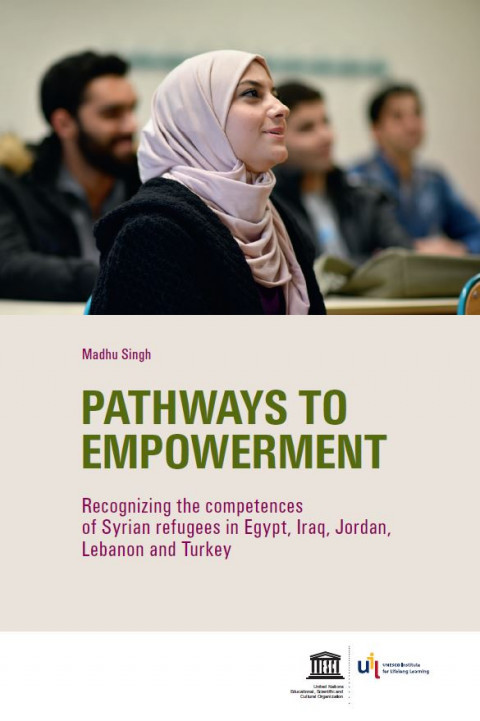 Pathways to Empowerment: Recognizing the Competences of Syrian Refugees in Egypt, Iraq, Jordan, Lebanon and Turkey Année de publication: 2018 Auteur: Madhu Singh Auteur institutionnel: UNESCO Institute for Lifelong Learning (UIL) For Syrian refugees living in Egypt, Iraq, Jordan, Lebanon and Turkey, recognition is a transformative mechanism that can help them enter or re-enter education, integrate into the world of work and participate fully in their host communities. However, while policy-makers in the region have prioritized the recognition, validation and accreditation of non-formal and informal learning, it remains a major challenge to develop systems that do this effectively. Pathways to Empowerment lays the essential groundwork for such a system, urging governments to develop comprehensive national strategies rather than ad hoc projects to recognize the competences of Syrian refugees. Its recommendations will contribute to dialogue between national authorities and social partners, and guide policy actions and RVA practices both in the region and in other parts of the world where recognition of refugees’ learning is a critical issue.
 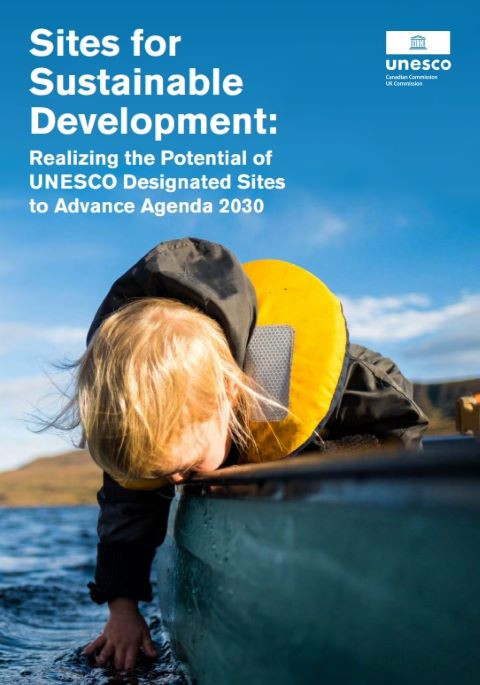 Sites for Sustainable Development: Realizing the Potential of UNESCO Designated Sites to Advance Agenda 2030 Année de publication: 2022 Auteur: Tim Carter | Eleanor R. Haine | Alexander J. Kent | Matthew Rabagliati Auteur institutionnel: Canadian Commission for UNESCO | United Kingdom National Commission for UNESCO This report outlines the role that UNESCO’s global network of designated sites — World Heritage Sites, global geoparks and biosphere reserves — can play in helping stakeholders (including businesses, communities, government agencies and their local organizations, Indigenous Peoples, traditional authorities, councils of elected representatives, and heritage and nature groups) carry out sustainable development approaches to tackle, mitigate and adapt to challenges like these.The ideas contained in this report emerge from a study designed to explore the merits of UNESCO’s increasing tendency to refer to biosphere reserves, global geoparks and World Heritage Sites as “sites for sustainable development.”
 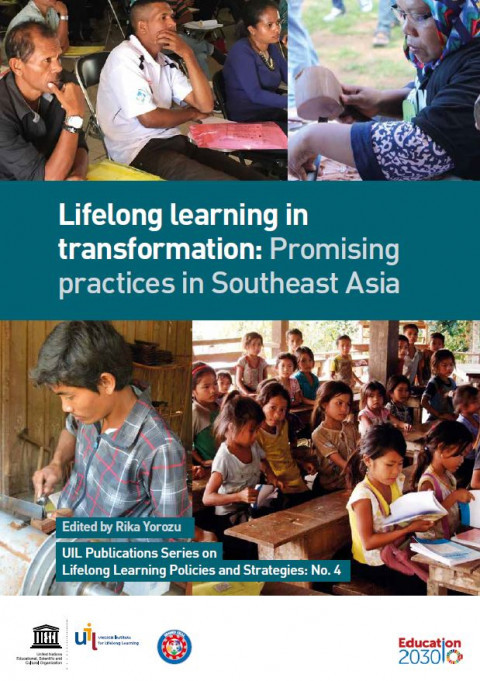 Lifelong Learning in Transformation: Promising Practices in Southeast Asia Année de publication: 2017 Auteur: Rika Yorozu Auteur institutionnel: UNESCO Institute for Lifelong Learning (UIL) This report is an outcome of a project on building a lifelong learning agenda in Southeast Asian countries, which aims to address the region’s remaining educational challenges in ensuring ‘inclusive and equitable quality education and promot[ing] lifelong learning opportunities for all’ (Goal 4 of the 2030 Agenda for Sustainable Development). By sharing promising policies and practices in implementing integrated lifelong learning from different perspectives, countries can learn from one another and move their visions for lifelong learning fully into practice. The publication documents a variety of promising practices from 11 countries, focusing particularly on the features critical to the promotion of lifelong learning for all; namely, inclusive and gender-responsive teaching and learning practices, recognition of learning outcomes from non-formal and informal learning, collaboration between social and economic development sectors and coherent national government policies and strategies. The report comprises three main sections: a reflection on lifelong learning in international and national documents, a collection of good practice drawn from their national reports, and a set of recommendations for policies and programmes promoting lifelong learning. It is hoped that these recommendations will stimulate discussion and new developments, in both policy and practice, in the region.
 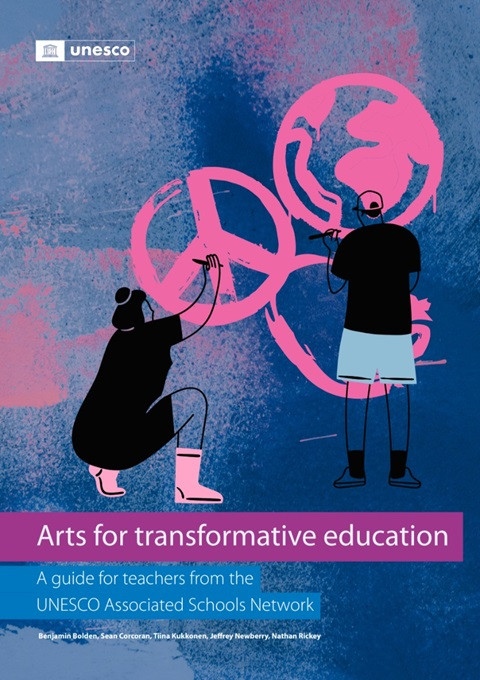 Arts for Transformative Education: A Guide for Teachers from the UNESCO Associated Schools Network Année de publication: 2024 Auteur: Benjamin Bolden | Sean Corcoran | Tiina Kukkonen | Jeffrey Newberry | Nathan Rickey Auteur institutionnel: UNESCO | Canadian Commission for UNESCO UNESCO’s vision of transformative education involves building learners’ capacities and empowering them to take action for a more peaceful and sustainable world. The arts offer tremendous potential for supporting learning that transforms individuals and communities. To fully realize that potential, teachers need to structure and support educational experiences that optimize what students will take away from them. This guide presents the research-informed Arts for Transformative Education model, a pioneering approach and thinking tool for teachers. The model was developed from data provided by over 600 teachers of the UNESCO Associated Schools network from 39 countries. The publication presents Learning Experience Descriptions and Snapshots illustrating how the model functions in real-world projects from around the globe, as well as Guidelines for Teachers outlining a step-by-step process for activating arts learning to empower transformative education.
  Global Inventory of Regional and National Qualifications Frameworks 2017, Vol. I: Thematic Chapters Année de publication: 2017 Auteur institutionnel: European Centre for the Development of Vocational Training (CEDEFOP) | European Training Foundation (ETF) | UNESCO | UNESCO Institute for Lifelong Learning (UIL) The global inventory 2017 further strengthens the knowledge base on developments in national and regional qualifications frameworks, as implemented by countries and regions, by end of 2016. It acts as an observatory of progress in establishing NQFs, as well as the challenges and success factors in implementation. The thematic chapters (Volume I) discuss key trends and policy issues emerging from qualifications frameworks and learning outcomes reforms and developments. Volume II consists of NQF case studies of 100 countries from all continents and seven regional qualifications frameworks (RQF). The case studies look at the educational, social, economic and political context in which an NQF is embedded, main policy objectives, implementation of learning outcomes, stakeholder involvement and institutional arrangements. They also show how NQFs open for and link to validation arrangements, support recognition and learning pathways. They conclude with important lessons and future plans.The global inventory draws on inventories from four agencies: the European Centre for the Development of Vocational Training (Cedefop), the European Training Foundation (ETF), the United Nations Educational, Scientific and Cultural Organisation (UNESCO) and the UNESCO Institute for Lifelong Learning (UIL), working and communicating with country officials and experts. It also draws on extensive international research in qualifications reforms, comparability of qualifications, and use of learning outcomes.
  Global Inventory of Regional and National Qualifications Frameworks 2017, Vol. II: National and Regional Cases Année de publication: 2017 Auteur institutionnel: European Centre for the Development of Vocational Training (CEDEFOP) | European Training Foundation (ETF) | UNESCO | UNESCO Institute for Lifelong Learning (UIL) The global inventory 2017 further strengthens the knowledge base on developments in national and regional qualifications frameworks, as implemented by countries and regions, by end of 2016. It acts as an observatory of progress in establishing NQFs, as well as the challenges and success factors in implementation. The thematic chapters (Volume I) discuss key trends and policy issues emerging from qualifications frameworks and learning outcomes reforms and developments. Volume II consists of NQF case studies of 100 countries from all continents and seven regional qualifications frameworks (RQF). The case studies look at the educational, social, economic and political context in which an NQF is embedded, main policy objectives, implementation of learning outcomes, stakeholder involvement and institutional arrangements. They also show how NQFs open for and link to validation arrangements, support recognition and learning pathways. They conclude with important lessons and future plans.The global inventory draws on inventories from four agencies: the European Centre for the Development of Vocational Training (Cedefop), the European Training Foundation (ETF), the United Nations Educational, Scientific and Cultural Organisation (UNESCO) and the UNESCO Institute for Lifelong Learning (UIL), working and communicating with country officials and experts. It also draws on extensive international research in qualifications reforms, comparability of qualifications, and use of learning outcomes.