
Ressources
Explorez une large gamme de ressources sur le GCED afin d’approfondir votre compréhension et de renforcer vos activités de recherche, de plaidoyer, d’enseignement et d’apprentissage.
2,768 résultats trouvés
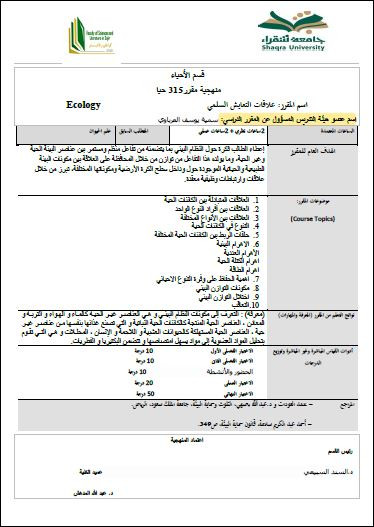 University Course: Relationships of Peaceful Coexistence Année de publication: 2021 Auteur: Somaya Youssef Al-Arabawy Auteur institutionnel: Shaqra University The goal is to give the student an idea about the ecosystem, including the organized and continuous interaction between the elements of the living and non-living environment, and the balance this interaction generates by maintaining the relationship between the components of the natural and living environment around and within the surface of the globe and its various components, which are highlighted through the relationships and complex functional connections. مقرر جامعي: علاقات التعايش السلمي Année de publication: 2021 Auteur: Somaya Youssef Al-Arabawy Auteur institutionnel: Shaqra University الهدف هو اعطاء الطالب فكرة حول النظام البيئي بما يتضمنه من تفاعل منظم ومستمر بين عناصر البيئة الحية وغير الحية، وما يولده هذا التفاعل من توازن من خلال المحافظة على العلاقة بين مكونات البيئة الطبيعية والحياتية الموجودة حول وداخل سطح الكرة الأرضية ومكوناتها المختلفة، تبرز من خلال علاقات وارتباطات وظيفية معقدة.
 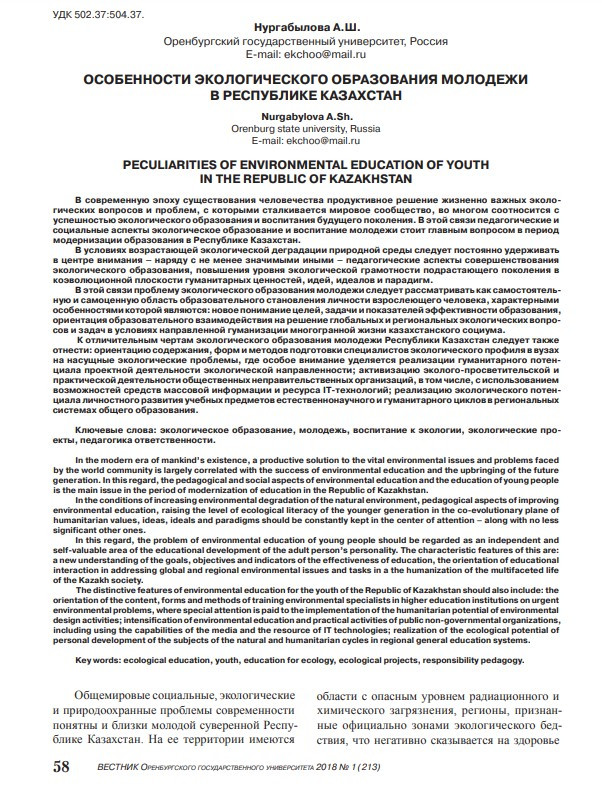 Peculiarities of Environmental Education of Youth in the Republic of Kazakhstan Année de publication: 2018 Auteur: Agila Sh. Nurgabylova In the modern era of mankind’s existence, a productive solution to the vital environmental issues and problems faced by the world community is largely correlated with the success of environmental education and the upbringing of the future generation. In this regard, the pedagogical and social aspects of environmental education and the education of young people is the main issue in the period of modernization of education in the Republic of Kazakhstan. Особенности экологического образования молодежи в республике Казахстан Année de publication: 2018 Auteur: Agila Sh. Nurgabylova В современную эпоху существования человечества продуктивное решение жизненно важных экологических вопросов и проблем, с которыми сталкивается мировое сообщество, во многом соотносится с успешностью экологического образования и воспитания будущего поколения. В этой связи педагогические и социальные аспекты экологическое образование и воспитание молодежи стоит главным вопросом в период модернизации образования в Республике Казахстан.
 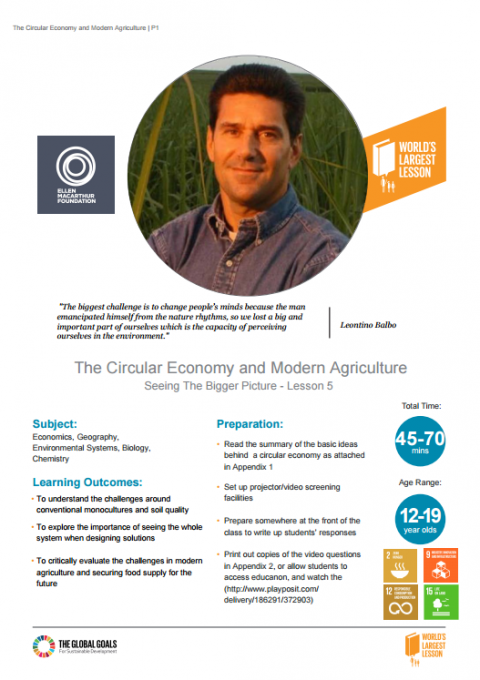 The Circular Economy and Modern Agriculture: Seeing The Bigger Picture - Lesson 5 Auteur institutionnel: United Nations Children's Fund (UNICEF) World’s Largest Lesson is a collaborative education project to support the announcement of the United Nations Global Goals for Sustainable Development. Learning outcomes of the project: • To understand the challenges around conventional monocultures and soil quality • To explore the importance of seeing the whole system when designing solutions • To critically evaluate the challenges in modern agriculture and securing food supply for the future
  Экологическое образование как составная часть содержания высшего образования (Международный журнал гуманитарных и естественных наук; № 5-2 (92), 2024) Année de publication: 2024 Auteur: Жээнбек Сейталиевич Абдиев В статье автор особо подчеркивает, что экологическое образование и воспитание не может быть эффективным, не формируя соответствующим образом экологического мировоззрения. В этом контексте главной парадигмой экологического образования и воспитания в Кыргызстане является формирование экологической культуры населения.
 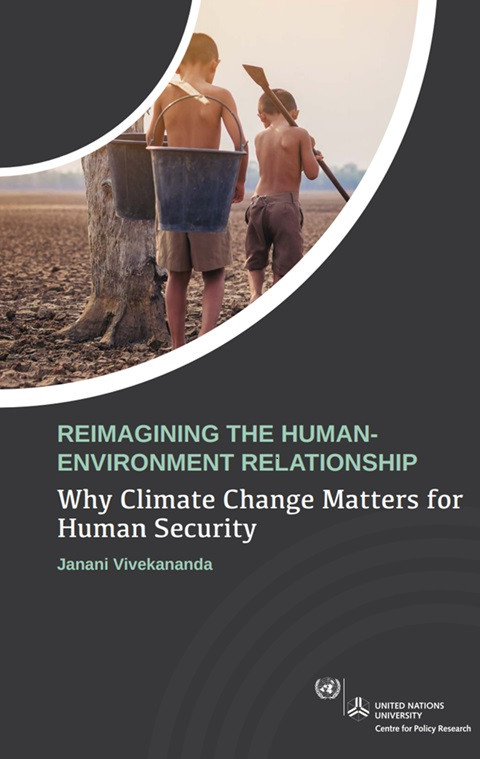 Why Climate Change Matters for Human Security Année de publication: 2022 Auteur: Janani Vivekananda Auteur institutionnel: United Nations University | United Nations Environment Programme (UNEP) This paper outlines the state of knowledge regarding security risks related to climate change, synthesizing the existing scientific evidence to set out five broad pathways of risk. Climate change itself is rarely a direct cause of conflict. Yet, there is ample evidence that its effects exacerbate important drivers and contextual factors of conflict and fragility, thereby challenging the stability of states and societies. Climate change impacts such as coral bleaching, diversity loss, and erratic rainfall can stress livelihoods and drive displacement, increase resource conflicts, and challenge the security and stability of people and states worldwide. Managing these security risks requires action across the entire impact chain: work to mitigate climate change; reducing its consequences on ecosystems; adapting socioeconomic systems; better management of climate-induced heightened resource competition; and strengthening governance and conflict management institutions. And every dimension of the response must be conflict-sensitive and climate proof. Without the right responses, climate change will mean more fragility, less peace and less security. But this paper sets out illustrative examples of how, with a greater understanding of how climate change interacts with social, political, economic and environmental drivers of conflict and fragility, we will be better placed to make the kind of risk-informed decisions is integral to achieving international peace and security.
 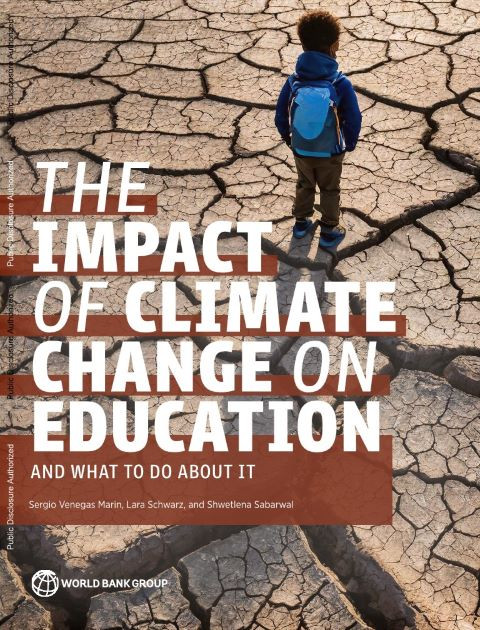 The Impact of Climate Change on Education and What to Do about It Année de publication: 2024 Auteur: Sergio Venegas Marin | Lara Schwarz | Shwetlena Sabarwal Auteur institutionnel: International Bank for Reconstruction and Development | World Bank Education can be the key to ending poverty in a livable planet, but governments must act now to protect it. Climate change is increasing the frequency and intensity of extreme weather events such as cyclones, floods, droughts, heatwaves and wildfires. These extreme weather events are in turn disrupting schooling; precipitating learning losses, dropouts, and long-term impacts. Even if the most drastic climate mitigation strategies were implemented, extreme weather events will continue to have detrimental impacts on education outcomes.
 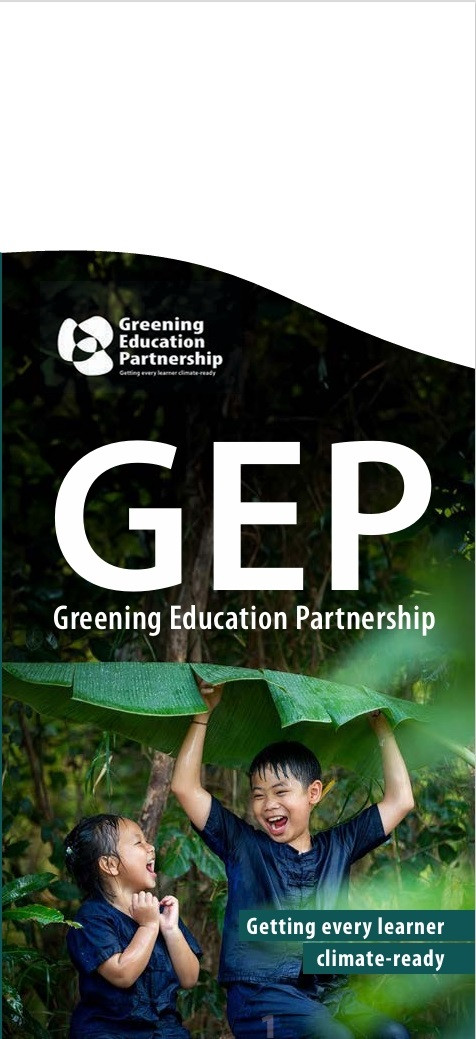 Greening Education Partnership: Getting Every Learner Climate-Ready Année de publication: 2024 Auteur institutionnel: UNESCO Bangkok The UN Secretary-General calls the climate crisis ‘a battle for our lives’, as we still struggle to transform our societies to reach the 1.5°C-degree path recommended by the Paris Agreement. Rapid and radical transformation at all levels and in many aspects of our life is required, with education as a central and powerful means to support the adaptation and strengthening of the resilience of learners and societies. It is also important to ensure that education systems become more resilient to climate change to create safe and climate-proof schools. Building off of the knowledge and practice accumulated in Education for Sustainable Development (ESD), a new Greening Education Partnership aims to deliver strong, coordinated and comprehensive action which will prepare every learner to acquire the knowledge, skills, values, and attitudes to tackle climate change and to promote sustainable development.
 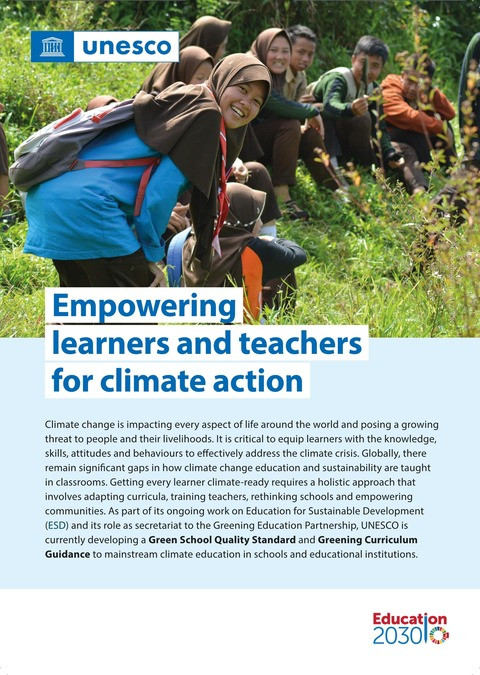 Empowering Learners and Teachers for Climate Action Année de publication: 2023 Auteur institutionnel: UNESCO Climate change is impacting every aspect of life around the world and posing a growing threat to people and their livelihoods. It is critical to equip learners with the knowledge, skills, attitudes and behaviours to effectively address the climate crisis. Globally, there remain significant gaps in how climate change education and sustainability are taught in classrooms. Getting every learner climate-ready requires a holistic approach that involves adapting curricula, training teachers, rethinking schools and empowering communities. As part of its ongoing work on Education for Sustainable Development (ESD) and its role as secretariat to the Greening Education Partnership, UNESCO is currently developing a Green School Quality Standard and Greening Curriculum Guidance to mainstream climate education in schools and educational institutions.