
Ressources
Explorez une large gamme de ressources sur le GCED afin d’approfondir votre compréhension et de renforcer vos activités de recherche, de plaidoyer, d’enseignement et d’apprentissage.
2,771 résultats trouvés
 Sexual Violence and the News Media: Issues, Challenges and Guidelines for Journalists in India Année de publication: 2021 Auteur: Chindu Sreedharan | Einar Thorsen Auteur institutionnel: UNESCO New Delhi This report presents the findings of a multilingual national study on the news reporting of sexual violence in India. Drawing on a content analysis of 10 newspapers covering six languages, and semi-structured interviews with 257 journalists working across 14 languages, it provides comparative insights into the routines journalists follow and the challenges they face when they cover sexual violence.The report evidences how news outlets tend to disproportionately publish unusual cases, such as those involving extreme brutality; focus on rape in urban areas; and rely heavily on police sources. Journalists rarely undertake in-depth inquiries into the cases they cover. The challenges they face include safety issues while newsgathering, difficulties in accessing key sources, and distress from the requirements of their assignments. Overall, nearly 20% of our respondents experienced psychological challenges while reporting on sexual violence, and 55% of women journalists reported workplace sexual harassment or violence.Based on the evidence, the report presents seven national and 10 organisational recommendations. It concludes by offering guidelines that individual journalists and media houses can adapt to suit their news routines.
  Indigenous Peoples and the United Nations Human Right System Année de publication: 2013 Auteur institutionnel: UN Human Rights Council The United Nations general assembly approved the United Nations declaration on the rights of indigenous peoples on September 13, 2007. The rights of indigenous peoples have evolved based on current international law, including human rights treaties, and depending on the circumstances in which the communities found themselves and their priorities, such as the rights to their lands, territories, resources and self-determination. Unfortunately, many indigenous peoples continue to encounter problems in the field of human rights. Some of the greatest difficulties they face stem from the pressure on their lands, territories and resources as a result of their activities related to development and resource extraction. Los pueblos indigenas y el sistema de derechos humanos de las naciones unidas Année de publication: 2013 Auteur institutionnel: UN Human Rights Council La asamblea general de Las Naciones Unidas aprobó la declaración de Las Naciones Unidas sobre los derechos de los pueblos indigenas el 13 de septiembre de 2007. Los derechos de los pueblos indígenas han evolucionado partiendo del derecho internacional vigente, inlcuidos los tratados de derechos humanos, en función de las circunstacias en que se encontraban los pueblos y sus prioridades, como los derechos a sus tierras, territorios, recursos y a la libre determinación. Lamentablemente, muchos pueblos indigenas siguen encontrando problemas en la esfera de los derechos humanos. Algunas de las mayores dificultades a las que hacen frente derivan de la presión de que son objeto sus tierras, territorios y recursos como consecuencia de sus actividades relacionadas con el desarrollo y la extracción de recursos.
 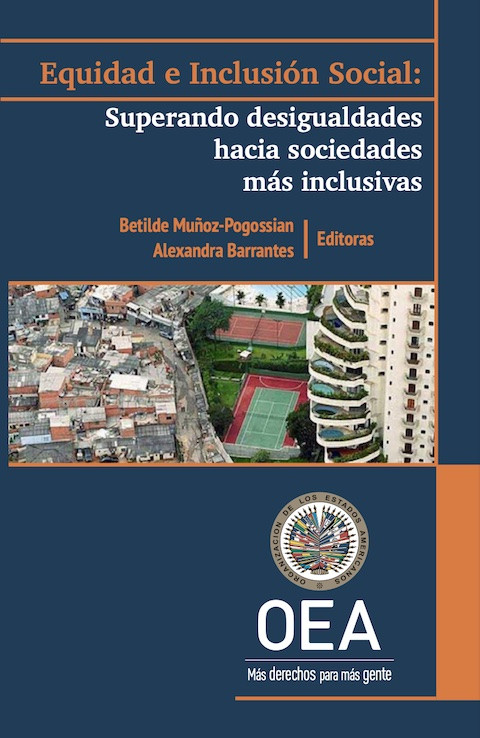 Equity and Social Inclusion: Overcoming Inequalities Towards More Inclusive Societies Année de publication: 2016 Auteur: Betilde Muñoz-Pogossian | Alexandra Barrantes Auteur institutionnel: Organization of American States (OAS) Inequality continues to be one of the main challenges for the countries of the Americas, and the debate about its roots and consequences has permeated all areas of public policy. The truth is that advances in civil and political rights have not been matched by advances in economic, social and cultural rights, and in this context and during the last 15 years, many of the countries of the region have taken measures of public policy to generate greater inclusion and a better redistribution of the benefits of economic growth, with the intention that this will translate into the enjoyment of more rights (in all spheres) for citizens. Equidad e inclusión social: Superando desigualdades hacía sociedades más inlcusivas Année de publication: 2016 Auteur: Betilde Muñoz-Pogossian | Alexandra Barrantes Auteur institutionnel: Organization of American States (OAS) La desigualdad continúa siendo uno de los principales retos de los países de las Américas, y el debate sobre sus raíces y consecuencias ha permeado todos los ámbitos de la política pública. Lo cierto es que los avances en materia de derechos civiles y políticos no se han correspondido con avances en materia de derechos económicos, sociales y culturales.En este marco y durante los últimos 15 años, muchos de los países de la región han tomado medidas de política pública para generar mayor inclusión y una mejor redistribución de los beneficios del crecimiento económico, con la intención de que esto se traduzca en el goce de más derechos (en todas sus esferas) para los ciudadanos y ciudadanas.
 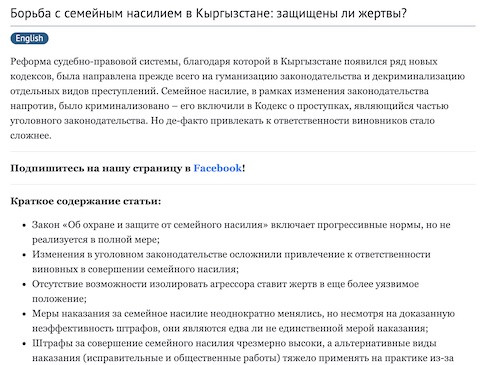 Curbing Domestic Violence in Kyrgyzstan: Are Victims Protected? Année de publication: 2020 Auteur: Anna Zubenko Auteur institutionnel: Central Asian Bureau for Analytical Reporting (CABAR) | Institute for War and Peace Reporting (IWPR) In this article, the author analyzes some of the results of the reforms of the judicial and legal system, thanks to which a number of new codes appeared in Kyrgyzstan, was aimed primarily at the humanization of legislation and decriminalization of certain types of crimes. On the contrary, domestic violence was criminalized as part of the legislative amendments - it was included in the Misdemeanor Code, which is part of the criminal law. However, according to the author, it has become more difficult to prosecute the perpetrators de facto.
  Sustainable Development in the European Union: Monitoring Report on Progress Towards the SDGs in an EU Context (2021) Année de publication: 2021 Auteur institutionnel: European Union (EU) Sustainable development is firmly anchored in the European Treaties and has been at the heart of European policy for a long time. The 2030 Agenda for Sustainable Development and its 17 Sustainable Development Goals (SDGs), adopted by the UN General Assembly in September 2015, have given a new impetus to global efforts for achieving sustainable development. The EU is fully committed to playing an active role in helping to maximise progress towards the Sustainable Development Goals. This publication is the fifth of Eurostat’s regular reports monitoring progress towards the SDGs in an EU context. The analysis in this publication builds on the EU SDG indicator set, developed in cooperation with a large number of stakeholders. The indicator set comprises 102 indicators and is structured along the 17 SDGs. For each SDG, it focuses on aspects that are relevant from an EU perspective. The monitoring report provides a statistical presentation of trends relating to the SDGs in the EU over the past five years (‘short-term’) and, when sufficient data are available, over the past 15 years (‘long-term’). The indicator trends are described on the basis of a set of specific quantitative rules. This 2021 edition also shows some of the early impacts of the COVID-19 pandemic that are visible in Eurostat’s official statistics.
  Gender Equality and Empowerment of Women and Girls in the UK: Meeting the Challenge of the Sustainable Development Goals Année de publication: 2016 Auteur: Holly Dustin | Helen Mott | Nicola Waterworth | Gillian Cowell | Janet Veitch Auteur institutionnel: British Council This research provides the first stocktake of gender equality in the UK from the perspective of the UN’s Sustainable Development Goals (SDGs), the 17 goals adopted by world leaders in 2015 in order to end poverty, protect the planet and ensure prosperity for all.It focuses on the UK’s successes towards achieving gender equality, as well as gaps and priorities for further action in five key areas: participation, power and leadership; education; economy; justice and violence against women and girls and culture (including arts, sports and technology). There are many examples of good practice from the UK, such as strong legislation, data gathering and structures. However, the research also concludes that women and girls continue to lag behind men and boys on key rights, opportunities and well-being, with men over-represented in almost all positions of power and decision-making. It also explores the impact of international linkages and collaboration to determine whether as the UK’s cultural relations organisation, there is a role for the British Council in this.
  Таджикистан: Анализ политики по поддержке людей с инвалидностью Année de publication: 2018 Auteur: Mikhail Petrushkov Auteur institutionnel: Central Asian Bureau for Analytical Reporting (CABAR) | Institute for War and Peace Reporting (IWPR) «На законодательном уровне в отношении соблюдения прав людей с инвалидностью и обеспечения равных условий делается многое. Правительство Таджикистана в 2016 году приняло «Национальную программу реабилитации инвалидов на 2017 – 2020 годы. Однако проведенный анализ финансовой составляющей Программы показал существенные недоработки», – отмечает в своей статье, написанной для аналитической платформы CABAR.asia Михаил Петрушков, аналитик (Душанбе).
  Online Media Literacy Strategy Année de publication: 2021 Auteur institutionnel: Government of the United Kingdom The Online Harms White Paper set out a commitment to develop an Online Media Literacy Strategy ahead of the implementation of the online harms regulator. The aim of the strategy is to educate and empower internet users across the UK to manage their online safety. Over 170 organisations are currently involved in delivering media literacy education in the UK. The Media Literacy Strategy sets out the government’s multi-year plan to bring coordination to the media literacy landscape and outlines a Media Literacy Framework of best practice principles to inform the content and delivery of media literacy education.