
Ressources
Explorez une large gamme de ressources sur le GCED afin d’approfondir votre compréhension et de renforcer vos activités de recherche, de plaidoyer, d’enseignement et d’apprentissage.
2,768 résultats trouvés
 Schools and war: urgent agendas for comparative and international education Année de publication: 2005 Auteur: Lynn Davies Auteur institutionnel: Taylor & Francis Cet article examine en premier lieu les contributions de l'éducation aux conflits, à travers la reproduction de l'inégalité et de l’exclusion, la perpétuation des divisions ethniques ou religieuses, l’acceptation de la dominance de l’agressivité masculine ; à travers la sélection, la compétition et la peur, et à travers une déformation des programmes scolaires mettant l’accent sur des zones cognitives étroites de l'apprentissage. Toutefois, le document décrit également quelques « notes positives », telles que les écoles de la résilience, l'impact des initiatives de l'éducation à la paix et l’importance croissante donnée à l'éducation à la citoyenneté mondiale.
  Lessons Learned from Mental Health and Education: Identifying Best Practices for Addressing Violent Extremism Année de publication: 2015 Auteur: Stevan Weine | B. Heidi Ellis | Ron Haddad | Alisa B. Miller | Rebecca Lowenhaupt | Chloe Polutnik Auteur institutionnel: National Consortium for the Study of Terrorism and Responses to Terrorism (START) The overall purpose of this research was to identify assets from the mental health and education fields that could contribute to best practices for preventing and intervening against violent extremism. Specifically we aimed to address the following questions:1) What prior knowledge, programmes or interventions within the mental health and education fields could contribute to best practices and other strategies that could help stop violent extremism? 2) How can professionals from the mental health and education fields best become involved in stopping violent extremism? Lessons Learned from Mental Health and Education: Identifying Best Practices for Addressing Violent Extremism Année de publication: 2015 Auteur: Stevan Weine | B. Heidi Ellis | Ron Haddad | Alisa B. Miller | Rebecca Lowenhaupt | Chloe Polutnik Auteur institutionnel: National Consortium for the Study of Terrorism and Responses to Terrorism (START) Il s’agit dans cette recherche d'identifier des ressources dans le domaine de l'éducation à la santé mentale qui pourraient contribuer aux meilleures pratiques dans la prévention et l'intervention contre l'extrémisme violent. Plus précisément, les auteurs ont cherché à répondre aux questions suivantes : 1) Quelles sont les connaissances, les programmes ou les interventions requis dans le domaine de l'éducation à la santé mentale pouvant contribuer aux meilleures pratiques et autres stratégies dans la lutte contre l'extrémisme violent ? 2) Comment les professionnels de l'éducation à la santé mentale peuvent s’impliquer davantage dans la lutte contre l'extrémisme violent ?
 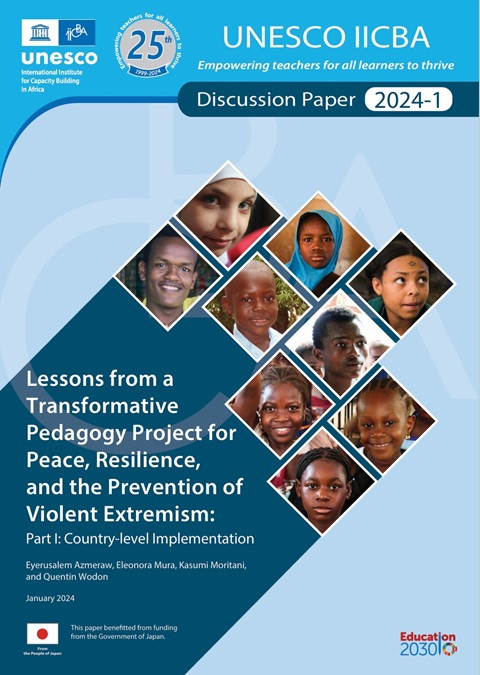 Lessons from a Transformative Pedagogy Project for Peace, Resilience, and the Prevention of Violent Extremism: Part I; Country-Level Implementation Année de publication: 2024 Auteur: Eyerusalem Azmeraw | Quentin Wodon | Eleonora Mura | Kasumi Moritani Auteur institutionnel: UNESCO International Institute for Capacity-Building in Africa (IICBA) From 2017 to 2022, UNESCO’s International Institute for Capacity Building in Africa (IICBA) led a series of projects for peacebuilding and the prevention of violent extremism through education with support from the Government of Japan. This two-part paper draws lessons from the projects. The first part of the paper briefly explains the transformative pedagogy approach that guided project implementation and provides examples of changes that were implemented at the country level under the projects. The analysis is qualitative, with the aim being to outline, through country examples, what can be achieved through such projects. Lessons on factors contributing to impact are also outlined.
 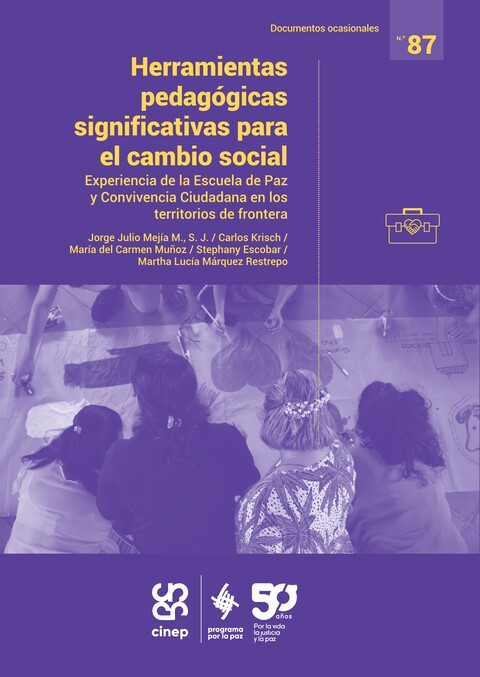 Significant Pedagogical Tools for Social Change Année de publication: 2023 Auteur: Jorge Julio Mejía | Carlos Krisch | Sthepany Escobar | Martha Lucía | Márquez Restrepo | María Del Carmen Muñoz Auteur institutionnel: Center for Research and Popular Education / Program for Peace (CINEP/PPP) This document includes significant pedagogical tools to promote processes of social change through training experiences for twelve years in territories on the Colombian-Venezuelan border. Through workshops and activities, participants have experienced transformations in attitudes and practices that have been useful for understanding the border as a shared space. Herramientas pedagógicas significativas para el cambio social Année de publication: 2023 Auteur: Jorge Julio Mejía | Carlos Krisch | Sthepany Escobar | Martha Lucía | Márquez Restrepo | María Del Carmen Muñoz Auteur institutionnel: Center for Research and Popular Education / Program for Peace (CINEP/PPP) En este documento se recogen las herramientas pedagógicas significativas para promover procesos de cambio social a través de experiencias formativas durante doce años en territorios de la frontera colombo-venezolana. Mediante talleres y actividades, los participantes han experimentado transformaciones en actitudes y prácticas que les han resultado útiles para comprender la frontera como un espacio compartido.
  Citizenship Education: Human Rights, History and Memory 50 Years After the 1973 Coup Année de publication: 2023 Auteur institutionnel: Chile. Ministry of Education Educational material that proposes a series of activities regarding the commemoration of the 50 years of the coup d'état, a topic that brings together the country through various channels and constitutes a great opportunity to contextualize the learning objectives linked to memory, democracy and human rights. Educación en ciudadanía derechos humanos historia y memoria: A 50 años del golpe de estado de 1973 Année de publication: 2023 Auteur institutionnel: Chile. Ministry of Education Material educativo que propone una serie de actividades a propósito de la conmemoración de los 50 años del golpe de Estado, tema que convoca al país a través de diversos canales y se constituye como una gran oportunidad para contextualizar los objetivos de aprendizaje vinculados a memoria, democracia y derechos humanos.
 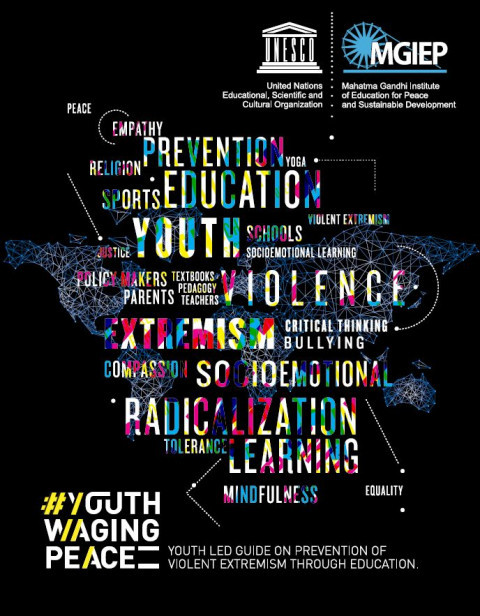 Youth Led Guide on Prevention of Violent Extremism through Education Année de publication: 2017 Auteur: Carolyn Nash | Yulia Nesterova | Kenneth Primrose | Wing Yu Alice Chan | Rios, Paul A. Chan | María José Velásquez Flores | Aniqah Zowmi Auteur institutionnel: Mahatma Gandhi Institute of Education for Peace and Sustainable Development (MGIEP) In September 2016, the education sector from the UNESCO headquarters and the UNESCO category 1 research Institute, the UNESCO Mahatma Gandhi Institute of Education for Peace and Sustainable Development(MGIEP) organised the first International Conference on Prevention of Violent Extremism through Education: Taking Action, in New Delhi, India. The usual plethora of reports and guides produced by experts on the subject, roundtables and expert panels were organised.But something different also happened. UNESCO MGIEP brought 50 youth from across the world rigorously selected through six week online discussion on the subject to participate in a first of its kind, “Talking Across Generations on Education (TAGe)” event. This event organised as a plenary session—not a side or lunch event—brought together these youth in a non-hierarchical “flat” dialogue with about 12 senior policymakers on the challenges and opportunities the youth see in preventing violent extremism through education.The conference culminated with the presentation of a “Youth Action Plan” containing three clear tangible action points. One action point was the development of a youth-led guide on Prevention of Violent Extremism through Education. This Guide is the result of that call to action.The Institute circulated a global call to youth who were willing to take up the challenge of producing the Guide. After a rigorous search based on a well-defined set of criteria, two coordinating lead authors were identified. These authors were then tasked to find the remaining authors who they saw fit to contribute to the Guide and this team then reached out to the wider group of youth to solicit their experiences and guidance in producing the Guide. The youth have done their part. They have reached out to more than 2,000 young people from more than 50 countries, collated their ideas and experiences and finally featured more than 150 unique voices into this document.
 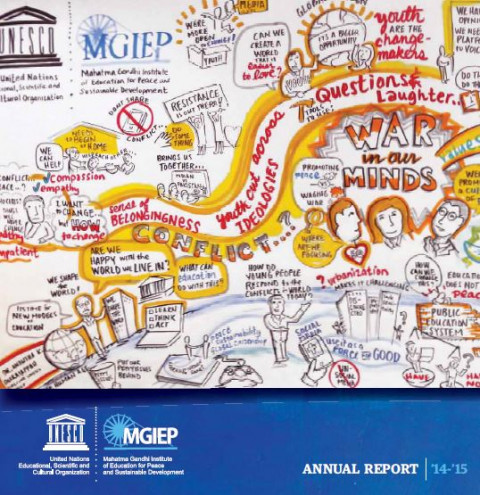 MGIEP Annual Report '14-'15 Année de publication: 2016 Auteur institutionnel: Mahatma Gandhi Institute of Education for Peace and Sustainable Development (MGIEP) The Mahatma Gandhi Institute of Education for Peace and Sustainable Development (MGIEP) is UNESCO’s first Category I institute in the Asia-Pacific region, established with the generous support of the Government of India. UNESCO MGIEP focuses on transforming current education policies and practices by developing innovative teaching and learning methods.Their objective is to build generations of young people equipped to create peaceful and sustainable societies. This annual report describes MGIEP’s main works and various educational programmes for peace and sustainable development.