
Ressources
Explorez une large gamme de ressources sur le GCED afin d’approfondir votre compréhension et de renforcer vos activités de recherche, de plaidoyer, d’enseignement et d’apprentissage.
1,951 résultats trouvés
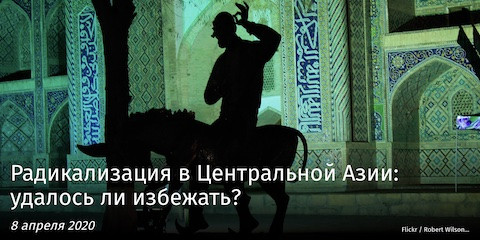 Radicalization in Central Asia: Have We Managed to Avoid It? Année de publication: 2020 Auteur: Milan Lazovic Auteur institutionnel: Russian International Affairs Council Central Asia is a very multifaceted, multi-ethnic, multi-confessional region, where many cultures, national traditions and ways of life intersect, united by a common factor - religious. The authors of the chapter on the role of religion in Central Asia in the book "Religion, Conflict, and Stability in the Former Soviet Union", prepared by the analytical center "RAND Corporation", touched upon a very important, significant and influential topic on the region. Experts note that, despite the success of Central Asia's attempts to avoid large-scale radicalization, there is a risk of its expansion today. Радикализация в Центральной Азии: удалось ли избежать? Année de publication: 2020 Auteur: Milan Lazovic Auteur institutionnel: Russian International Affairs Council Центральная Азия представляет собой весьма многогранный, полиэтнический, многоконфессиональный регион, где пересекаются множество культур, национальных традиций и укладов, объединенных общим фактором — религиозным. Авторы главы о роли религии в Центральной Азии в книге «Religion, Conflict, and Stability in the Former Soviet Union», подготовленной аналитическим центром «RAND Corporation», затронули весьма важную, значимую и имеющую широкое влияние на регион, тему. Специалисты отмечают, что, несмотря на успех попыток Центральной Азии избежать масштабной радикализации, риск ее расширения в наши дни существует.
  Digital Education Action Plan 2021-2027: Resetting Education and Training for the Digital Age Année de publication: 2020 Auteur institutionnel: European Union (EU) The Digital Education Action Plan (2021-2027) outlines the European Commission’s vision for high quality, inclusive and accessible digital education in Europe.It is a call to action for stronger cooperation at European level to learn from the COVID-19 crisis during which technology is being used at a scale never seen before in education and training make education and training systems fit for the digital age
 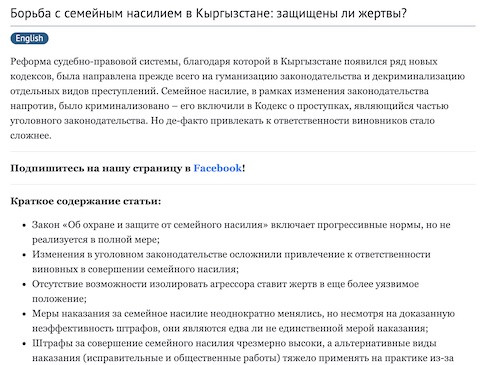 Curbing Domestic Violence in Kyrgyzstan: Are Victims Protected? Année de publication: 2020 Auteur: Anna Zubenko Auteur institutionnel: Central Asian Bureau for Analytical Reporting (CABAR) | Institute for War and Peace Reporting (IWPR) In this article, the author analyzes some of the results of the reforms of the judicial and legal system, thanks to which a number of new codes appeared in Kyrgyzstan, was aimed primarily at the humanization of legislation and decriminalization of certain types of crimes. On the contrary, domestic violence was criminalized as part of the legislative amendments - it was included in the Misdemeanor Code, which is part of the criminal law. However, according to the author, it has become more difficult to prosecute the perpetrators de facto.
 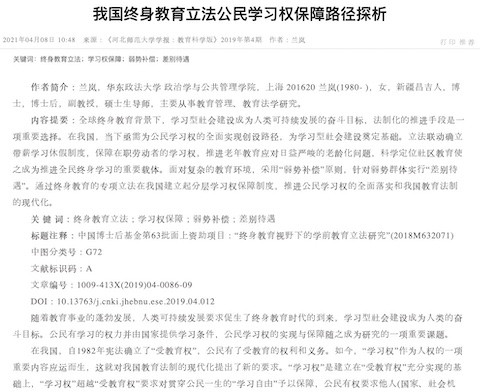 The Legislation of Lifelong Learning in China: Measures to Guarantee Citizens' Rights of Learning Année de publication: 2019 Auteur: Lan Lan Auteur institutionnel: Hebei Normal University This paper advocates the legislation of lifelong learning in China to guarantee the right of study for various disadvantaged groups such as the elders, youths, farmers, disableds, and ethnic minorities. 我国终身教育立法公民学习权保障路径探析 Année de publication: 2019 Auteur: Lan Lan Auteur institutionnel: 河北师范大学 文章讨论了中国对终身教育立法的诉求,以保障公民学习权,尤其是一些弱势群体,如老年人、农民、残疾人、少数民族等。
 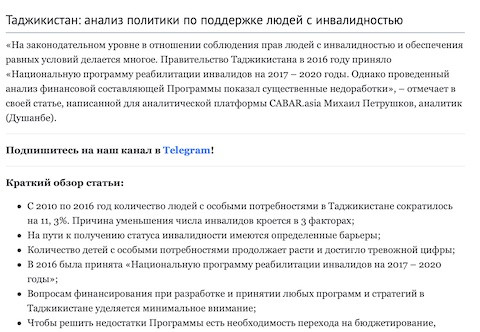 Таджикистан: Анализ политики по поддержке людей с инвалидностью Année de publication: 2018 Auteur: Mikhail Petrushkov Auteur institutionnel: Central Asian Bureau for Analytical Reporting (CABAR) | Institute for War and Peace Reporting (IWPR) «На законодательном уровне в отношении соблюдения прав людей с инвалидностью и обеспечения равных условий делается многое. Правительство Таджикистана в 2016 году приняло «Национальную программу реабилитации инвалидов на 2017 – 2020 годы. Однако проведенный анализ финансовой составляющей Программы показал существенные недоработки», – отмечает в своей статье, написанной для аналитической платформы CABAR.asia Михаил Петрушков, аналитик (Душанбе).
  Global Citizenship Education and the Police: An Opportunity For Partnership? Année de publication: 2021 Auteur: Robin Young Auteur institutionnel: Bridge 47 This publication aims to provide some reflective questions and practicalities to consider before embarking on a partnership with the police sector and to contribute to a wider reflection, dialogue and knowledge sharing within the GCE sector globally about the opportunities and challenges for advancing the mission of GCE through engagement with the police sector.
  Unlocking the Transformative Potential of Education: The Alliance Between Lifelong Learning and SDG Target 4.7 Année de publication: 2021 Auteur: Chris Millora Auteur institutionnel: Bridge 47 This paper has found that Lifelong learning as a spectrum of formal, informal and non-formal learning, offers a framework to embrace different forms of learning people gain in various spaces across their lifespan. While several lifelong learning policies emphasise economic benefits, evidence shows that lifelong learning also facilitates active citizenship, tolerance to diversity, empathy, learning to live together, leadership, intergenerational learning, and awareness of social injustices. This paper demonstrated the impact of ALE provisions that bring to centre stage the needs of adults – particularly women – in resource-poor contexts. These programmes recognise the ‘funds of knowledge’ and ‘banks of skills’ already existing in these communities – challenging the deficit discourse that is dominant particularly in development circles even today.Based on these findings, this paper puts forward seven interrelated policy recommendations: (1) acknowledgement, within SDG 4.7 policies, that learning occurs in all life stages, forms and spaces; (2) prioritisation of lifelong learning and transformative approaches to education into local, national, regional and global level policies, including provisions of funding; (3) a focus on the transformative competencies and outcomes of lifelong learning; (4) positioning lifelong learning as a cross- cutting (rather than separate) approach to achieving the SDGs; (5) increased attention to recognising, validating and accrediting (RVA) non-formal and informal learning; (6) involving marginalised groups as stakeholders that can shape policy and not only recipients; (7) increased government support and financing to adult educators and literacy facilitators.
  Transformative Competencies: How to Define and Implement Competencies for SDG Target 4.7 Année de publication: 2021 Auteur: Johanna Helin Auteur institutionnel: Bridge 47 This paper was commissioned to support advocacy for SDG Target 4.7 in European and global policies by exploring the concept of ‘Competencies for SDG Target 4.7’. This advocacy paper draws from a desk review of existing global and regional competency frameworks at national, regional and global levels. The aim is to get a clearer understanding of these transformative competencies and how they help the implementation and assessment of Target 4.7.This paper is divided in three sections. The first section provides background to the different world views that frame the discussion on competencies, before turning to presenting some of the competency frameworks for Target 4.7. The second section gives some examples of how these competencies are being introduced into national education policies, professional skills training and lifelong learning. The paper finishes with conclusions and policy recommendations.