
Ressources
Explorez une large gamme de ressources sur le GCED afin d’approfondir votre compréhension et de renforcer vos activités de recherche, de plaidoyer, d’enseignement et d’apprentissage.
1,951 résultats trouvés
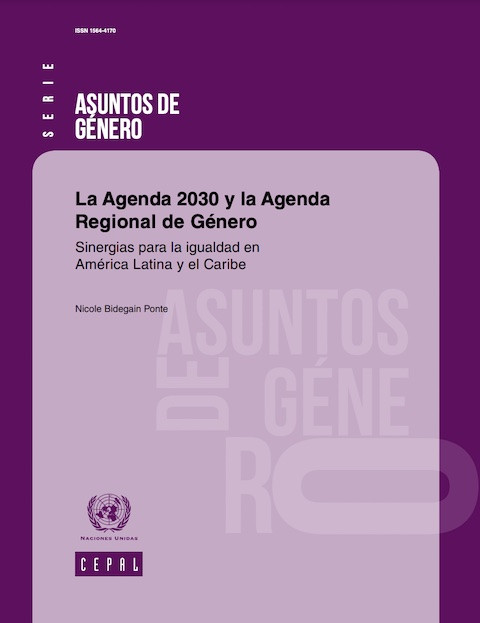 La Agenda 2030 y la Agenda Regional de Género: Sinergias para la igualdad en América Latina y el Caribe (Asuntos de Género; no. 143) Année de publication: 2017 Auteur: Nicole Bidegain Ponte Auteur institutionnel: UN. Economic Commission for Latin America and the Caribbean (ECLAC) En este documento se analiza la Agenda 2030 para el Desarrollo Sostenible y sus Objetivos de Desarrollo Sostenible (ODS) a la luz de los desafíos y prioridades para la igualdad de género y los derechos y la autonomía de las mujeres en América Latina y el Caribe. Se presentan ejemplos ilustrativos sobre las interrelaciones entre objetivos y metas de la Agenda 2030, y se advierte sobre la importancia de un abordaje integral para asegurar que el progreso en algunos de los ODS no se realice a través de medios que puedan obstaculizar el logro de los objetivos y metas vinculados a la igualdad de género y los derechos de las mujeres.
  The Science of Happiness Année de publication: 2018 Auteur institutionnel: BBVA Aprendemos Juntos Tal Ben-Shahar is the happiness scientist of the 21st century. In this video he talks about the need to teach with positive emotions to increase the happiness and creativity of students. Doctor in psychology and philosophy, Tal Ben-Shahar's Positive Psychology course at Harvard holds the record for the subject with the largest number of students in the history (1400 per semester) of Harvard University, earning the nickname "professor of the happiness". Ben-Shahar is the author of books such as "Choose the life you want" or "Practice happiness", among others, in which he talks about the emotions that improve learning, creativity, the capacity for innovation, and ultimately, people's daily life. La ciencia de la felicidad Année de publication: 2018 Auteur institutionnel: BBVA Aprendemos Juntos Tal Ben-Shahar es el científico de la felicidad del siglo XXI. En este vídeo nos habla sobre la necesidad de enseñar con emociones positivas para aumentar la felicidad y la creatividad de los estudiantes. Doctor en psicología y filosofía, El curso de Psicología Positiva de Tal Ben-Shahar en Harvard posee el récord de la asignatura con mayor número de alumnos de la historia (1400 por semestre) de la Universidad de Harvard ganándose el sobrenombre de “profesor de la felicidad”. Ben-Shahar es autor de libros como "Elige la vida que quieres” o "Practicar la felicidad”, entre otros, en los que nos habla sobre las emociones que mejoran el aprendizaje, la creatividad, la capacidad de innovación, y en definitiva, la vida diaria de las personas.
  What Does It Mean to Have Good Self-Esteem? Année de publication: 2020 Auteur institutionnel: BBVA Aprendemos Juntos The psychologist Silvia Congost exposes in this video the steps to develop a healthy self-esteem, based on the teachings of Nathaniel Branden, author of 'The six pillars of self-esteem': live consciously, accept oneself, take responsibility for our actions , develop assertiveness, live with a purpose and be a person of integrity. ¿Qué significa tener buena autoestima? Année de publication: 2020 Auteur institutionnel: BBVA Aprendemos Juntos La psicóloga Silvia Congost expone en este vídeo los pasos para desarrollar una sana autoestima, a partir de las enseñanzas de Nathaniel Branden, autor de 'Los seis pilares de la autoestima': vivir de forma consciente, aceptarse a uno mismo, responsabilizarnos de nuestros actos, desarrollar la asertividad, vivir con un propósito y ser personas íntegras.
 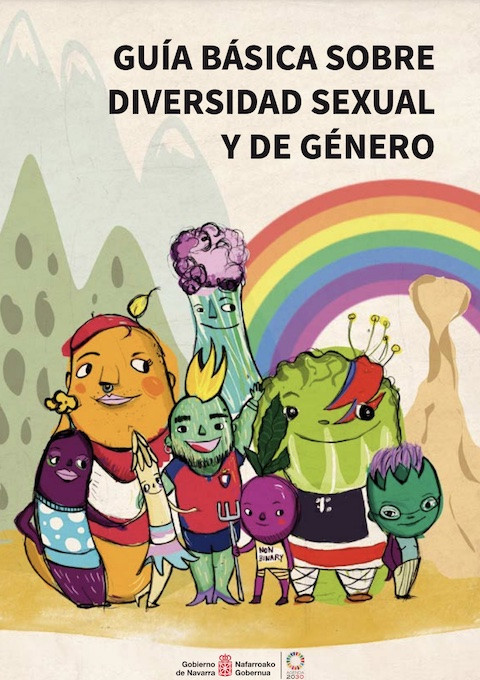 Basic Guide on Sexual and Gender Diversity Année de publication: 2020 Auteur: Miriam Solá García Auteur institutionnel: Navarra Institute for Equality This guide is a tool to learn about affective, sexual and gender diversity and reflect on why all of us have a key role in social change to achieve equality and recognition of LGTBI+ people. Respect for affective, sexual and gender diversity is an element of value and social wealth in whose promotion and experience all citizens are involved. Guía básica sobre diversidad sexual y de género Année de publication: 2020 Auteur: Miriam Solá García Auteur institutionnel: Navarra Institute for Equality Esta guía es una herramienta para conocer la diversidad afectiva, sexual y de género y reflexionar sobre por qué todas las personas tenemos un papel clave en el cambio social para lograr la igualdad y reconocimiento de las personas LGTBI+. El respeto por la diversidad afectiva, sexual y de género es un elemento de valor y de riqueza social en cuya promoción y vivencia está implicada toda la ciudadanía
 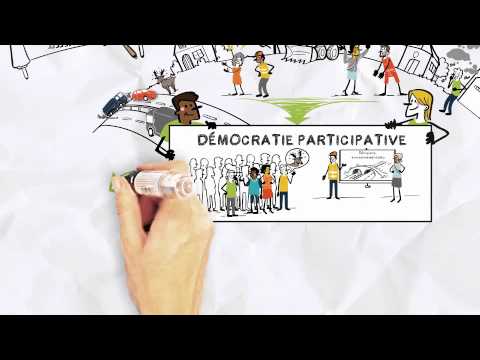 Why and How to Move Towards Participatory Democracy Année de publication: 2015 Auteur institutionnel: Fondation pour la Nature et l'Homme Co-constructing tomorrow's solutions is the major challenge of participatory democracy. However, the participation of citizens in decisions is not always obvious and today many projects are contested in the territory. Solutions exist to involve citizens more directly in environmental decisions, discover these issues and solutions in 3 minutes! Pourquoi et comment aller vers une démocratie participative Année de publication: 2015 Auteur institutionnel: Fondation pour la Nature et l'Homme Co-construire les solutions de demain, tel est l’enjeu majeur de la démocratie participative. Cependant, la participation des citoyens aux décisions n’est pas toujours évidente et aujourd’hui de nombreux projets sont contestés sur le territoire. Des solutions existent pour impliquer plus directement les citoyens dans les décisions environnementales, découvrez en 3 minutes ces enjeux et solutions !
 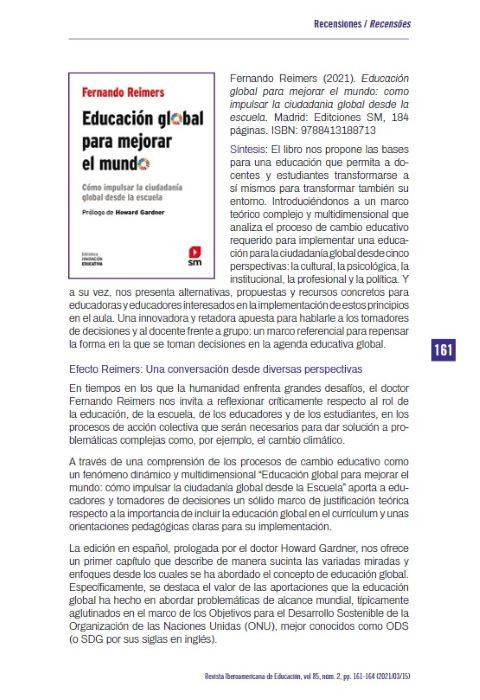 [Book Review] Global Education for a Better World (Ibero-American Journal of Education; vol. 85, no.2) Année de publication: 2021 Auteur: Patricia Vasquez | Gustavo Rojas Review of the book "Global education to improve the world: how to promote global citizenship from the School" in which Dr. Fernando Reimers proposes the bases for an education that allows teachers and students to transform themselves to also transform their environment. In this work, a complex and multidimensional theoretical framework is presented that analyzes the process of educational change required to implement an education for global citizenship from five perspectives: cultural, psychological, institutional, professional and political.